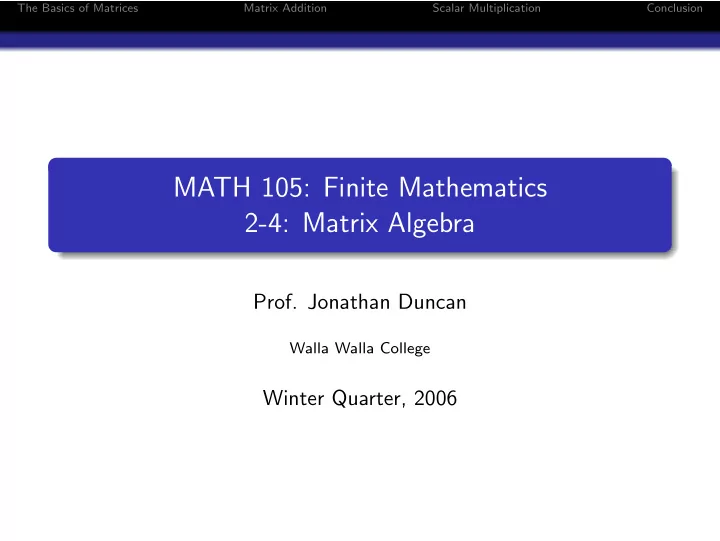
MATH 105: Finite Mathematics 2-4: Matrix Algebra Prof. Jonathan - - PowerPoint PPT Presentation

math 105 finite mathematics 2 4 matrix algebra
SMART_READER_LITE
LIVE PREVIEW

MATH 105: Finite Mathematics 2-4: Matrix Algebra Prof. Jonathan - - PowerPoint PPT Presentation

The Basics of Matrices Matrix Addition Scalar Multiplication Conclusion MATH 105: Finite Mathematics 2-4: Matrix Algebra Prof. Jonathan Duncan Walla Walla College Winter Quarter, 2006 The Basics of Matrices Matrix Addition Scalar


slide-1
SLIDE 1

The Basics of Matrices Matrix Addition Scalar Multiplication Conclusion

MATH 105: Finite Mathematics 2-4: Matrix Algebra

  • Prof. Jonathan Duncan

Walla Walla College

Winter Quarter, 2006

slide-2
SLIDE 2

The Basics of Matrices Matrix Addition Scalar Multiplication Conclusion

Outline

1

The Basics of Matrices

2

Matrix Addition

3

Scalar Multiplication

4

Conclusion

slide-3
SLIDE 3

The Basics of Matrices Matrix Addition Scalar Multiplication Conclusion

Outline

1

The Basics of Matrices

2

Matrix Addition

3

Scalar Multiplication

4

Conclusion

slide-4
SLIDE 4

The Basics of Matrices Matrix Addition Scalar Multiplication Conclusion

Exploring a Matrix

Since we’ve seen that matrices can be useful in solving equations, it makes sense to become more familiar with them. Matrix Vocabular The matrix shown below has 2 rows and 3 columns. Its dimension is 2 × 3. Any element of the matrix can be located by specifying the row and column number in which is appears. a11 a12 a13 a21 a22 a23

  • Locating Elements

Identify the element in each location.

1 The element in the 1st row, 2nd column 2 The element in the 2nd row, 3rd column

slide-5
SLIDE 5

The Basics of Matrices Matrix Addition Scalar Multiplication Conclusion

Exploring a Matrix

Since we’ve seen that matrices can be useful in solving equations, it makes sense to become more familiar with them. Matrix Vocabular The matrix shown below has 2 rows and 3 columns. Its dimension is 2 × 3. Any element of the matrix can be located by specifying the row and column number in which is appears. a11 a12 a13 a21 a22 a23

  • Locating Elements

Identify the element in each location.

1 The element in the 1st row, 2nd column 2 The element in the 2nd row, 3rd column

slide-6
SLIDE 6

The Basics of Matrices Matrix Addition Scalar Multiplication Conclusion

Exploring a Matrix

Since we’ve seen that matrices can be useful in solving equations, it makes sense to become more familiar with them. Matrix Vocabular The matrix shown below has 2 rows and 3 columns. Its dimension is 2 × 3. Any element of the matrix can be located by specifying the row and column number in which is appears. a11 a12 a13 a21 a22 a23

  • Locating Elements

Identify the element in each location.

1 The element in the 1st row, 2nd column 2 The element in the 2nd row, 3rd column

slide-7
SLIDE 7

The Basics of Matrices Matrix Addition Scalar Multiplication Conclusion

Exploring a Matrix

Since we’ve seen that matrices can be useful in solving equations, it makes sense to become more familiar with them. Matrix Vocabular The matrix shown below has 2 rows and 3 columns. Its dimension is 2 × 3. Any element of the matrix can be located by specifying the row and column number in which is appears. a11 a12 a13 a21 a22 a23

  • Locating Elements

Identify the element in each location.

1 The element in the 1st row, 2nd column 2 The element in the 2nd row, 3rd column

slide-8
SLIDE 8

The Basics of Matrices Matrix Addition Scalar Multiplication Conclusion

Exploring a Matrix

Since we’ve seen that matrices can be useful in solving equations, it makes sense to become more familiar with them. Matrix Vocabular The matrix shown below has 2 rows and 3 columns. Its dimension is 2 × 3. Any element of the matrix can be located by specifying the row and column number in which is appears. a11 a12 a13 a21 a22 a23

  • Locating Elements

Identify the element in each location.

1 The element in the 1st row, 2nd column (a12) 2 The element in the 2nd row, 3rd column

slide-9
SLIDE 9

The Basics of Matrices Matrix Addition Scalar Multiplication Conclusion

Exploring a Matrix

Since we’ve seen that matrices can be useful in solving equations, it makes sense to become more familiar with them. Matrix Vocabular The matrix shown below has 2 rows and 3 columns. Its dimension is 2 × 3. Any element of the matrix can be located by specifying the row and column number in which is appears. a11 a12 a13 a21 a22 a23

  • Locating Elements

Identify the element in each location.

1 The element in the 1st row, 2nd column (a12) 2 The element in the 2nd row, 3rd column

slide-10
SLIDE 10

The Basics of Matrices Matrix Addition Scalar Multiplication Conclusion

Exploring a Matrix

Since we’ve seen that matrices can be useful in solving equations, it makes sense to become more familiar with them. Matrix Vocabular The matrix shown below has 2 rows and 3 columns. Its dimension is 2 × 3. Any element of the matrix can be located by specifying the row and column number in which is appears. a11 a12 a13 a21 a22 a23

  • Locating Elements

Identify the element in each location.

1 The element in the 1st row, 2nd column (a12) 2 The element in the 2nd row, 3rd column (a23)

slide-11
SLIDE 11

The Basics of Matrices Matrix Addition Scalar Multiplication Conclusion

Another Example

Example Use the matrix A below to answer the following questions. A =   1 7 5 2 4 3 −1 4  

1 What is the dimension of this matrix? 2 What is the entry in the 1st row, 2nd column? 3 What is the entry in the 3rd row, 1st column?

slide-12
SLIDE 12

The Basics of Matrices Matrix Addition Scalar Multiplication Conclusion

Another Example

Example Use the matrix A below to answer the following questions. A =   1 7 5 2 4 3 −1 4  

1 What is the dimension of this matrix? 2 What is the entry in the 1st row, 2nd column? 3 What is the entry in the 3rd row, 1st column?

slide-13
SLIDE 13

The Basics of Matrices Matrix Addition Scalar Multiplication Conclusion

Another Example

Example Use the matrix A below to answer the following questions. A =   1 7 5 2 4 3 −1 4  

1 What is the dimension of this matrix?

(3 × 3)

2 What is the entry in the 1st row, 2nd column? 3 What is the entry in the 3rd row, 1st column?

slide-14
SLIDE 14

The Basics of Matrices Matrix Addition Scalar Multiplication Conclusion

Another Example

Example Use the matrix A below to answer the following questions. A =   1 7 5 2 4 3 −1 4  

1 What is the dimension of this matrix?

(3 × 3)

2 What is the entry in the 1st row, 2nd column? 3 What is the entry in the 3rd row, 1st column?

slide-15
SLIDE 15

The Basics of Matrices Matrix Addition Scalar Multiplication Conclusion

Another Example

Example Use the matrix A below to answer the following questions. A =   1 7 5 2 4 3 −1 4  

1 What is the dimension of this matrix?

(3 × 3)

2 What is the entry in the 1st row, 2nd column?

(7)

3 What is the entry in the 3rd row, 1st column?

slide-16
SLIDE 16

The Basics of Matrices Matrix Addition Scalar Multiplication Conclusion

Another Example

Example Use the matrix A below to answer the following questions. A =   1 7 5 2 4 3 −1 4  

1 What is the dimension of this matrix?

(3 × 3)

2 What is the entry in the 1st row, 2nd column?

(7)

3 What is the entry in the 3rd row, 1st column?

slide-17
SLIDE 17

The Basics of Matrices Matrix Addition Scalar Multiplication Conclusion

Another Example

Example Use the matrix A below to answer the following questions. A =   1 7 5 2 4 3 −1 4  

1 What is the dimension of this matrix?

(3 × 3)

2 What is the entry in the 1st row, 2nd column?

(7)

3 What is the entry in the 3rd row, 1st column?

(−1)

slide-18
SLIDE 18

The Basics of Matrices Matrix Addition Scalar Multiplication Conclusion

Special Types of Matrices

Two types of matrix are of particular interest. Row Vector A row vector is a 1 × n matrix where n is any integer greater than zero. Column Vector A column vector is an n × 1 matrix where n is any integer greater than zero. An Example Row Vector The matrix below is a 1 × 4 row vector. U =

  • 1

2 4 −3

  • An Example Column Vector

The matrix below is a 2 × 1 column vector. V = 2 3

slide-19
SLIDE 19

The Basics of Matrices Matrix Addition Scalar Multiplication Conclusion

Special Types of Matrices

Two types of matrix are of particular interest. Row Vector A row vector is a 1 × n matrix where n is any integer greater than zero. Column Vector A column vector is an n × 1 matrix where n is any integer greater than zero. An Example Row Vector The matrix below is a 1 × 4 row vector. U =

  • 1

2 4 −3

  • An Example Column Vector

The matrix below is a 2 × 1 column vector. V = 2 3

slide-20
SLIDE 20

The Basics of Matrices Matrix Addition Scalar Multiplication Conclusion

Special Types of Matrices

Two types of matrix are of particular interest. Row Vector A row vector is a 1 × n matrix where n is any integer greater than zero. Column Vector A column vector is an n × 1 matrix where n is any integer greater than zero. An Example Row Vector The matrix below is a 1 × 4 row vector. U =

  • 1

2 4 −3

  • An Example Column Vector

The matrix below is a 2 × 1 column vector. V = 2 3

slide-21
SLIDE 21

The Basics of Matrices Matrix Addition Scalar Multiplication Conclusion

Special Types of Matrices

Two types of matrix are of particular interest. Row Vector A row vector is a 1 × n matrix where n is any integer greater than zero. Column Vector A column vector is an n × 1 matrix where n is any integer greater than zero. An Example Row Vector The matrix below is a 1 × 4 row vector. U =

  • 1

2 4 −3

  • An Example Column Vector

The matrix below is a 2 × 1 column vector. V = 2 3

slide-22
SLIDE 22

The Basics of Matrices Matrix Addition Scalar Multiplication Conclusion

Special Types of Matrices

Two types of matrix are of particular interest. Row Vector A row vector is a 1 × n matrix where n is any integer greater than zero. Column Vector A column vector is an n × 1 matrix where n is any integer greater than zero. An Example Row Vector The matrix below is a 1 × 4 row vector. U =

  • 1

2 4 −3

  • An Example Column Vector

The matrix below is a 2 × 1 column vector. V = 2 3

slide-23
SLIDE 23

The Basics of Matrices Matrix Addition Scalar Multiplication Conclusion

Outline

1

The Basics of Matrices

2

Matrix Addition

3

Scalar Multiplication

4

Conclusion

slide-24
SLIDE 24

The Basics of Matrices Matrix Addition Scalar Multiplication Conclusion

Adding Matrices

When mathematicians introduce a new object, one of the first things they like to do with them is figure out how to combine them. Adding Matrices The sum of two matrices, A + B, of the same dimension is the matrix consisting of the sum of corresponding entries from A and

  • B. The resulting matrix has the same dimension as both original

matrices A and B Things to Notice:

1 You can only add matrices of the same dimension. 2 The new matrix will have this same dimension. 3 Add matrices element-by-element.

slide-25
SLIDE 25

The Basics of Matrices Matrix Addition Scalar Multiplication Conclusion

Adding Matrices

When mathematicians introduce a new object, one of the first things they like to do with them is figure out how to combine them. Adding Matrices The sum of two matrices, A + B, of the same dimension is the matrix consisting of the sum of corresponding entries from A and

  • B. The resulting matrix has the same dimension as both original

matrices A and B Things to Notice:

1 You can only add matrices of the same dimension. 2 The new matrix will have this same dimension. 3 Add matrices element-by-element.

slide-26
SLIDE 26

The Basics of Matrices Matrix Addition Scalar Multiplication Conclusion

Adding Matrices

When mathematicians introduce a new object, one of the first things they like to do with them is figure out how to combine them. Adding Matrices The sum of two matrices, A + B, of the same dimension is the matrix consisting of the sum of corresponding entries from A and

  • B. The resulting matrix has the same dimension as both original

matrices A and B Things to Notice:

1 You can only add matrices of the same dimension. 2 The new matrix will have this same dimension. 3 Add matrices element-by-element.

slide-27
SLIDE 27

The Basics of Matrices Matrix Addition Scalar Multiplication Conclusion

Adding Matrices

When mathematicians introduce a new object, one of the first things they like to do with them is figure out how to combine them. Adding Matrices The sum of two matrices, A + B, of the same dimension is the matrix consisting of the sum of corresponding entries from A and

  • B. The resulting matrix has the same dimension as both original

matrices A and B Things to Notice:

1 You can only add matrices of the same dimension. 2 The new matrix will have this same dimension. 3 Add matrices element-by-element.

slide-28
SLIDE 28

The Basics of Matrices Matrix Addition Scalar Multiplication Conclusion

Adding Matrices

When mathematicians introduce a new object, one of the first things they like to do with them is figure out how to combine them. Adding Matrices The sum of two matrices, A + B, of the same dimension is the matrix consisting of the sum of corresponding entries from A and

  • B. The resulting matrix has the same dimension as both original

matrices A and B Things to Notice:

1 You can only add matrices of the same dimension. 2 The new matrix will have this same dimension. 3 Add matrices element-by-element.

slide-29
SLIDE 29

The Basics of Matrices Matrix Addition Scalar Multiplication Conclusion

Adding Matrices

When mathematicians introduce a new object, one of the first things they like to do with them is figure out how to combine them. Adding Matrices The sum of two matrices, A + B, of the same dimension is the matrix consisting of the sum of corresponding entries from A and

  • B. The resulting matrix has the same dimension as both original

matrices A and B Things to Notice:

1 You can only add matrices of the same dimension. 2 The new matrix will have this same dimension. 3 Add matrices element-by-element.

slide-30
SLIDE 30

The Basics of Matrices Matrix Addition Scalar Multiplication Conclusion

Examples of Matrix Addition

Matrix Addition Add each pair of matrices, if possible.

1

2 −1 1 4 3 5

  • +

−1 4 1 −2 3

  • 2

1 2 7 2

  • +

1 −3

  • 3

4 1 3 2

  • +

−2 1 1

  • 4

−2 1 1

  • +

4 1 3 2

slide-31
SLIDE 31

The Basics of Matrices Matrix Addition Scalar Multiplication Conclusion

Examples of Matrix Addition

Matrix Addition Add each pair of matrices, if possible.

1

2 −1 1 4 3 5

  • +

−1 4 1 −2 3

  • 2

1 2 7 2

  • +

1 −3

  • 3

4 1 3 2

  • +

−2 1 1

  • 4

−2 1 1

  • +

4 1 3 2

slide-32
SLIDE 32

The Basics of Matrices Matrix Addition Scalar Multiplication Conclusion

Examples of Matrix Addition

Matrix Addition Add each pair of matrices, if possible.

1

2 −1 1 4 3 5

  • +

−1 4 1 −2 3

  • 2

1 2 7 2

  • +

1 −3

  • 3

4 1 3 2

  • +

−2 1 1

  • 4

−2 1 1

  • +

4 1 3 2

slide-33
SLIDE 33

The Basics of Matrices Matrix Addition Scalar Multiplication Conclusion

Examples of Matrix Addition

Matrix Addition Add each pair of matrices, if possible.

1

2 −1 1 4 3 5

  • +

−1 4 1 −2 3

  • 2

1 2 7 2

  • +

1 −3

  • 3

4 1 3 2

  • +

−2 1 1

  • 4

−2 1 1

  • +

4 1 3 2

slide-34
SLIDE 34

The Basics of Matrices Matrix Addition Scalar Multiplication Conclusion

Properties of Matrix Addition

In the last two examples, we got the same answer. Properties of Matrix Addition Let A, B, and C be matrices of the same dimension. Then,

1 A + B = B + A (Commutative Property of Addition) 2 A+(B +C) = (A+B)+C (Associative Property of Addition) 3 A + (−A) = 0 (Inverse Property of Addition)

The Zero Matrix A matrix of any dimension consisting of all zeros is called a zero matrix and written 0. Matrix Subtraction The difference between two matrices, A − B, is the sum of A and −B, the matrix obtained by multiplying every entry of B by −1.

slide-35
SLIDE 35

The Basics of Matrices Matrix Addition Scalar Multiplication Conclusion

Properties of Matrix Addition

In the last two examples, we got the same answer. Properties of Matrix Addition Let A, B, and C be matrices of the same dimension. Then,

1 A + B = B + A (Commutative Property of Addition) 2 A+(B +C) = (A+B)+C (Associative Property of Addition) 3 A + (−A) = 0 (Inverse Property of Addition)

The Zero Matrix A matrix of any dimension consisting of all zeros is called a zero matrix and written 0. Matrix Subtraction The difference between two matrices, A − B, is the sum of A and −B, the matrix obtained by multiplying every entry of B by −1.

slide-36
SLIDE 36

The Basics of Matrices Matrix Addition Scalar Multiplication Conclusion

Properties of Matrix Addition

In the last two examples, we got the same answer. Properties of Matrix Addition Let A, B, and C be matrices of the same dimension. Then,

1 A + B = B + A (Commutative Property of Addition) 2 A+(B +C) = (A+B)+C (Associative Property of Addition) 3 A + (−A) = 0 (Inverse Property of Addition)

The Zero Matrix A matrix of any dimension consisting of all zeros is called a zero matrix and written 0. Matrix Subtraction The difference between two matrices, A − B, is the sum of A and −B, the matrix obtained by multiplying every entry of B by −1.

slide-37
SLIDE 37

The Basics of Matrices Matrix Addition Scalar Multiplication Conclusion

Properties of Matrix Addition

In the last two examples, we got the same answer. Properties of Matrix Addition Let A, B, and C be matrices of the same dimension. Then,

1 A + B = B + A (Commutative Property of Addition) 2 A+(B +C) = (A+B)+C (Associative Property of Addition) 3 A + (−A) = 0 (Inverse Property of Addition)

The Zero Matrix A matrix of any dimension consisting of all zeros is called a zero matrix and written 0. Matrix Subtraction The difference between two matrices, A − B, is the sum of A and −B, the matrix obtained by multiplying every entry of B by −1.

slide-38
SLIDE 38

The Basics of Matrices Matrix Addition Scalar Multiplication Conclusion

Properties of Matrix Addition

In the last two examples, we got the same answer. Properties of Matrix Addition Let A, B, and C be matrices of the same dimension. Then,

1 A + B = B + A (Commutative Property of Addition) 2 A+(B +C) = (A+B)+C (Associative Property of Addition) 3 A + (−A) = 0 (Inverse Property of Addition)

The Zero Matrix A matrix of any dimension consisting of all zeros is called a zero matrix and written 0. Matrix Subtraction The difference between two matrices, A − B, is the sum of A and −B, the matrix obtained by multiplying every entry of B by −1.

slide-39
SLIDE 39

The Basics of Matrices Matrix Addition Scalar Multiplication Conclusion

Properties of Matrix Addition

In the last two examples, we got the same answer. Properties of Matrix Addition Let A, B, and C be matrices of the same dimension. Then,

1 A + B = B + A (Commutative Property of Addition) 2 A+(B +C) = (A+B)+C (Associative Property of Addition) 3 A + (−A) = 0 (Inverse Property of Addition)

The Zero Matrix A matrix of any dimension consisting of all zeros is called a zero matrix and written 0. Matrix Subtraction The difference between two matrices, A − B, is the sum of A and −B, the matrix obtained by multiplying every entry of B by −1.

slide-40
SLIDE 40

The Basics of Matrices Matrix Addition Scalar Multiplication Conclusion

Outline

1

The Basics of Matrices

2

Matrix Addition

3

Scalar Multiplication

4

Conclusion

slide-41
SLIDE 41

The Basics of Matrices Matrix Addition Scalar Multiplication Conclusion

Multiplication

Now that we’ve introduced addition and subtraction, we turn to

  • multiplication. There are two types of multiplication which we will

consider in this class. In this section, we look at the first. Scalar Multiplication Let A be an n × m matrix and c a real number, called a scalar. The produce of the matrix A with the scalar c is the m × n matrix cA whose entries are the produce of c with the corresponding entries in A. Things to Notice:

1 The dimension of the new matrix is the same as that of A. 2 This is called Scalar Multiplication because we multiply by the

scalar c, and not by another matrix.

slide-42
SLIDE 42

The Basics of Matrices Matrix Addition Scalar Multiplication Conclusion

Multiplication

Now that we’ve introduced addition and subtraction, we turn to

  • multiplication. There are two types of multiplication which we will

consider in this class. In this section, we look at the first. Scalar Multiplication Let A be an n × m matrix and c a real number, called a scalar. The produce of the matrix A with the scalar c is the m × n matrix cA whose entries are the produce of c with the corresponding entries in A. Things to Notice:

1 The dimension of the new matrix is the same as that of A. 2 This is called Scalar Multiplication because we multiply by the

scalar c, and not by another matrix.

slide-43
SLIDE 43

The Basics of Matrices Matrix Addition Scalar Multiplication Conclusion

Multiplication

Now that we’ve introduced addition and subtraction, we turn to

  • multiplication. There are two types of multiplication which we will

consider in this class. In this section, we look at the first. Scalar Multiplication Let A be an n × m matrix and c a real number, called a scalar. The produce of the matrix A with the scalar c is the m × n matrix cA whose entries are the produce of c with the corresponding entries in A. Things to Notice:

1 The dimension of the new matrix is the same as that of A. 2 This is called Scalar Multiplication because we multiply by the

scalar c, and not by another matrix.

slide-44
SLIDE 44

The Basics of Matrices Matrix Addition Scalar Multiplication Conclusion

Multiplication

Now that we’ve introduced addition and subtraction, we turn to

  • multiplication. There are two types of multiplication which we will

consider in this class. In this section, we look at the first. Scalar Multiplication Let A be an n × m matrix and c a real number, called a scalar. The produce of the matrix A with the scalar c is the m × n matrix cA whose entries are the produce of c with the corresponding entries in A. Things to Notice:

1 The dimension of the new matrix is the same as that of A. 2 This is called Scalar Multiplication because we multiply by the

scalar c, and not by another matrix.

slide-45
SLIDE 45

The Basics of Matrices Matrix Addition Scalar Multiplication Conclusion

Multiplication

Now that we’ve introduced addition and subtraction, we turn to

  • multiplication. There are two types of multiplication which we will

consider in this class. In this section, we look at the first. Scalar Multiplication Let A be an n × m matrix and c a real number, called a scalar. The produce of the matrix A with the scalar c is the m × n matrix cA whose entries are the produce of c with the corresponding entries in A. Things to Notice:

1 The dimension of the new matrix is the same as that of A. 2 This is called Scalar Multiplication because we multiply by the

scalar c, and not by another matrix.

slide-46
SLIDE 46

The Basics of Matrices Matrix Addition Scalar Multiplication Conclusion

Examples of Scalar Multiplication

Examples Find each scalar produce using the matrices A and B below. A = 1 3 5 −1

  • B =

2 −1 7 −4

  • 1 3A

2 −2B 3 2A − 3B

slide-47
SLIDE 47

The Basics of Matrices Matrix Addition Scalar Multiplication Conclusion

Examples of Scalar Multiplication

Examples Find each scalar produce using the matrices A and B below. A = 1 3 5 −1

  • B =

2 −1 7 −4

  • 1 3A

2 −2B 3 2A − 3B

slide-48
SLIDE 48

The Basics of Matrices Matrix Addition Scalar Multiplication Conclusion

Examples of Scalar Multiplication

Examples Find each scalar produce using the matrices A and B below. A = 1 3 5 −1

  • B =

2 −1 7 −4

  • 1 3A

3 9 15 −3

  • 2 −2B

3 2A − 3B

slide-49
SLIDE 49

The Basics of Matrices Matrix Addition Scalar Multiplication Conclusion

Examples of Scalar Multiplication

Examples Find each scalar produce using the matrices A and B below. A = 1 3 5 −1

  • B =

2 −1 7 −4

  • 1 3A

3 9 15 −3

  • 2 −2B

3 2A − 3B

slide-50
SLIDE 50

The Basics of Matrices Matrix Addition Scalar Multiplication Conclusion

Examples of Scalar Multiplication

Examples Find each scalar produce using the matrices A and B below. A = 1 3 5 −1

  • B =

2 −1 7 −4

  • 1 3A

3 9 15 −3

  • 2 −2B

−4 2 −14 8

  • 3 2A − 3B
slide-51
SLIDE 51

The Basics of Matrices Matrix Addition Scalar Multiplication Conclusion

Examples of Scalar Multiplication

Examples Find each scalar produce using the matrices A and B below. A = 1 3 5 −1

  • B =

2 −1 7 −4

  • 1 3A

3 9 15 −3

  • 2 −2B

−4 2 −14 8

  • 3 2A − 3B
slide-52
SLIDE 52

The Basics of Matrices Matrix Addition Scalar Multiplication Conclusion

Examples of Scalar Multiplication

Examples Find each scalar produce using the matrices A and B below. A = 1 3 5 −1

  • B =

2 −1 7 −4

  • 1 3A

3 9 15 −3

  • 2 −2B

−4 2 −14 8

  • 3 2A − 3B

−1 11 1 5

slide-53
SLIDE 53

The Basics of Matrices Matrix Addition Scalar Multiplication Conclusion

Properties of Scalar Multiplication

Just as with addition, there are certain properties of scalar multiplication of which we should be aware. Properties of Scalar Multiplication Let k and h be real numbers, A and B matrices of the same

  • dimension. Then,

1 k(hA) = (hk)A (Associative Property of Scalar Multiplication) 2 (k + h)A = kA + hA (Distributive Property I) 3 k(A + B) = kA + kB (Distributive Property II)

slide-54
SLIDE 54

The Basics of Matrices Matrix Addition Scalar Multiplication Conclusion

Properties of Scalar Multiplication

Just as with addition, there are certain properties of scalar multiplication of which we should be aware. Properties of Scalar Multiplication Let k and h be real numbers, A and B matrices of the same

  • dimension. Then,

1 k(hA) = (hk)A (Associative Property of Scalar Multiplication) 2 (k + h)A = kA + hA (Distributive Property I) 3 k(A + B) = kA + kB (Distributive Property II)

slide-55
SLIDE 55

The Basics of Matrices Matrix Addition Scalar Multiplication Conclusion

Properties of Scalar Multiplication

Just as with addition, there are certain properties of scalar multiplication of which we should be aware. Properties of Scalar Multiplication Let k and h be real numbers, A and B matrices of the same

  • dimension. Then,

1 k(hA) = (hk)A (Associative Property of Scalar Multiplication) 2 (k + h)A = kA + hA (Distributive Property I) 3 k(A + B) = kA + kB (Distributive Property II)

slide-56
SLIDE 56

The Basics of Matrices Matrix Addition Scalar Multiplication Conclusion

Properties of Scalar Multiplication

Just as with addition, there are certain properties of scalar multiplication of which we should be aware. Properties of Scalar Multiplication Let k and h be real numbers, A and B matrices of the same

  • dimension. Then,

1 k(hA) = (hk)A (Associative Property of Scalar Multiplication) 2 (k + h)A = kA + hA (Distributive Property I) 3 k(A + B) = kA + kB (Distributive Property II)

slide-57
SLIDE 57

The Basics of Matrices Matrix Addition Scalar Multiplication Conclusion

Properties of Scalar Multiplication

Just as with addition, there are certain properties of scalar multiplication of which we should be aware. Properties of Scalar Multiplication Let k and h be real numbers, A and B matrices of the same

  • dimension. Then,

1 k(hA) = (hk)A (Associative Property of Scalar Multiplication) 2 (k + h)A = kA + hA (Distributive Property I) 3 k(A + B) = kA + kB (Distributive Property II)

slide-58
SLIDE 58

The Basics of Matrices Matrix Addition Scalar Multiplication Conclusion

Verifying Properties

Example Verify these properties using the scalars k = 2, h = 3 and the matrices A and B shown below. A = 2 3 1 −1 5

  • B =

−1 2 5 1

  • 1 2(3A) = 6A

2 (2 + 3)B = 2B + 3B 3 2(A + B) = 2A + 2B

slide-59
SLIDE 59

The Basics of Matrices Matrix Addition Scalar Multiplication Conclusion

Verifying Properties

Example Verify these properties using the scalars k = 2, h = 3 and the matrices A and B shown below. A = 2 3 1 −1 5

  • B =

−1 2 5 1

  • 1 2(3A) = 6A

2 (2 + 3)B = 2B + 3B 3 2(A + B) = 2A + 2B

slide-60
SLIDE 60

The Basics of Matrices Matrix Addition Scalar Multiplication Conclusion

Verifying Properties

Example Verify these properties using the scalars k = 2, h = 3 and the matrices A and B shown below. A = 2 3 1 −1 5

  • B =

−1 2 5 1

  • 1 2(3A) = 6A

2 (2 + 3)B = 2B + 3B 3 2(A + B) = 2A + 2B

slide-61
SLIDE 61

The Basics of Matrices Matrix Addition Scalar Multiplication Conclusion

Outline

1

The Basics of Matrices

2

Matrix Addition

3

Scalar Multiplication

4

Conclusion

slide-62
SLIDE 62

The Basics of Matrices Matrix Addition Scalar Multiplication Conclusion

Important Concepts

Things to Remember from Section 2-4

1 Matrix Dimensions and Element Locations 2 Rules for Matrix Addition 3 Rules for Scalar Multiplication

slide-63
SLIDE 63

The Basics of Matrices Matrix Addition Scalar Multiplication Conclusion

Important Concepts

Things to Remember from Section 2-4

1 Matrix Dimensions and Element Locations 2 Rules for Matrix Addition 3 Rules for Scalar Multiplication

slide-64
SLIDE 64

The Basics of Matrices Matrix Addition Scalar Multiplication Conclusion

Important Concepts

Things to Remember from Section 2-4

1 Matrix Dimensions and Element Locations 2 Rules for Matrix Addition 3 Rules for Scalar Multiplication

slide-65
SLIDE 65

The Basics of Matrices Matrix Addition Scalar Multiplication Conclusion

Important Concepts

Things to Remember from Section 2-4

1 Matrix Dimensions and Element Locations 2 Rules for Matrix Addition 3 Rules for Scalar Multiplication

slide-66
SLIDE 66

The Basics of Matrices Matrix Addition Scalar Multiplication Conclusion

Next Time. . .

In section 2-5 we will learn how to multiply two matrices together. This will give us the ability to solve systems of equations using matrices in a new way. For next time Read section 2-5

slide-67
SLIDE 67

The Basics of Matrices Matrix Addition Scalar Multiplication Conclusion

Next Time. . .

In section 2-5 we will learn how to multiply two matrices together. This will give us the ability to solve systems of equations using matrices in a new way. For next time Read section 2-5