1/21/20 Natural Language Processing Logistics Dan Klein, John - - PDF document

1 21 20
SMART_READER_LITE
LIVE PREVIEW

1/21/20 Natural Language Processing Logistics Dan Klein, John - - PDF document

1/21/20 Natural Language Processing Logistics Dan Klein, John DeNero, GSI: David Gaddy UC Berkeley Logistics Resources and Readings Enrollment Requirements Resources Class is currently full Webpage (syllabus, readings,


slide-1
SLIDE 1

1/21/20 1

Natural Language Processing

Dan Klein, John DeNero, GSI: David Gaddy UC Berkeley

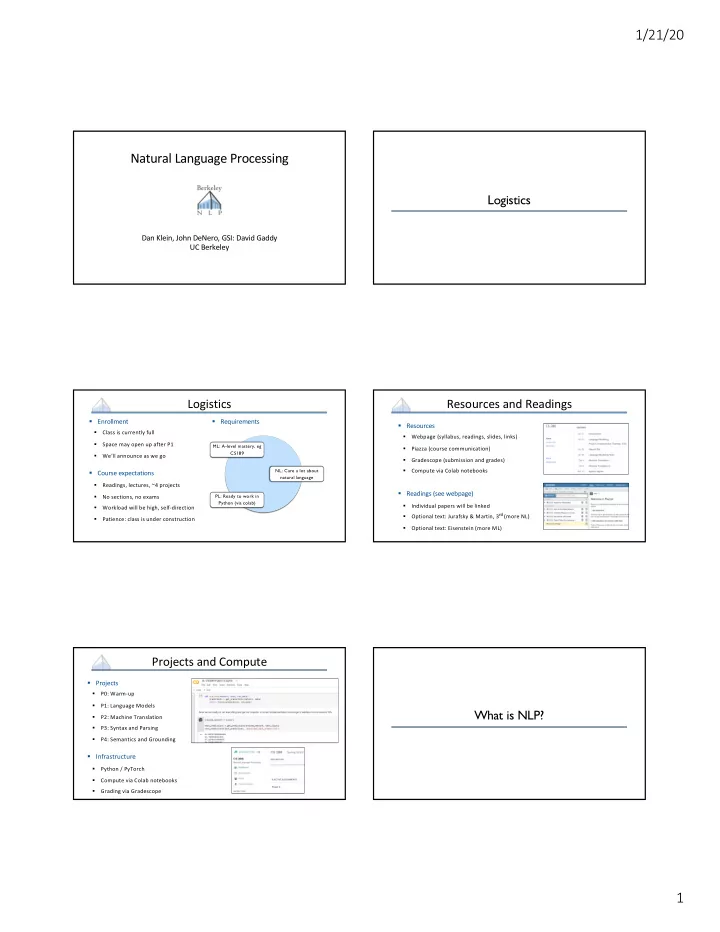
Logistics Logistics

§ Enrollment

§ Class is currently full § Space may open up after P1 § We’ll announce as we go

§ Course expectations

§ Readings, lectures, ~4 projects § No sections, no exams § Workload will be high, self-direction § Patience: class is under construction

ML: A-level mastery, eg CS189 PL: Ready to work in Python (via colab) NL: Care a lot about natural language

§ Requirements

Resources and Readings

§ Resources

§ Webpage (syllabus, readings, slides, links) § Piazza (course communication) § Gradescope (submission and grades) § Compute via Colab notebooks

§ Readings (see webpage)

§ Individual papers will be linked § Optional text: Jurafsky & Martin, 3rd (more NL) § Optional text: Eisenstein (more ML)

Projects and Compute

§ Projects

§ P0: Warm-up § P1: Language Models § P2: Machine Translation § P3: Syntax and Parsing § P4: Semantics and Grounding

§ Infrastructure

§ Python / PyTorch § Compute via Colab notebooks § Grading via Gradescope

What is NLP?

slide-2
SLIDE 2

1/21/20 2

Natural Language Processing

Goal: Deep Understanding

§ Requires context, linguistic structure, meanings…

Reality: Shallow Matching

§ Requires robustness and scale § Amazing successes, but fundamental limitations Neural ASR Regexps Search

NLP History

1950 1960 1970 1980 1990 2000 2010 2020

Neural nets? Weaver on MT Bell Labs ASR ALPAC kills MT Rule-based MT Neural MT Penn Treebank Structured ML Statistical MT Neural TTS Pretraining Rule-based Semantics CYC

Pre-Compute Era Symbolic Era Empirical Era Scale Era

Grep

Transforming Language Speech Systems

§ Automatic Speech Recognition (ASR)

§ Audio in, text out § SOTA: <<1% error for digit strings, 5% conversational speech, still >>20% hard acoustics

§ Text to Speech (TTS)

§ Text in, audio out § SOTA: nearly perfect aside from prosody

“Speech Lab”

Speak-N-Spell / Google WaveNet / The Verge

Machine Translation

§ Translate text from one language to another § Challenges:

§ What’s the mapping? [learning to translate] § How to make it efficient? [fast translation search] § Fluency (next class) vs fidelity (later)

Example: Yejin Choi

Machine Translation

Google Translate 2020

slide-3
SLIDE 3

1/21/20 3

Spoken Language Translation

Image: Microsoft Skype via Yejin Choi

Summarization

§ Condensing documents

§ Single or multiple docs § Extractive or synthetic § Aggregative or representative

§ Very context- dependent! § An example of analysis with generation

Image: CNN via Wei Gao

Understanding Language Search, Questions, and Reasoning Jeopardy!

Images: Jeopardy Productions

Question Answering: Watson

slide-4
SLIDE 4

1/21/20 4

Question Answering: Watson

Slide: Yejin Choi

Language Comprehension?

Interactive Language Example: Virtual Assistants

§ VAs must do

§ Speech recognition § Language analysis § Dialog processing § Text to speech

Image: Wikipedia

Conversations with Devices?

Slide: Yejin Choi

Social AIs and Chatbots

Microsoft’s XiaoIce

Source: Microsoft

slide-5
SLIDE 5

1/21/20 5

Chatbot Competitions!

§ Alexa Prize competition to build chatbots that keep users engaged

§ Winner in 2017: UW’s Sounding Board (Fang, Cheng, Holtzman, Ostendorf, Sap, Clark, Choi) § Winner in 2018: UC Davis’s Gunrock (Zhou Yu et al)

§ Compare to the Turing test (eg Loebner Prize) where the goal is to fool people

SoundingBoard Example

Source: Mari Ostendorf

Sounding Board’s Architecture

Source: Yejin Choi

Sounding Board’s Architecture

Source: Yejin Choi

Related Areas What is Nearby NLP?

§ Computational Linguistics

§ Using computational methods to learn more about how language works § We end up doing this and using it

§ Cognitive Science

§ Figuring out how the human brain works § Includes the bits that do language § Humans: the only working NLP prototype!

§ Speech Processing

§ Mapping audio signals to text § Traditionally separate from NLP, converging

slide-6
SLIDE 6

1/21/20 6

Example: NLP Meets CL

§ Example: Language change, reconstructing ancient forms, phylogenies … just one example of the kinds of linguistic models we can build

Why is Language Hard? Problem: Ambiguity

§ Headlines:

§ Enraged Cow Injures Farmer with Ax § Teacher Strikes Idle Kids § Hospitals Are Sued by 7 Foot Doctors § Ban on Nude Dancing on Governor’s Desk § Iraqi Head Seeks Arms § Stolen Painting Found by Tree § Kids Make Nutritious Snacks § Local HS Dropouts Cut in Half

§ Why are these funny?

What Do We Need to Understand Language?

We Need Representation: Linguistic Structure

Slide: Greg Durrett

Example: Syntactic Analysis

Hurricane Emily howled toward Mexico 's Caribbean coast on Sunday packing 135 mph winds and torrential rain and causing panic in Cancun, where frightened tourists squeezed into musty shelters .

Accuracy: 95+

slide-7
SLIDE 7

1/21/20 7

PLURAL NOUN NOUN DET DET ADJ NOUN NP NP CONJ NP PP

We Need Data

We Need Lots of Data: MT

Cela constituerait une solution transitoire qui permettrait de conduire à terme à une charte à valeur contraignante. That would be an interim solution which would make it possible to work towards a binding charter in the long term . [this] [constituerait] [assistance] [transitoire] [who] [permettrait] [licences] [to] [terme] [to] [a] [charter] [to] [value] [contraignante] [.] [it] [would] [a solution] [transitional] [which] [would] [of] [lead] [to] [term] [to a] [charter] [to] [value] [binding] [.] [this] [would be] [a transitional solution] [which would] [lead to] [a charter] [legally binding] [.] [that would be] [a transitional solution] [which would] [eventually lead to] [a binding charter] [.] SOURCE HUMAN 1x DATA 10x DATA 100x DATA 1000x DATA

We Need Models: Data Alone Isn’t Enough!

We Need World Knowledge

Slide: Greg Durrett

Data and Knowledge

§ Classic knowledge representation worries: How will a machine ever know that…

§ Ice is frozen water? § Beige looks like this: § Chairs are solid?

§ Answers:

§ 1980: write it all down § 2000: get by without it § 2020: learn it from data Personal Pronouns (PRP)

Learning Latent Syntax

PRP-1 it them him PRP-2 it he they PRP-3 It He I NNP-14 Oct. Nov. Sept. NNP-12 John Robert James NNP-2 J. E. L. NNP-1 Bush Noriega Peters NNP-15 New San Wall NNP-3 York Francisco Street

Proper Nouns (NNP)

slide-8
SLIDE 8

1/21/20 8

We Need Grounding

Grounding: linking linguistic concepts to non-linguistic ones

Slide: Greg Durrett

Example: Grounded Dialog

When is my package arriving? Friday!

Example: Grounded Dialog

What’s the most valuable American company? Apple Who is its CEO? Tim Cook

Why is Language Hard?

§ We Need:

§ Representations § Models § Data § Machine Learning § Scale § Efficient Algorithms § Grounding

§ … and often we need all these things at the same time

What is this Class? What is this Class?

§ Three aspects to the course:

§ Linguistic Issues § What are the range of language phenomena? § What are the knowledge sources that let us disambiguate? § What representations are appropriate? § How do you know what to model and what not to model? § Modeling Methods § Increasingly sophisticated model structures § Learning and parameter estimation § Efficient inference: dynamic programming, search, sampling § Engineering Methods § Issues of scale § Where the theory breaks down (and what to do about it)

§ We’ll focus on what makes the problems hard, and what works in practice…

slide-9
SLIDE 9

1/21/20 9

Class Requirements and Goals

§ Class requirements

§ Uses a variety of skills / knowledge:

§ Probability and statistics, graphical models (parts of cs281a) § Basic linguistics background (ling100) § Strong coding skills (Python, ML libraries)

§ Most people are probably missing one of the above § You will often have to work on your own to fill the gaps

§ Class goals

§ Learn the issues and techniques of modern NLP § Build realistic NLP tools § Be able to read current research papers in the field § See where the holes in the field still are!

§ This semester: new projects, new topics, lots under construction!