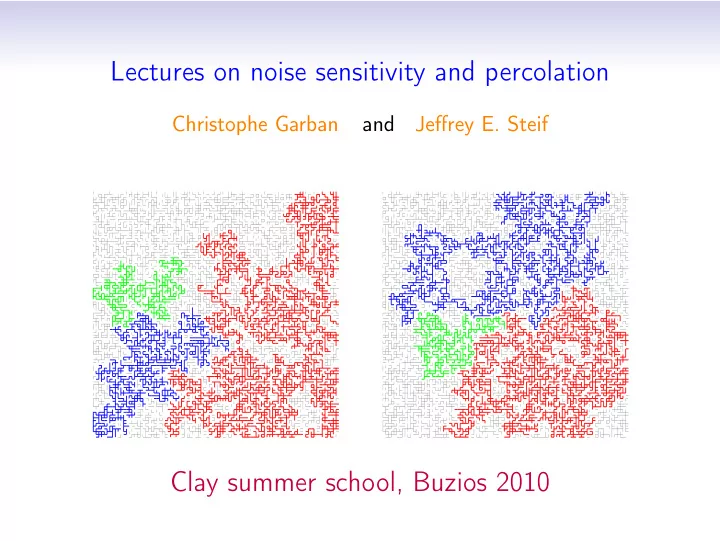
SLIDE 1
Lectures on noise sensitivity and percolation
Christophe Garban and Jeffrey E. Steif
Clay summer school, Buzios 2010
SLIDE 2
Boolean functions
Definition
A Boolean function is a function f : {−1, 1}n → {0, 1} OR {−1, 1}
SLIDE 3 Boolean functions
Definition
A Boolean function is a function f : {−1, 1}n → {0, 1} OR {−1, 1} Example: Majority f (x1, . . . , xn) = sign(
n
xi)
SLIDE 4
Boolean functions
SLIDE 5
Boolean functions computer sci- ence
SLIDE 6
Boolean functions computer sci- ence Probability theory
SLIDE 7
Boolean functions computer sci- ence Analytical tools (Fourier analysis) Probability theory
SLIDE 8
Boolean functions computer sci- ence Analytical tools (Fourier analysis) Probability theory Statistical physics (percolation)
SLIDE 9
A concrete situation : VOTING SCHEMES
Imagine one has n people labelled 1, . . . , n which are deciding between candidates A and B according to a certain procedure or voting scheme. This procedure can be represented by a Boolean function f : {−1, 1}n → {0, 1}
SLIDE 10
A concrete situation : VOTING SCHEMES
Imagine one has n people labelled 1, . . . , n which are deciding between candidates A and B according to a certain procedure or voting scheme. This procedure can be represented by a Boolean function f : {−1, 1}n → {0, 1} For instance, you may think of A = Al Gore B = Bush n ≈ 108
SLIDE 11
Noise stability
Suppose the election is “well-balanced” between A and B. One may thus consider the actual configuration of votes as a random ω = (x1, . . . , xn) ∈ {−1, 1}n , sampled according to the uniform measure. The outcome of the election should be f (ω).
SLIDE 12 Noise stability
Suppose the election is “well-balanced” between A and B. One may thus consider the actual configuration of votes as a random ω = (x1, . . . , xn) ∈ {−1, 1}n , sampled according to the uniform measure. The outcome of the election should be f (ω). In fact due to inevitable errors in the recording of the votes, the outcome is f (ωǫ) instead. Here ωǫ is a “slight perturbation” of ω.
Informal definition
Noise stability corresponds to P
- f (ω) = f (ωǫ)
- being “small” .
SLIDE 13
Case of the majority function
If f (ω) = sign( xi),
ω n
SLIDE 14
Case of the majority function
If f (ω) = sign( xi),
ω ωǫ n
SLIDE 15
Percolation
Sub-critical (p < pc) critique (pc) Super-critical (p > pc) δZ2
SLIDE 16
Percolation
Sub-critical (p < pc) critique (pc) Super-critical (p > pc) δZ2
SLIDE 17
Percolation
Sub-critical (p < pc) Critical (pc) Super-critical (p > pc) δZ2 δZ2
Question
How does critical percolation “react” to perturbations ?
SLIDE 18
ω:
SLIDE 19
ω → ωǫ:
SLIDE 20
Large clusters are very sensitive to “noise”
SLIDE 21
Large clusters are very sensitive to “noise”
SLIDE 22
Large scale properties are encoded by Boolean functions of the ‘inputs’
SLIDE 23
Large scale properties are encoded by Boolean functions of the ‘inputs’
b · n a · n
SLIDE 24
Large scale properties are encoded by Boolean functions of the ‘inputs’
b · n a · n
Let fn : {−1, 1}O(1)n2 → {0, 1} be the Boolean function defined as follows
SLIDE 25
Large scale properties are encoded by Boolean functions of the ‘inputs’
b · n a · n
Let fn : {−1, 1}O(1)n2 → {0, 1} be the Boolean function defined as follows fn(ω) := 1 if there is a left-right crossing
SLIDE 26
Large scale properties are encoded by Boolean functions of the ‘inputs’
b · n a · n
Let fn : {−1, 1}O(1)n2 → {0, 1} be the Boolean function defined as follows fn(ω) := 1 if there is a left-right crossing else
SLIDE 27
Large scale properties are encoded by Boolean functions of the ‘inputs’
b · n a · n
Let fn : {−1, 1}O(1)n2 → {0, 1} be the Boolean function defined as follows fn(ω) := 1 if there is a left-right crossing else
Informal definition
Noise sensitivity corresponds to fn(ω) and fn(ωǫ) being very little correlated (i.e. Cov(fn(ω), fn(ωǫ)) being very small).
SLIDE 28
Applications to dynamical percolation
Informal definition
This is a very simple (stationary) dynamics on percolation configurations.
SLIDE 29
Applications to dynamical percolation
Informal definition
This is a very simple (stationary) dynamics on percolation configurations. Each hexagon (or edge) switches color at the times of a Poisson Point Process.
SLIDE 30
How is it related to Noise Sensitivity ? t
SLIDE 31
How is it related to Noise Sensitivity ? t ωt ωt+ǫ n
SLIDE 32
Applications to Sub-Gaussian fluctuations
Informal definition (First Passage Percolation)
Let 0 < a < b. Define the random metric on the graph Zd as follows: for each edge e ∈ Ed, fix its length τe to be a with probability 1/2 and b with probability 1/2.
SLIDE 33
Applications to Sub-Gaussian fluctuations
Informal definition (First Passage Percolation)
Let 0 < a < b. Define the random metric on the graph Zd as follows: for each edge e ∈ Ed, fix its length τe to be a with probability 1/2 and b with probability 1/2. It is well-known that the random ball Bω(R) := {x ∈ Zd, dist
ω (0, x) ≤ R}
has an asymptotic shape.
SLIDE 34
Applications to Sub-Gaussian fluctuations
Informal definition (First Passage Percolation)
Let 0 < a < b. Define the random metric on the graph Zd as follows: for each edge e ∈ Ed, fix its length τe to be a with probability 1/2 and b with probability 1/2. It is well-known that the random ball Bω(R) := {x ∈ Zd, dist
ω (0, x) ≤ R}
has an asymptotic shape.
Question
What are the fluctuations around this asymptotic shape ?
SLIDE 35 What will be our main tools ?
- Some concepts which arised in computer science: influence of a
variable, etc
SLIDE 36 What will be our main tools ?
- Some concepts which arised in computer science: influence of a
variable, etc
- Discrete Fourier analysis
SLIDE 37 What will be our main tools ?
- Some concepts which arised in computer science: influence of a
variable, etc
- Discrete Fourier analysis
In the same way as a function f : R/Z → R can be decomposed into Fourier series, we will see that a Boolean function f : {−1, 1}n → {0, 1} can be naturally decomposed into f =
ˆ f (S)χS
SLIDE 38 What will be our main tools ?
- Some concepts which arised in computer science: influence of a
variable, etc
- Discrete Fourier analysis
In the same way as a function f : R/Z → R can be decomposed into Fourier series, we will see that a Boolean function f : {−1, 1}n → {0, 1} can be naturally decomposed into f =
ˆ f (S)χS
Fact
f being noise sensitive will correspond to f being of “High frequency”.
SLIDE 39 What will be our main tools ?
- Some concepts which arised in computer science: influence of a
variable, etc
- Discrete Fourier analysis
SLIDE 40 What will be our main tools ?
- Some concepts which arised in computer science: influence of a
variable, etc
- Discrete Fourier analysis
- Hypercontractivity
SLIDE 41 What will be our main tools ?
- Some concepts which arised in computer science: influence of a
variable, etc
- Discrete Fourier analysis
- Hypercontractivity
- Randomized algorithms
SLIDE 42 What will be our main tools ?
- Some concepts which arised in computer science: influence of a
variable, etc
- Discrete Fourier analysis
- Hypercontractivity
- Randomized algorithms
- Viewing the “frequencies of percolation” as random fractals of the
plane.