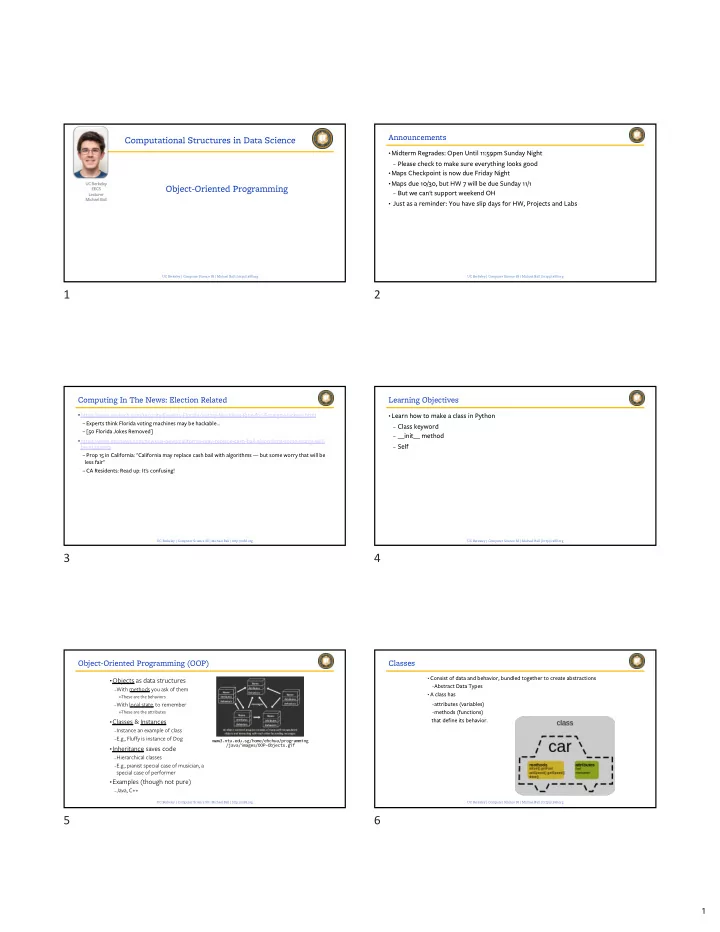
1 2 Computing In The News: Election Related Learning Objectives - - PDF document

1 2
SMART_READER_LITE
LIVE PREVIEW

1 2 Computing In The News: Election Related Learning Objectives - - PDF document

Announcements Computational Structures in Data Science Midterm Regrades: Open Until 11:59pm Sunday Night Please check to make sure everything looks good Maps Checkpoint is now due Friday Night Maps due 10/30, but HW 7 will be due


slide-1
SLIDE 1

1

Computational Structures in Data Science

UC Berkeley EECS Lecturer Michael Ball

UC Berkeley | Computer Science 88 | Michael Ball | http://cs88.org

Object-Oriented Programming

1

UC Berkeley | Computer Science 88 | Michael Ball | http://cs88.org

Announcements

  • Midterm Regrades: Open Until 11:59pm Sunday Night

– Please check to make sure everything looks good

  • Maps Checkpoint is now due Friday Night
  • Maps due 10/30, but HW 7 will be due Sunday 11/1

– But we can't support weekend OH

  • Just as a reminder: You have slip days for HW, Projects and Labs

2

UC Berkeley | Computer Science 88 | Michael Ball | http://cs88.org

Computing In The News: Election Related

  • https://www.govtech.com/security/Experts-Florida-Voting-Machines-Ripe-for-Foreign-Hackers.html

– Experts think Florida voting machines may be hackable… – [50 Florida Jokes Removed]

  • https://www.nbcnews.com/news/us-news/california-may-replace-cash-bail-algorithms-some-worry-will-

be-n1243750 – Prop 15 in California: "California may replace cash bail with algorithms — but some worry that will be less fair" – CA Residents: Read up: It's confusing!

3

UC Berkeley | Computer Science 88 | Michael Ball | http://cs88.org

Learning Objectives

  • Learn how to make a class in Python

– Class keyword – __init__ method – Self

4

UC Berkeley | Computer Science 88 | Michael Ball | http://cs88.org

Object-Oriented Programming (OOP)

  • Objects as data structures

–With methods you ask of them »These are the behaviors –With local state, to remember »These are the attributes

  • Classes & Instances

–Instance an example of class –E.g., Fluffy is instance of Dog

  • Inheritance saves code

–Hierarchical classes –E.g., pianist special case of musician, a

special case of performer

  • Examples (though not pure)

–Java, C++ www3.ntu.edu.sg/home/ehchua/programming /java/images/OOP-Objects.gif

5

UC Berkeley | Computer Science 88 | Michael Ball | http://cs88.org

Classes

  • Consist of data and behavior, bundled together to create abstractions

–Abstract Data Types

  • A class has

–attributes (variables) –methods (functions)

that define its behavior.

6

slide-2
SLIDE 2

2

UC Berkeley | Computer Science 88 | Michael Ball | http://cs88.org

Objects

  • An object is the instance of a class.

7

UC Berkeley | Computer Science 88 | Michael Ball | http://cs88.org

Objects

  • Objects are concrete instances of classes in memory.
  • They can have state

–mutable vs immutable (lists vs tuples)

  • Functions do one thing (well)

–Objects do a collection of related things

  • In Python, everything is an object

–All objects have attributes –Manipulation happens through methods

8

UC Berkeley | Computer Science 88 | Michael Ball | http://cs88.org

Python class statement

class ClassName: <statement-1> . . . <statement-N> class ClassName ( inherits ): <statement-1> . . . <statement-N>

9

UC Berkeley | Computer Science 88 | Michael Ball | http://cs88.org

Example: Account

class BaseAccount: def init(self, name, initial_deposit): self.name = name self.balance = initial_deposit def account_name(self): return self.name def account_balance(self): return self.balance def withdraw(self, amount): self.balance -= amount return self.balance new namespace methods attributes The object dot

10

UC Berkeley | Computer Science 88 | Michael Ball | http://cs88.org

Creating an object, invoking a method

my_acct = BaseAccount() my_acct.init("John Doe", 93) my_acct.withdraw(42)

dot The Class Constructor

11

UC Berkeley | Computer Science 88 | Michael Ball | http://cs88.org

Special Initialization Method

class BaseAccount: def __init__(self, name, initial_deposit): self.name = name self.balance = initial_deposit def account_name(self): return self.name def account_balance(self): return self.balance def withdraw(self, amount): self.balance -= amount return self.balance return None

12

slide-3
SLIDE 3

3

UC Berkeley | Computer Science 88 | Michael Ball | http://cs88.org

More on Attributes

  • Attributes of an object accessible with ‘dot’ notation
  • bj.attr
  • You can distinguish between ”public” and “private” data.

–Used to clarify to programmers how you class should be used. –In Python an _ prefix means “this thing is private” –_foo and __foo do different things inside a class. –More for the curious.

  • Class variables vs Instance variables:

–Class variable set for all instances at once –Instance variables per instance value

13

UC Berkeley | Computer Science 88 | Michael Ball | http://cs88.org

Example

class BaseAccount: def __init__(self, name, initial_deposit): self.name = name self.balance = initial_deposit def name(self): return self.name def balance(self): return self.balance def withdraw(self, amount): self.balance -= amount return self.balance

14

UC Berkeley | Computer Science 88 | Michael Ball | http://cs88.org

Example: “private” attributes

class BaseAccount: def __init__(self, name, initial_deposit): self._name = name self._balance = initial_deposit def name(self): return self._name def balance(self): return self._balance def withdraw(self, amount): self._balance -= amount return self._balance

15

UC Berkeley | Computer Science 88 | Michael Ball | http://cs88.org

Example: class attribute

class BaseAccount: account_number_seed = 1000 def __init__(self, name, initial_deposit): self._name = name self._balance = initial_deposit self._acct_no = BaseAccount.account_number_seed BaseAccount.account_number_seed += 1 def name(self): return self._name def balance(self): return self._balance def withdraw(self, amount): self._balance -= amount return self._balance

16

UC Berkeley | Computer Science 88 | Michael Ball | http://cs88.org

More class attributes

class BaseAccount: account_number_seed = 1000 accounts = [] def __init__(self, name, initial_deposit): self._name = name self._balance = initial_deposit self._acct_no = BaseAccount.account_number_seed BaseAccount.account_number_seed += 1 BaseAccount.accounts.append(self) def name(self): ... def show_accounts(): for account in BaseAccount.accounts: print(account.name(), account.account_no(),account.balance())

17

UC Berkeley | Computer Science 88 | Michael Ball | http://cs88.org

Class Inheritance

  • Classes can inherit methods and attributes from parent classes but extend

into their own class.

18

slide-4
SLIDE 4

4

UC Berkeley | Computer Science 88 | Michael Ball | http://cs88.org

Inheritance

  • Define a class as a specialization of an existing class
  • Inherent its attributes, methods (behaviors)
  • Add additional ones
  • Redefine (specialize) existing ones

–Ones in superclass still accessible in its namespace

19

UC Berkeley | Computer Science 88 | Michael Ball | http://cs88.org

Example

class Account(BaseAccount): def deposit(self, amount): self._balance += amount return self._balance

21

UC Berkeley | Computer Science 88 | Michael Ball | http://cs88.org

More special methods

class Account(BaseAccount): def deposit(self, amount): self._balance += amount return self._balance def __repr__(self): return '< ' + str(self._acct_no) + '[' + str(self._name) + '] >' def __str__(self): return 'Account: ' + str(self._acct_no) + '[' + str(self._name) + ']' def show_accounts(): for account in BaseAccount.accounts: print(account) Goal: unambiguous Goal: readable

22

UC Berkeley | Computer Science 88 | Michael Ball | http://cs88.org

Classes using classes

class Bank: accounts = [] def add_account(self, name, account_type, initial_deposit): assert (account_type == 'savings') or (account_type == 'checking'), "Bad Account type" assert initial_deposit > 0, "Bad deposit" new_account = Account(name, account_type, initial_deposit) Bank.accounts.append(new_account) def show_accounts(self): for account in Bank.accounts: print(account)

23