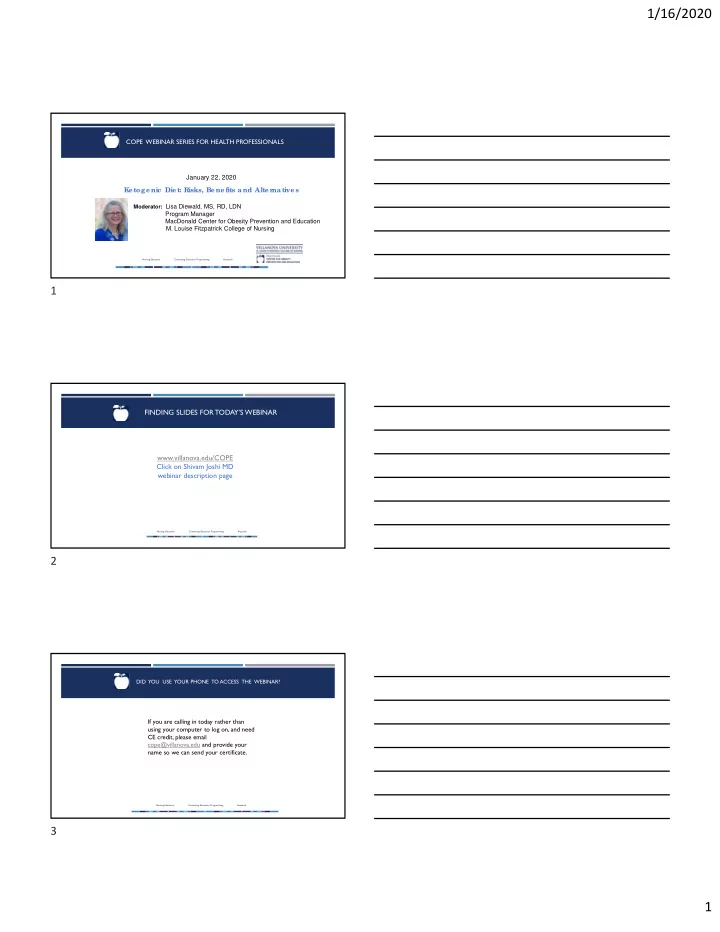
1/16/2020 COPE WEBINAR SERIES FOR HEALTH PROFESSIONALS January 22, - - PDF document

1 16 2020
SMART_READER_LITE
LIVE PREVIEW

1/16/2020 COPE WEBINAR SERIES FOR HEALTH PROFESSIONALS January 22, - - PDF document

1/16/2020 COPE WEBINAR SERIES FOR HEALTH PROFESSIONALS January 22, 2020 Ketogenic Diet: R isks, Benefits and Alter natives Moderator: Lisa Diewald, MS, RD, LDN Program Manager MacDonald Center for Obesity Prevention and Education M. Louise


slide-1
SLIDE 1

1/16/2020 1

COPE WEBINAR SERIES FOR HEALTH PROFESSIONALS January 22, 2020 Ketogenic Diet: R isks, Benefits and Alter natives

Moderator: Lisa Diewald, MS, RD, LDN

Program Manager MacDonald Center for Obesity Prevention and Education

  • M. Louise Fitzpatrick College of Nursing

Nursing Education Continuing Education Programming Research

FINDING SLIDES FOR TODAY’S WEBINAR www.villanova.edu/COPE Click on Shivam Joshi MD webinar description page

Nursing Education Continuing Education Programming Research

DID YOU USE YOUR PHONE TO ACCESS THE WEBINAR?

If you are calling in today rather than using your computer to log on, and need CE credit, please email cope@villanova.edu and provide your name so we can send your certificate.

Nursing Education Continuing Education Programming Research

1 2 3

slide-2
SLIDE 2

1/16/2020 2

OBJECTIVES

Nursing Education Continuing Education Programming Research

  • 1. Provide an overview of the ketogenic diet,

including the risks and benefits

  • 2. Review the latest evidence on the

effectiveness of the ketogenic diet in treating obesity and type 2 diabetes.

  • 3. Discuss clinical and practical implications and

future research directions

CE DETAILS

Villanova University College of Nursing is accredited as a provider of continuing nursing education by the American Nurses Credentialing Center Commission on Accreditation Villanova University College of Nursing Continuing Education/COPE is a Continuing Professional Education (CPE) Accredited Provider with the Commission on Dietetic Registration

Nursing Education Continuing Education Programming Research

NUTRITION FUTURE FORWARD: ARE WE READY FOR OUT OF THE BOX THINKING?

March 6, 2020 9 AM-4 PM Driscoll Hall Auditorium Villanova University RNs: 6 contact hours RD/ RDN/ DTR: 6 CPEUs

Villanova.edu/cope

4 5 6

slide-3
SLIDE 3

1/16/2020 3

CE CREDITS

  • This webinar awards 1 contact hour for nurses

and 1 CPEU for dietitians

  • Suggested CDR Learning Need Codes:

4000, 5370, 5790, 9020

  • Level 2
  • CDR Performance Indicators: 6.2.5, 6.3.7, 6.3.8

Nursing Education Continuing Education Programming Research

Ketogenic Diet: Risks, Benefits and Alternatives

Shivam Joshi, MD Clinical Assistant Professor of Medicine NYU School of Medicine

DISCLOSURE The planners and presenter of this program have no conflicts of interest to disclose. Accredited status does not imply endorsement by Villanova University, COPE or the American Nurses Credentialing Center

  • f any commercial products or medical/nutrition advice

displayed in conjunction with an activity.

7 8 9

slide-4
SLIDE 4

1/16/2020 4

Ketogenic Diet: Risks, Benefits, and Alternatives

Shivam Joshi, MD Clinical Assistant Professor NYU School of Medicine January 22, 2020

Disclosures

  • None
  • But, I do eat carbohydrates.

Table of Contents

  • Basics of the Ketogenic Diet
  • Benefits
  • The Ketogenic Diet for Weight Loss
  • The Ketogenic Diet for Type 2 Diabetes Mellitus
  • Potential Risks of the Ketogenic Diet
  • Pediatric Epilepsy Literature
  • LDL Cholesterol
  • Kidney Stones
  • Conclusion

10 11 12

slide-5
SLIDE 5

1/16/2020 5

The Origins of the Ketogenic Diet

  • The ketogenic diet actually first emerged as a treatment for epilepsy
  • Since the time of Hippocrates, people have noticed that fasting

suppressed seizure activity

  • Trials of fasting confirmed this in the 1900s
  • In 1921, Dr. Russell Wilder of the Mayo Clinic thought the benefit
  • f fasting was actually the ketones produced during fasting

The Origins of the Ketogenic Diet

  • Ketones can also be produced by restricting carbohydrates
  • Dr. Wilder then used high-fat, low-carb ketone-inducing diet to produce

similar seizure-reducing effects in pediatric patients with epilepsy

  • Ketogenic diets for epilepsy were popular until the use of anti-epileptic

drugs (beginning with phenytoin in 1938)

  • Ketogenic diets later re-emerged in the 20th century as a treatment for
  • besity and diabetes in the context of the popular low-carbohydrate trend

The Basics of the Ketogenic Diet

  • The ketogenic diet is a very-low

carbohydrate diet

  • To replace carbohydrates, fat is

consumed as the primary source

  • f calories
  • Protein is consumed in

“moderation” Very Low Carbohydrate Diet Up to 5 to 10% carbohydrates (20 to 50 grams of carbs per day) Low Carbohydrate Diet Up to 20% carbohydrates

13 14 15

slide-6
SLIDE 6

1/16/2020 6

How much is 20 to 50 grams

  • f carbs per day?

20 grams of carbs

  • 0.8 medium apple OR
  • 0.7 medium banana OR
  • 1.4 slices of whole wheat bread

50 grams of carbs

  • 2 medium apples OR
  • 1.87 medium bananas OR
  • 3.57 slices of whole wheat bread

The keto diet is an extreme version of a low-carbohydrate diet

What are ketones?

  • Ketones produced during the
  • xidation of fat
  • Keto diet, DKA, alcoholism,

starvation (anytime there is a shortage of usable carbohydrates)

  • Fats are oxidized in the liver to

ketones

  • Oxidation of fatty acids yields ATP

for energy

  • Ketones are also used for energy

Acetoacetate Beta-hydroxybutyrate Acetone

Keto Diet Ratio

Ratio

  • Describes the intensity of the carbohydrate restriction
  • Example: 4:1 ratio means 4 grams of fat to 1 gram of protein and

carbohydrates combined

  • Higher the ratio the more intense the carbohydrate restriction
  • Popular ketogenic diets are 4:1 or 3:1

16 17 18

slide-7
SLIDE 7

1/16/2020 7

What does the keto diet look like? Keto Diet for Weight Loss Background on Obesity

  • Adults obese: 39.8%
  • Adults overweight or obese: 71.6%
  • In years past, America’s solution

to the obesity epidemic: low-fat diets

19 20 21

slide-8
SLIDE 8

1/16/2020 8

Low-Fat Foods from Before

The Problems with Those Low-Fat Diets

Problem 1

  • Many foods – although low in fat

– still were not healthy!

Problem 2

  • These foods simply exchanged

calories from fat with calories from refined carbohydrates

Serdula et al. AJPH 2004 94(6):2014.

The Problems with Those Low-Fat Diets

Problem 3

  • A “low-fat diet” is a diet that is

typically less than 10 to 30% of calories from fat

  • America never ate less than 30%
  • f calories from fat (we were

never truly on a low-fat diet!)

Ford et al. AJCN 97.4 (2013): 848.

22 23 24

slide-9
SLIDE 9

1/16/2020 9

The Problems with Those Low-Fat Diets

Problem 4

  • We are eating between 240 to 802

more calories per day than we did ~50 years ago!

Increasing Caloric Consumption

Ford et al. AJCN 97.4 (2013): 848 FAOSTAT https://www.ers.usda.gov/data-products/food-availability-per-capita-data-system/

Low-Fat Diets  Low-Carb Diets

Popular Logic

“If restricting fat and eating more carbs made things worse, then doing the opposite should fix things.”

In Reality

  • 1. We never ate healthy foods!
  • 2. We ate a lot of refined carbs!
  • 3. We never truly were on a low-

fat diet!

  • 4. We actually ate more calories!

Low-carbohydrate diets

Keto Diet for Weight Loss

  • Keto enthusiasts tout the diet as

an effective means of weight loss

  • Increased metabolism
  • Increased satiety
  • Increased compliance
  • Less calories consumed

25 26 27

slide-10
SLIDE 10

1/16/2020 10

Keto Diet for Weight Loss

  • Numerous anecdotal

experiences that are often highly publicized

However, caloric restriction by any means will result in weight loss!

Caloric Restriction for Weight Loss: Take 1

  • RCT of 160 participants randomly

assigned to either Atkins, Weight Watchers, Zone, or Ornish Diet

  • No difference in weight loss between

strategies at one year

“Amount of weight loss was associated with self reported dietary adherence level (r=0.60; P<.001) but not with diet type (r=0.07; P=.40).”

Caloric Restriction for Weight Loss: Take 2

  • RCT of 811 overweight assigned to 1 of

4 diets of different macronutrient compositions

  • After two years, weight loss was

essentially the same on all diets “CONCLUSIONS Reduced-calorie diets result in clinically meaningful weight loss regardless of which macronutrients they emphasize.”

28 29 30

slide-11
SLIDE 11

1/16/2020 11

Caloric Restriction for Weight Loss: Take 3

  • RCT of 609 participants

assigned to either a LOW-FAT

  • r a LOW-CARBOHYDRATE

diet for 12 months

  • No significant difference in

weights between the two groups at 12 months

Caloric Restriction for Weight Loss: Take 4

  • Meta-analysis of 53 studies and

68,128 people

But What about Fat Loss and Energy Expenditure?

  • Meta-Analysis of 32 controlled

feeding studies

  • Both energy expenditure and fat

loss are higher on low fat diets

31 32 33

slide-12
SLIDE 12

1/16/2020 12

But what about ketogenic diets for weight loss?

  • Meta-analysis of randomized

controlled trials lasting for more than 12 months

  • 13 studies involving 1,415

individuals

  • Ketogenic diet showed an

additional weight loss of 0.91 kg (1.98 lbs) over low-fat diets

  • Statistically significant but is it

clinically significant?

Dietary adherence is important for weight loss, but this diet is very hard to adhere to…

So much so that nearly every long-term (>12 months) study reporting carb intake at the end was not actually on a keto diet

Bueno et al. Br J N 2013 110(7): 1178

Some of the Weight Lost is Not Fat….

Water Loss Fat Free (Lean Body) Mass Loss

Kirkpatrick et al. Journal of Clinical Lipidology. 2019;13:689,711.

34 35 36

slide-13
SLIDE 13

1/16/2020 13

Fat Free Mass Loss Greater on a Ketogenic Diet

  • 17 overweight men on a

conventional diet or a ketogenic diet

  • Both diets lost fat
  • But loss of fat-free mass (muscle

mass) was greater with the keto diet

Hall KD et al. Am J Clin Nutr. 2016;104:324-333.

Keto Diet for Diabetes Popular Understanding

  • Since the ketogenic diet is low in

carbohydrates, the idea is that blood sugars will not increase if there is no dietary glucose to increase it

  • This is a good idea in theory,

and has been used by some with type 1 diabetes However…..

  • Adherence is difficult
  • Underlying glucose tolerance

(insulin resistance in T2DM) may worsen

  • Not any better than other dietary

strategies

37 38 39

slide-14
SLIDE 14

1/16/2020 14

Promise with Industry-Funded, Non- Randomized Studies

  • 1.3% improvement in HbA1c in

those on the ketogenic diet

  • Non-randomized
  • Compared to “usual care”

(unequal arms)

  • Industry funded

RCTs Show Decreasing Benefit with Increasing Duration of Study

  • Benefit decreases with

duration of RCT

  • Diabetes usually is not a

short-term disease process for patients

Trial Duration Mean Reduction

  • f HbA1c
  • n

Ketogenic Diet Mean Reduction

  • f HbA1c
  • n Control

Diet Difference in Mean HbA1c Reduction Between Diets Westman et al. 2008 24 weeks 1.5% 0.5% 1.0% Saslow et al. 2017 32 weeks 0.8% 0.3% 0.5% Saslow et al. 2017 52 weeks 0.5% 0.2% 0.3%

Westman EC et al. Nutrition & Metabolism. 2008;5(1):36. Saslow LR et al. Journal of Medical Internet Research. 2017;19(2):e36. Saslow LR et al. Nutrition & Diabetes 7.12 (2017): 304

No Difference in Long-Term (> 1 year) Studies

  • Meta-analysis of randomized

controlled trials lasting for more than 12 months

  • 8 studies involving 770

individuals (not all studies examined had data)

  • No difference in fasting

blood glucose or HbA1c between groups

40 41 42

slide-15
SLIDE 15

1/16/2020 15

Fat Worsens Glucose Metabolism

  • 15 male students divided into 3 groups

to consume either carbohydrates, fats,

  • r protein
  • Each group consumed a high amount
  • f their respective macronutrient for 2

days prior to a glucose tolerance test (175 g)

  • Sweeney. JAMA 1927

High-Fat Diets May Actually Worsen Glucose Metabolism

  • Nine healthy young men (mean

age 27 years; mean BMI 22 kg/m2) consumed either

  • a normal diet (67% carbs, 22% fat,

11% protein) for 3 days

  • LC/HFD (20% carbs, 69% fat, 11%

protein) for 3 days

Numao et al. European Journal of Clinical Nutrition (2012) 66, 926–931 Despite eating fewer carbs, those on a high-fat diet had higher blood sugars!

The Ketogenic Diet May Actually Worsen Glucose Metabolism

  • 17 men (BMI 25 to 30) were

either fed a

  • Basal diet (15% protein, 50% carbs,

35% fat) for 4 weeks

  • Ketogenic diet (15% protein, 5%

carbs, 80% fat) for 4 weeks

  • Participants on both diets were

then given a carb-rich meal

Rosenbaum et al. Obesity 27.6 (2019): 971-981 Post-prandial blood glucose was actually higher in those who had been on the ketogenic diet for the prior 4 weeks!

43 44 45

slide-16
SLIDE 16

1/16/2020 16

Side Effects of the Ketogenic Diet from the Pediatric Epilepsy Literature

No Shortage of Complications

46 47 48

slide-17
SLIDE 17

1/16/2020 17

Vitamin & Mineral Deficiencies

Deaths Associated with the Ketogenic Diet

Other Concerns of the Ketogenic Diet

49 50 51

slide-18
SLIDE 18

1/16/2020 18

Significant Increase in LDL Cholesterol & Apolipoprotein B

Raggi et al. Atherosclerosis (2020) 292:119-126

Apolipoprotein B also increases on the ketogenic diet and “should be taken as an ominous harbinger”

The Reason LDL Goes Up

  • LDL increased by diets high in
  • Saturated fat
  • Trans fat
  • Cholesterol
  • Animal protein
  • Triglycerides do go down (but

likely do not outweigh the harm caused by an increase in LDL and apolipoprotein B)

  • Utilizing polyunsaturated (PUFA)

and monounsaturated (MUFA) fatty acids can help mitigate the rise in LDL (“plant keto”)

Kirkpatrick et al. Journal of Clinical Lipidology. 2019;13:689,711.

52 53 54

slide-19
SLIDE 19

1/16/2020 19

Kidney Stones are a Common Complication

  • f Ketogenic Diets

Reasons for Kidney Stones on the Ketogenic Diet

  • Reduced water intake (fewer

water containing fruits and vegetables)

  • Animal protein acidifies the

urine

  • High fat consumption binds

calcium in the gut (leading to

  • xalate excretion in in the urine)
  • Low levels of dietary citrate (stone

inhibitor)

  • Low levels of dietary magnesium

and potassium (stone inhibitors)

  • Acidosis from the diet and foods

acidifies urine (promotes stones)

  • Salt content of these foods

promotes urine calcium excretion

Anecdotes of Kidney Stones…

https://blog.virtahealth.com/ketogenic-diet-kidney-stones/

55 56 57

slide-20
SLIDE 20

1/16/2020 20

Other Potential Risks & Considerations

  • Additional risks from low-carb diets in

general

  • Increased mortality
  • Cardiovascular disease
  • Birth defects?
  • Unfavorable changes in the gut microbiome
  • No long-term safety data exist
  • For example, what if this eating pattern

leads to increased CAD after 5 years? (we simply don’t know…)

  • Opportunity cost of not eating whole grains,

fruits, and legumes

  • Lose out on potential health benefits of

these foods

  • Do we increase long-term risk?
  • Unnatural eating pattern
  • No known population to eat this way
  • Even the Inuit have a mutation to

circumvent ketosis

Concluding Thoughts Risks, Benefits and Alternatives …

  • Benefits: nearly non-existent when compared to a high-carb, low-fat

dietary eating pattern (for most) after 1 year

  • Risks: numerous from the pediatric epilepsy and low-carbohydrate

literature; opportunity costs; lack of long-term safety data

  • Alternatives: numerous alternatives exist with wide variations even within

carbohydrate-rich diets

58 59 60

slide-21
SLIDE 21

1/16/2020 21

Diets are a Personal Choice but Require Informed Decision Making

Also, there are a lot of other diets

  • ut there!

Benefits Risks

US News & World Report Rankings

At the top… At the bottom…

For More Information …

61 62 63

slide-22
SLIDE 22

1/16/2020 22

“An ounce of prevention…” Acknowledgments

  • Dr. Rob Ostfeld, Montefiore Health System
  • Dr. Michelle McMacken, NYU School of Medicine
  • Dr. David Goldfarb, NYU School of Medicine
  • Dr. James Underberg, NYU School of Medicine
  • Dr. William Bulsiewicz, MD, MSCI
  • Brenda Davis, RD

Thank You!

How to Reach Me

  • Website: www.afternoonrounds.com
  • Email: afternoonrounds@gmail.com
  • Facebook/Instagram/Twitter: sjoshiMD

64 65 66

slide-23
SLIDE 23

1/16/2020 23

  • Look for an email containing a link to an evaluation.

The email will be sent to the email address that you used to register for the webinar.

  • Complete the evaluation soon after receiving it. It

will expire after 3 weeks.

  • You will be emailed a certificate within 2-3 business

days.

  • Remember: If you used your phone to call in, and

want CE credit for attending, please send an email with your name to cope@villanova.edu so you receive your certificate.

TO RECEIVE YOUR CE CERTIFICATE

Villanova.edu/cope

Upcoming FREE Continuing Education Webinar

Presented by: Tanja Kral, Ph.D. Associate Professor of Nutrition Science University of Pennsylvania School of Nursing & Perelman School of Medicine

Early life risk factors for obesity in children with Autism Spectrum Disorder

Wednesday, March 25th, 2020, 12-1 PM To register: Villanova.edu/cope Villanova.edu/cope

NEW! Enduring Continuing Education Catalog

  • Webinars and conferences on variety of

topics

  • Catch up on continuing education needs
  • For more info:

Villanova.edu/cope

67 68 69

slide-24
SLIDE 24

1/16/2020 24

QUESTIONS & ANSWERS

Moderator: Lisa K. Diewald MS, RD, LDN Email: cope@villanova.edu Website: www.villanova.edu/COPE

70