1.1 Notes on Assumption (2.) 1.1.1 The unconditional mean of the - - PDF document

1 1 notes on assumption 2
SMART_READER_LITE
LIVE PREVIEW

1.1 Notes on Assumption (2.) 1.1.1 The unconditional mean of the - - PDF document

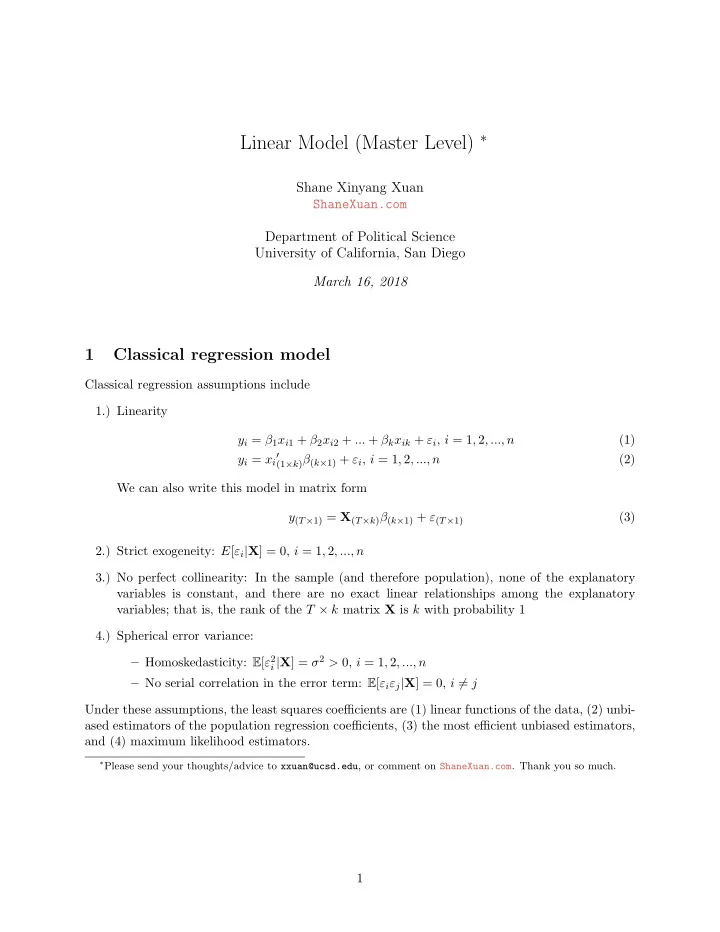
Linear Model (Master Level) Shane Xinyang Xuan ShaneXuan.com Department of Political Science University of California, San Diego March 16, 2018 1 Classical regression model Classical regression assumptions include 1.) Linearity y i =


slide-1
SLIDE 1

Linear Model (Master Level) ∗

Shane Xinyang Xuan ShaneXuan.com Department of Political Science University of California, San Diego March 16, 2018

1 Classical regression model

Classical regression assumptions include 1.) Linearity yi = β1xi1 + β2xi2 + ... + βkxik + εi, i = 1, 2, ..., n (1) yi = xi′

(1×k)β(k×1) + εi, i = 1, 2, ..., n

(2) We can also write this model in matrix form y(T×1) = X(T×k)β(k×1) + ε(T×1) (3) 2.) Strict exogeneity: E[εi|X] = 0, i = 1, 2, ..., n 3.) No perfect collinearity: In the sample (and therefore population), none of the explanatory variables is constant, and there are no exact linear relationships among the explanatory variables; that is, the rank of the T × k matrix X is k with probability 1 4.) Spherical error variance: – Homoskedasticity: E[ε2

i |X] = σ2 > 0, i = 1, 2, ..., n

– No serial correlation in the error term: E[εiεj|X] = 0, i = j Under these assumptions, the least squares coefficients are (1) linear functions of the data, (2) unbi- ased estimators of the population regression coefficients, (3) the most efficient unbiased estimators, and (4) maximum likelihood estimators.

∗Please send your thoughts/advice to xxuan@ucsd.edu, or comment on ShaneXuan.com. Thank you so much.

1

slide-2
SLIDE 2

1.1 Notes on Assumption (2.)

1.1.1 The unconditional mean of the error term is zero The unconditional mean of the error term is zero. The law of total expectations states that E[E(y|x)] = E[y] (4) Since E[εi|X] = 0, we know that E[εi] = E[E(εi|X)] = 0 (5) 1.1.2 The regressors are orthogonal to the error term We first apply the law of iterated expectations: E[xiεi] = E[E(xiεi|xi)] (6) It follows that E[xiεi] = E[xiE(εi|xi)] = 0 Hence, we have shown that E[xiεi] = 0 for every observation.

1.2 Notes on Assumption (4.)

We can write Assumption (4.) in a more compact way: E[εε′|X] = σ2IT (7) ≡ var(ε|X) (8) For example, the (i, j) element of the T × T matrix εε′ is εiεj, and E[εiεj] = 0 because the (i, j) element is on the off-diagonal of matrix εε′. In sum, Equation (8) is a compact way that assumes both homoskedasticity, and no serial correlation in the error term. This assumption will be relaxed in certain circumstances. 2

slide-3
SLIDE 3

2 Finite sample properties of b

Unbiased Under Assumptions (1.)–(3.), E[b|X] = β

  • Proof. To prove this property, we just need to show E[b − β|X] = 0. Note that

E[b − β|X] = E[(X′X)−1X′ε|X] = (X′X)−1X′E[ε|X] = 0

  • Variance Under Assumptions (1.)–(4.), var(b|X) = σ2(X′X)−1

Proof. var(b|X) = E[(b − β)2|X] (9) = E[(b − β)(b − β)′|X] (10) = E[Aεε′A′|X], A′ = (X′X)−1X′ (11) = AE[εε′|X]A′ (12) = σ2AA′ (13) = σ2 (X′X)−1X′

  • Ik

X(X′X)−1 (14) = σ2(X′X)−1 (15)

  • 3