05/09/2016 Collaboration Matters! Dr. Fiona King School of - - PDF document

05 09 2016
SMART_READER_LITE
LIVE PREVIEW

05/09/2016 Collaboration Matters! Dr. Fiona King School of - - PDF document

05/09/2016 Collaboration Matters! Dr. Fiona King School of Inclusive and Special Education Overview Context for Collaboration Defining collaboration Challenges and Barriers Paving a way forward Context: Education as economic


slide-1
SLIDE 1

05/09/2016 1

Collaboration Matters!

  • Dr. Fiona King

School of Inclusive and Special Education

Overview

  • Context for Collaboration
  • Defining collaboration
  • Challenges and Barriers
  • Paving a way forward

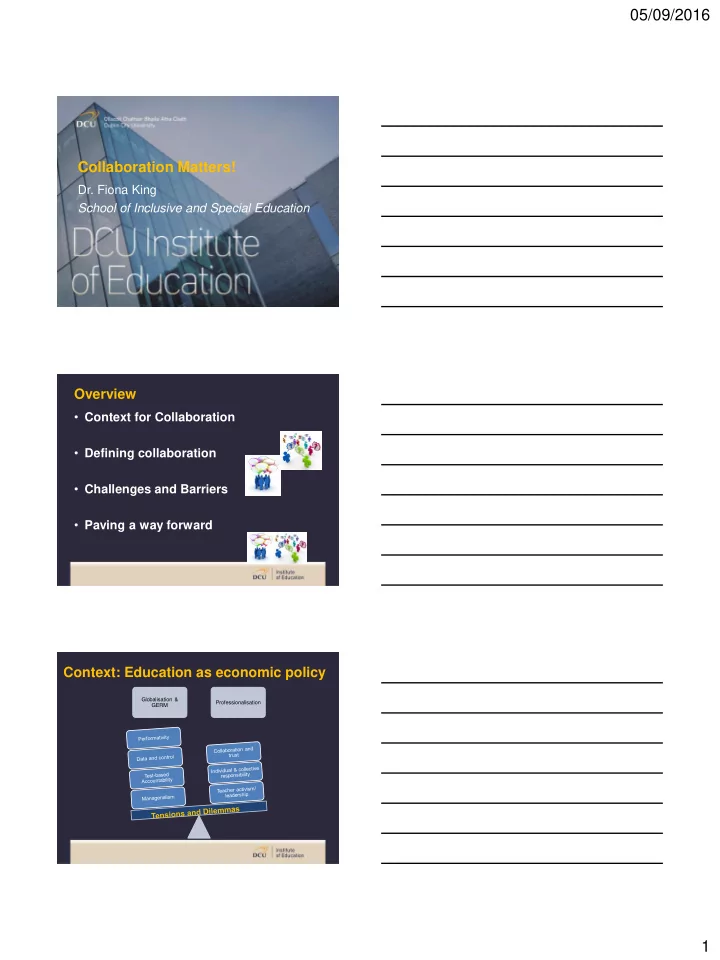
Context: Education as economic policy

Globalisation & GERM Professionalisation

slide-2
SLIDE 2

05/09/2016 2

Context: Professional Capital

  • Human Capital

– Development of teachers’ knowledge and skills in teaching (Entrants, ITE, CPD)

  • Social Capital

– Teachers working collaboratively – Sharing other people’s human capital

  • Decisional Capital

– HC + SC + DC (decision-making and judgements)

  • (Hargreaves and Fullan, 2012)

Context: Complexity of teaching

Teachers’ specialist or expert knowledge –Content knowledge –Pedagogic knowledge –Curricular knowledge –Pedagogic content knowledge –Knowledge of learners –Knowledge of educational contexts

  • most challenging, most demanding, subtle, nuanced and

frightening activity that our species has ever invented.

  • (Shulman, 1987)
  • Theory

Skills Research

Pedagogic knowledge

IN SI G HT

Experience

Subject knowledge Other knowledge

(Hegarty, 2014)

Context:

slide-3
SLIDE 3

05/09/2016 3

Monday, September 05, 2016 Event Name and Venue 7

Social capital…but…

  • ‘Lonely profession’, always in pejorative terms
  • Isolated profession…’limits access to new ideas and

better solutions, drives stress inward to fester and accumulate, fails to recognise and praise success, and permits incompetence to exist and persist to the detriment of pupils, colleagues, and the teachers

  • themselves. Isolation allows, even if it does not always

produce, conservatism and resistance to innovation in teaching’ (Hargreaves and Fullan 1992:11)

  • Work in isolation- “fail to lighten the load” (Kugelmass, 2001:

51)

Poll

  • individual practice still reigns (O’Sullivan 2011;

Eivers and Clerkin 2013).

  • From your own experience in education is

it a lonely profession or an isolated profession where individual practice still reigns?

Social Capital

– Teachers working collaboratively – Sharing other people’s human capital

But what is collaboration…working towards a definition…

“… a process by which people work co-operatively together to accomplish a task, or series of tasks, of benefit to one or more people by reaching a mutual understanding of how to solve problems and resolve complex ethical and practical dilemmas,………….” (Devecchi and Rouse, 2010)

slide-4
SLIDE 4

05/09/2016 4

AA Continuum of Collaboration

Most collaborative Least collaborative (Lacey, 2001; Cook and Friend, 2010; Moran 2007)

Liaison Consultation Co-operation Co-ordination Collaboration

Another continuum…

Sharing Planning Sharing resources Sharing Teaching Sharing Observation Sharing Feedback Sharing Improvement

(O’Sullivan, 2011) At what level is collaboration?

Collaboration…

  • Exchange
  • Division of work
  • Co- construction

(Webs et al., 2016)

slide-5
SLIDE 5

05/09/2016 5

Put simply…collaboration is . . .

Teachers talking about teaching Joint planning, designing, researching, evaluating/preparing of teaching materials Teachers working together in classrooms (Hargreaves and Fullan 1992)

Courageous conversations

(Ontario, SL) Complicated Discussions (Lopez, 2014)

Critical conversations

(Ryan, 2014) Creating interruptions (Ainscow, 2015)

Teachers talking about teaching

  • Most of the professional knowledge teachers use in their

daily work is tacit.. Rarely made explicit with colleagues… (Centre for Educational Research and Innovation (CERI), 2008)

  • Teachers find it difficult to talk about what they do and

why they do it… because they work in isolation…engage language of thinking…move knowledge around… (Ainscow, 2015)

  • Knowledge mobilization (Brown et al., 2015)
  • Collaboration . . . necessary, but not sufficient ...

(Stevenson, 2011

Collaborative Practice Analytical Framework

Collaboration

(James and Goodhew, 2011)

Reflection

A focus on the primary task

Collaborative practice
slide-6
SLIDE 6

05/09/2016 6

So collaboration isn’t . . .

  • Sharing resources, but not joint development
  • Being friendly -‘we get along really well’
  • Not just a ‘group think’
  • Staying outside the classroom door
  • Contrived collegiality…top-down

– but can provide impetus for collaboration – can also be a barrier

(Hargreaves and Fullan, 1992)

Poll

  • From your own experience in education do

we engage in collaborative practice?

  • What forms of collaborative practice?

With whom, why?

  • With pupils and among pupils

– Student voice central to professional learning – Article 12 UNCRC (1991) – group work…

  • Parents
  • Teachers:

– Co-teaching – Peer observation – Lesson study…

  • SNAs
  • Teachers in other schools…
  • All partners in education and beyond-across disciplines
slide-7
SLIDE 7

05/09/2016 7

Beliefs and practices

  • Gap between idealism and practice?
  • Independent V interdependent (Heldens et al.,

2015)

  • Value collaborative practice, collaborative CPD

(Pedder et al., 2008; King, 2014)… does it happen in practice (Frost, 2012)?

  • Inclusive and special education- importance of

collaboration and collaborative practice… yet findings from O’Gorman and Drudy (2010) (c 800 teachers) show collaboration focused elements least important

Challenges and Barriers

  • Not enough time (timetabling, consultation, formal &

informal meetings, poor use of meeting time) (Travers et al. 2010)

  • No confidential space for discussion
  • Added strain of working with another person / people
  • Fear of role boundaries becoming blurred
  • Fear of loss of autonomy / independent control
  • Concerns over confidentiality and trust
  • Language barriers and different cultural values and

expectations (Day and Prunty, 2015)

Barriers to Collaboration

  • Across disciplines:
  • Major differences between education, health, social

work management structures, working conditions and hours.

  • Different perspectives, ethics and mindsets as a

result of different training.

  • Lack of shared knowledge
  • Case-load pressures
  • Use of different and sometimes intimidating

terminology across disciplines

  • Mismatch of expectations
  • Mandated (contrived collegiality)
  • Lack of support (Travers et al. 2010; King, 2011)
slide-8
SLIDE 8

05/09/2016 8

Barriers to Collaboration

  • With students:
  • Children’s capacity to meaningfully contribute

to decision-making

  • Concern it will undermine adult authority
  • Too much effort and time (Lundy, 2007)
  • Mandated (contrived collegiality)
  • Lack of support (Travers et al. 2010; King, 2011)

Addressing Challenges and Barriers

  • Collective will to make it happen (Chapman et al.,

2012)

  • Change begins with ourselves…desire to

change… change-agent (King, 2016) – Unhappy – Values – moral purpose/ making a difference

(Looney, 2013)

  • ‘living contradiction’ (Whitehead, 1989)
  • Moral purpose keeps us close to the needs of children;

change agentry causes us to develop better strategies for accomplishing our moral goals (3)

Addressing Challenges and Barriers

  • Role of Leadership (King, 2011):

– Alignment between principals and teachers’ values – Creating organisational capacity for change

  • Not mandated
  • Attending collaborative discussions- value it
  • Time to plan, reflect and consolidate learning
  • Non-contact time… on the agenda…timetabling
  • Resources
  • No micromanagement
  • Trusting teachers/staff

– Empowering teachers to create collaborative cultures

  • Fostering collaborative cultures of learning
  • Encouraging teachers to become leaders e.g. modelling practices for others
  • Facilitating distributed leaders
  • Developing Professional Learning Communities
  • Hiring staff that are open to collaboration and collaborative practice
slide-9
SLIDE 9

05/09/2016 9

Collaborative Learning Initiative (CLI)

A good news story…

Sunday, September 04, 2016 Event Name and Venue 26

CLI values:

  • Teachers at the heart of change
  • Collaborative working and collective responsibility
  • Equality within and across participating groups.
  • Valuing professional judgement and expertise
  • Research-informed and research-engaged
  • Partnerships - teachers, advisors and students
  • Knowledge creating and knowledge sharing

(Stevenson, 2012; King and Feeley, 2014)

Event Name and Venue 27

CLI – support from above. . .

Learn to let go Trust Encourage Value and celebrate Problem-solve – remove obstacles, don’t create them Believe Resource: create time Work with: ‘our’ project, not ‘your’ project Challenge: upwards and downwards (Stevenson, 2012)

slide-10
SLIDE 10

05/09/2016 10

Collaboration Matters!

  • Collaboration and Collaborative Practice
  • Student and teacher development
  • School improvement
  • Take risks together
  • Greater capacities for change
  • Systems don’t change by themselves…

actions of individuals and small groups working together…

(Fullan, 1993)

Thank you!

fiona.king@dcu.ie