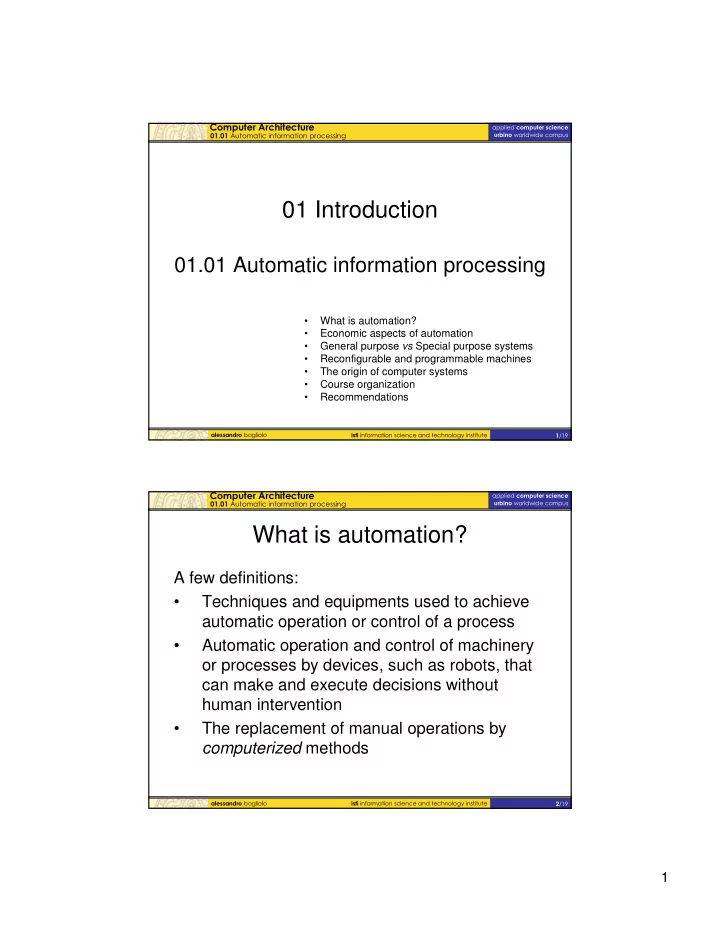
01 Introduction 01.01 Automatic information processing What is - - PDF document

01 introduction
SMART_READER_LITE
LIVE PREVIEW

01 Introduction 01.01 Automatic information processing What is - - PDF document


slide-1
SLIDE 1

1

  • 01 Introduction

01.01 Automatic information processing

  • What is automation?
  • Economic aspects of automation
  • General purpose vs Special purpose systems
  • Reconfigurable and programmable machines
  • The origin of computer systems
  • Course organization
  • Recommendations
  • What is automation?

A few definitions:

  • Techniques and equipments used to achieve

automatic operation or control of a process

  • Automatic operation and control of machinery
  • r processes by devices, such as robots, that

can make and execute decisions without human intervention

  • The replacement of manual operations by

computerized methods

slide-2
SLIDE 2

2

  • 2

4 6 8 10 12 14 16 18 10 20 30 Number of executions Cost/Time Manual solution Automatic solution

Economic aspects of automation 1

a b c d Break even a = manual setup cost/time b = automatic setup cost/time c = cost/time per manual execution d = cost/time per automatic execution

  • 10

20 30 40 50 60 70 80 20 40 60 Market size Price Production cost Price

Economic aspects of automation 2

g e e = initial investment f = marginal cost of production g = target production profit f

slide-3
SLIDE 3

3

  • 5

10 15 20 25 5 10 15 20 25 30 Number of executions Cost Manual solution Automatic solution

Economic aspects of automation 3

Market size Market size

  • General vs Special purpose
  • The broader the range of applications of an

automatic equipment

– the larger its market – the lower its price – the larger the number of executions

  • Using a general purpose equipment has two

main advantages

– lower costs reduce the breakeven point – broader applicability makes it easier to reach it

slide-4
SLIDE 4

4

  • Reconfigurable equipment
  • Reconfiguration enables re-use
  • The same equipment can be used to solve

different problems (or to execute different processes) at the cost of a simple reconfiguration

  • If an in-house reconfigurable equipment can be

used to solve a new problem, the setup cost of the automatic solution for the new problem reduces to the reconfiguration cost

  • Programmable equipments
  • Programmable devices can accept, interpret and

execute instructions taken from a given instruction set

  • A complex process can be specified step by step

in terms of instructions by means of a program

  • A programmable device is a truly general-

purpose machine

slide-5
SLIDE 5

5

  • The origin of computer systems

Information theory

  • Any information can be represented as a

sequence of a finite number of binary digits (at the cost of a possible approximation) taking value 0 or 1

info representation "0000" 1 "0001" 2 "0010" 3 "0011" 4 "0100" 5 "0101" info representation A "01000001" B "01000010" C "01000011" D "01000100" E "01000101" F "01000110" info representation ON "1" OFF "0"

  • The origin of computer systems

Boolean algebra

  • Logic operators AND, OR, and NOT are defined
  • n the Boolean set B={0,1} [Boole, 1848]
  • Any logic function f:BnB can be expressed in

terms of AND, OR, and NOT and evaluated by performing a sequence of elementary operations

a b f=a+b 1 1 1 1 1 1

f = (a AND (NOT b)) OR (b AND (NOT a))

slide-6
SLIDE 6

6

  • The origin of computer systems

Switching theory (1)

  • Assigning logical values to the states of an

electrical signal, it is possible to implement elementary logic functions by means of switching networks [Shannon, 1938]

f(a,b) = a OR b

  • The origin of computer systems

Switching theory (2)

  • Any logic function can be implemented by a

switching network

  • A programmable switching network, that can

compute at least AND, OR and NOT, can be programmed to evaluate any logic function

a b c OR AND

f(a,b,c) = (a OR b) AND c

slide-7
SLIDE 7

7

  • The origin of computer systems

Technology

  • Digital integrated circuits are micro-fabricated

devices that contain networks of up to one hundred million transistors (i.e., switches)

  • The minimum feature size of today’s transistors

is 0.09µm

  • The large scale production makes digital

integrated circuits very cheap

  • The origin of computer systems

The big picture

  • Any information can be represented by

sequences of 0s and 1s

  • Any processing of binary values can be

performed by switching networks

  • Programmable switching networks can be used

to perform any kind of information processing

  • Computer systems are automatic information

processing systems based on programmable switching networks

slide-8
SLIDE 8

8

  • The origin of computer systems

The big picture

  • Computer systems are truly general purpose

information processing systems

  • Using a general-purpose computer system to

solve a specific problem entails writing a specific program

  • The origin of computer systems

The big picture

  • Software development/purchase is the only

setup cost

  • The cost of the computer system that executes

the software is usually negligible since

– Computer systems are cheap thanks to their market – Computer systems are assumed to be already in house thanks to their wide applicability

  • Automation is defined as

– the replacement of manual operations by computerized methods

slide-9
SLIDE 9

9

  • Course organization

Main topics

  • Digital representation of information
  • Logic networks
  • Computer systems
  • CPU
  • Memory
  • Communication
  • Course organization

Exams

The exam entails three steps:

1. Report on a project assigned by the instructor

mark a: 0 a 33, passed with a 18

2. Written (online) test covering the entire program

mark b: 0 b 33, passed with b 18

3. Oral exam

mark c: -5 c 5

Rules:

  • You must have passed (in any order) steps 1 and 2 to take step 3
  • Partial results of steps 1 and 2 hold for the entire Academic Year
  • Project reports must be submitted at least one weak before the

date of the first oral examination you want to take

  • The final mark is computed as: (a+b)/2+c
slide-10
SLIDE 10

10

  • Course organization

Recommendations

  • Attend new courses during the second semester rather

than studying the old ones (use the summer to recuperate)

  • Take the exams of the courses taught in the second

semester in June (use the fall session to recuperate)

  • Read learning materials as soon as they are published
  • Attend at least one classroom per week to keep in touch

with students and instructors

  • Ask questions in chats and forums
  • Organize with other students to make sure that at least 10

people attend each classroom, or otherwise the transcripts

  • f the classrooms will be useless