01 02 03 04 What is What is an How do we help What resources - - PDF document

01 02 03 04
SMART_READER_LITE
LIVE PREVIEW

01 02 03 04 What is What is an How do we help What resources - - PDF document

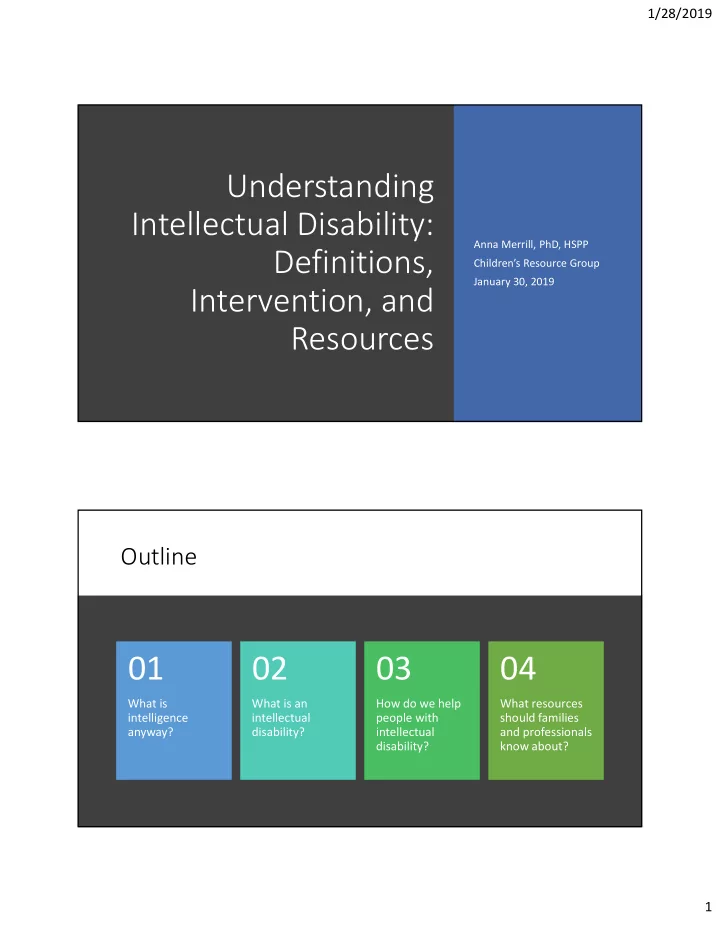
1/28/2019 Understanding Intellectual Disability: Anna Merrill, PhD, HSPP Definitions, Childrens Resource Group January 30, 2019 Intervention, and Resources Outline 01 02 03 04 What is What is an How do we help What resources


slide-1
SLIDE 1

1/28/2019 1

Understanding Intellectual Disability: Definitions, Intervention, and Resources

Anna Merrill, PhD, HSPP Children’s Resource Group January 30, 2019

Outline

What is intelligence anyway?

01

What is an intellectual disability?

02

How do we help people with intellectual disability?

03

What resources should families and professionals know about?

04

slide-2
SLIDE 2

1/28/2019 2

What is intelligence?

Biological The limit set by your genetics, determines the functioning of the brain Psychometric Measured in a psychological evaluation using standardized testing, related to biology but influenced by context and culture Social Observable behaviors in specific contexts that lead to success (performance at work, academic achievement)

Psychologist’s Definition of Intelligence

  • Ability to reason

abstractly, solve complex problems, and acquire new knowledge

slide-3
SLIDE 3

1/28/2019 3

Intellectual Disability

A disability categorized by significant difficulties in both

  • Intellectual Functioning
  • Thinking, learning, reasoning,

problem-solving

  • Adaptive Functioning
  • Every day social, conceptual, and

practical skills

The previous term for this diagnosis was “mental retardation” *The disability originates in childhood*

The Distribution of Intellectual Functioning

slide-4
SLIDE 4

1/28/2019 4

Adaptive Functioning:

the skills needed to make it through every day life

Conceptual: Language, reading, writing, math, reasoning, memory Social: Interpersonal communication, friendships, leisure skills Practical: Personal care,

  • rganization, community

use

slide-5
SLIDE 5

1/28/2019 5

What does Intellectual Disability look like?

Learning is more concrete, abstract concepts are difficult Passive learning is less likely Limited use of strategies for learning or problem-solving Difficulty with thinking ahead and planning Slower processing or responding Difficulty with self-direction or internal motivation Difficulty generalizing things learned across people and places

How is Intellectual Disability Different from a Learning Disability?

  • Learning Disability =

Learning Disorder = Learning Difference

  • Specific Learning Disorder
  • Significant difficulty in a

specific academic area

  • Reading (Dyslexia)
  • Writing

(Dysgraphia)

  • Math (Dyscalculia)
  • Measured through

academic achievement testing, NOT IQ testing

slide-6
SLIDE 6

1/28/2019 6

The Psychological Evaluation

Psychological evaluation

Administration

  • f

Standardized Testing Interview or Intake with Family Parent, Caregiver, Teacher Questionnaires Behavioral Observations

Measuring Cognitive Functioning

  • Administration of an IQ

test

  • WPPSI-IV, WISC-V,

WAIS-IV

  • SB-5
  • WJ-IV
  • DAS-II
  • Administered by a

trained psychologist in a

  • ne-on-one setting
  • Can occur in a school or

clinical setting

slide-7
SLIDE 7

1/28/2019 7

Measuring Adaptive Functioning

  • Parent, Caregiver, Teacher or the Individual

Themselves complete a questionnaire

  • ABAS-3
  • Vineland -3
  • Typically includes rating how much support an

individual needs across different skills

  • does not have skill, needs support or

reminders, completely independent on that skill ID Diagnosis

Psychological evaluation

Administration

  • f

Standardized Testing Interview or Intake with Family Parent, Caregiver, Teacher Questionnaires Behavioral Observations

slide-8
SLIDE 8

1/28/2019 8

Levels of Intellectual Disability

“Why did this happen to my child?”

  • About 2/3 of cases of ID have

an identified “cause”

  • Genetic disorders
  • Alcohol (FAS)/Lead

exposure

  • Issues with

pregnancy/delivery

  • Neurological disorders

(epilepsy, CP)

  • This means about 1/3 of the

time, we do not know why a child is born with an intellectual disability

  • However, this does not typically

change the course of treatment

slide-9
SLIDE 9

1/28/2019 9

Considerations in the Diagnosis of ID

Community or Environmental Factors Cultural or Linguistic Factors Other disabilities that impact functioning (e.g. physical disabilities, blindness, deafness, other mental health diagnoses)

Co-occurring Conditions

  • Neurodevelopmental Disorder
  • Mental Health Diagnosis
  • Psychiatric Condition

Children with an intellectual disability are 3-4 times more likely to have another:

  • Autism Spectrum Disorder
  • Speech and language disorders
  • ADHD
  • Anxiety or Mood disorders
  • Schizophrenia

Possible co-occurring diagnoses include:

slide-10
SLIDE 10

1/28/2019 10

Intervention for Individuals with ID

How can we adjust the environment and expectations to meet the individual’s needs?

  • Education of parents,

siblings, teachers, clinicians

  • Establishing realistic

expectations

Visual supports in the environment to increase independence Use of schedules and routines Allow more time for transitions, decrease transitions when possible Repetition and reinforcement to learn new skills Talk less, decrease stimulation in the environment Infuse choice as frequently as possible Consideration of medication

Considerations for Intervention

Always ask, “Am I asking too much, too fast?” Recognize that the individual’s needs, wants, or desires are not the same as yours Establish a routine that is fulfilling to the individual but not over stimulating Make sure that the individual (and the caregivers!) are getting enough sleep, nutrition, exercise

slide-11
SLIDE 11

1/28/2019 11

Resources

Resources - General Information

The Arc of Indiana: https://www.arcind.org/ Family Voices Indiana: http://www.fvindiana.org/ The American Association on Intellectual and Developmental Disabilities: http://aaidd.org/

The Association of University Centers on Disabilities: https://www.aucd.org

  • Tuesdays with Liz Web Series:

https://www.youtube.com/playlist?list=PLEHWL7i0kECV8GSORs5 6oK7SP7GXHorOB

slide-12
SLIDE 12

1/28/2019 12

Resources – Government Agencies

Indiana First Steps: https://www.in.gov/fssa/ddrs/4685.htm Vocational Rehabilitation: https://www.in.gov/fssa/ddrs/2636.htm Bureau of Developmental Disabilities: https://www.in.gov/fssa/ddrs/2639.htm

  • Non-income based financial supports:
  • Family Support Waiver – a set amount of money that can be

used to pay for therapies, case management, respite, transportation, adult day services, etc., must apply, there is a waitlist

  • Community Integration and Habilitation Waiver – money

reserved for individuals deemed to have priority status due to circumstances such as death of a caregiver, evidence of abuse/neglect, or evidence of an extreme health/safety risk

Resources - Education

Indiana Office of Special Education: https://www.doe.in.gov/specialed

  • Coffee Talk on YouTube regarding the Certificate of

Completion: https://www.youtube.com/watch?v=Q44eTf4cv- 8&feature=youtu.be

  • Three Pathways to Graduation:

https://www.doe.in.gov/graduation-pathways

INSOURCE: http://insource.org/ The Council for Exceptional Children: https://www.cec.sped.org/
slide-13
SLIDE 13

1/28/2019 13

Resources – Transition to Adulthood

Guardianship/Supported Decision Making – legal process in which a person is appointed to support, or be responsible for, another individual and the management of their property

  • https://www.arcind.org/future-planning/guardianship/

Special Needs Trust – allows an individual to access financial resources while safeguarding public benefits

  • https://www.thearctrust.org/pooled-trust/

Consultation with an attorney

  • https://www.specialneedsalliance.org/

Thank you!

Anna Merrill, PhD, HSPP

crg@childrensresourcegroup.com http://www.childrensresourcegrou p.com/