
SLIDE 1
9/ 19/ 2007
zs Reijerw aard
Drinking-water in Ridderkerk.
Ridderkerk
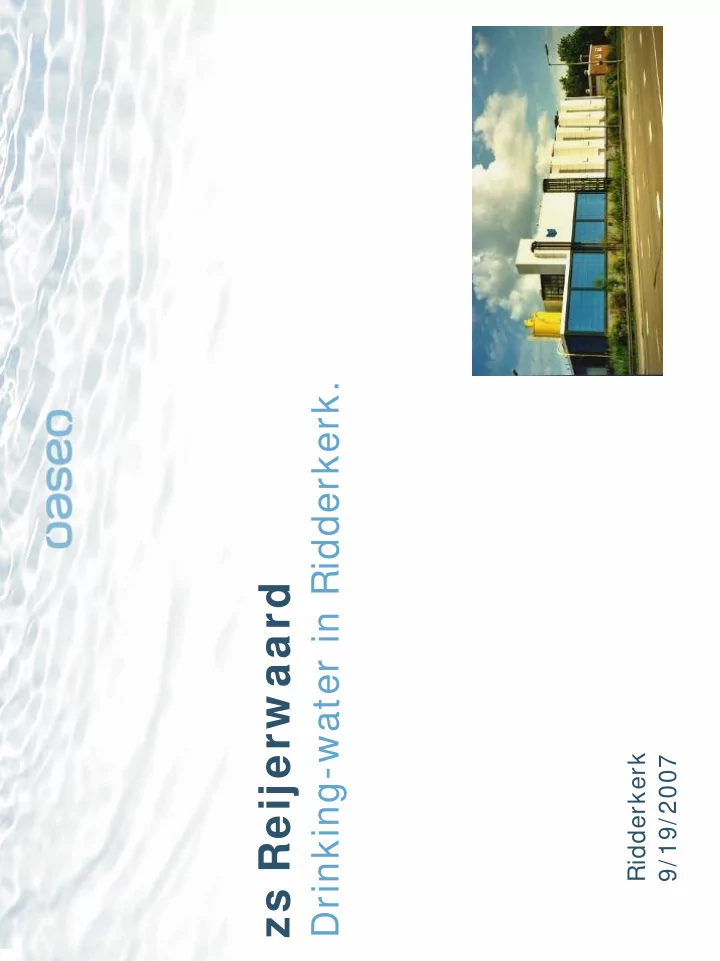
zs Reijerw aard Ridderkerk 9/ 19/ 2007 History 1 9 0 6 - The - - PDF document
Drinking-water in Ridderkerk. zs Reijerw aard Ridderkerk 9/ 19/ 2007 History 1 9 0 6 - The start of the water company. 1 9 2 0 - Expansion of the purification capacity. 1 9 3 9 - Modernization of the water tower. 1 9 6 1 - Build of the
9/ 19/ 2007
Ridderkerk
9/ 19/ 2007 | zs Reijerwaard 2
1 9 0 6 - The start of the water company. 1 9 2 0 - Expansion of the purification capacity. 1 9 3 9 - Modernization of the water tower. 1 9 6 1 - Build of the current purification station. 1 9 7 3 - Expansion of the storage capacity. 1 9 9 2 - Active-carbon filters, extra sand filters. 1 9 9 5 - Extra sand filters. 1 9 9 6 - Water softening installation. 2 0 0 4 - Membrane installation.
9/ 19/ 2007 | zs Reijerwaard 3
W ells Cascades 1 st and 2 nd sand filters. Softening CO-filters Active-carbon Storage / Distribution
9/ 19/ 2007 | zs Reijerwaard 4
Water is taken from three sand layers in the ground. Layer 1: 10 – 20 m Layer 2: 50 – 70 m Layer 3: 90 –110 m Number: 31 Capacity wells: 25 m³ / h Capacity max.: 750 m³ / h Capacity avg.: 330 m³ / h
9/ 19/ 2007 | zs Reijerwaard 5
De cascade is made up out 7 stainless steel containers with overflow edges. The well water doesn’t contain any oxygen. But is does contain methane, H2S and CO² . The cascade removes methane, H2S and CO² and replaces it with oxygen. With ventilators fresh air is supplied and the unwanted gasses are removed. Number: 2 Overflow edge length: 4,5 m. Drop height: (6x) 0,5 m.
9/ 19/ 2007 | zs Reijerwaard 6
De 1st filtration step is a concrete container filled with sand. In the cascade the water is supplied with oxygen. This will cause iron to
Ammonia is removed with the help of bacteria. Also manganese is collected by the sand filter. With ventilators fresh air is supplied and the unwanted gasses are removed. Number: 7 Filter square: 26 m² Filter height: 2,2 m Filter material: Sand / Anthracite
9/ 19/ 2007 | zs Reijerwaard 7
The membrane installation (reverse osmosis) is used to remove the chloride from the water. This water is merged with the main filtration between the 1st and 2nd filtration step. By removing all the chloride from a small part of the well water the chloride level in the total water stream is kept below the allowed level. Number: 1 Capacity: 25 m 3/ h (net) Output: 75%
9/ 19/ 2007 | zs Reijerwaard 8
De 2nd filtration step is a concrete container filled with sand. What the 1st filtration step didn’t remove is removed in the 2nd filtration step. The main thing it removes is ammonia. With ventilators fresh air is supplied and the unwanted gasses are removed. Number: 9 Filter square: 18 m² Filter height: 2 m Filter material: Sand
9/ 19/ 2007 | zs Reijerwaard 9
The softening reactor is a large steel vessel with a cone shape at the bottom and the top. At the bottom lime is added to the water. A chemical reaction will force the added lime and the calcium from the water on to the sand. The sand will grow into a pellet. When the pellets are a certain diameter they are removed and replaced with new sand. Number: 2 + 1 Height: 11 m Diameter: 1,75 m Sand/ pellet level: ± 8 m Sand: 0,5 mm Pellet: 1 mm
9/ 19/ 2007 | zs Reijerwaard 1 0
De 3rd filtration step is a concrete container filled with sand. The water level is kept at a certain height. (submerged filter) This filter “captures” calcium particle that could not stick to the sand or pellets in the softening reactor. The calcium particles that are collected are removed with backwashing the filter. Number: 6 Filter square: 18 m² Filter height: 1,6 m Filter material: Sand
9/ 19/ 2007 | zs Reijerwaard 1 1
De 4th filtration step is a concrete container filled with active-carbon. The active-carbon adsorbs all kinds of chemicals like pesticides. Also the smell, color and taste of the water is improved. The filters can be used in a 2 x 2 pseudo moving bed or as a 4 x 1 parallel configuration. The adsorbed “chemicals” will be removed at the supplier of the active-carbon. Number: 4 Filter square: 26m² Filter height: 2,1 m Filter material: Active-cabon
9/ 19/ 2007 | zs Reijerwaard 1 2
The UV installation is a stainless steel tube with quartz glass tubes. Inside the quartz glass tubes there are UV lamps. The light spectrum is ultra violet light. This UV light will destroy viruses, bacteria, fungi and algae. Number: 3 (each unit 4 lamps) Capacity : 3 x 240 m 3/ h
9/ 19/ 2007 | zs Reijerwaard 1 3
The drinking water is stored in large concrete containers. From the storage the water is distributed to the city of Ridderkerk. The expansion vessels will dampen pressure peaks from the pumps when they are switching on or off. Number: 4 storage reservoirs 4 pumps 2 expansion vessels Capacity: 0 to 2000 m 3/ h Storage: ± 5500 m 3.
9/ 19/ 2007 | zs Reijerwaard 1 4