
SLIDE 1
ZONES OF REGULATION
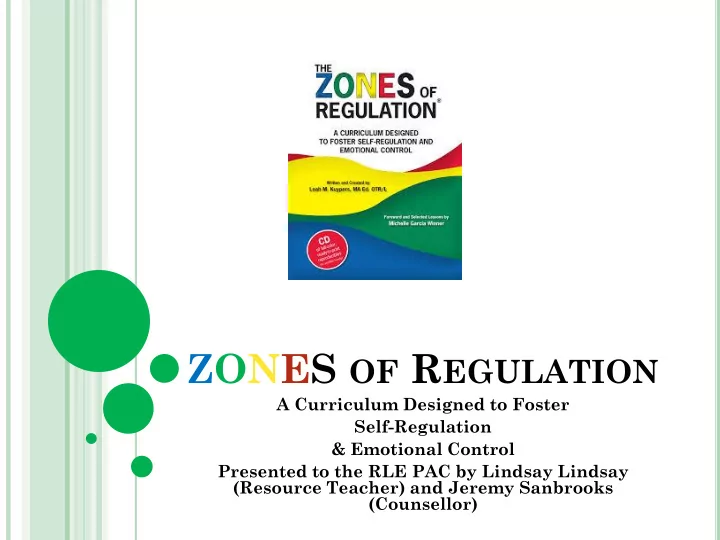
A Curriculum Designed to Foster Self-Regulation & Emotional Control Presented to the RLE PAC by Lindsay Lindsay (Resource Teacher) and Jeremy Sanbrooks (Counsellor)
ZONES OF R EGULATION A Curriculum Designed to Foster - - PowerPoint PPT Presentation
ZONES OF R EGULATION A Curriculum Designed to Foster Self-Regulation & Emotional Control Presented to the RLE PAC by Lindsay Lindsay (Resource Teacher) and Jeremy Sanbrooks (Counsellor) T HINK A BOUT I T .. We know when our kids are
A Curriculum Designed to Foster Self-Regulation & Emotional Control Presented to the RLE PAC by Lindsay Lindsay (Resource Teacher) and Jeremy Sanbrooks (Counsellor)
The ability to adjust level of alertness AND direct
Encompasses: Self-control Resiliency Self-management Anger management Impulse control Sensory regulation
We need to teach our kids GOOD coping and regulation strategies so they can help themselves when they become stressed, anxious, or sad. Typically, kids who can self-regulate will turn into teens who can self-regulate. Self-regulation skills are vital for the success and happiness of our children.
How does mental health impact children and youth?
by a mental illness or disorder
age 12 to 19, have experienced a major depressive episode.
depression
Canadians, second only to accidents
services receives them. (Canadian Mental Health Association, 2014)
Higher academic achievement is more likely
Self-regulation abilities have a stronger
Normandeau & Guay, 1998
Research shows that teachers can have a positive
Peisner-Feinberg, Bryant & Clifford, 2000.
There are four zones to describe how your brain and body feel. BLUE Zone – Your body is running slow, such as when you are tired, sick, sad or bored. GREEN Zone – Like a green light, you are “good to go.” You body may feel happy, calm and focused. YELLOW Zone – This zone describes when you start to loose control, such as when you are frustrated, anxious, worried, silly
RED Zone – This zone is for extreme emotions such as anger, terror and aggression. When you are in this zone, you are out of control, have trouble making good decisions and must STOP!
Indentify their feelings and levels of alertness Effective regulation tools When and how to use the tools Problem solve positive solutions Understand how their behaviours influence
Independent Regulation!
Think of your child(ren)… What zone is that child(ren) usually in? What do you do to help regulate your child(ren)?
Safety is first priority Limit verbals This is not a teachable moment Validate the student’s feelings Evoke some of the emotion in yourself Give them time and space Process later using STOP, OPT and GO Solution
Designated safe spot Avoid power struggles Teach all tools in a calm regulated state
STOP Stop before you act OPT Think of all your options and how they will work out GO Go with your best options
Problem: ________________________________________ My best option is: ________________________________
You Can Do IT!!!
Activity: Complete the worksheet “This is a picture of me
Once you have completed the worksheet, get
Have fun!