ZIONS BANCORPORATION (Exact name of registrant as specified in its - - PDF document

zions bancorporation
SMART_READER_LITE
LIVE PREVIEW

ZIONS BANCORPORATION (Exact name of registrant as specified in its - - PDF document

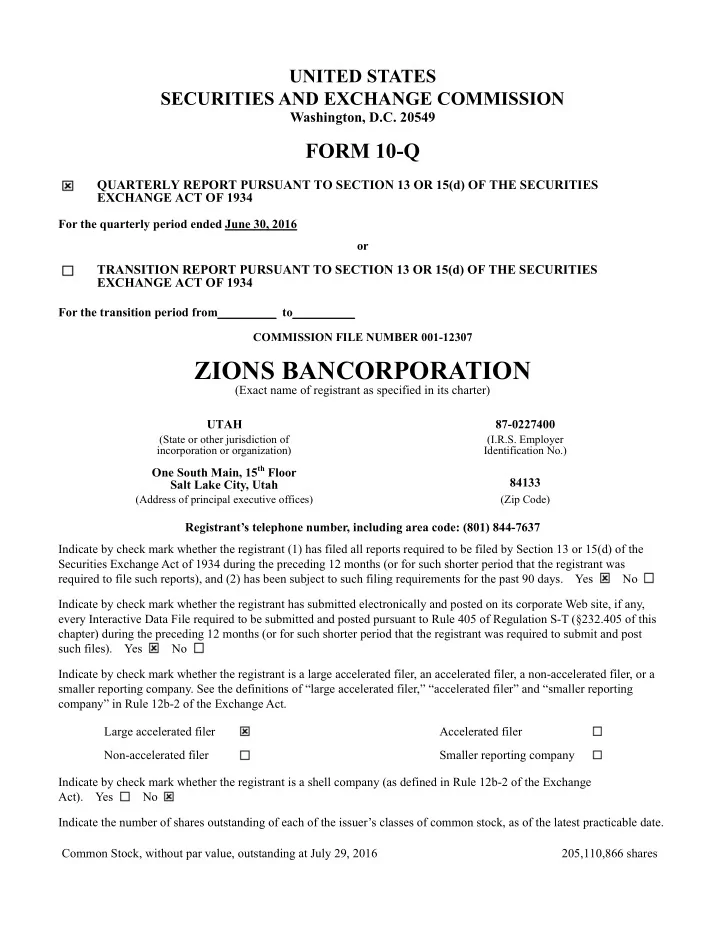
UNITED STATES SECURITIES AND EXCHANGE COMMISSION Washington, D.C. 20549 FORM 10-Q QUARTERLY REPORT PURSUANT TO SECTION 13 OR 15(d) OF THE SECURITIES EXCHANGE ACT OF 1934 For the quarterly period ended June 30, 2016 or TRANSITION REPORT


slide-1
SLIDE 1

UNITED STATES SECURITIES AND EXCHANGE COMMISSION

Washington, D.C. 20549

FORM 10-Q

QUARTERLY REPORT PURSUANT TO SECTION 13 OR 15(d) OF THE SECURITIES EXCHANGE ACT OF 1934 For the quarterly period ended June 30, 2016

  • r

TRANSITION REPORT PURSUANT TO SECTION 13 OR 15(d) OF THE SECURITIES EXCHANGE ACT OF 1934 For the transition period from to

COMMISSION FILE NUMBER 001-12307

ZIONS BANCORPORATION

(Exact name of registrant as specified in its charter) UTAH 87-0227400

(State or other jurisdiction of incorporation or organization) (I.R.S. Employer Identification No.)

One South Main, 15th Floor Salt Lake City, Utah 84133

(Address of principal executive offices) (Zip Code)

Registrant’s telephone number, including area code: (801) 844-7637 Indicate by check mark whether the registrant (1) has filed all reports required to be filed by Section 13 or 15(d) of the Securities Exchange Act of 1934 during the preceding 12 months (or for such shorter period that the registrant was required to file such reports), and (2) has been subject to such filing requirements for the past 90 days. Yes No Indicate by check mark whether the registrant has submitted electronically and posted on its corporate Web site, if any, every Interactive Data File required to be submitted and posted pursuant to Rule 405 of Regulation S-T (§232.405 of this chapter) during the preceding 12 months (or for such shorter period that the registrant was required to submit and post such files). Yes No Indicate by check mark whether the registrant is a large accelerated filer, an accelerated filer, a non-accelerated filer, or a smaller reporting company. See the definitions of “large accelerated filer,” “accelerated filer” and “smaller reporting company” in Rule 12b-2 of the Exchange Act. Large accelerated filer Accelerated filer Non-accelerated filer Smaller reporting company Indicate by check mark whether the registrant is a shell company (as defined in Rule 12b-2 of the Exchange Act). Yes No Indicate the number of shares outstanding of each of the issuer’s classes of common stock, as of the latest practicable date. Common Stock, without par value, outstanding at July 29, 2016 205,110,866 shares

slide-2
SLIDE 2

2

ZIONS BANCORPORATION AND SUBSIDIARIES Table of Contents

Page

PART I. FINANCIAL INFORMATION Item 1. Financial Statements (Unaudited) Consolidated Balance Sheets Consolidated Statements of Income Consolidated Statements of Comprehensive Income Consolidated Statements of Changes in Shareholders’ Equity Consolidated Statements of Cash Flows Notes to Consolidated Financial Statements Item 2. Management’s Discussion and Analysis of Financial Condition and Results of Operations Item 3. Quantitative and Qualitative Disclosures About Market Risk Item 4. Controls and Procedures PART II. OTHER INFORMATION Item 1. Legal Proceedings Item 1A. Risk Factors Item 2. Unregistered Sales of Equity Securities and Use of Proceeds Item 6. Exhibits Signatures 3 4 5 6 7 8 52 92 92 92 92 92 93 94

slide-3
SLIDE 3

Table of Contents 3

PART I. FINANCIAL INFORMATION ITEM 1. FINANCIAL STATEMENTS (Unaudited)

ZIONS BANCORPORATION AND SUBSIDIARIES

CONSOLIDATED BALANCE SHEETS

(In thousands, except shares) June 30, 2016 December 31, 2015 (Unaudited)

ASSETS Cash and due from banks $ 560,262 $ 798,319 Money market investments: Interest-bearing deposits 2,154,959 6,108,124 Federal funds sold and security resell agreements 620,469 619,758 Investment securities: Held-to-maturity, at amortized cost (approximate fair value $720,991 and $552,088) 713,392 545,648 Available-for-sale, at fair value 9,477,089 7,643,116 Trading account, at fair value 118,775 48,168 10,309,256 8,236,932 Loans held for sale 146,512 149,880 Loans and leases, net of unearned income and fees 42,501,575 40,649,542 Less allowance for loan losses 608,345 606,048 Loans held for investment, net of allowance 41,893,230 40,043,494 Other noninterest-bearing investments 850,578 848,144 Premises and equipment, net 955,540 905,462 Goodwill 1,014,129 1,014,129 Core deposit and other intangibles 12,281 16,272 Other real estate owned 8,354 7,092 Other assets 1,117,422 916,937 $ 59,642,992 $ 59,664,543 LIABILITIES AND SHAREHOLDERS’ EQUITY Deposits: Noninterest-bearing demand $ 22,276,600 $ 22,276,664 Interest-bearing: Savings and money market 25,540,525 25,672,356 Time 2,336,088 2,130,680 Foreign 117,708 294,391 50,270,921 50,374,091 Federal funds and other short-term borrowings 270,255 346,987 Long-term debt 698,712 812,366 Reserve for unfunded lending commitments 64,780 74,838 Other liabilities 711,941 548,742 Total liabilities 52,016,609 52,157,024 Shareholders’ equity: Preferred stock, without par value, authorized 4,400,000 shares 709,601 828,490 Common stock, without par value; authorized 350,000,000 shares; issued and

  • utstanding 205,103,566 and 204,417,093 shares

4,783,061 4,766,731 Retained earnings 2,110,069 1,966,910 Accumulated other comprehensive income (loss) 23,652 (54,612) Total shareholders’ equity 7,626,383 7,507,519 $ 59,642,992 $ 59,664,543 See accompanying notes to consolidated financial statements.

slide-4
SLIDE 4

Table of Contents 4 ZIONS BANCORPORATION AND SUBSIDIARIES

CONSOLIDATED STATEMENTS OF INCOME

(Unaudited)

(In thousands, except per share amounts) Three Months Ended June 30, Six Months Ended June 30, 2016 2015 2016 2015

Interest income: Interest and fees on loans $ 433,743 $ 420,642 $ 854,251 $ 836,397 Interest on money market investments 5,564 5,785 12,593 11,003 Interest on securities 47,645 28,809 95,009 56,282 Total interest income 486,952 455,236 961,853 903,682 Interest expense: Interest on deposits 11,869 12,321 23,714 24,425 Interest on short- and long-term borrowings 10,234 19,211 20,448 38,207 Total interest expense 22,103 31,532 44,162 62,632 Net interest income 464,849 423,704 917,691 841,050 Provision for loan losses 34,492 566 76,637 (928) Net interest income after provision for loan losses 430,357 423,138 841,054 841,978 Noninterest income: Service charges and fees on deposit accounts 42,108 41,616 83,369 82,810 Other service charges, commissions and fees 51,906 46,602 101,380 89,604 Wealth management income 8,788 8,160 16,742 15,775 Loan sales and servicing income 10,178 8,382 18,157 16,088 Capital markets and foreign exchange 4,545 7,275 10,212 12,776 Dividends and other investment income 6,226 9,343 10,865 18,715 Fair value and nonhedge derivative income (loss) (1,910) 1,844 (4,495) 756 Equity securities gains, net 2,709 4,839 2,159 8,192 Fixed income securities gains (losses), net 25 (138,436) 53 (138,675) Other 1,142 5,693 4,036 6,615 Total noninterest income 125,717 (4,682) 242,478 112,656 Noninterest expense: Salaries and employee benefits 241,341 251,133 499,679 494,652 Occupancy, net 29,621 30,095 59,400 59,434 Furniture, equipment and software 30,550 31,247 62,565 60,960 Other real estate expense, net (527) (445) (1,856) (71) Credit-related expense 5,845 8,106 11,779 14,045 Provision for unfunded lending commitments (4,246) (2,326) (10,058) (1,115) Professional and legal services 12,229 13,110 23,700 24,593 Advertising 5,268 6,511 10,896 13,486 FDIC premiums 9,580 8,609 16,734 16,728 Amortization of core deposit and other intangibles 1,979 2,318 3,993 4,676 Debt extinguishment cost 106 2,395 353 2,395 Other 50,148 48,244 100,282 102,191 Total noninterest expense 381,894 398,997 777,467 791,974 Income before income taxes 174,180 19,459 306,065 162,660 Income taxes 60,231 5,499 101,679 56,675 Net income 113,949 13,960 204,386 105,985 Dividends on preferred stock (13,543) (15,060) (25,203) (31,806) Preferred stock redemption (9,759) — (9,759) — Net earnings applicable to common shareholders $ 90,647 $ (1,100) $ 169,424 $ 74,179 Weighted average common shares outstanding during the period: Basic shares 204,236 202,888 204,113 202,746 Diluted shares 204,536 202,888 204,317 203,295 Net earnings per common share: Basic $ 0.44 $ (0.01) $ 0.82 $ 0.36 Diluted 0.44 (0.01) 0.82 0.36 See accompanying notes to consolidated financial statements.

slide-5
SLIDE 5

Table of Contents 5 ZIONS BANCORPORATION AND SUBSIDIARIES

CONSOLIDATED STATEMENTS OF COMPREHENSIVE INCOME

(Unaudited)

Three Months Ended June 30, Six Months Ended June 30, (In thousands) 2016 2015 2016 2015

Net income for the period $ 113,949 $ 13,960 $ 204,386 $ 105,985 Other comprehensive income, net of tax: Net unrealized holding gains (losses) on investment securities 32,859 (7,294) 65,027 (6,808) Reclassification of HTM securities to AFS securities — — — 10,938 Reclassification to earnings for realized net fixed income securities losses (gains) (16) 85,664 (33) 85,812 Net unrealized gains (losses) on other noninterest-bearing investments (566) 2,339 (136) 1,975 Net unrealized holding gains (losses) on derivative instruments 4,850 (219) 17,751 2,334 Reclassification adjustment for increase in interest income recognized in earnings on derivative instruments (1,822) (753) (3,680) (1,382) Pension and postretirement — — (665) — Other comprehensive income 35,305 79,737 78,264 92,869 Comprehensive income $ 149,254 $ 93,697 $ 282,650 $ 198,854 See accompanying notes to consolidated financial statements.

slide-6
SLIDE 6

Table of Contents 6 ZIONS BANCORPORATION AND SUBSIDIARIES

CONSOLIDATED STATEMENTS OF CHANGES IN SHAREHOLDERS’ EQUITY

(Unaudited)

(In thousands, except shares and per share amounts) Preferred stock Common stock Retained earnings Accumulated

  • ther

comprehensive income (loss) Total shareholders’ equity Shares Amount

Balance at December 31, 2015 $ 828,490 204,417,093 $ 4,766,731 $ 1,966,910 $ (54,612) $ 7,507,519 Net income for the period 204,386 204,386 Other comprehensive income, net of tax 78,264 78,264 Preferred stock redemption (118,889) 2,504 (9,759) (126,144) Net activity under employee plans and related tax benefits 686,473 13,826 13,826 Dividends on preferred stock (25,203) (25,203) Dividends on common stock, $0.12 per share (24,753) (24,753) Change in deferred compensation (1,512) (1,512) Balance at June 30, 2016 $ 709,601 205,103,566 $ 4,783,061 $ 2,110,069 $ 23,652 $ 7,626,383 Balance at December 31, 2014 $ 1,004,011 203,014,903 $ 4,723,855 $ 1,769,705 $ (128,041) $ 7,369,530 Net income for the period 105,985 105,985 Other comprehensive income, net of tax 92,869 92,869 Subordinated debt converted to preferred stock 21 (6) 15 Net activity under employee plans and related tax benefits 726,011 14,423 14,423 Dividends on preferred stock (31,806) (31,806) Dividends on common stock, $0.10 per share (20,444) (20,444) Change in deferred compensation (397) (397) Balance at June 30, 2015 $ 1,004,032 203,740,914 $ 4,738,272 $ 1,823,043 $ (35,172) $ 7,530,175 See accompanying notes to consolidated financial statements.

slide-7
SLIDE 7

Table of Contents 7 ZIONS BANCORPORATION AND SUBSIDIARIES

CONSOLIDATED STATEMENTS OF CASH FLOWS

(Unaudited)

(In thousands) Three Months Ended June 30, Six Months Ended June 30, 2016 2015 2016 2015

CASH FLOWS FROM OPERATING ACTIVITIES Net income for the period $ 113,949 $ 13,960 $ 204,386 $ 105,985 Adjustments to reconcile net income to net cash provided by operating activities: Provision for credit losses 30,246 (1,760) 66,579 (2,043) Depreciation and amortization 45,297 35,113 86,033 69,282 Fixed income securities losses (gains), net (25) 138,436 (53) 138,675 Deferred income tax benefit (6,109) (44,431) (10,789) (41,029) Net increase in trading securities (52,937) (2,899) (70,607) (3,920) Net decrease (increase) in loans held for sale (35,309) (23,568) 3,257 (20,051) Change in other liabilities 144,867 (61,829) 162,637 (36,263) Change in other assets (225,202) 32,079 (217,901) (33,169) Other, net (2,973) (70) 11,024 (3,619) Net cash provided by operating activities 11,804 85,031 234,566 173,848 CASH FLOWS FROM INVESTING ACTIVITIES Net decrease (increase) in money market investments 1,850,874 (754,443) 3,952,454 (501,169) Proceeds from maturities and paydowns of investment securities held-to-maturity 10,415 21,587 32,451 60,910 Purchases of investment securities held-to-maturity (92,161) (1,485) (200,302) (24,061) Proceeds from sales, maturities, and paydowns of investment securities available-for-sale 475,056 751,373 2,573,582 980,267 Purchases of investment securities available-for-sale (1,243,709) (972,714) (4,366,953) (1,757,570) Loans purchased (104,066) — (104,066) — Other net change in loans held for investment (1,018,557) 148,336 (1,826,915) 47,894 Purchases of premises and equipment (51,859) (33,835) (91,874) (67,368) Proceeds from sales of other real estate owned 4,437 5,172 8,741 8,573 Other, net 10,825 25,974 260 29,325 Net cash used in investing activities (158,745) (810,035) (22,622) (1,223,199) CASH FLOWS FROM FINANCING ACTIVITIES Net increase (decrease) in deposits 406,633 813,764 (79,601) 1,089,049 Net change in short-term funds borrowed 38,067 23,527 (76,732) (17,099) Cash paid for preferred stock redemption (126,144) — (126,144) — Repayments of long-term debt (104,447) (44,420) (115,083) (52,605) Proceeds from the issuance of common stock 2,948 5,070 3,486 6,032 Dividends paid on common and preferred stock (22,795) (29,045) (50,216) (52,279) Other, net (4,862) (6,512) (5,711) (7,451) Net cash provided by (used in) financing activities 189,400 762,384 (450,001) 965,647 Net increase (decrease) in cash and due from banks 42,459 37,380 (238,057) (83,704) Cash and due from banks at beginning of period 517,803 720,858 798,319 841,942 Cash and due from banks at end of period $ 560,262 $ 758,238 $ 560,262 $ 758,238 Cash paid for interest $ 24,622 $ 28,938 $ 43,052 $ 51,057 Net cash paid for income taxes 101,512 92,326 101,428 91,826 See accompanying notes to consolidated financial statements.

slide-8
SLIDE 8

Table of Contents 8 ZIONS BANCORPORATION AND SUBSIDIARIES

NOTES TO CONSOLIDATED FINANCIAL STATEMENTS

(Unaudited)

June 30, 2016

  • 1. BASIS OF PRESENTATION

The accompanying unaudited consolidated financial statements of Zions Bancorporation (“the Parent”) and its majority-owned subsidiaries (collectively “the Company,” “Zions,” “we,” “our,” “us”) have been prepared in accordance with U.S. generally accepted accounting principles (“GAAP”) for interim financial information and with the instructions to Form 10-Q and Article 10 of Regulation S-X. Accordingly, they do not include all of the information and footnotes required by GAAP for complete financial statements. In the opinion of management, all adjustments (consisting of normal recurring accruals) considered necessary for a fair presentation have been

  • included. References to GAAP, including standards promulgated by the Financial Accounting Standards Board

(“FASB”), are made according to sections of the Accounting Standards Codification (“ASC”). Changes to the ASC are made with Accounting Standards Updates (“ASU”) that include consensus issues of the Emerging Issues Task Force (“EITF”). In certain cases, ASUs are issued jointly with International Financial Reporting Standards (“IFRS”). Operating results for the three and six months ended June 30, 2016 and 2015 are not necessarily indicative of the results that may be expected in future periods. In preparing the consolidated financial statements, we are required to make estimates and assumptions that affect the amounts reported in the financial statements and accompanying

  • notes. Actual results could differ from those estimates. The consolidated balance sheet at December 31, 2015 is

from the audited financial statements at that date, but does not include all of the information and footnotes required by GAAP for complete financial statements. For further information, refer to the consolidated financial statements and footnotes thereto included in the Company’s 2015 Annual Report on Form 10-K. Certain prior period amounts have been reclassified to conform with the current period presentation. These reclassifications did not affect net income or shareholders’ equity. Zions Bancorporation is a financial holding company headquartered in Salt Lake City, Utah, and with its subsidiaries, provides a full range of banking and related services. Following the close of business on December 31, 2015, the Company completed the merger of its subsidiary banks and other subsidiaries into a single bank, ZB, N.A. The Company continues to manage its banking operations through seven separately managed and branded segments in 11 Western and Southwestern states as follows: Zions Bank, in Utah, Idaho and Wyoming; Amegy Bank (“Amegy”), in Texas; California Bank & Trust (“CB&T”); National Bank of Arizona (“NBAZ”); Nevada State Bank (“NSB”); Vectra Bank Colorado (“Vectra”), in Colorado and New Mexico; and The Commerce Bank of Washington (“TCBW”), in Washington and Oregon. Pursuant to a Board resolution adopted November 21, 2014, The Commerce Bank of Oregon merged into TCBW following the close of business on March 31, 2015.

slide-9
SLIDE 9

Table of Contents ZIONS BANCORPORATION AND SUBSIDIARIES 9

  • 2. RECENT ACCOUNTING PRONOUNCEMENTS

Standard Description Date of adoption Effect on the financial statements or other significant matters

Standards not yet adopted by the Company ASU 2016-09, Stock Compensation (Topic 718): Improvements to Share- Based Payment Accounting The standard requires entities to recognize the income tax effects of share-based payment awards in the income statement when the awards vest or are settled (i.e. the additional paid-in capital pools will be eliminated). The guidance on employers’ accounting for an employee’s use

  • f shares to satisfy the employer’s statutory income tax

withholding obligation and for forfeitures is changing. The standard also provides an entity to make an entity-wide accounting policy election to either estimate the number of awards that are expected to vest or account for forfeitures when they occur. January 1, 2017 We are currently evaluating the potential impact of this new guidance

  • n the Company’s

financial statements. ASU 2016-01, Financial Instruments – Overall (Subtopic 825-10): Recognition and Measurement of Financial Assets and Financial Liabilities The standard provides revised accounting guidance related to the accounting for and reporting of financial instruments. Some of the main provisions include: – Equity investments that do not result in consolidation and are not accounted for under the equity method would be measured at fair value through net income, unless they qualify for the proposed practicability exception for investments that do not have readily determinable fair values. – Changes in instrument-specific credit risk for financial liabilities that are measured under the fair value option would be recognized in other comprehensive income. – Elimination of the requirement to disclose the methods and significant assumptions used to estimate the fair value

  • f financial instruments carried at amortized cost. However

it will require the use of exit price when measuring the fair value of financial instruments measured at amortized cost for disclosure purposes. January 1, 2018 We do not currently expect this new guidance will have a material impact on the Company’s financial statements. ASU 2014-09, Revenue from Contracts with Customers (Topic 606), and subsequent related ASUs The core principle of the new guidance is that a company will recognize revenue when it transfers promised goods or services to customers in an amount that reflects the consideration to which the company expects to be entitled in exchange for those goods or services. The banking industry does not expect significant changes because major sources of revenue are from financial instruments that have been excluded from the scope of the new standard, (including loans, derivatives, debt and equity securities, etc.). However, these new standards affect other fees charged by banks, such as asset management fees, credit card interchange fees, deposit account fees, etc. Adoption may be made on a full retrospective basis with practical expedients, or on a modified retrospective basis with a cumulative effect adjustment. Early adoption of the guidance is permitted as of January 1, 2017. January 1, 2018 While we currently do not expect these standards will have a material impact on the Company’s financial statements, we are still in process of conducting our evaluation. ASU 2016-02, Leases (Topic 842) The standard requires that a lessee recognize assets and liabilities for leases with lease terms of more than 12

  • months. The recognition, measurement, and presentation of

expenses and cash flows arising from a lease by a lessee primarily will depend on its classification as a finance or

  • perating lease. However, the standard will require both

types of leases to be recognized on the balance sheet. It also requires disclosures to better understand the amount, timing, and uncertainty of cash flows arising from leases. These disclosures include qualitative and quantitative requirements, providing additional information about the amounts recorded in the financial statements. January 1, 2019 We are currently evaluating the potential impact of this new guidance

  • n the Company’s

financial statements.

slide-10
SLIDE 10

Table of Contents ZIONS BANCORPORATION AND SUBSIDIARIES 10

Standard Description Date of adoption Effect on the financial statements or other significant matters

Standards not yet adopted by the Company (continued) ASU 2016-13, Credit Losses (Topic 326): Measurement of Credit Losses on Financial Instruments The standard significantly changes how entities will measure credit losses for most financial assets and certain

  • ther instruments that are not measured at fair value

through net income. The standard replaces today’s “incurred loss” approach with an “expected loss” model for instruments such as loans and held-to-maturity securities that are measured at amortized cost. The standard requires credit losses relating to available-for-sale debt securities to be recorded through an allowance for credit losses rather than a reduction of the carrying amount. It also changes the accounting for purchased credit-impaired debt securities and loans. The standard retains many of the current disclosure requirements in current GAAP and expands certain disclosure requirements. Early adoption of the guidance is permitted as of January 1, 2019. January 1, 2020 While we expect this standard will have a material impact on the Company’s financial statements, we are still in process of conducting our evaluation. Standards adopted by the Company ASU 2015-02, Consolidation (Topic 810): Amendments to the Consolidation Analysis The new standard changes certain criteria in the variable interest model and the voting model to determine whether certain legal entities are variable interest entities (“VIEs”) and whether they should be consolidated. Additional disclosures are required for entities not currently considered VIEs, but may become VIEs under the new guidance and may be subject to consolidation. Adoption may be retrospective or modified retrospective with a cumulative effect adjustment. January 1, 2016 We currently do not consolidate any VIEs and our adoption of this standard did not have a material impact on the Company’s financial statements. ASU 2015-03, Interest – Imputation of Interest (Subtopic 835-30): Simplifying the Presentation of Debt Issuance Costs The standard requires that debt issuance costs be presented in the balance sheet as a direct deduction from the carrying amount of the associated debt liability, consistent with debt

  • discounts. Adoption is retrospective.

January 1, 2016 Our adoption of this standard did not have a material impact on the accompanying financial statements. ASU 2015-05, Intangibles – Goodwill and Other – Internal-Use Software (Subtopic 350-40): Customer’s Accounting for Fees Paid in a Cloud Computing Arrangement The standard provides guidance to determine whether an arrangement includes a software license. If it does, the customer accounts for it the same way as for other software

  • licenses. If no software license is included, the customer

accounts for it as a service contract. Adoption may be retrospective or prospective. January 1, 2016 We adopted this standard on a prospective basis and it did not have a material impact on the accompanying financial statements. ASU 2015-07, Fair Value Measurement (Topic 820): Disclosures for Investments in Certain Entities That Calculate Net Asset Value per Share (or its Equivalent) The guidance eliminates the current requirement to categorize within the fair value hierarchy investments whose fair values are measured at net asset value (“NAV”) using the practical expedient in ASC 820. Fair value disclosure of these investments will be made to facilitate reconciliation to amounts reported on the balance sheet. Other related disclosures will continue when the NAV practical expedient is used. Adoption is retrospective. January 1, 2016 Our adoption of this standard did not have a material impact on the accompanying financial statements.

slide-11
SLIDE 11

Table of Contents ZIONS BANCORPORATION AND SUBSIDIARIES 11

  • 3. SUPPLEMENTAL CASH FLOW INFORMATION

Noncash activities are summarized as follows:

(In thousands) Three Months Ended June 30, Six Months Ended June 30, 2016 2015 2016 2015

Loans held for investment transferred to other real estate owned $ 1,318 $ 3,084 $ 7,316 $ 6,652 Loans held for sale reclassified to (from) loans held for investment 1,912 (2,395) 3,888 10,743 Adjusted cost of HTM securities reclassified as AFS securities — — — 79,276

  • 4. OFFSETTING ASSETS AND LIABILITIES

Gross and net information for selected financial instruments in the balance sheet is as follows:

June 30, 2016 (In thousands) Gross amounts not offset in the balance sheet Description Gross amounts recognized Gross amounts

  • ffset in the

balance sheet Net amounts presented in the balance sheet Financial instruments Cash collateral received/ pledged Net amount

Assets: Federal funds sold and security resell agreements $ 620,469 $ — $ 620,469 $ — $ — $ 620,469 Derivatives (included in other assets) 152,466 — 152,466 (28,496) — 123,970 $ 772,935 $ — $ 772,935 $ (28,496) $ — $ 744,439 Liabilities: Federal funds and other short-term borrowings $ 270,255 $ — $ 270,255 $ — $ — $ 270,255 Derivatives (included in other liabilities) 127,757 — 127,757 (28,496) (89,151) 10,110 $ 398,012 $ — $ 398,012 $ (28,496) $ (89,151) $ 280,365

December 31, 2015 (In thousands) Gross amounts not offset in the balance sheet Description Gross amounts recognized Gross amounts

  • ffset in the

balance sheet Net amounts presented in the balance sheet Financial instruments Cash collateral received/ pledged Net amount

Assets: Federal funds sold and security resell agreements $ 619,758 $ — $ 619,758 $ — $ — $ 619,758 Derivatives (included in other assets) 77,638 — 77,638 (6,990) 70,648 $ 697,396 $ — $ 697,396 $ (6,990) $ — $ 690,406 Liabilities: Federal funds and other short-term borrowings $ 346,987 $ — $ 346,987 $ — $ — $ 346,987 Derivatives (included in other liabilities) 72,568 — 72,568 (6,990) (60,923) 4,655 $ 419,555 $ — $ 419,555 $ (6,990) $ (60,923) $ 351,642

Security repurchase and reverse repurchase (“resell”) agreements are offset, when applicable, in the balance sheet according to master netting agreements. Security repurchase agreements are included with “Federal funds and other short-term borrowings.” Derivative instruments may be offset under their master netting agreements; however, for accounting purposes, we present these items on a gross basis in the Company’s balance sheet. See Note 7 for further information regarding derivative instruments.

slide-12
SLIDE 12

Table of Contents ZIONS BANCORPORATION AND SUBSIDIARIES 12

  • 5. INVESTMENTS

Investment Securities Investment securities are summarized below. Note 10 discusses the process to estimate fair value for investment securities.

June 30, 2016 (In thousands) Amortized cost Gross unrealized gains Gross unrealized losses Estimated fair value

Held-to-maturity Municipal securities $ 713,392 $ 12,522 $ 4,923 $ 720,991 Available-for-sale U.S. Government agencies and corporations: Agency securities 1,668,158 28,570 600 1,696,128 Agency guaranteed mortgage-backed securities 4,869,173 46,097 4,827 4,910,443 Small Business Administration loan-backed securities 2,092,969 11,383 14,930 2,089,422 Municipal securities 659,432 14,144 309 673,267 Other debt securities 25,402 141 3,987 21,556 9,315,134 100,335 24,653 9,390,816 Money market mutual funds and other 86,156 117 — 86,273 9,401,290 100,452 24,653 9,477,089 Total $ 10,114,682 $ 112,974 $ 29,576 $ 10,198,080

December 31, 2015 (In thousands) Amortized cost Gross unrealized gains Gross unrealized losses Estimated fair value

Held-to-maturity Municipal securities $ 545,648 $ 11,218 $ 4,778 $ 552,088 Available-for-sale U.S. Government agencies and corporations: Agency securities 1,231,740 4,313 2,658 1,233,395 Agency guaranteed mortgage-backed securities 3,964,593 7,919 36,037 3,936,475 Small Business Administration loan-backed securities 1,932,817 12,602 14,445 1,930,974 Municipal securities 417,374 2,177 856 418,695 Other debt securities 25,454 152 2,665 22,941 7,571,978 27,163 56,661 7,542,480 Money market mutual funds and other 100,612 61 37 100,636 7,672,590 27,224 56,698 7,643,116 Total $ 8,218,238 $ 38,442 $ 61,476 $ 8,195,204

CDO Sales and Paydowns During the second quarter of 2015, we sold the remaining portfolio of our collateralized debt obligation (“CDO”) securities, or $574 million at amortized cost, and realized net losses of approximately $137 million. During the first quarter of 2015, we reclassified all of the remaining held-to-maturity (“HTM”) CDO securities, or approximately $79 million at amortized cost, to Available-for-Sale (“AFS”) securities. The reclassification resulted from increased risk weights for these securities under the new Basel III capital rules, and was made in accordance with applicable accounting guidance that allows for such reclassifications when increased risk weights of debt securities must be used for regulatory risk-based capital purposes. No gain or loss was recognized in the statement of income at the time of reclassification. Maturities The amortized cost and estimated fair value of investment debt securities are shown subsequently as of June 30, 2016 by expected timing of principal payments. Actual principal payments may differ from contractual or expected

slide-13
SLIDE 13

Table of Contents ZIONS BANCORPORATION AND SUBSIDIARIES 13

principal payments because borrowers may have the right to call or prepay obligations with or without call or prepayment penalties.

Held-to-maturity Available-for-sale (In thousands) Amortized cost Estimated fair value Amortized cost Estimated fair value

Principal return in one year or less $ 72,693 $ 72,938 $ 1,295,398 $ 1,305,827 Principal return after one year through five years 247,119 251,539 3,773,685 3,801,514 Principal return after five years through ten years 234,328 239,120 2,720,386 2,753,721 Principal return after ten years 159,252 157,394 1,525,665 1,529,754 $ 713,392 $ 720,991 $ 9,315,134 $ 9,390,816

The following is a summary of the amount of gross unrealized losses for investment securities and the estimated fair value by length of time the securities have been in an unrealized loss position:

June 30, 2016 Less than 12 months 12 months or more Total (In thousands) Gross unrealized losses Estimated fair value Gross unrealized losses Estimated fair value Gross unrealized losses Estimated fair value

Held-to-maturity Municipal securities $ 4,280 $ 145,639 $ 643 $ 12,387 $ 4,923 $ 158,026 Available-for-sale U.S. Government agencies and corporations: Agency securities 87 23,856 513 125,850 600 149,706 Agency guaranteed mortgage-backed securities 1,004 271,185 3,823 386,971 4,827 658,156 Small Business Administration loan-backed securities 4,256 582,167 10,674 552,261 14,930 1,134,428 Municipal securities 45 24,682 264 13,879 309 38,561 Other — — 3,987 11,016 3,987 11,016 5,392 901,890 19,261 1,089,977 24,653 1,991,867 Mutual funds and other — — — — — — 5,392 901,890 19,261 1,089,977 24,653 1,991,867 Total $ 9,672 $1,047,529 $ 19,904 $1,102,364 $ 29,576 $2,149,893

December 31, 2015 Less than 12 months 12 months or more Total (In thousands) Gross unrealized losses Estimated fair value Gross unrealized losses Estimated fair value Gross unrealized losses Estimated fair value

Held-to-maturity Municipal securities $ 4,521 $ 122,197 $ 257 $ 13,812 $ 4,778 $ 136,009 Available-for-sale U.S. Government agencies and corporations: Agency securities 2,176 559,196 482 131,615 2,658 690,811 Agency guaranteed mortgage-backed securities 34,583 3,639,824 1,454 65,071 36,037 3,704,895 Small Business Administration loan-backed securities 5,348 567,365 9,097 535,376 14,445 1,102,741 Municipal securities 735 102,901 121 5,733 856 108,634 Other — — 2,665 12,337 2,665 12,337 42,842 4,869,286 13,819 750,132 56,661 5,619,418 Mutual funds and other 37 35,488 — — 37 35,488 42,879 4,904,774 13,819 750,132 56,698 5,654,906 Total $ 47,400 $5,026,971 $ 14,076 $ 763,944 $ 61,476 $5,790,915

slide-14
SLIDE 14

Table of Contents ZIONS BANCORPORATION AND SUBSIDIARIES 14

At June 30, 2016 and December 31, 2015, respectively, 135 and 187 HTM and 470 and 709 AFS investment securities were in an unrealized loss position. Other-Than-Temporary Impairment Ongoing Policy We review investment securities on a quarterly basis for the presence of other-than-temporary impairment (“OTTI”). We assess whether OTTI is present when the fair value of a debt security is less than its amortized cost basis at the balance sheet date (the majority of the investment portfolio are debt securities). Under these circumstances, OTTI is considered to have occurred if (1) we have formed a documented intent to sell identified securities or initiated such sales; (2) it is “more likely than not” we will be required to sell the security before recovery of its amortized cost basis; or (3) the present value of expected cash flows is not sufficient to recover the entire amortized cost basis. Noncredit-related OTTI in securities we intend to sell is recognized in earnings as is any credit-related OTTI in securities, regardless of our intent. Noncredit-related OTTI on AFS securities not expected to be sold is recognized in other comprehensive income (“OCI”). The amount of noncredit-related OTTI in a security is quantified as the difference in a security’s amortized cost after adjustment for credit impairment, and its lower fair value. Presentation

  • f OTTI is made in the statement of income on a gross basis with an offset for the amount of OTTI recognized in

OCI. OTTI Conclusions Our 2015 Annual Report on Form 10-K describes in more detail our OTTI evaluation process. The following summarizes the conclusions from our OTTI evaluation by each security type that has significant gross unrealized losses at June 30, 2016: Small Business Administration (“SBA”) Loan-Backed Securities: These securities were generally purchased at premiums with maturities from 5 to 25 years and have principal cash flows guaranteed by the SBA. Unrealized losses relate to changes in interest rates subsequent to purchase and are not attributable to credit. At June 30, 2016, we did not have an intent to sell identified SBA securities with unrealized losses or initiate such sales, and we believe it is more likely than not we would not be required to sell such securities before recovery of their amortized cost basis. Therefore, we did not record OTTI for these securities during the second quarter of 2016. The following is a tabular rollforward of the total amount of credit-related OTTI:

(In thousands) Three Months Ended June 30, 2016 Six Months Ended June 30, 2016 HTM AFS Total HTM AFS Total

Balance of credit-related OTTI at beginning

  • f period

$ — $ — $ — $ — $ — $ — Reductions for securities sold or paid off during the period — — — — — — Reclassification of securities from HTM to AFS — — — — — — Balance of credit-related OTTI at end of period $ — $ — $ — $ — $ — $ —

(In thousands) Three Months Ended June 30, 2015 Six Months Ended June 30, 2015 HTM AFS Total HTM AFS Total

Balance of credit-related OTTI at beginning

  • f period

$ — $ (103,238) $ (103,238) $ (9,079) $ (95,472) $ (104,551) Reductions for securities sold or paid off during the period — 103,238 103,238 — 104,551 104,551 Reclassification of securities from HTM to AFS — — — 9,079 (9,079) — Balance of credit-related OTTI at end of period $ — $ — $ — $ — $ — $ —

slide-15
SLIDE 15

Table of Contents ZIONS BANCORPORATION AND SUBSIDIARIES 15

The following summarizes gains and losses, including OTTI, that were recognized in the statement of income:

Three Months Ended Six Months Ended June 30, 2016 June 30, 2015 June 30, 2016 June 30, 2015 (In thousands) Gross gains Gross losses Gross gains Gross losses Gross gains Gross losses Gross gains Gross losses

Investment securities: Held-to-maturity $ — $ — $ — $ — $ — $ — $ 1 $ — Available-for-sale 30 5 7,402 146,315 60 7 8,360 147,513 Other noninterest-bearing investments 2,711 2 6,008 692 5,898 3,739 9,603 934 2,741 7 13,410 147,007 5,958 3,746 17,964 148,447 Net gains (losses) $ 2,734 $(133,597) $ 2,212 $(130,483) Statement of income information: Equity securities gains, net $ 2,709 $ 4,839 $ 2,159 $ 8,192 Fixed income securities gains (losses), net 25 (138,436) 53 (138,675) Net gains (losses) $ 2,734 $(133,597) $ 2,212 $(130,483)

Interest income by security type is as follows:

(In thousands) Three Months Ended June 30, 2016 Six Months Ended June 30, 2016 Taxable Nontaxable Total Taxable Nontaxable Total

Investment securities: Held-to-maturity $ 2,572 $ 3,158 $ 5,730 $ 5,176 $ 5,884 $ 11,060 Available-for-sale 38,577 2,581 41,158 78,184 4,536 82,720 Trading 757 — 757 1,229 — 1,229 $ 41,906 $ 5,739 $ 47,645 $ 84,589 $ 10,420 $ 95,009

(In thousands) Three Months Ended June 30, 2015 Six Months Ended June 30, 2015 Taxable Nontaxable Total Taxable Nontaxable Total

Investment securities: Held-to-maturity $ 3,093 $ 2,774 $ 5,867 $ 6,685 $ 5,636 $ 12,321 Available-for-sale 21,637 695 22,332 41,405 1,348 42,753 Trading 610 — 610 1,208 — 1,208 $ 25,340 $ 3,469 $ 28,809 $ 49,298 $ 6,984 $ 56,282

Investment securities with a carrying value of $1.7 billion at June 30, 2016 and $2.3 billion at December 31, 2015 were pledged to secure public and trust deposits, advances, and for other purposes as required by law. Securities are also pledged as collateral for security repurchase agreements. Private Equity Investments Effect of Volcker Rule The Volcker Rule, as published pursuant to the Dodd-Frank Act in December 2013 and amended in January 2014, significantly restricted certain activities by covered bank holding companies, including restrictions on certain types

  • f securities, proprietary trading, and private equity investing. The Company’s private equity investments (“PEIs”)

consist of Small Business Investment Companies (“SBICs”) and non-SBICs. Following the sales of its CDO securities, the only prohibited investments under the Volcker Rule requiring divestiture by the Company were certain of its PEIs. Of the recorded PEIs of $133 million at June 30, 2016, approximately $7 million remain prohibited by the Volcker Rule.

slide-16
SLIDE 16

Table of Contents ZIONS BANCORPORATION AND SUBSIDIARIES 16

As of June 30, 2016 we have sold a total of $18 million of PEIs during 2016 and 2015 as follows: $9 million during 2016 and $9 million during 2015. All of these sales were related to prohibited PEIs and resulted in insignificant amounts of realized gains or losses. We will dispose of the remaining $7 million of prohibited PEIs before the required deadline, which has been extended to July 21, 2017. See other discussions in Notes 10 and 11. As discussed in Note 11, we have $20 million at June 30, 2016 of unfunded commitments for PEIs, of which approximately $2 million relate to prohibited PEIs. Until we dispose of the prohibited PEIs, we expect to fund these commitments if and as the capital calls are made, as allowed under the Volcker Rule.

  • 6. LOANS AND ALLOWANCE FOR CREDIT LOSSES

Loans and Loans Held for Sale Loans are summarized as follows according to major portfolio segment and specific loan class:

(In thousands) June 30, 2016 December 31, 2015

Loans held for sale $ 146,512 $ 149,880 Commercial: Commercial and industrial $ 13,757,123 $ 13,211,481 Leasing 426,449 441,666 Owner occupied 6,988,647 7,150,028 Municipal 756,145 675,839 Total commercial 21,928,364 21,479,014 Commercial real estate: Construction and land development 2,088,250 1,841,502 Term 9,229,683 8,514,401 Total commercial real estate 11,317,933 10,355,903 Consumer: Home equity credit line 2,507,176 2,416,357 1-4 family residential 5,680,050 5,382,099 Construction and other consumer real estate 419,299 385,240 Bankcard and other revolving plans 459,707 443,780 Other 189,046 187,149 Total consumer 9,255,278 8,814,625 Total loans $ 42,501,575 $ 40,649,542

Loan balances are presented net of unearned income and fees, which amounted to $149.7 million at June 30, 2016 and $150.3 million at December 31, 2015. Owner occupied and commercial real estate (“CRE”) loans include unamortized premiums of approximately $23.0 million at June 30, 2016 and $26.2 million at December 31, 2015. Municipal loans generally include loans to municipalities with the debt service being repaid from general funds or pledged revenues of the municipal entity, or to private commercial entities or 501(c)(3) not-for-profit entities utilizing a pass-through municipal entity to achieve favorable tax treatment. Land development loans included in the construction and land development loan class were $280.5 million at June 30, 2016 and $288.0 million at December 31, 2015. Loans with a carrying value of approximately $26.0 billion at June 30, 2016 have been pledged at the Federal Reserve and the Federal Home Loan Bank (“FHLB”) of Des Moines as collateral for current and potential borrowings compared to $19.4 billion at December 31, 2015 at the Federal Reserve and various FHLBs. We sold loans totaling $317.5 million and $590.7 million for the three and six months ended June 30, 2016, and $335.8 million and $636.2 million for the three and six months ended June 30, 2015, respectively, that were

slide-17
SLIDE 17

Table of Contents ZIONS BANCORPORATION AND SUBSIDIARIES 17

classified as loans held for sale. The sold loans were derecognized from the balance sheet. Loans classified as loans held for sale primarily consist of conforming residential mortgages and the guaranteed portion of SBA loans. Amounts added to loans held for sale during these periods were $356.9 million and $592.6 million for the three and six months ended June 30, 2016, and $359.0 million and $668.7 million for the three and six months ended June 30, 2015, respectively. The principal balance of sold loans for which we retain servicing was approximately $1.2 billion at June 30, 2016 and $1.3 billion at December 31, 2015. Income from loans sold, excluding servicing, was $5.9 million and $8.9 million for the three and six months ended June 30, 2016, and $4.3 million and $8.9 million for the three and six months ended June 30, 2015, respectively. Allowance for Credit Losses The allowance for credit losses (“ACL”) consists of the allowance for loan and lease losses (“ALLL”) (also referred to as the allowance for loan losses) and the reserve for unfunded lending commitments (“RULC”). Allowance for Loan and Lease Losses The ALLL represents our estimate of probable and estimable losses inherent in the loan and lease portfolio as of the balance sheet date. Losses are charged to the ALLL when recognized. Generally, commercial and CRE loans are charged off or charged down when they are determined to be uncollectible in whole or in part, or when 180 days past due unless the loan is well secured and in process of collection. Consumer loans are either charged off or charged down to net realizable value no later than the month in which they become 180 days past due. Closed-end consumer loans that are not secured by residential real estate are either charged off or charged down to net realizable value no later than the month in which they become 120 days past due. We establish the amount of the ALLL by analyzing the portfolio at least quarterly, and we adjust the provision for loan losses so the ALLL is at an appropriate level at the balance sheet date. We determine our ALLL as the best estimate within a range of estimated losses. The methodologies we use to estimate the ALLL depend upon the impairment status and loan portfolio. The methodology for impaired loans is discussed subsequently. For commercial and CRE loans with commitments equal to or greater than $750,000, we assign internal risk grades using a comprehensive loan grading system based on financial and statistical models, individual credit analysis, and loan officer experience and judgment. The credit quality indicators discussed subsequently are based on this grading system. Estimated losses for these commercial and CRE loans are derived from a statistical analysis of our historical default and loss given default (“LGD”) experience over the period of January 2008 through the most recent full quarter. For consumer and small commercial and CRE loans with commitments less than $750,000, we primarily use roll rate models to forecast probable inherent losses. Roll rate models measure the rate at which these loans migrate from one delinquency category to the next worse delinquency category, and eventually to loss. We estimate roll rates for these loans using recent delinquency and loss experience by segmenting our loan portfolios into separate pools based on common risk characteristics and separately calculating historical delinquency and loss experience for each pool. These roll rates are then applied to current delinquency levels to estimate probable inherent losses. The current status and historical changes in qualitative and environmental factors may not be reflected in our quantitative models. Thus, after applying historical loss experience, as described above, we review the quantitatively derived level of ALLL for each segment using qualitative criteria and use those criteria to determine

  • ur estimate within the range. We track various risk factors that influence our judgment regarding the level of the

ALLL across the portfolio segments. These factors primarily include:

  • Changes in lending policies and procedures, including changes in underwriting standards and collection, charge-
  • ff, and recovery practices
  • Changes in international, national, regional, and local economic and business conditions
  • Changes in the nature and volume of the portfolio and in the terms of loans
  • Changes in the experience, ability, and depth of lending management and other relevant staff
slide-18
SLIDE 18

Table of Contents ZIONS BANCORPORATION AND SUBSIDIARIES 18

  • Changes in the volume and severity of past due loans, the volume of nonaccrual loans, and the volume and

severity of adversely classified or graded loans

  • Changes in the quality of the loan review system
  • Changes in the value of underlying collateral for collateral-dependent loans
  • The existence and effect of any concentration of credit, and changes in the level of such concentrations
  • The effect of other external factors such as competition and legal and regulatory requirements

The magnitude of the impact of these factors on our qualitative assessment of the ALLL changes from quarter to quarter according to changes made by management in its assessment of these factors, the extent these factors are already reflected in historic loss rates, and the extent changes in these factors diverge from one to another. We also consider the uncertainty inherent in the estimation process when evaluating the ALLL. Reserve for Unfunded Lending Commitments We also estimate a reserve for potential losses associated with off-balance sheet commitments, including standby letters of credit. We determine the RULC using the same procedures and methodologies that we use for the ALLL. The loss factors used in the RULC are the same as the loss factors used in the ALLL, and the qualitative adjustments used in the RULC are the same as the qualitative adjustments used in the ALLL. We adjust the Company’s unfunded lending commitments that are not unconditionally cancelable to an outstanding amount equivalent using credit conversion factors, and we apply the loss factors to the outstanding equivalents. Changes in ACL Assumptions During the first quarter of 2016, due to the consolidation of our separate banking charters, we enhanced our methodology to estimate the ACL on a Company-wide basis. As described previously, for large commercial and CRE loans, we began estimating historic loss factors by separately calculating historic default and LGD rates, instead of directly calculating loss rates for groupings of probability of default and LGD grades using a loss migration approach. For small commercial and CRE loans, we began using roll rate models to forecast probable inherent losses. For consumer loans, we began pooling loans by current loan-to-value, where applicable. The impact

  • f these changes was largely neutral to the total ACL at implementation.
slide-19
SLIDE 19

Table of Contents ZIONS BANCORPORATION AND SUBSIDIARIES 19

Changes in the allowance for credit losses are summarized as follows:

Three Months Ended June 30, 2016 (In thousands) Commercial Commercial real estate Consumer Total

Allowance for loan losses Balance at beginning of period $ 463,987 $ 117,712 $ 30,195 $ 611,894 Additions: Provision for loan losses 25,186 9,621 (315) 34,492 Deductions: Gross loan and lease charge-offs (46,635) (7,839) (3,155) (57,629) Recoveries 14,526 2,073 2,989 19,588 Net loan and lease charge-offs (32,109) (5,766) (166) (38,041) Balance at end of period $ 457,064 $ 121,567 $ 29,714 $ 608,345 Reserve for unfunded lending commitments Balance at beginning of period $ 56,267 $ 12,759 $ — $ 69,026 Provision credited to earnings (2,744) (1,502) — (4,246) Balance at end of period $ 53,523 $ 11,257 $ — $ 64,780 Total allowance for credit losses at end of period Allowance for loan losses $ 457,064 $ 121,567 $ 29,714 $ 608,345 Reserve for unfunded lending commitments 53,523 11,257 — 64,780 Total allowance for credit losses $ 510,587 $ 132,824 $ 29,714 $ 673,125

Six Months Ended June 30, 2016 (In thousands) Commercial Commercial real estate Consumer Total

Allowance for loan losses Balance at beginning of period $ 454,277 $ 113,992 $ 37,779 $ 606,048 Additions: Provision for loan losses 71,061 11,322 (5,746) 76,637 Deductions: Gross loan and lease charge-offs (89,865) (8,814) (7,060) (105,739) Recoveries 21,591 5,067 4,741 31,399 Net loan and lease charge-offs (68,274) (3,747) (2,319) (74,340) Balance at end of period $ 457,064 $ 121,567 $ 29,714 $ 608,345 Reserve for unfunded lending commitments Balance at beginning of period $ 57,696 $ 16,526 $ 616 $ 74,838 Provision credited to earnings (4,173) (5,269) (616) (10,058) Balance at end of period $ 53,523 $ 11,257 $ — $ 64,780 Total allowance for credit losses at end of period Allowance for loan losses $ 457,064 $ 121,567 $ 29,714 $ 608,345 Reserve for unfunded lending commitments 53,523 11,257 — 64,780 Total allowance for credit losses $ 510,587 $ 132,824 $ 29,714 $ 673,125

slide-20
SLIDE 20

Table of Contents ZIONS BANCORPORATION AND SUBSIDIARIES 20

Three Months Ended June 30, 2015 (In thousands) Commercial Commercial real estate Consumer Total

Allowance for loan losses Balance at beginning of period $ 442,072 $ 131,615 $ 46,326 $ 620,013 Additions: Provision for loan losses 5,941 (4,983) (392) 566 Adjustment for FDIC-supported/PCI loans (19) 57 — 38 Deductions: Gross loan and lease charge-offs (23,822) (3,943) (3,283) (31,048) Recoveries 13,598 3,050 3,158 19,806 Net loan and lease charge-offs (10,224) (893) (125) (11,242) Balance at end of period $ 437,770 $ 125,796 $ 45,809 $ 609,375 Reserve for unfunded lending commitments Balance at beginning of period $ 62,775 $ 18,937 $ 575 $ 82,287 Provision credited to earnings (2,001) (298) (27) (2,326) Balance at end of period $ 60,774 $ 18,639 $ 548 $ 79,961 Total allowance for credit losses at end of period Allowance for loan losses $ 437,770 $ 125,796 $ 45,809 $ 609,375 Reserve for unfunded lending commitments 60,774 18,639 548 79,961 Total allowance for credit losses $ 498,544 $ 144,435 $ 46,357 $ 689,336

Six Months Ended June 30, 2015 (In thousands) Commercial Commercial real estate Consumer Total

Allowance for loan losses Balance at beginning of period $ 412,514 $ 145,009 $ 47,140 $ 604,663 Additions: Provision for loan losses 30,875 (31,870) 67 (928) Adjustment for FDIC-supported/PCI loans (57) 57 — — Deductions: Gross loan and lease charge-offs (39,773) (4,569) (6,894) (51,236) Recoveries 34,211 17,169 5,496 56,876 Net loan and lease charge-offs (5,562) 12,600 (1,398) 5,640 Balance at end of period $ 437,770 $ 125,796 $ 45,809 $ 609,375 Reserve for unfunded lending commitments Balance at beginning of period $ 58,931 $ 21,517 $ 628 $ 81,076 Provision charged (credited) to earnings 1,843 (2,878) (80) (1,115) Balance at end of period $ 60,774 $ 18,639 $ 548 $ 79,961 Total allowance for credit losses at end of period Allowance for loan losses $ 437,770 $ 125,796 $ 45,809 $ 609,375 Reserve for unfunded lending commitments 60,774 18,639 548 79,961 Total allowance for credit losses $ 498,544 $ 144,435 $ 46,357 $ 689,336

slide-21
SLIDE 21

Table of Contents ZIONS BANCORPORATION AND SUBSIDIARIES 21

The ALLL and outstanding loan balances according to the Company’s impairment method are summarized as follows:

June 30, 2016 (In thousands) Commercial Commercial real estate Consumer Total

Allowance for loan losses: Individually evaluated for impairment $ 53,644 $ 3,648 $ 6,796 $ 64,088 Collectively evaluated for impairment 402,559 117,288 22,890 542,737 Purchased loans with evidence of credit deterioration 861 631 28 1,520 Total $ 457,064 $ 121,567 $ 29,714 $ 608,345 Outstanding loan balances: Individually evaluated for impairment $ 452,250 $ 102,806 $ 78,307 $ 633,363 Collectively evaluated for impairment 21,432,102 11,170,511 9,168,216 41,770,829 Purchased loans with evidence of credit deterioration 44,012 44,616 8,755 97,383 Total $ 21,928,364 $ 11,317,933 $ 9,255,278 $ 42,501,575

December 31, 2015 (In thousands) Commercial Commercial real estate Consumer Total

Allowance for loan losses: Individually evaluated for impairment $ 36,909 $ 3,154 $ 9,462 $ 49,525 Collectively evaluated for impairment 417,295 110,417 27,866 555,578 Purchased loans with evidence of credit deterioration 73 421 451 945 Total $ 454,277 $ 113,992 $ 37,779 $ 606,048 Outstanding loan balances: Individually evaluated for impairment $ 289,629 $ 107,341 $ 92,605 $ 489,575 Collectively evaluated for impairment 21,129,125 10,193,840 8,712,079 40,035,044 Purchased loans with evidence of credit deterioration 60,260 54,722 9,941 124,923 Total $ 21,479,014 $ 10,355,903 $ 8,814,625 $ 40,649,542

Nonaccrual and Past Due Loans Loans are generally placed on nonaccrual status when payment in full of principal and interest is not expected, or the loan is 90 days or more past due as to principal or interest, unless the loan is both well secured and in the process of collection. Factors we consider in determining whether a loan is placed on nonaccrual include delinquency status, collateral value, borrower or guarantor financial statement information, bankruptcy status, and

  • ther information which would indicate that the full and timely collection of interest and principal is uncertain.

A nonaccrual loan may be returned to accrual status when all delinquent interest and principal become current in accordance with the terms of the loan agreement; the loan, if secured, is well secured; the borrower has paid according to the contractual terms for a minimum of six months; and analysis of the borrower indicates a reasonable assurance of the ability and willingness to maintain payments. Payments received on nonaccrual loans are applied as a reduction to the principal outstanding. Closed-end loans with payments scheduled monthly are reported as past due when the borrower is in arrears for two

  • r more monthly payments. Similarly, open-end credit such as charge-card plans and other revolving credit plans are

reported as past due when the minimum payment has not been made for two or more billing cycles. Other multi- payment obligations (i.e., quarterly, semiannual, etc.), single payment, and demand notes are reported as past due when either principal or interest is due and unpaid for a period of 30 days or more.

slide-22
SLIDE 22

Table of Contents ZIONS BANCORPORATION AND SUBSIDIARIES 22

Nonaccrual loans are summarized as follows:

(In thousands) June 30, 2016 December 31, 2015

Loans held for sale $ 13,570 $ — Commercial: Commercial and industrial $ 340,883 $ 163,906 Leasing 13,914 3,829 Owner occupied 69,646 73,881 Municipal 893 951 Total commercial 425,336 242,567 Commercial real estate: Construction and land development 4,610 7,045 Term 51,209 40,253 Total commercial real estate 55,819 47,298 Consumer: Home equity credit line 11,698 8,270 1-4 family residential 38,600 50,254 Construction and other consumer real estate 627 748 Bankcard and other revolving plans 1,667 537 Other 85 186 Total consumer loans 52,677 59,995 Total $ 533,832 $ 349,860

Past due loans (accruing and nonaccruing) are summarized as follows:

June 30, 2016 (In thousands) Current 30-89 days past due 90+ days past due Total past due Total loans Accruing loans 90+ days past due Nonaccrual loans that are current 1

Loans held for sale $ 132,942 $ — $ 13,570 $ 13,570 $ 146,512 $ — $ — Commercial: Commercial and industrial $ 13,622,079 $ 73,002 $ 62,042 $ 135,044 $ 13,757,123 $ 10,210 $ 275,451 Leasing 424,112 — 2,337 2,337 426,449 1,826 13,403 Owner occupied 6,937,243 23,486 27,918 51,404 6,988,647 4,241 39,773 Municipal 756,145 — — — 756,145 — 893 Total commercial 21,739,579 96,488 92,297 188,785 21,928,364 16,277 329,520 Commercial real estate: Construction and land development 2,062,760 23,699 1,791 25,490 2,088,250 — 2,558 Term 9,193,382 13,119 23,182 36,301 9,229,683 11,254 36,774 Total commercial real estate 11,256,142 36,818 24,973 61,791 11,317,933 11,254 39,332 Consumer: Home equity credit line 2,495,556 6,230 5,390 11,620 2,507,176 — 4,687 1-4 family residential 5,649,946 10,936 19,168 30,104 5,680,050 288 15,742 Construction and other consumer real estate 411,212 7,504 583 8,087 419,299 314 308 Bankcard and other revolving plans 456,443 2,217 1,047 3,264 459,707 861 1,332 Other 188,322 715 9 724 189,046 — 52 Total consumer loans 9,201,479 27,602 26,197 53,799 9,255,278 1,463 22,121 Total $ 42,197,200 $ 160,908 $143,467 $ 304,375 $ 42,501,575 $ 28,994 $ 390,973

slide-23
SLIDE 23

Table of Contents ZIONS BANCORPORATION AND SUBSIDIARIES 23

December 31, 2015 (In thousands) Current 30-89 days past due 90+ days past due Total past due Total loans Accruing loans 90+ days past due Nonaccrual loans that are current 1

Commercial: Commercial and industrial $ 13,114,045 $ 60,523 $ 36,913 $ 97,436 $ 13,211,481 $ 3,065 $ 117,942 Leasing 440,963 183 520 703 441,666 — 3,309 Owner occupied 7,085,086 37,776 27,166 64,942 7,150,028 3,626 43,984 Municipal 668,207 7,586 46 7,632 675,839 46 951 Total commercial 21,308,301 106,068 64,645 170,713 21,479,014 6,737 166,186 Commercial real estate: Construction and land development 1,835,360 842 5,300 6,142 1,841,502 — 1,745 Term 8,469,390 10,424 34,587 45,011 8,514,401 21,697 24,867 Total commercial real estate 10,304,750 11,266 39,887 51,153 10,355,903 21,697 26,612 Consumer: Home equity credit line 2,407,972 4,717 3,668 8,385 2,416,357 — 3,053 1-4 family residential 5,340,549 14,828 26,722 41,550 5,382,099 1,036 20,939 Construction and other consumer real estate 374,987 8,593 1,660 10,253 385,240 1,337 408 Bankcard and other revolving plans 440,358 1,861 1,561 3,422 443,780 1,217 146 Other 186,436 647 66 713 187,149 — 83 Total consumer loans 8,750,302 30,646 33,677 64,323 8,814,625 3,590 24,629 Total $ 40,363,353 $ 147,980 $138,209 $ 286,189 $ 40,649,542 $ 32,024 $ 217,427

1 Represents nonaccrual loans that are not past due more than 30 days; however, full payment of principal and interest is still

not expected.

Credit Quality Indicators In addition to the past due and nonaccrual criteria, we also analyze loans using loan risk grading systems, which vary based on the size and type of credit risk exposure. The internal risk grades assigned to loans follow our definitions of Pass, Special Mention, Substandard, and Doubtful, which are consistent with published definitions of regulatory risk classifications. Definitions of Pass, Special Mention, Substandard, and Doubtful are summarized as follows: Pass – A Pass asset is higher quality and does not fit any of the other categories described below. The likelihood

  • f loss is considered low.

Special Mention – A Special Mention asset has potential weaknesses that deserve management’s close attention. If left uncorrected, these potential weaknesses may result in deterioration of the repayment prospects for the asset or in the bank’s credit position at some future date. Substandard – A Substandard asset is inadequately protected by the current sound worth and paying capacity of the obligor or of the collateral pledged, if any. Assets so classified have well-defined weaknesses and are characterized by the distinct possibility that the bank may sustain some loss if deficiencies are not corrected. Doubtful – A Doubtful asset has all the weaknesses inherent in a Substandard asset with the added characteristics that the weaknesses make collection or liquidation in full highly questionable and improbable. We generally assign internal risk grades to commercial and CRE loans with commitments equal to or greater than $750,000 based on financial and statistical models, individual credit analysis, and loan officer experience and

  • judgment. For these larger loans, we assign one of multiple grades within the Pass classification or one of the

following four grades: Special Mention, Substandard, Doubtful, and Loss. Loss indicates that the outstanding

slide-24
SLIDE 24

Table of Contents ZIONS BANCORPORATION AND SUBSIDIARIES 24

balance has been charged off. We confirm our internal risk grades quarterly, or as soon as we identify information that affects the credit risk of the loan. For consumer loans and certain small commercial and CRE loans with commitments less than $750,000, we generally assign internal risk grades similar to those described previously based on automated rules that depend on refreshed credit scores, payment performance, and other risk indicators. These are generally assigned either a Pass

  • r Substandard grade and are reviewed as we identify information that might warrant a grade change.

Outstanding loan balances (accruing and nonaccruing) categorized by these credit quality indicators are summarized as follows:

June 30, 2016 (In thousands) Pass Special Mention Sub- standard Doubtful Total loans Total allowance

Commercial: Commercial and industrial $ 12,393,067 $ 316,850 $ 1,047,206 $ — $ 13,757,123 Leasing 394,633 1,601 30,215 — 426,449 Owner occupied 6,549,125 149,434 290,088 — 6,988,647 Municipal 741,826 — 14,319 — 756,145 Total commercial 20,078,651 467,885 1,381,828 — 21,928,364 $ 457,064 Commercial real estate: Construction and land development 2,015,546 64,383 8,321 — 2,088,250 Term 9,020,963 51,872 156,848 — 9,229,683 Total commercial real estate 11,036,509 116,255 165,169 — 11,317,933 121,567 Consumer: Home equity credit line 2,493,134 — 14,042 — 2,507,176 1-4 family residential 5,636,600 — 43,450 — 5,680,050 Construction and other consumer real estate 417,723 — 1,576 — 419,299 Bankcard and other revolving plans 455,721 — 3,986 — 459,707 Other 188,834 — 212 — 189,046 Total consumer loans 9,192,012 — 63,266 — 9,255,278 29,714 Total $ 40,307,172 $ 584,140 $ 1,610,263 $ — $ 42,501,575 $ 608,345

December 31, 2015 (In thousands) Pass Special Mention Sub- standard Doubtful Total loans Total allowance

Commercial: Commercial and industrial $ 12,007,076 $ 399,847 $ 804,403 $ 155 $ 13,211,481 Leasing 411,131 5,166 25,369 — 441,666 Owner occupied 6,720,052 139,784 290,192 — 7,150,028 Municipal 663,903 — 11,936 — 675,839 Total commercial 19,802,162 544,797 1,131,900 155 21,479,014 $ 454,277 Commercial real estate: Construction and land development 1,786,610 42,348 12,544 — 1,841,502 Term 8,319,348 47,245 139,036 8,772 8,514,401 Total commercial real estate 10,105,958 89,593 151,580 8,772 10,355,903 113,992 Consumer: Home equity credit line 2,404,635 — 11,722 — 2,416,357 1-4 family residential 5,325,519 — 56,580 — 5,382,099 Construction and other consumer real estate 381,738 — 3,502 — 385,240 Bankcard and other revolving plans 440,282 — 3,498 — 443,780 Other 186,836 — 313 — 187,149 Total consumer loans 8,739,010 — 75,615 — 8,814,625 37,779 Total $ 38,647,130 $ 634,390 $ 1,359,095 $ 8,927 $ 40,649,542 $ 606,048

slide-25
SLIDE 25

Table of Contents ZIONS BANCORPORATION AND SUBSIDIARIES 25

Impaired Loans Loans are considered impaired when, based on current information and events, it is probable that we will be unable to collect all amounts due in accordance with the contractual terms of the loan agreement, including scheduled interest payments. For our non-purchased credit-impaired loans, if a nonaccrual loan has a balance greater than $1 million, or if a loan is a troubled debt restructuring (“TDR”), including TDRs that subsequently default, or if the loan is no longer reported as a TDR, we individually evaluate the loan for impairment and estimate a specific reserve for the loan for all portfolio segments under applicable accounting guidance. Smaller nonaccrual loans are pooled for ALLL estimation purposes. Purchase credit-impaired (“PCI”) loans are included in impaired loans and are accounted for under separate accounting guidance. See subsequent discussion under Purchased Loans. When a loan is impaired, we estimate a specific reserve for the loan based on the projected present value of the loan’s future cash flows discounted at the loan’s effective interest rate, the observable market price of the loan, or the fair value of the loan’s underlying collateral. The process of estimating future cash flows also incorporates the same determining factors discussed previously under nonaccrual loans. When we base the impairment amount on the fair value of the loan’s underlying collateral, we generally charge off the portion of the balance that is impaired, such that these loans do not have a specific reserve in the ALLL. Payments received on impaired loans that are accruing are recognized in interest income, according to the contractual loan agreement. Payments received on impaired loans that are on nonaccrual are not recognized in interest income, but are applied as a reduction to the principal outstanding. The amount of interest income recognized on a cash basis during the time the loans were impaired within the three and six months ended June 30, 2016 and 2015 was not significant. Information on impaired loans individually evaluated is summarized as follows, including the average recorded investment and interest income recognized for the three and six months ended June 30, 2016 and 2015:

June 30, 2016 (In thousands) Unpaid principal balance Recorded investment Total recorded investment Related allowance with no allowance with allowance

Commercial: Commercial and industrial $ 422,844 $ 81,883 $ 293,498 $ 375,381 $ 49,385 Owner occupied 117,779 66,143 41,654 107,797 4,166 Municipal 1,372 893 — 893 — Total commercial 541,995 148,919 335,152 484,071 53,551 Commercial real estate: Construction and land development 18,714 3,152 8,155 11,307 746 Term 125,446 84,530 22,277 106,807 1,545 Total commercial real estate 144,160 87,682 30,432 118,114 2,291 Consumer: Home equity credit line 27,658 20,796 4,175 24,971 206 1-4 family residential 58,960 26,423 29,691 56,114 6,393 Construction and other consumer real estate 3,400 963 1,853 2,816 103 Other 2,307 160 1,598 1,758 17 Total consumer loans 92,325 48,342 37,317 85,659 6,719 Total $ 778,480 $ 284,943 $ 402,901 $ 687,844 $ 62,561

slide-26
SLIDE 26

Table of Contents ZIONS BANCORPORATION AND SUBSIDIARIES 26

December 31, 2015 (In thousands) Unpaid principal balance Recorded investment Total recorded investment Related allowance with no allowance with allowance

Commercial: Commercial and industrial $ 272,161 $ 44,190 $ 163,729 $ 207,919 $ 30,538 Owner occupied 141,526 83,024 43,243 126,267 5,486 Municipal 1,430 951 — 951 — Total commercial 415,117 128,165 206,972 335,137 36,024 Commercial real estate: Construction and land development 22,791 5,076 9,558 14,634 618 Term 142,239 82,864 34,361 117,225 2,604 Total commercial real estate 165,030 87,940 43,919 131,859 3,222 Consumer: Home equity credit line 27,064 18,980 5,319 24,299 243 1-4 family residential 74,009 29,540 41,155 70,695 8,736 Construction and other consumer real estate 2,741 989 1,014 2,003 173 Other 3,187 36 2,570 2,606 299 Total consumer loans 107,001 49,545 50,058 99,603 9,451 Total $ 687,148 $ 265,650 $ 300,949 $ 566,599 $ 48,697

Three Months Ended June 30, 2016 Six Months Ended June 30, 2016 (In thousands) Average recorded investment Interest income recognized Average recorded investment Interest income recognized

Commercial: Commercial and industrial $ 429,681 $ 1,176 $ 317,211 $ 2,505 Owner occupied 111,165 3,131 113,198 5,557 Municipal 901 — 916 — Total commercial 541,747 4,307 431,325 8,062 Commercial real estate: Construction and land development 11,658 695 11,922 1,202 Term 98,234 3,512 96,925 6,871 Total commercial real estate 109,892 4,207 108,847 8,073 Consumer: Home equity credit line 24,609 367 24,227 744 1-4 family residential 61,481 455 60,372 901 Construction and other consumer real estate 2,829 48 2,814 95 Bankcard and other revolving plans — 1 — 17 Other 2,086 92 2,294 200 Total consumer loans 91,005 963 89,707 1,957 Total $ 742,644 $ 9,477 $ 629,879 $ 18,092

slide-27
SLIDE 27

Table of Contents ZIONS BANCORPORATION AND SUBSIDIARIES 27

Three Months Ended June 30, 2015 Six Months Ended June 30, 2015 (In thousands) Average recorded investment Interest income recognized Average recorded investment Interest income recognized

Commercial: Commercial and industrial $ 174,911 $ 2,831 $ 155,584 $ 4,255 Owner occupied 144,613 3,186 142,817 6,970 Municipal 1,008 — 1,021 — Total commercial 320,532 6,017 299,422 11,225 Commercial real estate: Construction and land development 35,562 1,628 36,215 2,177 Term 144,054 5,063 142,439 10,038 Total commercial real estate 179,616 6,691 178,654 12,215 Consumer: Home equity credit line 25,400 416 24,948 821 1-4 family residential 69,874 534 68,464 1,041 Construction and other consumer real estate 2,497 22 2,529 64 Bankcard and other revolving plans — 1 1 100 Other 4,176 230 4,463 516 Total consumer loans 101,947 1,203 100,405 2,542 Total $ 602,095 $ 13,911 $ 578,481 $ 25,982

Modified and Restructured Loans Loans may be modified in the normal course of business for competitive reasons or to strengthen the Company’s

  • position. Loan modifications and restructurings may also occur when the borrower experiences financial difficulty

and needs temporary or permanent relief from the original contractual terms of the loan. These modifications are structured on a loan-by-loan basis and, depending on the circumstances, may include extended payment terms, a modified interest rate, forgiveness of principal, or other concessions. Loans that have been modified to accommodate a borrower who is experiencing financial difficulties, and for which the Company has granted a concession that it would not otherwise consider, are considered TDRs. We consider many factors in determining whether to agree to a loan modification involving concessions, and seek a solution that will both minimize potential loss to the Company and attempt to help the borrower. We evaluate borrowers’ current and forecasted future cash flows, their ability and willingness to make current contractual or proposed modified payments, the value of the underlying collateral (if applicable), the possibility of obtaining additional security or guarantees, and the potential costs related to a repossession or foreclosure and the subsequent sale of the collateral. TDRs are classified as either accrual or nonaccrual loans. A loan on nonaccrual and restructured as a TDR will remain on nonaccrual status until the borrower has proven the ability to perform under the modified structure for a minimum of six months, and there is evidence that such payments can and are likely to continue as agreed. Performance prior to the restructuring, or significant events that coincide with the restructuring, are included in assessing whether the borrower can meet the new terms and may result in the loan being returned to accrual at the time of restructuring or after a shorter performance period. If the borrower’s ability to meet the revised payment schedule is uncertain, the loan remains classified as a nonaccrual loan. A TDR loan that specifies an interest rate that at the time of the restructuring is greater than or equal to the rate the bank is willing to accept for a new loan with comparable risk may not be reported as a TDR or an impaired loan in the calendar years subsequent to the restructuring if it is in compliance with its modified terms.

slide-28
SLIDE 28

Table of Contents ZIONS BANCORPORATION AND SUBSIDIARIES 28

Selected information on TDRs that includes the recorded investment on an accruing and nonaccruing basis by loan class and modification type is summarized in the following schedules:

June 30, 2016 Recorded investment resulting from the following modification types: (In thousands) Interest rate below market Maturity

  • r term

extension Principal forgiveness Payment deferral Other1 Multiple modification types2 Total

Accruing Commercial: Commercial and industrial $ 293 $ 13,341 $ 11 $ 80 $ 854 $ 38,413 $ 52,992 Owner occupied 2,181 1,106 909 — 7,793 16,919 28,908 Total commercial 2,474 14,447 920 80 8,647 55,332 81,900 Commercial real estate: Construction and land development 42 — — — — 8,146 8,188 Term 4,606 467 158 978 1,794 13,591 21,594 Total commercial real estate 4,648 467 158 978 1,794 21,737 29,782 Consumer: Home equity credit line 197 2,315 9,955 — 164 2,702 15,333 1-4 family residential 2,009 344 5,727 256 3,180 30,592 42,108 Construction and other consumer real estate 168 350 15 1,142 — 932 2,607 Other — — 124 — — — 124 Total consumer loans 2,374 3,009 15,821 1,398 3,344 34,226 60,172 Total accruing 9,496 17,923 16,899 2,456 13,785 111,295 171,854 Nonaccruing Commercial: Commercial and industrial 70 308 — 1,182 17,879 71,189 90,628 Owner occupied 1,090 859 — 2,968 266 16,761 21,944 Municipal — 893 — — — — 893 Total commercial 1,160 2,060 — 4,150 18,145 87,950 113,465 Commercial real estate: Construction and land development — 290 — — 1,726 — 2,016 Term 1,752 1,128 — — 1,967 9,531 14,378 Total commercial real estate 1,752 1,418 — — 3,693 9,531 16,394 Consumer: Home equity credit line — 601 1,589 46 — 764 3,000 1-4 family residential — 280 2,060 292 802 6,904 10,338 Construction and other consumer real estate — 92 — 37 — 53 182 Total consumer loans — 973 3,649 375 802 7,721 13,520 Total nonaccruing 2,912 4,451 3,649 4,525 22,640 105,202 143,379 Total $ 12,408 $ 22,374 $ 20,548 $ 6,981 $ 36,425 $ 216,497 $ 315,233

slide-29
SLIDE 29

Table of Contents ZIONS BANCORPORATION AND SUBSIDIARIES 29

December 31, 2015 Recorded investment resulting from the following modification types: (In thousands) Interest rate below market Maturity

  • r term

extension Principal forgiveness Payment deferral Other1 Multiple modification types2 Total

Accruing Commercial: Commercial and industrial $ 202 $ 3,236 $ 13 $ 100 $ 23,207 $ 34,473 $ 61,231 Owner occupied 1,999 681 929 — 9,879 16,339 29,827 Total commercial 2,201 3,917 942 100 33,086 50,812 91,058 Commercial real estate: Construction and land development 94 — — — — 9,698 9,792 Term 4,696 638 166 976 2,249 20,833 29,558 Total commercial real estate 4,790 638 166 976 2,249 30,531 39,350 Consumer: Home equity credit line 192 2,147 9,763 — 164 3,155 15,421 1-4 family residential 2,669 353 6,747 433 3,440 32,903 46,545 Construction and other consumer real estate 174 384 — — — 1,152 1,710 Other — — — — — — — Total consumer loans 3,035 2,884 16,510 433 3,604 37,210 63,676 Total accruing 10,026 7,439 17,618 1,509 38,939 118,553 194,084 Nonaccruing Commercial: Commercial and industrial 28 455 — 1,879 3,577 49,617 55,556 Owner occupied 685 1,669 — 724 34 16,335 19,447 Municipal — 951 — — — — 951 Total commercial 713 3,075 — 2,603 3,611 65,952 75,954 Commercial real estate: Construction and land development — 333 — — 3,156 208 3,697 Term 1,844 — — — 2,960 5,203 10,007 Total commercial real estate 1,844 333 — — 6,116 5,411 13,704 Consumer: Home equity credit line 7 500 1,400 54 — 233 2,194 1-4 family residential — 275 2,052 136 1,180 7,299 10,942 Construction and other consumer real estate — 101 17 48 — 44 210 Total consumer loans 7 876 3,469 238 1,180 7,576 13,346 Total nonaccruing 2,564 4,284 3,469 2,841 10,907 78,939 103,004 Total $ 12,590 $ 11,723 $ 21,087 $ 4,350 $ 49,846 $ 197,492 $ 297,088

1 Includes TDRs that resulted from other modification types including, but not limited to, a legal judgment awarded on different

terms, a bankruptcy plan confirmed on different terms, a settlement that includes the delivery of collateral in exchange for debt reduction, etc.

2 Includes TDRs that resulted from a combination of any of the previous modification types.

slide-30
SLIDE 30

Table of Contents ZIONS BANCORPORATION AND SUBSIDIARIES 30

Unfunded lending commitments on TDRs amounted to approximately $2.3 million at June 30, 2016 and $7.5 million at December 31, 2015. The total recorded investment of all TDRs in which interest rates were modified below market was $167.4 million at June 30, 2016 and $188.0 million at December 31, 2015. These loans are included in the previous schedule in the columns for interest rate below market and multiple modification types. The net financial impact on interest income due to interest rate modifications below market for accruing TDRs is summarized in the following schedule:

Three Months Ended June 30, Six Months Ended June 30, (In thousands) 2016 2015 2016 2015

Commercial: Commercial and industrial $ (79) $ (64) $ (151) $ (119) Owner occupied (50) (72) (99) (184) Total commercial (129) (136) (250) (303) Commercial real estate: Construction and land development (1) (26) (2) (63) Term (73) (103) (153) (212) Total commercial real estate (74) (129) (155) (275) Consumer: Home equity credit line — — (1) (1) 1-4 family residential (206) (267) (436) (538) Construction and other consumer real estate (5) (7) (10) (14) Total consumer loans (211) (274) (447) (553) Total decrease to interest income1 $ (414) $ (539) $ (852) $ (1,131)

1 Calculated based on the difference between the modified rate and the premodified rate applied to the recorded investment.

On an ongoing basis, we monitor the performance of all TDRs according to their restructured terms. Subsequent payment default is defined in terms of delinquency, when principal or interest payments are past due 90 days or more for commercial loans, or 60 days or more for consumer loans.

slide-31
SLIDE 31

Table of Contents ZIONS BANCORPORATION AND SUBSIDIARIES 31

The recorded investment of accruing and nonaccruing TDRs that had a payment default during the period listed below (and are still in default at period end) and are within 12 months or less of being modified as TDRs is as follows:

Three Months Ended June 30, 2016 Six Months Ended June 30, 2016 (In thousands) Accruing Nonaccruing Total Accruing Nonaccruing Total

Commercial: Commercial and industrial $ — $ 15,306 $ 15,306 $ — $ 17,433 $ 17,433 Owner occupied — 3,488 3,488 — 3,488 3,488 Total commercial — 18,794 18,794 — 20,921 20,921 Commercial real estate: Construction and land development — — — — — — Term — — — — — — Total commercial real estate — — — — — — Consumer: Home equity credit line — — — — — — 1-4 family residential — 318 318 — 318 318 Construction and other consumer real estate — — — — — — Total consumer loans — 318 318 — 318 318 Total $ — $ 19,112 $ 19,112 $ — $ 21,239 $ 21,239

Three Months Ended June 30, 2015 Six Months Ended June 30, 2015 (In thousands) Accruing Nonaccruing Total Accruing Nonaccruing Total

Commercial: Commercial and industrial $ — $ 135 $ 135 $ — $ 135 $ 135 Owner occupied — 1,098 1,098 — 2,057 2,057 Total commercial — 1,233 1,233 — 2,192 2,192 Commercial real estate: Construction and land development — — — — — — Term — 846 846 — 846 846 Total commercial real estate — 846 846 — 846 846 Consumer: Home equity credit line — — — — — — 1-4 family residential — 107 107 — 107 107 Construction and other consumer real estate — — — — — — Total consumer loans — 107 107 — 107 107 Total $ — $ 2,186 $ 2,186 $ — $ 3,145 $ 3,145 Note: Total loans modified as TDRs during the 12 months previous to June 30, 2016 and 2015 were $161.6 million and $88.7 million, respectively.

At June 30, 2016 and December 31, 2015, the amount of foreclosed residential real estate property held by the Company was approximately $2.8 million and $0.5 million, and the recorded investment in consumer mortgage loans collateralized by residential real estate property that are in the process of foreclosure was approximately $8.5 million and $12.5 million, respectively. Concentrations of Credit Risk Credit risk is the possibility of loss from the failure of a borrower, guarantor, or another obligor to fully perform under the terms of a credit-related contract. Credit risks (whether on- or off-balance sheet) may occur when individual borrowers, groups of borrowers, or counterparties have similar economic characteristics, including industries, geographies, collateral types, sponsors, etc., and are similarly affected by changes in economic or other

  • conditions. Credit risk also includes the loss that would be recognized subsequent to the reporting date if
slide-32
SLIDE 32

Table of Contents ZIONS BANCORPORATION AND SUBSIDIARIES 32

counterparties failed to perform as contracted. See Note 7 for a discussion of counterparty risk associated with the Company’s derivative transactions. We perform an ongoing analysis of our loan portfolio to evaluate whether there is any significant exposure to any concentrations of credit risk. Based on this analysis, we believe that the loan portfolio is generally well diversified; however, there are certain significant concentrations in CRE and oil and gas-related lending. Further, we cannot guarantee that we have fully understood or mitigated all risk concentrations or correlated risks. We have adopted and adhere to concentration limits on various types of CRE lending, particularly construction and land development lending, leveraged and enterprise value lending, municipal lending, and oil and gas-related lending. All of these limits are continually monitored and revised as necessary. Purchased Loans Background and Accounting We purchase loans in the ordinary course of business and account for them and the related interest income based on their performing status at the time of acquisition. PCI loans have evidence of credit deterioration at the time of acquisition and it is probable that not all contractual payments will be collected. Interest income for PCI loans is accounted for on an expected cash flow basis. Certain other loans acquired by the Company that are not credit- impaired include loans with revolving privileges and are excluded from the PCI tabular disclosures following. Interest income for these loans is accounted for on a contractual cash flow basis. Upon acquisition, in accordance with applicable accounting guidance, the acquired loans were recorded at their fair value without a corresponding

  • ALLL. Certain acquired loans with similar characteristics such as risk exposure, type, size, etc., are grouped and

accounted for in loan pools. Outstanding Balances and Accretable Yield The outstanding balances of all required payments and the related carrying amounts for PCI loans are as follows:

(In thousands) June 30, 2016 December 31, 2015

Commercial $ 50,951 $ 72,440 Commercial real estate 53,083 65,167 Consumer 9,482 11,082 Outstanding balance $ 113,516 $ 148,689 Carrying amount $ 97,383 $ 125,029 Less ALLL 1,520 945 Carrying amount, net $ 95,863 $ 124,084

At the time of acquisition of PCI loans, we determine the loan’s contractually required payments in excess of all cash flows expected to be collected as an amount that should not be accreted (nonaccretable difference). With respect to the cash flows expected to be collected, the portion representing the excess of the loan’s expected cash flows over our initial investment (accretable yield) is accreted into interest income on a level yield basis over the remaining expected life of the loan or pool of loans. The effects of estimated prepayments are considered in estimating the expected cash flows. Certain PCI loans are not accounted for as previously described because the estimation of cash flows to be collected involves a high degree of uncertainty. Under these circumstances, the accounting guidance provides that interest income is recognized on a cash basis similar to the cost recovery methodology for nonaccrual loans. The net carrying amounts in the preceding schedule also include the amounts for these loans, which were $1.7 million at June 30, 2016. There were no amounts of these loans at December 31, 2015.

slide-33
SLIDE 33

Table of Contents ZIONS BANCORPORATION AND SUBSIDIARIES 33

Changes in the accretable yield for PCI loans were as follows:

(In thousands) Three Months Ended June 30, Six Months Ended June 30, 2016 2015 2016 2015

Balance at beginning of period $ 43,105 $ 50,931 $ 39,803 $ 45,055 Accretion (7,255) (11,674) (13,393) (21,257) Reclassification from nonaccretable difference 1,140 4,579 9,570 17,860 Disposals and other 1,043 2,866 2,053 5,044 Balance at end of period $ 38,033 $ 46,702 $ 38,033 $ 46,702 Note: Amounts have been adjusted based on refinements to the original estimates of the accretable yield.

The primary drivers of reclassification to accretable yield from nonaccretable difference and increases in disposals and other resulted primarily from (1) changes in estimated cash flows, (2) unexpected payments on nonaccrual loans, and (3) recoveries on zero balance loans pools. See subsequent discussion under changes in cash flow estimates. ALLL Determination For all acquired loans, the ALLL is only established for credit deterioration subsequent to the date of acquisition and represents our estimate of the inherent losses in excess of the book value of acquired loans. The ALLL for acquired loans is included in the overall ALLL in the balance sheet. During the three and six months ended June 30, we adjusted the ALLL for acquired loans by recording a provision for loan losses of $1.3 million and $0.9 million in 2016, and $0.3 million and $(0.5) million in 2015, respectively. The provision is net of the ALLL reversals resulting from changes in cash flow estimates, which are discussed subsequently. Changes in the provision for loan losses and related ALLL are driven in large part by the same factors that affect the changes in reclassification from nonaccretable difference to accretable yield, as discussed under changes in cash flow estimates. Changes in Cash Flow Estimates Over the life of the loan or loan pool, we continue to estimate cash flows expected to be collected. We evaluate quarterly at the balance sheet date whether the estimated present values of these loans using the effective interest rates have decreased below their carrying values. If so, we record a provision for loan losses. For increases in carrying values that resulted from better-than-expected cash flows, we use such increases first to reverse any existing ALLL. During the three and six months ended June 30, total reversals to the ALLL, including the impact of increases in estimated cash flows, were $0.1 million and $0.5 million in 2016, and $1.1 million and $2.5 million in 2015, respectively. When there is no current ALLL, we increase the amount of accretable yield on a prospective basis over the remaining life of the loan and recognize this increase in interest income. For the three and six months ended June 30, the impact of increased cash flow estimates recognized in the statement

  • f income for acquired loans with no ALLL was approximately $5.6 million and $10.1 million in 2016, and $9.3

million and $16.7 million in 2015, respectively, of additional interest income.

  • 7. DERIVATIVE INSTRUMENTS AND HEDGING ACTIVITIES

Objectives Our objectives in using derivatives are to add stability to interest income or expense, to modify the duration of specific assets or liabilities as we consider advisable, to manage exposure to interest rate movements or other identified risks, and/or to directly offset derivatives sold to our customers. We apply hedge accounting to certain derivatives executed for risk management purposes as described in more detail subsequently. However, we do not apply hedge accounting to all of the derivatives involved in our risk management activities. Derivatives not

slide-34
SLIDE 34

Table of Contents ZIONS BANCORPORATION AND SUBSIDIARIES 34

designated as accounting hedges are not speculative and are used to economically manage our exposure to interest rate movements and other identified risks, but do not meet the strict hedge accounting requirements. Accounting We record all derivatives on the balance sheet at fair value. Note 10 discusses the process to estimate fair value for

  • derivatives. The accounting for changes in the fair value of derivatives depends on the intended use of the derivative

and the resulting accounting designation. Derivatives used to hedge the exposure to changes in the fair value of an asset, liability, or firm commitment attributable to a particular risk, such as interest rate risk, are considered fair value hedges. Derivatives used to hedge the exposure to variability in expected cash flows, or other types of forecasted transactions, are considered cash flow hedges. For derivatives designated as fair value hedges, changes in the fair value of the derivative are recognized in earnings together with changes in the fair value of the related hedged item. The net amount, if any, representing hedge ineffectiveness, is reflected in earnings. In previous years, we used fair value hedges to manage interest rate exposure to certain long-term debt. These hedges have been terminated and their remaining balances were completely amortized into earnings during 2015. For derivatives designated as cash flow hedges, the effective portion of changes in the fair value of the derivative are recorded in OCI and recognized in earnings when the hedged transaction affects earnings. The ineffective portion of changes in the fair value of cash flow hedges is recognized directly in earnings. We use interest rate swaps as part of our cash flow hedging strategy to hedge the variable cash flows associated with designated commercial loans. These interest rate swap agreements designated as cash flow hedges involve the receipt of fixed- rate amounts in exchange for variable-rate payments over the life of the agreements without exchange of the underlying notional amount. No derivatives have been designated as hedges of net investments in foreign

  • perations.

We assess the effectiveness of each hedging relationship by comparing the changes in fair value or cash flows on the derivative hedging instrument with the changes in fair value or cash flows on the designated hedged item or

  • transaction. For derivatives not designated as accounting hedges, changes in fair value are recognized in earnings.

The remaining balances of any derivative instruments terminated prior to maturity, including amounts in accumulated other comprehensive income (“AOCI”) for swap hedges, are accreted or amortized to interest income

  • r expense over the period to their previously stated maturity dates.

Amounts in AOCI are reclassified to interest income as interest is earned on related variable-rate loans and as amounts for terminated hedges are accreted or amortized to earnings. For the 12 months following June 30, 2016, we estimate that an additional $8.7 million will be reclassified. Collateral and Credit Risk Exposure to credit risk arises from the possibility of nonperformance by counterparties. Financial institutions which are well capitalized and well established are the counterparties for those derivatives entered into for asset liability management and to offset derivatives sold to our customers. The Company reduces its counterparty exposure for derivative contracts by centrally clearing all eligible derivatives. For those derivatives that are not centrally cleared, the counterparties are typically financial institutions or customers of the Company. For those that are financial institutions, we manage our credit exposure through the use

  • f a Credit Support Annex (“CSA”) to International Swaps and Derivative Association (“ISDA”) master
  • agreements. Eligible collateral types are documented by the CSA and controlled under the Company’s general credit
  • policies. Collateral balances are typically monitored on a daily basis. A valuation haircut policy reflects the fact that

collateral may fall in value between the date the collateral is called and the date of liquidation or enforcement. In practice, all of the Company’s collateral held as credit risk mitigation under a CSA is cash. We offer interest rate swaps to our customers to assist them in managing their exposure to changing interest rates. Upon issuance, all of these customer swaps are immediately offset through matching derivative contracts, such that the Company minimizes its interest rate risk exposure resulting from such transactions. Most of these customers do

slide-35
SLIDE 35

Table of Contents ZIONS BANCORPORATION AND SUBSIDIARIES 35

not have the capability for centralized clearing. Therefore, we manage the credit risk through loan underwriting, which includes a credit risk exposure formula for the swap, the same collateral and guarantee protection applicable to the loan and credit approvals, limits, and monitoring procedures. Fee income from customer swaps is included in

  • ther service charges, commissions and fees. No significant losses on derivative instruments have occurred as a

result of counterparty nonperformance. Nevertheless, the related credit risk is considered and measured when and where appropriate. See Note 6 for further discussion of our underwriting, collateral requirements, and other procedures used to address credit risk. Our derivative contracts require us to pledge collateral for derivatives that are in a net liability position at a given balance sheet date. Certain of these derivative contracts contain credit-risk-related contingent features that include the requirement to maintain a minimum debt credit rating. We may be required to pledge additional collateral if a credit-risk-related feature were triggered, such as a downgrade of our credit rating. However, in past situations, not all counterparties have demanded that additional collateral be pledged when provided for under their contracts. At June 30, 2016, the fair value of our derivative liabilities was $127.8 million, for which we were required to pledge cash collateral of approximately $110.7 million in the normal course of business. If our credit rating were downgraded one notch by either Standard & Poor’s or Moody’s at June 30, 2016, the additional amount of collateral we could be required to pledge is approximately $2.9 million. As a result of the Dodd-Frank Act, all newly eligible derivatives entered into are cleared through a central clearinghouse. Derivatives that are centrally cleared do not have credit-risk-related features that require additional collateral if our credit rating were downgraded. Derivative Amounts Selected information with respect to notional amounts and recorded gross fair values at June 30, 2016 and December 31, 2015, and the related gain (loss) of derivative instruments for the six months ended June 30, 2016 and 2015 is summarized as follows:

June 30, 2016 December 31, 2015 Notional amount Fair value Notional amount Fair value (In thousands) Other assets Other liabilities Other assets Other liabilities

Derivatives designated as hedging instruments Cash flow hedges: Interest rate swaps $ 1,387,500 $ 27,073 $ — $ 1,387,500 $ 5,461 $ 956 Total derivatives designated as hedging instruments 1,387,500 27,073 — 1,387,500 5,461 956 Derivatives not designated as hedging instruments Interest rate swaps and forwards 219,708 2,678 406 40,314 — 8 Interest rate swaps for customers 1 3,755,129 104,996 111,994 3,256,190 51,353 53,843 Foreign exchange 503,426 17,719 15,357 463,064 20,824 17,761 Total derivatives not designated as hedging instruments 4,478,263 125,393 127,757 3,759,568 72,177 71,612 Total derivatives $ 5,865,763 $152,466 $127,757 $ 5,147,068 $ 77,638 $ 72,568

1 Notional amounts include both the customer swaps and the offsetting derivative contracts.

slide-36
SLIDE 36

Table of Contents ZIONS BANCORPORATION AND SUBSIDIARIES 36

Three Months Ended June 30, 2016 Six Months Ended June 30, 2016 Amount of derivative gain (loss) recognized/reclassified (In thousands) OCI Reclassified from AOCI to interest income 2 Noninterest income (expense) Offset to interest expense OCI Reclassified from AOCI to interest income 3 Noninterest income (expense) Offset to interest expense

Derivatives designated as hedging instruments Cash flow hedges 1: Interest rate swaps $ 7,794 $ 2,938 $28,490 $ 5,935 7,794 2,938 28,490 5,935 Fair value hedges: Terminated swaps on long- term debt $ — $ — Total derivatives designated as hedging instruments 7,794 2,938 — 28,490 5,935 — Derivatives not designated as hedging instruments Interest rate swaps and forward contracts $ 1,921 $ 2,156 Interest rate swaps for customers 1,237 728 Foreign exchange 2,432 4,668 Total derivatives not designated as hedging instruments 5,590 7,552 Total derivatives $ 7,794 $ 2,938 $ 5,590 $ — $28,490 $ 5,935 $ 7,552 $ —

Three Months Ended June 30, 2015 Six Months Ended June 30, 2015 Amount of derivative gain (loss) recognized/reclassified (In thousands) OCI Reclassified from AOCI to interest income 2 Noninterest income (expense) Offset to interest expense OCI Reclassified from AOCI to interest income 3 Noninterest income (expense) Offset to interest expense

Derivatives designated as hedging instruments Cash flow hedges 1: Interest rate swaps $ (424) $ 1,218 $ 3,829 $ 2,234 (424) 1,218 3,829 2,234 Fair value hedges: Terminated swaps on long- term debt $ 465 $ 933 Total derivatives designated as hedging instruments (424) 1,218 465 3,829 2,234 933 Derivatives not designated as hedging instruments Interest rate swaps for customers $ 3,873 $ 4,390 Futures contracts — 1 Foreign exchange 1,697 4,432 Total derivatives not designated as hedging instruments 5,570 8,823 Total derivatives $ (424) $ 1,218 $ 5,570 $ 465 $ 3,829 $ 2,234 $ 8,823 $ 933 Note: These schedules are not intended to present at any given time the Company’s long/short position with respect to its derivative contracts.

1 Amounts recognized in OCI and reclassified from AOCI represent the effective portion of the change in fair value of the

derivative.

2 Amounts for the three and six months ended June 30, of $2.9 million and $5.9 million in 2016, and $1.2 million and $2.2

million in 2015, respectively, are the amounts of reclassification to earnings from AOCI presented in Note 8.

slide-37
SLIDE 37

Table of Contents ZIONS BANCORPORATION AND SUBSIDIARIES 37

The fair value of derivative assets was reduced by a net credit valuation adjustment of $7.0 million and $1.7 million at June 30, 2016 and 2015, respectively. The adjustment for derivative liabilities was not significant at June 30, 2016 and 2015. These adjustments are required to reflect both our own nonperformance risk and the respective counterparty’s nonperformance risk.

  • 8. DEBT AND SHAREHOLDERS’ EQUITY

Long-term debt is summarized as follows:

(In thousands) June 30, 2016 December 31, 2015

Junior subordinated debentures related to trust preferred securities $ 164,950 $ 164,950 Subordinated notes 246,357 246,170 Senior notes 286,578 400,334 Capital lease obligations 827 912 Total $ 698,712 $ 812,366

The preceding carrying values represent the par value of the debt adjusted for any unamortized premium or discount

  • r unamortized debt issuance costs. The amount of long-term debt as of December 31, 2015 presented in the

schedule differs from the amount in our 2015 10-K as a result of the reclassification of unamortized debt issuance costs to long-term debt in compliance with ASU 2015-03. Debt Redemptions and Maturities During the first six months of 2016, $89 million of our 4.0% senior notes matured. In addition, we purchased $15 million of our 4.5% senior notes and redeemed $11 million of our 3.6% senior medium-term notes. We have elected to exercise our right to redeem the junior subordinated debentures related to trust preferred securities issued to the following trusts, or intend to make such election when notice provisions allow. Redemptions will occur at the next payment date.

(In thousands) Balance Coupon rate 1 Next payment date

Amegy Statutory Trust I $ 51,547 3mL+2.85% September 17, 2016 Amegy Statutory Trust II 36,083 3mL+1.90% October 7, 2016 Amegy Statutory Trust III 61,856 3mL+1.78% September 15, 2016 Stockmen’s Statutory Trust II 7,732 3mL+3.15% September 26, 2016 Stockmen’s Statutory Trust III 7,732 3mL+2.89% September 17, 2016 Total $ 164,950

1 Designation of “3mL” is three-month London Interbank Offered Rate (“LIBOR”).

Shareholders’ Equity On April 25, 2016, we launched a tender offer to purchase up to $120 million par amount of certain outstanding preferred stock. Our preferred stock decreased by $119 million in the second quarter of 2016 as a result of the tender offer, including the purchase of $27 million of its Series I preferred stock, $59 million

  • f its Series J preferred stock, and $33 million of its Series G preferred stock for an aggregate cash payment of 126
  • million. The total one-time reduction to net earnings applicable to common shareholders associated with the

preferred stock redemption was $9.8 million. Accumulated other comprehensive income (loss) increased to $24 million at June 30, 2016 from $(12) million at March 31, 2016 and $(55) million at December 31, 2015, primarily as a result of improvement in the fair value of the Company’s AFS securities portfolio due largely to changes in the interest rate environment.

slide-38
SLIDE 38

Table of Contents ZIONS BANCORPORATION AND SUBSIDIARIES 38

Basel III Capital Framework Effective January 1, 2015, we adopted the new Basel III capital framework that was issued by the Federal Reserve for U.S. banking organizations. We adopted the new capital rules on a phase-in basis and will adopt the fully phased-in requirements effective January 1, 2019. Accumulated Other Comprehensive Income Changes in AOCI by component are as follows:

(In thousands) Net unrealized gains (losses) on investment securities Net unrealized gains (losses) on derivatives and

  • ther

Pension and post- retirement Total

Six Months Ended June 30, 2016

Balance at December 31, 2015 $ (18,369) $ 1,546 $ (37,789) $ (54,612) Other comprehensive income (loss) before reclassifications, net of tax 65,027 17,615 (665) 81,977 Amounts reclassified from AOCI, net of tax (33) (3,680) — (3,713) Other comprehensive income (loss) 64,994 13,935 (665) 78,264 Balance at June 30, 2016 $ 46,625 $ 15,481 $ (38,454) $ 23,652 Income tax expense included in other comprehensive income $ 40,322 $ 8,407 $ 665 $ 49,394

Six Months Ended June 30, 2015

Balance at December 31, 2014 $ (91,921) $ 2,226 $ (38,346) $ (128,041) Other comprehensive income before reclassifications, net of tax 4,131 4,308 — 8,439 Amounts reclassified from AOCI, net of tax 85,812 (1,382) — 84,430 Other comprehensive income 89,943 2,926 — 92,869 Balance at June 30, 2015 $ (1,978) $ 5,152 $ (38,346) $ (35,172) Income tax expense included in other comprehensive income $ 58,778 $ 1,867 $ — $ 60,645

Amounts reclassified from AOCI 1 Statement

  • f income

(SI) Balance sheet (BS) (In thousands) Three Months Ended June 30, Six Months Ended June 30, Details about AOCI components 2016 2015 2016 2015 Affected line item

Net realized gains (losses) on investment securities $ 25 $ (138,436) $ 53 $ (138,675) SI Fixed income securities gains (losses), net Income tax expense (benefit) 9 (52,772) 20 (52,863) Amounts reclassified from AOCI $ 16 $ (85,664) $ 33 $ (85,812) Net unrealized gains on derivative instruments $ 2,938 $ 1,218 $ 5,935 $ 2,234 SI Interest and fees on loans Income tax expense 1,116 465 2,255 852 Amounts Reclassified from AOCI $ 1,822 $ 753 $ 3,680 $ 1,382

1 Negative reclassification amounts indicate decreases to earnings in the statement of income and increases to balance sheet

  • assets. The opposite applies to positive reclassification amounts.
  • 9. INCOME TAXES

The effective income tax rate of 34.6% for the second quarter of 2016 was higher than the 2015 second quarter rate

  • f 28.3%. The tax rates for both the second quarter of 2016 and 2015 were benefited primarily by the non-taxability
  • f certain income items. The tax rate for the second quarter of 2016 was higher compared to the same period in

2015 due to a decrease in the proportion of nontaxable items relative to pretax income for that period. On a year-to- date basis, the 2016 tax rate of 33.2% was lower than the 2015 tax rate of 34.8%. The year-to-date tax rates for 2016 and 2015 were similarly impacted by the above-discussed permanent items. However, the 2016 effective tax rate was further benefited by the release of various state uncertain tax positions.

slide-39
SLIDE 39

ZIONS BANCORPORATION AND SUBSIDIARIES 39

Net deferred tax assets were approximately $164 million at June 30, 2016 and $203 million at December 31, 2015. We evaluate deferred tax assets on a regular basis to determine whether an additional valuation allowance is

  • required. Based on this evaluation, and considering the weight of the positive evidence compared to the negative

evidence, we have concluded that an additional valuation allowance is not required as of June 30, 2016.

  • 10. FAIR VALUE

Fair Value Measurement Fair value is defined as the exchange price that would be received for an asset or paid to transfer a liability (an exit price) in the principal or most advantageous market for the asset or liability in an orderly transaction between market participants on the measurement date. To measure fair value, a hierarchy has been established that requires an entity to maximize the use of observable inputs and minimize the use of unobservable inputs. This hierarchy uses three levels of inputs to measure the fair value of assets and liabilities as follows: Level 1 – Quoted prices in active markets for identical assets or liabilities in active markets that the Company has the ability to access; Level 2 – Observable inputs other than Level 1 including quoted prices for similar assets or liabilities in active markets, quoted prices for identical or similar assets or liabilities in less active markets, observable inputs other than quoted prices that are used in the valuation of an asset or liability, and inputs that are derived principally from or corroborated by observable market data by correlation or other means; and Level 3 – Unobservable inputs supported by little or no market activity for financial instruments whose value is determined by pricing models, discounted cash flow methodologies, or similar techniques, as well as instruments for which the determination of fair value requires significant management judgment or estimation. The level in the fair value hierarchy within which the fair value measurement is classified is determined based on the lowest level input that is significant to the fair value measure in its entirety. Market activity is presumed to be

  • rderly in the absence of evidence of forced or disorderly sales, although such sales may still be indicative of fair
  • value. Applicable accounting guidance precludes the use of blockage factors or liquidity adjustments due to the

quantity of securities held by an entity. We use fair value to measure certain assets and liabilities on a recurring basis when fair value is the primary measure for accounting. Fair value is used on a nonrecurring basis to measure certain assets when adjusting carrying values, such as the application of lower of cost or fair value accounting, including recognition of impairment on

  • assets. Fair value is also used when providing required disclosures for certain financial instruments.

Fair Value Policies and Procedures We have various policies, processes and controls in place to ensure that fair values are reasonably developed, reviewed and approved for use. These include a Securities Valuation Committee (“SVC”) comprised of executive management appointed by the Board of Directors. The SVC reviews and approves on a quarterly basis the key components of fair value estimation, including critical valuation assumptions for Level 3 modeling. A Model Risk Management Group conducts model validations, including internal models, and sets policies and procedures for revalidation, including the timing of revalidation. Third Party Service Providers We use a third party pricing service to fair value measurements for approximately 89% of our AFS Level 2

  • securities. Fair value measurements for other AFS Level 2 generally use certain inputs corroborated by market data

and include standard form discounted cash flow modeling. For Level 2 securities, the third party pricing service provides documentation on an ongoing basis that presents market corroborative data, including detail pricing information and market reference data. The documentation includes benchmark yields, reported trades, broker-dealer quotes, issuer spreads, two-sided markets, benchmark securities, bids, offers, and reference data, including information from the vendor trading platform. We review, test

slide-40
SLIDE 40

Table of Contents ZIONS BANCORPORATION AND SUBSIDIARIES 40

and validate this information as appropriate. Absent observable trade data, we do not adjust prices from our third party sources. The following describes the hierarchy designations, valuation methodologies, and key inputs to measure fair value

  • n a recurring basis for designated financial instruments:

Available-for-Sale U.S. Treasury, Agencies and Corporations U.S. Treasury securities are measured under Level 1 using quoted market prices when available. U.S. agencies and corporations are measured under Level 2 generally using the previously discussed third party pricing service. Municipal Securities Municipal securities are measured under Level 2 generally using the third party pricing service or an internal

  • model. Valuation inputs include Baa municipal curves, as well as FHLB and LIBOR swap curves. Our valuation

methodology for non-rated municipal securities changed at year-end to utilize more observable inputs, primarily municipal market yield curves, compared to our previous valuation method. The resulting values were determined to be Level 2. Money Market Mutual Funds and Other Money market mutual funds and other securities are measured under Level 1 or Level 2. For Level 1, quoted market prices are used which may include NAVs or their equivalents. Level 2 valuations generally use quoted prices for similar securities. Trading Account Securities in the trading account are generally measured under Level 2 using third party pricing service providers as described previously. Bank-Owned Life Insurance Bank-owned life insurance (“BOLI”) is measured under Level 2 according to cash surrender values (“CSVs”) of the insurance policies that are provided by a third party service. Nearly all policies are general account policies with CSVs based on the Company’s claims on the assets of the insurance companies. The insurance companies’ investments include predominantly fixed income securities consisting of investment-grade corporate bonds and various types of mortgage instruments. Management regularly reviews its BOLI investment performance, including concentrations among insurance providers. Private Equity Investments Private equity investments are measured under Level 3. The Equity Investments Committee, consisting of executives familiar with the investments, reviews periodic financial information, including audited financial statements when available. Certain analytics may be employed that include current and projected financial performance, recent financing activities, economic and market conditions, market comparables, market liquidity, sales restrictions, and other factors. The amount of unfunded commitments to invest is disclosed in Note 11. Certain restrictions apply for the redemption of these investments and certain investments are prohibited by the Volcker

  • Rule. See discussions in Notes 5 and 11.

Agriculture Loan Servicing This asset results from our servicing of agriculture loans approved and funded by Federal Agricultural Mortgage Corporation (“FAMC”). We provide this servicing under an agreement with FAMC for loans they own. The asset’s fair value represents our projection of the present value of future cash flows measured under Level 3 using discounted cash flow methodologies.

slide-41
SLIDE 41

Table of Contents ZIONS BANCORPORATION AND SUBSIDIARIES 41

Interest-Only Strips Interest-only strips are created as a by-product of the securitization process. When the guaranteed portions of SBA 7 (a) loans are pooled, interest-only strips may be created in the pooling process. The asset’s fair value represents our projection of the present value of future cash flows measured under Level 3 using discounted cash flow methodologies. Deferred Compensation Plan Assets and Obligations Invested assets in the deferred compensation plan consist of shares of registered investment companies. These mutual funds are valued under Level 1 at quoted market prices, which represents the NAV of shares held by the plan at the end of the period. Derivatives Derivatives are measured according to their classification as either exchange-traded or over-the-counter (“OTC”). Exchange-traded derivatives consist of foreign currency exchange contracts measured under Level 1 because they are traded in active markets. OTC derivatives, including those for customers, consist of interest rate swaps and

  • ptions. These derivatives are measured under Level 2 using third party services. Observable market inputs include

yield curves (the LIBOR swap curve and relevant overnight index swap curves), foreign exchange rates, commodity prices, option volatilities, counterparty credit risk, and other related data. Credit valuation adjustments are required to reflect nonperformance risk for both the Company and the respective counterparty. These adjustments are determined generally by applying a credit spread to the total expected exposure of the derivative. Securities Sold, Not Yet Purchased Securities sold, not yet purchased, included in “Federal funds and other short-term borrowings” on the balance sheet, are measured under Level 1 using quoted market prices. If not available, quoted prices under Level 2 for similar securities are used.

slide-42
SLIDE 42

Table of Contents ZIONS BANCORPORATION AND SUBSIDIARIES 42

Quantitative Disclosure of Fair Value Measurements Assets and liabilities measured at fair value by class on a recurring basis are summarized as follows:

(In thousands) June 30, 2016 Level 1 Level 2 Level 3 Total

ASSETS Investment securities: Available-for-sale: U.S. Treasury, agencies and corporations $ — $ 8,695,993 $ — $ 8,695,993 Municipal securities 673,267 673,267 Other debt securities 21,556 21,556 Money market mutual funds and other 85,545 728 86,273 85,545 9,391,544 — 9,477,089 Trading account 118,775 118,775 Other noninterest-bearing investments: Bank-owned life insurance 491,725 491,725 Private equity investments 122,257 122,257 Other assets: Agriculture loan servicing and interest-only strips 18,228 18,228 Deferred compensation plan assets 83,706 83,706 Derivatives: Interest rate swaps and forwards 29,751 29,751 Interest rate swaps for customers 104,996 104,996 Foreign currency exchange contracts 17,719 17,719 17,719 134,747 — 152,466 $ 186,970 $10,136,791 $ 140,485 $10,464,246 LIABILITIES Securities sold, not yet purchased $ 1,609 $ — $ — $ 1,609 Other liabilities: Deferred compensation plan obligations 83,706 83,706 Derivatives: Interest rate swaps and forwards 406 406 Interest rate swaps for customers 111,994 111,994 Foreign currency exchange contracts 15,357 15,357 15,357 112,400 — 127,757 $ 100,672 $ 112,400 $ — $ 213,072

slide-43
SLIDE 43

Table of Contents ZIONS BANCORPORATION AND SUBSIDIARIES 43

(In thousands) December 31, 2015 Level 1 Level 2 Level 3 Total

ASSETS Investment securities: Available-for-sale: U.S. Treasury, agencies and corporations $ — $ 7,100,844 $ — $ 7,100,844 Municipal securities 418,695 418,695 Other debt securities 22,941 22,941 Money market mutual funds and other 61,807 38,829 100,636 61,807 7,581,309 — 7,643,116 Trading account 48,168 48,168 Other noninterest-bearing investments: Bank-owned life insurance 485,978 485,978 Private equity investments 120,027 120,027 Other assets: Agriculture loan servicing and interest-only strips 13,514 13,514 Deferred compensation plan assets 84,570 84,570 Derivatives: Interest rate swaps and forwards 5,966 5,966 Interest rate swaps for customers 51,353 51,353 Foreign currency exchange contracts 20,824 20,824 20,824 57,319 — 78,143 $ 167,201 $ 8,172,774 $ 133,541 $ 8,473,516 LIABILITIES Securities sold, not yet purchased $ 30,158 $ — $ — $ 30,158 Other liabilities: Deferred compensation plan obligations 84,570 84,570 Derivatives: Interest rate swaps and forwards 835 835 Interest rate swaps for customers 53,843 53,843 Foreign currency exchange contracts 17,761 17,761 17,761 54,678 — 72,439 $ 132,489 $ 54,678 $ — $ 187,167

slide-44
SLIDE 44

Table of Contents ZIONS BANCORPORATION AND SUBSIDIARIES 44

Reconciliation of Level 3 Fair Value Measurements The following reconciles the beginning and ending balances of assets and liabilities that are measured at fair value by class on a recurring basis using Level 3 inputs:

Level 3 Instruments Three Months Ended June 30, 2016 (In thousands) Municipal securities Trust preferred – banks and insurance Other Private equity investments Ag loan svcg and int-only strips Derivatives and other liabilities

Balance at March 31, 2016 $ — $ — $ — $ 119,222 $17,067 $ — Net gains (losses) included in: Statement of income: Dividends and other investment income 130 Equity securities gains, net 2,555 Other noninterest income 1,531 Purchases 4,515 Sales (3,378) Redemptions and paydowns (787) (370) Balance at June 30, 2016 $ — $ — $ — $ 122,257 $18,228 $ —

Level 3 Instruments Six Months Ended June 30, 2016 (In thousands) Municipal securities Trust preferred – banks and insurance Other Private equity investments Ag loan svcg and int-only strips Derivatives and other liabilities

Balance at December 31, 2015 $ — $ — $ — $ 120,027 $13,514 $ — Net gains (losses) included in: Statement of income: Dividends and other investment losses (1,354) Equity securities gains, net 546 Other noninterest income 4,991 Purchases 7,316 368 Sales (3,414) Redemptions and paydowns (864) (645) Balance at June 30, 2016 $ — $ — $ — $ 122,257 $18,228 $ —

slide-45
SLIDE 45

Table of Contents ZIONS BANCORPORATION AND SUBSIDIARIES 45

Level 3 Instruments Three Months Ended June 30, 2015 (In thousands) Municipal securities Trust preferred – banks and insurance Other Private equity investments Ag loan svcg and int-only strips Derivatives and other liabilities

Balance at March 31, 2015 $ 2,465 $ 438,338 $ 4,803 $ 105,232 $12,001 $ — Net gains (losses) included in: Statement of income: Accretion of purchase discount on securities available-for-sale 1 214 Dividends and other investment losses (1,633) Equity securities gains, net 714 Fixed income securities losses, net (375) (136,368) (606) Other noninterest income 1,483 Other comprehensive income (loss) 560 148,496 (116) Purchases 7,262 210 Sales (2,651) (437,442) (4,081) (991) Redemptions and paydowns (13,238) (469) (192) Balance at June 30, 2015 $ — $ — $ — $ 110,115 $13,502 $ —

Level 3 Instruments Six Months Ended June 30, 2015 (In thousands) Municipal securities Trust preferred – banks and insurance Other Private equity investments Ag loan svcg and int-only strips Derivatives and other liabilities

Balance at December 31, 2014 $ 4,164 $ 393,007 $ 4,761 $ 97,649 $12,227 $ (13) Net gains (losses) included in: Statement of income: Accretion of purchase discount on securities available-for-sale 3 471 Dividends and other investment losses (559) Equity securities gains, net 3,967 Fixed income securities losses, net (344) (136,691) (606) Other noninterest income 1,487 Other noninterest expense 13 Other comprehensive income (loss) 687 141,547 (74) Fair value of HTM securities reclassified as AFS 57,308 Purchases 12,314 381 Sales (2,651) (440,055) (4,081) (2,508) Redemptions and paydowns (1,859) (15,587) (748) (593) Balance at June 30, 2015 $ — $ — $ — $ 110,115 $13,502 $ —

No transfers of assets or liabilities occurred among Levels 1, 2 or 3 for the three and six months ended June 30, 2016 and 2015. The preceding reconciling amounts using Level 3 inputs include the following realized amounts in the statement of income:

(In thousands) Three Months Ended June 30, Six Months Ended June 30, 2016 2015 2016 2015

Dividends and other investment income $ — $ 4 $ — $ 4 Fixed income securities losses, net — (137,349) — (137,641) Equity securities gains (losses), net 93 (674) 93 (674)

slide-46
SLIDE 46

Table of Contents ZIONS BANCORPORATION AND SUBSIDIARIES 46

Nonrecurring Fair Value Measurements Included in the balance sheet amounts are the following amounts of assets that had fair value changes during the year-to-date period measured on a nonrecurring basis.

(In thousands) Fair value at June 30, 2016 Fair value at December 31, 2015 Level 1 Level 2 Level 3 Total Level 1 Level 2 Level 3 Total

ASSETS Private equity investments, carried at cost $ — $ — $ 1,477 $ 1,477 $ — $ — $10,707 $ 10,707 Impaired loans — 51,033 — 51,033 — 10,991 — 10,991 Other real estate owned — 3,660 — 3,660 — 2,388 — 2,388 $ — $ 54,693 $ 1,477 $ 56,170 $ — $ 13,379 $10,707 $ 24,086

The previous fair values may not be current as of the dates indicated, but rather as of the date the fair value change

  • ccurred, such as a charge for impairment. Accordingly, carrying values may not equal current fair value.

Gains (losses) from fair value changes (In thousands) Three Months Ended June 30, Six Months Ended June 30, 2016 2015 2016 2015

ASSETS Private equity investments, carried at cost $ — $ (1,125) $ (342) $ (2,278) Impaired loans (14,796) (2,808) (29,487) (5,357) Other real estate owned (563) (310) (600) (1,318) $ (15,359) $ (4,243) $ (30,429) $ (8,953)

During the three and six months ended June 30, we recognized net gains of $1.0 million and $2.9 million in 2016 and $1.1 million and $1.9 million in 2015 from the sale of other real estate owned (“OREO”) properties that had a carrying value at the time of sale of approximately $4.7 million and $10.1 million during the six months ended June 30, 2016 and 2015, respectively. Previous to their sale in these periods, we recognized impairment on these properties of an insignificant amount in 2016 and 2015. Private equity investments carried at cost were measured at fair value for impairment purposes according to the methodology previously discussed for these investments. Amounts of PEIs carried at cost were $17.9 million at June 30, 2016 and $25.3 million at December 31, 2015. Amounts of other noninterest-bearing investments carried at cost were $191.2 million at June 30, 2016 and $191.5 million at December 31, 2015, which were comprised of Federal Reserve and FHLB stock. Impaired (or nonperforming) loans that are collateral-dependent were measured at fair value based on the fair value

  • f the collateral. OREO was measured initially at fair value based on property appraisals at the time of transfer and

subsequently at the lower of cost or fair value. Measurement of fair value for collateral-dependent loans and OREO was based on third party appraisals that utilize

  • ne or more valuation techniques (income, market and/or cost approaches). Any adjustments to calculated fair value

were made based on recently completed and validated third party appraisals, third party appraisal services, automated valuation services, or our informed judgment. Evaluations were made to determine that the appraisal process met the relevant concepts and requirements of applicable accounting guidance. Automated valuation services may be used primarily for residential properties when values from any of the previous methods were not available within 90 days of the balance sheet date. These services use models based on market, economic, and demographic values. The use of these models has only occurred in a very few instances and the related property valuations have not been sufficiently significant to consider disclosure under Level 3 rather than Level 2.

slide-47
SLIDE 47

Table of Contents ZIONS BANCORPORATION AND SUBSIDIARIES 47

Impaired loans that are not collateral-dependent were measured based on the present value of future cash flows discounted at the expected coupon rates over the lives of the loans. Because the loans were not discounted at market interest rates, the valuations do not represent fair value and have been excluded from the nonrecurring fair value balance in the preceding schedules. Fair Value of Certain Financial Instruments Following is a summary of the carrying values and estimated fair values of certain financial instruments:

June 30, 2016 December 31, 2015 (In thousands) Carrying value Estimated fair value Level Carrying value Estimated fair value Level

Financial assets: HTM investment securities $ 713,392 $ 720,991 2 $ 545,648 $ 552,088 2 Loans and leases (including loans held for sale), net of allowance 42,039,742 42,184,148 3 40,193,374 39,535,365 3 Financial liabilities: Time deposits 2,336,088 2,343,427 2 2,130,680 2,129,742 2 Foreign deposits 117,708 117,690 2 294,391 294,321 2 Long-term debt 698,712 738,760 2 812,366 838,796 2

This summary excludes financial assets and liabilities for which carrying value approximates fair value and financial instruments that are recorded at fair value on a recurring basis. Financial instruments for which carrying values approximate fair value include cash and due from banks, money market investments, demand, savings and money market deposits, federal funds purchased and security repurchase agreements. The estimated fair value of demand, savings and money market deposits is the amount payable on demand at the reporting date. Carrying value is used because the accounts have no stated maturity and the customer has the ability to withdraw funds immediately. HTM investment securities primarily consist of municipal securities. They were measured at fair value according to the methodology previously discussed. Loans are measured at fair value according to their status as nonimpaired or impaired. For nonimpaired loans, fair value is estimated by discounting future cash flows using the LIBOR yield curve adjusted by a factor which reflects the credit and interest rate risk inherent in the loan. These future cash flows are then reduced by the estimated “life-

  • f-the-loan” aggregate credit losses in the loan portfolio. These adjustments for lifetime future credit losses are

derived from the methods used to estimate the ALLL for our loan portfolio and are adjusted quarterly as necessary to reflect the most recent loss experience. Impaired loans that are collateral-dependent are already considered to be held at fair value. Impaired loans that are not collateral-dependent have future cash flows reduced by the estimated “life-of-the-loan” credit loss derived from methods used to estimate the ALLL for these loans. See Impaired Loans in Note 6 for details on the impairment measurement method for impaired loans. Loans, other than those held for sale, are not normally purchased and sold by the Company, and there are no active trading markets for most of this portfolio. Time and foreign deposits, and any other short-term borrowings, are measured at fair value by discounting future cash flows using the LIBOR yield curve to the given maturity dates. Long-term debt is measured at fair value based on actual market trades (i.e., an asset value) when available, or discounting cash flows to maturity using the LIBOR yield curve adjusted for credit spreads. These fair value disclosures represent our best estimates based on relevant market information and information about the financial instruments. Fair value estimates are based on judgments regarding current economic conditions, future expected loss experience, risk characteristics of the various instruments, and other factors. These estimates are subjective in nature, involve uncertainties and matters of significant judgment, and cannot be determined with

  • precision. Changes in these methodologies and assumptions could significantly affect the estimates.
slide-48
SLIDE 48

Table of Contents ZIONS BANCORPORATION AND SUBSIDIARIES 48

  • 11. COMMITMENTS, GUARANTEES AND CONTINGENT LIABILITIES

Commitments and Guarantees Contractual amounts of off-balance sheet financial instruments used to meet the financing needs of our customers are as follows:

(In thousands) June 30, 2016 December 31, 2015

Net unfunded commitments to extend credit 1 $ 17,524,020 $ 17,169,785 Standby letters of credit: Financial 771,167 661,554 Performance 204,922 216,843 Commercial letters of credit 46,254 18,447 Total unfunded lending commitments $ 18,546,363 $ 18,066,629

1 Net of participations

The Company’s 2015 Annual Report on Form 10-K contains further information about these commitments and guarantees including their terms and collateral requirements. At June 30, 2016, the Company had recorded approximately $4.7 million as a liability for the guarantees associated with the standby letters of credit, which consisted of $1.9 million attributable to the RULC and $2.8 million of deferred commitment fees. At June 30, 2016, the Parent has guaranteed $165 million of debt of affiliated trusts issuing trust preferred securities. At June 30, 2016, we had unfunded commitments for PEIs of approximately $20 million. These obligations have no stated maturity. Certain PEIs related to these commitments are prohibited by the Volcker Rule. See related discussions about these investments in Notes 5 and 10. Legal Matters We are subject to litigation in court and arbitral proceedings, as well as proceedings, investigations, examinations and other actions brought or considered by governmental and self-regulatory agencies. Litigation may relate to lending, deposit and other customer relationships, vendor and contractual issues, employee matters, intellectual property matters, personal injuries and torts, regulatory and legal compliance, and other matters. While most matters relate to individual claims, we are also subject to putative class action claims and similar broader claims. Proceedings, investigations, examinations and other actions brought or considered by governmental and self- regulatory agencies may relate to our banking, investment advisory, trust, securities, and other products and services; our customers’ involvement in money laundering, fraud, securities violations and other illicit activities or

  • ur policies and practices relating to such customer activities; and our compliance with the broad range of banking,

securities and other laws and regulations applicable to us. At any given time, we may be in the process of responding to subpoenas, requests for documents, data and testimony relating to such matters and engaging in discussions to resolve the matters. As of June 30, 2016, we were subject to the following material litigation and governmental inquiries:

  • a class action case, Reyes v. Zions First National Bank, et. al., which was brought in the United States District

Court for the Eastern District of Pennsylvania in early 2010. This case relates to payment processing services provided by Modern Payments, a small subsidiary of Zions, to ten of its customers that allegedly engaged in wrongful telemarketing practices. The plaintiff has been seeking a trebled monetary award under the federal RICO Act. During the second quarter of 2016, the parties reached an agreement in principle to settle the case for $37.50 million to $37.75 million, (with the amount within that range dependent upon the outcome of certain contingencies). A definitive settlement agreement on those terms was executed by the parties and preliminarily approved by the District Court in July 2016. The settlement agreement is subject to further court process and final approval by the District Court. These further steps are likely to take place over the remainder

  • f 2016. There can be no assurance that the settlement agreement will ultimately be approved by the District
slide-49
SLIDE 49

Table of Contents ZIONS BANCORPORATION AND SUBSIDIARIES 49

Court or become effective. As of December 31, 2015, we had fully reserved for our obligations with respect to the settlement, so the settlement did not cause us to incur additional settlement expenses in the second quarter. A portion of the settlement amount is covered by our insurance policies and will be funded by our insurers.

  • a governmental inquiry into our payment processing practices relating primarily to the allegedly fraudulent

telemarketers at issue in the Reyes case, discussed above (conducted by the Department of Justice). Our first contact with the Department of Justice relating to this matter occurred in early 2013. We understand that the Department of Justice desires to pursue claims against us. We have engaged in preliminary settlement discussions with the Department of Justice. There can be no assurance, however, that the parties will be able to settle this matter.

  • a governmental inquiry into possible money laundering activities of one of our bank customers and our anti-

money laundering practices relating to that customer (conducted by the United States Attorney’s Office for the Southern District of New York). Our first contact with the United States Attorney’s Office relating to this matter occurred in early 2012. We are unclear about the status of this inquiry.

  • a civil suit, Liu Aifang, et al. v. Velocity VIII, et al., (“Aifang”) brought against us in the United States District

Court for the Central District of California in April 2015. The case relates to our banking relationships with customers who were approved promoters of an EB-5 Visa Immigrant Investment Program that allegedly misappropriated investors’ funds. On September 30, 2015, the Court granted in part and denied in part our motion to dismiss plaintiffs’ claims. The plaintiffs’ remaining claims assert negligence, conversion and that the bank aided and abetted the promoter customers’ conversion of the investors’ funds deposited with us. Fact discovery has been completed and trial is scheduled for mid-September 2016. In early August 2016 we entered into a settlement agreement with the plaintiffs. The settlement is subject to additional court process and there can be no assurance that it will ultimately become effective. We do not believe the settlement will have a material effect on our financial results.

  • a civil suit, Shou-En Wang v. CB&T (“Wang”), brought against us in Superior Court for Los Angeles County,

Central District in April 2016. This recently filed case makes similar allegations to those in the Aifang case, but is brought by other plaintiffs. At least quarterly, we review outstanding and new legal matters, utilizing then available information. In accordance with applicable accounting guidance, if we determine that a loss from a matter is probable and the amount of the loss can be reasonably estimated, we establish an accrual for the loss. In the absence of such a determination, no accrual is made. Once established, accruals are adjusted to reflect developments relating to the matters. In our review, we also assess whether we can determine the range of reasonably possible losses for significant matters in which we are unable to determine that the likelihood of a loss is remote. Because of the difficulty of predicting the outcome of legal matters, discussed subsequently, we are able to meaningfully estimate such a range

  • nly for a limited number of matters. Based on information available as of June 30, 2016, we estimated that the

aggregate range of reasonably possible losses for those matters to be from $0 million to roughly $20 million in excess of amounts accrued. The matters underlying the estimated range will change from time to time, and actual results may vary significantly from this estimate. Those matters for which a meaningful estimate is not possible are not included within this estimated range and, therefore, this estimated range does not represent our maximum loss exposure. Based on our current knowledge, we believe that our current estimated liability for litigation and other legal actions and claims, reflected in our accruals and determined in accordance with applicable accounting guidance, is adequate and that liabilities in excess of the amounts currently accrued, if any, arising from litigation and other legal actions and claims for which an estimate as previously described is possible, will not have a material impact on our financial condition, results of operations, or cash flows. However, in light of the significant uncertainties involved in these matters, and the very large or indeterminate damages sought in some of these matters, an adverse outcome in

  • ne or more of these matters could be material to our financial condition, results of operations, or cash flows for any

given reporting period.

slide-50
SLIDE 50

Table of Contents ZIONS BANCORPORATION AND SUBSIDIARIES 50

Any estimate or determination relating to the future resolution of litigation, arbitration, governmental or self- regulatory examinations, investigations or actions or similar matters is inherently uncertain and involves significant

  • judgment. This is particularly true in the early stages of a legal matter, when legal issues and facts have not been

well articulated, reviewed, analyzed, and vetted through discovery, preparation for trial or hearings, substantive and productive mediation or settlement discussions, or other actions. It is also particularly true with respect to class action and similar claims involving multiple defendants, matters with complex procedural requirements or substantive issues or novel legal theories, and examinations, investigations and other actions conducted or brought by governmental and self-regulatory agencies, in which the normal adjudicative process is not applicable. Accordingly, we usually are unable to determine whether a favorable or unfavorable outcome is remote, reasonably likely, or probable, or to estimate the amount or range of a probable or reasonably likely loss, until relatively late in the course of a legal matter, sometimes not until a number of years have elapsed. Accordingly, our judgments and estimates relating to claims will change from time to time in light of developments and actual outcomes will differ from our estimates. These differences may be material.

  • 12. RETIREMENT PLANS

The following discloses the net periodic benefit cost (credit) and its components for the Company’s pension and postretirement plans:

Pension benefits Supplemental retirement benefits Postretirement benefits Pension benefits Supplemental retirement benefits Postretirement benefits (In thousands) Three Months Ended June 30, Six Months Ended June 30, 2016 2015 2016 2015 2016 2015 2016 2015 2016 2015 2016 2015 Service cost $ — $ — $ — $ — $ 5 $ 8 $ — $ — $ — $ — $ 10 $ 16 Interest cost 1,762 1,783 101 101 10 10 3,525 3,566 201 201 19 20 Expected return on plan assets (2,754) (3,090) — — — — (5,509) (6,180) — — — — Amortization of net actuarial (gain) loss 1,659 1,574 29 31 (17) (13) 3,319 3,147 59 62 (33) (26) Net periodic benefit cost (credit) $ 667 $ 267 $ 130 $ 132 $ (2) $ 5 $ 1,335 $ 533 $ 260 $ 263 $ (4) $ 10

As disclosed in the Company’s 2015 Annual Report on Form 10-K, the Company has frozen its participation and benefit accruals for the pension plan and its contributions for individual benefit payments in the postretirement benefit plan.

  • 13. OPERATING SEGMENT INFORMATION

We manage our operations and prepare management reports and other information with a primary focus on geographical area. Following the close of business on December 31, 2015, we completed the merger of our subsidiary banks and certain non-banking subsidiaries, including Zions Management Services Company (“ZMSC”), with and into a single bank, ZB, N.A. We continue to manage our banking operations under our existing brand names, including Zions Bank, Amegy Bank, California Bank & Trust, National Bank of Arizona, Nevada State Bank, Vectra Bank Colorado, and The Commerce Bank of Washington. Performance assessment and resource allocation are based upon this geographical structure. Due to the charter consolidation, we have moved to an internal funds transfer pricing allocation system to report results of operations for business segments. This process continues to be refined. Total average loans and deposits presented for the banking segments do not include intercompany amounts between banking segments, but may include deposits with the Other segment. Prior period amounts have been reclassified to reflect these changes. As of June 30, 2016, Zions Bank operates 99 branches in Utah, 24 branches in Idaho, and one branch in Wyoming. Amegy operates 75 branches in Texas. CB&T operates 94 branches in California. NBAZ operates 65 branches in

  • Arizona. NSB operates 49 branches in Nevada. Vectra operates 36 branches in Colorado and one branch in New
  • Mexico. TCBW operates one branch in Washington and one branch in Oregon. Effective April 1, 2015, TCBO was

merged into TCBW.

slide-51
SLIDE 51

Table of Contents ZIONS BANCORPORATION AND SUBSIDIARIES 51

The operating segment identified as “Other” includes the Parent, ZMSC, certain nonbank financial service subsidiaries, and eliminations of transactions between segments. The Parent’s operations are significant to the Other

  • segment. The Company’s net interest income is substantially affected by the Parent’s interest expense on long-term
  • debt. The condensed statement of income identifies the components of income and expense which affect the
  • perating amounts presented in the Other segment.

The accounting policies of the individual operating segments are the same as those of the Company. Transactions between operating segments are primarily conducted at fair value, resulting in profits that are eliminated for reporting consolidated results of operations. Operating segments pay for centrally provided services based upon estimated or actual usage of those services. The following schedule presents selected operating segment information for the three months ended June 30, 2016 and 2015:

(In millions) Zions Bank Amegy CB&T NBAZ NSB 2016 2015 2016 2015 2016 2015 2016 2015 2016 2015

SELECTED INCOME STATEMENT DATA Net interest income $ 158.8 $ 154.1 $ 122.0 $ 115.5 $ 114.0 $ 107.1 $ 48.3 $ 45.5 $ 30.6 $ 31.3 Provision for loan losses 0.1 (8.4) 30.7 13.9 4.1 (3.5) — 2.7 0.8 (3.0) Net interest income after provision for loan losses 158.7 162.5 91.3 101.6 109.9 110.6 48.3 42.8 29.8 34.3 Noninterest income 36.7 33.7 28.1 30.5 16.4 18.2 10.0 9.7 9.7 9.5 Noninterest expense 97.9 109.3 75.1 93.3 64.0 79.0 32.2 37.1 30.8 34.1 Net Income (loss) before taxes $ 97.5 $ 86.9 $ 44.3 $ 38.8 $ 62.3 $ 49.8 $ 26.1 $ 15.4 $ 8.7 $ 9.7 SELECTED AVERAGE BALANCE SHEET DATA Total loans $12,600 $12,091 $10,761 $10,159 $ 9,260 $ 8,472 $ 4,008 $ 3,846 $2,274 $2,357 Total deposits 15,977 15,953 10,959 11,246 10,882 9,865 4,582 4,292 4,103 3,902

Vectra TCBW Other Consolidated Company 2016 2015 2016 2015 2016 2015 2016 2015

SELECTED INCOME STATEMENT DATA Net interest income $ 29.7 $ 29.7 $ 9.5 $ 8.9 $ (48.1) $ (68.4) $ 464.8 $ 423.7 Provision for loan losses (2.7) (0.3) 1.4 (0.8) — — 34.4 0.6 Net interest income after provision for loan losses 32.4 30.0 8.1 9.7 (48.1) (68.4) 430.4 423.1 Noninterest income 5.5 5.3 1.4 1.0 17.9 (112.6) 125.7 (4.7) Noninterest expense 21.1 24.4 5.1 (1.5) 55.7 23.3 381.9 399.0 Net Income (loss) before taxes $ 16.8 $ 10.9 $ 4.4 $ 12.2 $ (85.9) $ (204.3) $ 174.2 $ 19.4 SELECTED AVERAGE BALANCE SHEET DATA Total loans $ 2,415 $ 2,401 $ 777 $ 721 $ 13 $ 84 $ 42,108 $ 40,131 Total deposits 2,667 2,831 947 852 (167) (816) 49,950 48,125

slide-52
SLIDE 52

Table of Contents ZIONS BANCORPORATION AND SUBSIDIARIES 52

The following schedule presents selected operating segment information for the six months ended June 30, 2016 and 2015:

(In millions) Zions Bank Amegy CB&T NBAZ NSB 2016 2015 2016 2015 2016 2015 2016 2015 2016 2015

SELECTED INCOME STATEMENT DATA Net interest income $ 313.4 $ 307.1 $ 240.1 $ 232.8 $ 220.5 $ 210.7 $ 94.8 $ 89.6 $ 61.2 $ 62.2 Provision for loan losses (30.5) (13.0) 135.2 25.1 1.0 (7.6) 1.8 3.4 (24.7) (11.7) Net interest income after provision for loan losses 343.9 320.1 104.9 207.7 219.5 218.3 93.0 86.2 85.9 73.9 Noninterest income 72.7 64.7 57.2 59.7 32.5 32.3 19.5 17.9 19.2 18.3 Noninterest expense 195.0 216.9 160.8 186.3 132.5 153.0 64.7 74.2 61.6 66.5 Net Income (loss) before taxes $ 221.6 $ 167.9 $ 1.3 $ 81.1 $ 119.5 $ 97.6 $ 47.8 $ 29.9 $ 43.5 $ 25.7 SELECTED AVERAGE BALANCE SHEET DATA Total loans $12,453 $12,096 $10,566 $10,217 $ 9,083 $ 8,487 $ 3,936 $ 3,805 $2,269 $2,371 Total deposits 15,839 15,871 11,116 11,384 10,681 9,783 4,513 4,235 4,057 3,829

Vectra TCBW Other Consolidated Company 2016 2015 2016 2015 2016 2015 2016 2015

SELECTED INCOME STATEMENT DATA Net interest income $ 60.3 $ 58.5 $ 18.8 $ 17.0 $ (91.4) $ (136.8) $ 917.7 $ 841.1 Provision for loan losses (5.9) 3.5 (0.4) (0.6) 0.1 — 76.6 (0.9) Net interest income after provision for loan losses 66.2 55.0 19.2 17.6 (91.5) (136.8) 841.1 842.0 Noninterest income 11.3 10.4 2.3 2.0 27.8 (92.6) 242.5 112.7 Noninterest expense 42.6 48.4 10.1 6.3 110.2 40.4 777.5 792.0 Net Income (loss) before taxes $ 34.9 $ 17.0 $ 11.4 $ 13.3 $ (173.9) $ (269.8) $ 306.1 $ 162.7 SELECTED AVERAGE BALANCE SHEET DATA Total loans $ 2,434 $ 2,379 $ 755 $ 717 $ 60 $ 83 $ 41,556 $ 40,155 Total deposits 2,725 2,700 950 841 (128) (837) 49,753 47,806

ITEM 2. MANAGEMENT’S DISCUSSION AND ANALYSIS OF FINANCIAL CONDITION AND RESULTS OF OPERATIONS FORWARD-LOOKING INFORMATION Statements in this Quarterly Report on Form 10-Q that are based on other than historical data are forward-looking within the meaning of the Private Securities Litigation Reform Act of 1995. Forward-looking statements provide current expectations or forecasts of future events and include, among others:

  • statements with respect to the beliefs, plans, objectives, goals, targets, commitments, designs, guidelines,

expectations, anticipations, and future financial condition, results of operations and performance of Zions Bancorporation (“the Parent”) and its subsidiaries (collectively “the Company,” “Zions,” “we,” “our,” “us”); and

  • statements preceded by, followed by, or that include the words “may,” “could,” “should,” “would,” “believe,”

“anticipate,” “estimate,” “expect,” “intend,” “target,” “commit,” “design,” “plan,” “projects,” or similar expressions. These forward-looking statements are not guarantees of future performance, nor should they be relied upon as representing management’s views as of any subsequent date. Forward-looking statements involve significant risks and uncertainties and actual results may differ materially from those presented, either expressed or implied, including, but not limited to, those presented in Management’s Discussion and Analysis. Factors that might cause such differences include, but are not limited to:

  • the Company’s ability to successfully execute its business plans, manage its risks, and achieve its objectives,

including its restructuring and efficiency initiatives and its tender offers for certain of its preferred stock;

  • changes in local, national and international political and economic conditions, including without limitation the

political and economic effects of the recent economic crisis, delay of recovery from that crisis, economic and

slide-53
SLIDE 53

Table of Contents ZIONS BANCORPORATION AND SUBSIDIARIES 53

fiscal imbalances in the United States and other countries, potential or actual downgrades in ratings of sovereign debt issued by the United States and other countries, and other major developments, including wars, military actions, and terrorist attacks;

  • changes in financial and commodity market prices and conditions, either internationally, nationally or locally in

areas in which the Company conducts its operations, including without limitation rates of business formation and growth, commercial and residential real estate development, real estate prices, and oil and gas-related commodity prices;

  • changes in markets for equity, fixed income, commercial paper and other securities, including availability,

market liquidity levels, and pricing, including the actual amount and duration of declines in the price of oil and gas;

  • any impairment of our goodwill or other intangibles, or any adjustment of valuation allowances on our deferred

tax assets due to adverse changes in the economic environment, declining operations of the reporting unit, or

  • ther factors;
  • changes in interest rates, the quality and composition of the loan and securities portfolios, demand for loan

products, deposit flows and competition;

  • acquisitions and integration of acquired businesses;
  • increases in the levels of losses, customer bankruptcies, bank failures, claims, and assessments;
  • changes in fiscal, monetary, regulatory, trade and tax policies and laws, and regulatory assessments and fees,

including policies of the U.S. Department of Treasury, the OCC, the Board of Governors of the Federal Reserve Board System, the FDIC, the SEC, and the CFPB;

  • the impact of executive compensation rules under the Dodd-Frank Act and banking regulations which may

impact the ability of the Company and other American financial institutions to retain and recruit executives and

  • ther personnel necessary for their businesses and competitiveness;
  • the impact of the Dodd-Frank Act and Basel III, and rules and regulations thereunder, on our required regulatory

capital and liquidity levels, governmental assessments on us (including, but not limited to, the Federal Reserve reviews of our annual capital plan), the scope of business activities in which we may engage, the manner in which we engage in such activities, the fees we may charge for certain products and services, and other matters affected by the Dodd-Frank Act and these international standards;

  • continuing consolidation in the financial services industry;
  • new legal claims against the Company, including litigation, arbitration and proceedings brought by

governmental or self-regulatory agencies, or changes in existing legal matters;

  • success in gaining regulatory approvals, when required;
  • changes in consumer spending and savings habits;
  • increased competitive challenges and expanding product and pricing pressures among financial institutions;
  • inflation and deflation;
  • technological changes and the Company’s implementation of new technologies;
  • the Company’s ability to develop and maintain secure and reliable information technology systems;
  • legislation or regulatory changes which adversely affect the Company’s operations or business;
  • the Company’s ability to comply with applicable laws and regulations;
  • changes in accounting policies or procedures as may be required by the FASB or regulatory agencies; and
  • costs of deposit insurance and changes with respect to FDIC insurance coverage levels.

Except to the extent required by law, the Company specifically disclaims any obligation to update any factors or to publicly announce the result of revisions to any of the forward-looking statements included herein to reflect future events or developments.

slide-54
SLIDE 54

Table of Contents ZIONS BANCORPORATION AND SUBSIDIARIES 54

GLOSSARY OF ACRONYMS

ACL Allowance for Credit Losses HECL Home Equity Credit Line AFS Available-for-Sale HQLA High-Quality Liquid Assets ALCO Asset/Liability Committee HTM Held-to-Maturity ALLL Allowance for Loan and Lease Losses IFRS International Financial Reporting Standards Amegy Amegy Bank, a division of ZB, N.A. ISDA International Swaps and Derivative Association AOCI Accumulated Other Comprehensive Income LCR Liquidity Coverage Ratio ASC Accounting Standards Codification LGD Loss Given Default ASU Accounting Standards Update LIBOR London Interbank Offered Rate ATM Automated Teller Machine NAV Net Asset Value BOLI Bank-Owned Life Insurance NBAZ National Bank of Arizona, a division of ZB, N.A. bps basis points NIM Net Interest Margin CAC Credit Administration Committee NSB Nevada State Bank, a division of ZB, N.A. CB&T California Bank & Trust, a division of ZB, N.A. NSFR Net Stable Funding Ratio CCAR Comprehensive Capital Analysis and Review NYMEX New York Mercantile Exchange CDO Collateralized Debt Obligation OCC Office of the Comptroller of the Currency CET1 Common Equity Tier 1 (Basel III) OCI Other Comprehensive Income CFPB Consumer Financial Protection Bureau OREO Other Real Estate Owned CLTV Combined Loan-to-Value Ratio OTC Over-the-Counter COSO Committee of Sponsoring Organizations of the Treadway Commission OTTI Other-Than-Temporary Impairment CRE Commercial Real Estate Parent Zions Bancorporation CSA Credit Support Annex PCI Purchase Credit-Impaired CSV Cash Surrender Value PEIs Private Equity Investments DFAST Dodd-Frank Act Stress Test PPNR Pre-provision Net Revenue Dodd-Frank Act Dodd-Frank Wall Street Reform and Consumer Protection Act ROC Risk Oversight Committee DTA Deferred Tax Asset RULC Reserve for Unfunded Lending Commitments EITF Emerging Issues Task Force SBA Small Business Administration ERM Enterprise Risk Management SBICs Small Business Investment Companies ERMC Enterprise Risk Management Committee SEC Securities and Exchange Commission EVE Economic Value of Equity at Risk SNCs Shared National Credits FAMC Federal Agricultural Mortgage Corporation, or “Farmer Mac” SVC Securities Valuation Committee FASB Financial Accounting Standards Board TCBO The Commerce Bank of Oregon, a division of ZB, N.A. FDIC Federal Deposit Insurance Corporation TCBW The Commerce Bank of Washington, a division

  • f ZB, N.A.

FHLB Federal Home Loan Bank TDR Troubled Debt Restructuring FHLMC Federal Home Loan Mortgage Corporation, or “Freddie Mac” Vectra Vectra Bank Colorado, a division of ZB, N.A. FNMA Federal National Mortgage Association, or “Fannie Mae” VIE Variable Interest Entity FRB Federal Reserve Board ZB, N.A. ZB, National Association GAAP Generally Accepted Accounting Principles Zions Bank Zions Bank, a division of ZB, N.A. GNMA Government National Mortgage Association, or “Ginnie Mae” ZMSC Zions Management Services Company

CRITICAL ACCOUNTING POLICIES AND SIGNIFICANT ESTIMATES The Company has made no significant changes in its critical accounting policies and significant estimates from those disclosed in its 2015 Annual Report on Form 10-K.

slide-55
SLIDE 55

Table of Contents ZIONS BANCORPORATION AND SUBSIDIARIES 55

RESULTS OF OPERATIONS Executive Summary Net earnings applicable to common shareholders for the second quarter of 2016 was $90.6 million, or $0.44 per diluted common share, compared to net earnings applicable to common shareholders of $78.8 million, or $0.38 per diluted common share for the first quarter of 2016, and $(1.1) million, or $(0.01) per diluted common share for the second quarter of 2015. The Company’s second quarter 2015 results included a $137 million pre-tax loss from the sale of remaining collateralized debt obligations (“CDOs”). Excluding this loss, net earnings applicable to common shareholders was $83.4 million, $0.41 per diluted common share for the same quarter. Major Initiative Announced in 2015 In June 2015, we announced a series of initiatives designed to substantially improve customer experience (e.g., faster turnaround times), simplify our corporate structure and operations, and drive positive operating leverage. Key elements of the announcement included:

  • Consolidation of bank charters from seven to one while maintaining local leadership, local product pricing, and

local brands. The consolidation of the bank charters occurred on December 31, 2015.

  • Creation of a Chief Banking Officer position, with responsibility for retail banking, wealth management, and

residential mortgage lending.

  • Consolidation of risk functions and other non-customer facing operations, while emphasizing local credit

decision making.

  • Investment in technology to modernize our loan, deposit, and customer information systems to meet the

demands of a rapidly changing information technology environment. The Company expects to continue to benefit from these initiatives to create efficiencies and improve customer experience. Financial Performance Targets Following are the targeted financial performance outcomes of these organizational changes, and associated

  • perational and technological initiatives with some brief comments regarding current performance against these

measures:

  • Maintain adjusted noninterest expense less than $1.58 billion in 2016, although increasing somewhat in 2017;

this target excludes those same expense items excluded in arriving at the efficiency ratio (see “GAAP to Non- GAAP Reconciliations” on page 90 for more information regarding the calculation of the efficiency ratio). For the second quarter of 2016 adjusted noninterest expense was $384.3 million and first quarter adjusted noninterest expense was $396.0 million, leading to an annualized amount of $1.56 billion, which is consistent with our commitment to hold adjusted noninterest expense to less than $1.58 billion in 2016.

  • Achieve an efficiency ratio less than 66% in 2016, and in the low 60s by fiscal year-end 2017, driven by

expense and revenue initiatives detailed below; the announced target assumes a slight increase in interest rates. Our efficiency ratio improved 399 bps to 64.5% for the second quarter of 2016 compared with 68.5% during the first quarter of 2016, and improved 659 bps compared with an efficiency ratio of 71.1% for the second quarter

  • f 2015. The 2016 year-to-date ratio is 66.5%, which is an improvement of 502 bps compared with the

efficiency ratio of 71.5% for the first six months of 2015. We show the efficiency ratio for six-month periods, in addition to the three-month periods, in order to illustrate the trend over longer periods as quarterly fluctuations may not be reflective of the prevailing trend, while yearly results may not accurately reflect the pace of change. We are committed to achieving an efficiency ratio less than 66% in 2016. See “GAAP to Non-GAAP Reconciliations” on page 90 for more information regarding the calculation of the efficiency ratio.

  • Achieve annual gross pretax cost savings of $120 million from operational expense initiatives by year-end

2017, which include overhauling technology, consolidating legal charters, and improving operating efficiency across the Company. We remain on track and expect to exceed 80% of our target to reduce gross expenses by the end of 2016, which is assisting us in our ability to hold expenses flat.

slide-56
SLIDE 56

Table of Contents ZIONS BANCORPORATION AND SUBSIDIARIES 56

Our initiatives are designed to make the Company a more efficient organization that drives positive operating leverage, increases returns on tangible common equity over the long term to double digit levels, simplifies the corporate structure and operations, and improves customer experience. The increase in operating leverage is evident through increased revenue from growth in loans, deployment of cash to mortgage-backed securities, increased use

  • f interest rate swaps, improvement in core fee income, and disciplined expense management.

If successfully implemented, these initiatives should ultimately produce better revenue and expense trajectories, improve profitability, and drive stronger investor returns. Areas Experiencing Strength in the Second Quarter and First Six Months of 2016 Net interest income, which is more than three-quarters of our revenue, was $464.8 million in the second quarter of 2016 and $452.8 million and $423.7 million in the first quarter of 2016 and second quarter of 2015, respectively. Year-to-date net interest income is also up in 2016, increasing 9.1% to $917.7 million in 2016 from $841.1 in 2015. The increase in net interest income was due to our effort to change the mix of interest-earning assets from lower- yielding money market securities into higher-yielding loans and investment securities and to reduce interest expense related to long-term debt. The average investment securities portfolio for the second quarter of 2016 grew by $4.4 billion compared to the same prior year period, which resulted in a $20.1 million increase in interest income on investment securities over the same quarters. As a result of tender offers, early calls and maturities, the average balance of long-term debt for the second quarter of 2016 decreased by $286.1 million compared to the same prior year period, which led to a $9.2 million decrease in interest expense for the second quarter of 2016 compared to the second quarter of 2015. These actions should improve both the Company’s revenue stability under future stressful economic scenarios and current earnings as compared to the alternative of holding money market investments. Some of the same factors that led to an increase in net interest income also helped improve net interest margin (“NIM”) between the second quarter of 2016 and the first quarter of 2016, which was 3.39% and 3.35%

  • respectively. Although the yield on securities fell slightly between the quarters, it was stable on the Company’s

funding base and rose slightly in the loan portfolio. Average loan yields increased 2 bps during the quarter due to changes in the commercial real estate (“CRE”) portfolio. Net interest margin for the second quarter of 2015 was 3.18%. A major driver for the 21 bps increase year-over-year is our strategy to reduce higher cost debt and shift away from lower-yielding money market investments into higher-yielding investment and lending assets. We continue to generate strong growth in adjusted pre-provision net revenue (“PPNR”), reflecting operating leverage improvement resulting from solid loan growth, a more profitable earning assets mix, and controlled core

  • perating expenses. Adjusted PPNR was $211.5 million in the second quarter of 2016, compared with $182.1

million in the first quarter of 2016 and $160.4 million in the second quarter 2015, representing increases of 16.1% and 31.8%, respectively. These increases in PPNR were due to higher net interest income between the periods, driven by the previously detailed factors. The higher adjusted PPNR in the second quarter of 2016, as well as lower adjusted noninterest expense compared with the second quarter of 2015, led to an improvement in the efficiency ratio from 71.1% to 64.5% between the second quarter 2015 and 2016, respectively. Noninterest expense of $381.9 million for the second quarter of 2016 was $17.1 million lower than it was in the second quarter of 2015. The second quarter of 2015 included approximately $6 million of seasonal share-based compensation; however, even considering this, noninterest expense improved by a significant amount. See “GAAP to Non-GAAP Reconciliations” on page 90 for more information regarding the calculation of adjusted PPNR. Net loans and leases were $42.5 billion at June 30, 2016, increasing $1.1 billion and $2.5 billion compared to March 31, 2016 and June 30, 2015, respectively. The $1.1 billion loan growth during the second quarter represents a 2.6% (10.5% on an annualized basis based on second quarter growth) increase. This solid growth was widespread across product and geography with particular strength in 1-4 family residential consumer and term CRE loans. Customer-related fees in the second quarter of 2016 increased by 4.6% compared to the prior quarter and 4.9% from the prior year period. Most of the quarter-over-quarter increase was due to an increase in customer swap fees, credit card and interchange fees, and SBA and mortgage loan sales. In the second quarter of 2016 there was a $1.7 million gain related to the increased valuation of mortgage loans held for sale at quarter end which was attributable to the

slide-57
SLIDE 57

Table of Contents ZIONS BANCORPORATION AND SUBSIDIARIES 57

sharp decline of interest rates at the end of the month of June. As such, we do not expect that specific gain to be repeated, although we continue to experience strong growth in our mortgage business. Asset quality for the non-oil and gas portfolio remained strong with net charge-offs of $1.0 million remaining relatively stable with the prior quarter. The ratio of nonperforming assets to loans and leases and other real estate

  • wned (“OREO”) decreased to 1.30% at June 30, 2016 from $1.33% at March 31, 2016. Due to weaknesses in the
  • il and gas-related portfolio, classified loans for the entire loan portfolio increased to $1.6 billion in the second

quarter of 2016 from $1.5 billion in the first quarter; however, the percentage of classified loans that were current (performing) between these periods was 88.8% and 87.7%, respectively. Although the amount of classified loans has increased, the performance of these loans has not deteriorated to the same extent. Areas Experiencing Challenges in the Second Quarter and First Six Months of 2016 The overall credit quality of our loan portfolio remained strong, but the credit quality of our oil and gas-related portfolio experienced some deterioration. Criticized oil and gas-related loan balances decreased $19 million in the second quarter of 2016 relative to the first quarter, an improvement compared to the prior quarter’s deterioration of $197 million. We did experience some continued adverse grade migration in oil and gas-related classified loans, which increased $99 million from the first quarter of 2016. Nonaccrual oil and gas-related loan balances were flat relative to the prior quarter, and of those nonaccruing loans, 89.2% and 90.6% for the second and first quarter of 2016 respectively, were current on their payments of principal and interest. As part of our risk management efforts, we reduced our total oil and gas-related credit exposure to $4.4 billion, a reduction of approximately $271 million during the current quarter and $875 million between second quarter 2016 and the same prior year period. Net Interest Income, Margin and Interest Rate Spreads Net interest income is the difference between interest earned on interest-earning assets and interest paid on interest- bearing liabilities. Taxable-equivalent net interest income is the largest portion of our revenue. For the second quarter of 2016, taxable-equivalent net interest income was $470.9 million, compared to $458.2 million for the first quarter of 2016 and $428.0 million for the second quarter of 2015. Net interest margin in 2016 vs. 2015 The NIM was 3.39% and 3.18% for the second quarter of 2016 and 2015, respectively, and 3.35% for the first quarter of 2016. The increased NIM for the second quarter, compared to the same prior year period, resulted primarily from lower rates on long-term debt as a result of tender offers, early calls and maturities of high-cost debt and the change in the mix of interest-earning assets by moving funds from lower-yielding money market investments into available-for-sale (“AFS”) investment securities and loans. Due to market trends and competitive pricing, general yields on interest-earning assets have declined year-over-year; however, interest-earning asset balances continue to increase on variable-rate assets. The average loan portfolio increased $2.0 billion between the second quarter of 2016 and the second quarter of 2015, the average yield fell by 6 bps over the same period due to a continuation of competitive pricing pressure and depressed interest rates as new loans were originated or existing loans reset or were modified. The yield increased 2 bps between the first quarter of 2016 and the second quarter of 2016 primarily as a result of changes in the yield in CRE term loans. The average balance of AFS securities for the second quarter of 2016 increased by $4.3 billion, or 93.0%, but the average yield was 6 bps lower compared to the same prior year period. The decrease in the average yield was more than offset by the increase in average balance which produced $19.8 million more of interest income compared with the same prior year quarter. Average noninterest-bearing demand deposits provided us with low cost funding and comprised 43.7% of average total deposits for the second quarter of 2016, compared to 43.6% for the second quarter of 2015. Average interest- bearing deposits increased by 3.6% in the second quarter of 2016, compared to the same prior year period, while the average rate paid declined by 1 bp to 17 bps. Although we consider a wide variety of sources when determining our funding needs, we benefit from access to borrower deposits, particularly noninterest-bearing deposits, that provide

slide-58
SLIDE 58

Table of Contents ZIONS BANCORPORATION AND SUBSIDIARIES 58

us with a low cost of funds and have a positive impact on our NIM. A significant decrease in the amount of noninterest-bearing deposits may have a negative impact on our NIM. The average balance of long-term debt was $286.1 million lower for the second quarter of 2016 compared to the same prior year period. The reduced balance was a result of tender offers, early calls, and maturities. The average interest rate paid on long-term debt decreased by 208 bps between the same periods. This is primarily due to higher cost long-term debt maturities in both the third and fourth quarter of 2015. Additionally, $89 million par amount of long-term debt matured late in the second quarter of 2016. We continue to look for opportunities to manage down the cost of funds. Refer to the “Liquidity Risk Management” section beginning on page 83 for more information. See “Interest Rate and Market Risk Management” on page 79 for further discussion of how we manage the portfolios of interest-earning assets, interest-bearing liabilities, and the associated risk. Interest rate spreads The spread on average interest-bearing funds was 3.25% and 2.98% for the second quarter of 2016 and 2015,

  • respectively. The spread on average interest-bearing funds for these periods was affected by the same factors that

had an impact on the NIM. The mix of interest-earning assets may change over time as we emphasize loan growth in 1-4 family residential and commercial and industrial loans. Although we have experienced strong growth in term CRE, internal concentration limits and risk management practices may reduce the growth rate in future quarters. In addition, as discussed below, we are continuing to invest in short-to-medium duration U.S. agency pass-through securities that qualify as high-quality liquid assets (“HQLA”); over time we expect these investments to continue to reduce the proportion of earning assets in money market investments, and increase the proportion of AFS securities. Average yields on the loan portfolio may continue to experience modest downward pressure due to competitive pricing and growth in lower-yielding residential mortgages. We believe that some of the downward pressure on the NIM will be mitigated by lower interest expense on reduced levels of long-term debt due to maturities that occurred towards the end of 2015 and have continued through the first half of 2016. We also believe we can offset some of the pressure on the NIM through loan growth, redeployment of cash held in money market investments to term investment securities, and employment of interest rate swaps designated as cash flow hedges. We expect to remain “asset-sensitive” (which refers to net interest income increasing as a result of a rising interest rate environment) with regard to interest rate risk. In response to liquidity and liquidity stress-testing regulations, which elevate, relative to historic levels, the proportion of HQLA we will be required to hold, we decided in the second half of 2014 to begin deploying cash into short-to-medium duration U.S. agency pass-through securities. During the second quarter of 2016, we purchased HQLA securities of $1.1 billion at amortized cost, increasing HQLA securities by $626 million after paydowns and payoffs during the quarter. We plan to continue these

  • purchases. Over time these purchases are expected to somewhat reduce our asset sensitivity compared to previous
  • periods. Our estimates of the Company’s actual interest rate risk position are highly dependent upon a number of

assumptions regarding the repricing behavior of various deposit and loan types in response to changes in both short- term and long-term interest rates, balance sheet composition, and other modeling assumptions, as well as the actions

  • f competitors and customers in response to those changes. In addition, our modeled projections for noninterest-

bearing demand deposits, which are a substantial portion of our deposit balances, are particularly reliant on assumptions for which there is little historical experience due to the prolonged period of very low interest rates. Further detail on interest rate risk is discussed in “Interest Rate and Market Risk Management” on page 79. The following schedule summarizes the average balances, the amount of interest earned or incurred, and the applicable yields for interest-earning assets and the costs of interest-bearing liabilities that generate taxable- equivalent net interest income.

slide-59
SLIDE 59

Table of Contents ZIONS BANCORPORATION AND SUBSIDIARIES 59 CONSOLIDATED AVERAGE BALANCE SHEETS, YIELDS AND RATES (Unaudited)

Three Months Ended June 30, 2016 Three Months Ended June 30, 2015 (In thousands) Average balance Amount of interest 1 Average yield/rate Average balance Amount of interest 1 Average yield/rate

ASSETS Money market investments $ 4,045,333 $ 5,564 0.55% $ 8,414,602 $ 5,785 0.28% Securities: Held-to-maturity 669,372 7,430 4.46 583,349 7,361 5.06 Available-for-sale 8,852,688 42,547 1.93 4,585,760 22,706 1.99 Trading account 78,479 757 3.88 76,706 610 3.19 Total securities 9,600,539 50,734 2.13 5,245,815 30,677 2.35 Loans held for sale 126,045 1,104 3.52 115,377 1,002 3.48 Loans and leases 2 Commercial 21,934,114 229,098 4.20 21,527,723 226,656 4.22 Commercial real estate 11,169,157 119,695 4.31 10,089,092 112,472 4.47 Consumer 9,004,845 86,821 3.88 8,514,519 82,955 3.91 Total loans and leases 42,108,116 435,614 4.16 40,131,334 422,083 4.22 Total interest-earning assets 55,880,033 493,016 3.55 53,907,128 459,547 3.42 Cash and due from banks 520,769 591,347 Allowance for loan losses (606,228) (621,348) Goodwill 1,014,129 1,014,129 Core deposit and other intangibles 13,527 22,135 Other assets 2,723,529 2,558,514 Total assets $ 59,545,759 $ 57,471,905 LIABILITIES AND SHAREHOLDERS’ EQUITY Interest-bearing deposits: Savings and money market $ 25,779,999 $ 9,258 0.14% $ 24,514,516 $ 9,743 0.16% Time 2,192,366 2,515 0.46 2,300,593 2,464 0.43 Foreign 138,583 96 0.28 325,640 114 0.14 Total interest-bearing deposits 28,110,948 11,869 0.17 27,140,749 12,321 0.18 Borrowed funds: Federal funds and other short-term borrowings 546,707 321 0.24 214,287 74 0.14 Long-term debt 790,103 9,913 5.05 1,076,178 19,137 7.13 Total borrowed funds 1,336,810 10,234 3.08 1,290,465 19,211 5.97 Total interest-bearing liabilities 29,447,758 22,103 0.30 28,431,214 31,532 0.44 Noninterest-bearing deposits 21,839,395 20,984,073 Other liabilities 596,697 559,722 Total liabilities 51,883,850 49,975,009 Shareholders’ equity: Preferred equity 778,844 1,004,031 Common equity 6,883,065 6,492,865 Total shareholders’ equity 7,661,909 7,496,896 Total liabilities and shareholders’ equity $ 59,545,759 $ 57,471,905 Spread on average interest-bearing funds 3.25% 2.98% Taxable-equivalent net interest income and net yield

  • n interest-earning assets

$ 470,913 3.39% $ 428,015 3.18%

1 Taxable-equivalent rates used where applicable. 2 Net of unearned income and fees, net of related costs. Loans include nonaccrual and restructured loans.

slide-60
SLIDE 60

Table of Contents ZIONS BANCORPORATION AND SUBSIDIARIES 60

Six Months Ended June 30, 2016 Six Months Ended June 30, 2015 (In thousands) Average balance Amount of interest 1 Average yield/rate Average balance Amount of interest 1 Average yield/rate

ASSETS Money market investments $ 4,583,908 $ 12,593 0.55% $ 8,215,087 $ 11,003 0.27% Securities: Held-to-maturity 615,706 14,228 4.65 608,001 15,356 5.09 Available-for-sale 8,480,698 85,162 2.02 4,334,279 43,479 2.02 Trading account 65,923 1,229 3.75 73,327 1,208 3.32 Total securities 9,162,327 100,619 2.21 5,015,607 60,043 2.41 Loans held for sale 133,234 2,482 3.75 110,356 1,916 3.50 Loans and leases 2 Commercial 21,779,124 454,686 4.20 21,551,958 449,990 4.21 Commercial real estate 10,862,513 230,617 4.27 10,086,995 223,285 4.46 Consumer 8,913,872 172,320 3.89 8,516,086 165,991 3.93 Total loans and leases 41,555,509 857,623 4.15 40,155,039 839,266 4.21 Total interest-earning assets 55,434,978 973,317 3.53 53,496,089 912,228 3.44 Cash and due from banks 624,173 667,062 Allowance for loan losses (603,222) (615,324) Goodwill 1,014,129 1,014,129 Core deposit and other intangibles 14,453 23,239 Other assets 2,701,527 2,558,434 Total assets $ 59,186,038 $ 57,143,629 LIABILITIES AND SHAREHOLDERS’ EQUITY Interest-bearing deposits: Savings and money market $ 25,565,018 $ 18,646 0.15% $ 24,365,220 $ 19,188 0.16% Time 2,140,032 4,819 0.45 2,336,344 5,002 0.43 Foreign 186,957 249 0.27 338,684 235 0.14 Total interest-bearing deposits 27,892,007 23,714 0.17 27,040,248 24,425 0.18 Borrowed funds: Federal funds and other short-term borrowings 407,069 441 0.22 217,002 152 0.14 Long-term debt 799,613 20,007 5.03 1,080,992 38,055 7.10 Total borrowed funds 1,206,682 20,448 3.41 1,297,994 38,207 5.94 Total interest-bearing liabilities 29,098,689 44,162 0.31 28,338,242 62,632 0.45 Noninterest-bearing deposits 21,860,586 20,765,946 Other liabilities 588,075 586,091 Total liabilities 51,547,350 49,690,279 Shareholders’ equity: Preferred equity 803,667 1,004,023 Common equity 6,835,021 6,449,327 Total shareholders’ equity 7,638,688 7,453,350 Total liabilities and shareholders’ equity $ 59,186,038 $ 57,143,629 Spread on average interest-bearing funds 3.22% 2.99% Taxable-equivalent net interest income and net yield

  • n interest-earning assets

$ 929,155 3.37% $ 849,596 3.20%

1 Taxable-equivalent rates used where applicable. 2 Net of unearned income and fees, net of related costs. Loans include nonaccrual and restructured loans.

Provisions for Credit Losses The provision for loan losses is the amount of expense that, in our judgment, is required to maintain the allowance for loan losses at an adequate level based on the inherent risks in the loan portfolio. The provision for unfunded lending commitments is used to maintain the reserve for unfunded lending commitments (“RULC”) at an adequate

slide-61
SLIDE 61

Table of Contents ZIONS BANCORPORATION AND SUBSIDIARIES 61

level based on the inherent risks associated with such commitments. In determining adequate levels of the allowance and reserve, we perform periodic evaluations of our various loan portfolios, the levels of actual charge-

  • ffs, credit trends, and external factors. See Note 6 of the Notes to Consolidated Financial Statements and “Credit

Risk Management” on page 69 for more information on how we determine the appropriate level for the allowance for loan and lease losses (“ALLL”) and the RULC. During the past few years, we have experienced a significant improvement in credit quality metrics for loans outside the oil and gas-related portfolio; however, in recent quarters we have experienced deterioration in various credit quality metrics primarily associated with oil and gas-related loans. The year-to-date difference between 2016 and 2015 shows an increase in the provision of $77.6 million, which is mainly due to incurred losses in the oil and gas- related portfolio. For the second quarter of 2016 the Company had net charge-offs of $37 million in its oil and gas- related portfolio, compared with $36 million in the first quarter. Non-oil and gas net charge-offs were $1 million for the first six months of 2016 due to recoveries. Overall net charge-offs for the second quarter 2016 were $38 million, up from $11 million for the second quarter of 2015. The increase is predominantly due to credit deterioration in the

  • il and gas-related portfolio. We expect the quarterly provision for credit losses, which includes the provision for

both funded loans and unfunded loan commitments, to be stable relative to the second quarter, assuming no significant adverse change in market conditions. Nonperforming assets were $556 million at June 30, 2016, compared $357 million at December 31, 2015. The ratio

  • f nonperforming assets to loans and leases and OREO increased to 1.30% at June 30, 2016 from 0.87% at

December 31, 2015; however, this figure declined slightly from 1.33% at March 31, 2016. Classified loans increased to $1.6 billion at June 30, 2016 from $1.4 billion at December 31, 2015. Classified loans current as to principal and interest payments, were 88.8% at June 30, 2016, compared to 86.5% at December 31, 2015. Classified loans are loans with well-defined credit weaknesses that are risk graded substandard or doubtful. The ALLL increased by approximately $2 million since December 31, 2015. In addition to loan growth, the decline in credit quality and the increase of charge-offs in the oil and gas-related portfolio, offset by improvements in the rest of the funded loan portfolio, resulted in a provision of $34.5 million in the second quarter of 2016, compared with $42.1 million in the first quarter of 2016 and $0.6 million in the second quarter of 2015. We continue to exercise caution with regard to the appropriate level of the allowance for loan losses, given the state of the economy and the current volatility in oil and gas prices and the potential for oil and gas prices to remain low for an extended period of time. Refer to the “Oil and Gas-Related Exposure” section on page 70 for more information. During the second quarter of 2016, we recorded a $(4.2) million provision for unfunded lending commitments compared to a $(5.8) million in the first quarter of 2016 and $(2.3) million in the second quarter of 2015. The negative provision recognized in the second quarter of 2016 is primarily due to improvement, outside of the oil and gas-related portfolio, in portfolio-specific credit quality metrics, sustained improvement in broader economy and credit quality indicators, and changes in the portfolio mix. From quarter to quarter, the provision for unfunded lending commitments may be subject to sizable fluctuations due to changes in the timing and volume of loan commitments, originations, funding, and changes in credit quality. Noninterest Income Noninterest income represents revenues we earn for products and services that have no associated interest rate or

  • yield. For the second quarter of 2016 noninterest income was $125.7 million, compared to $(4.7) million for the

second quarter of 2015. Year-to-date noninterest income also increased to $242.5 million for the first six months of 2016 from $112.7 million for the same prior year period. The major driver for the increase in noninterest income between 2016 and 2015 was the sale of our remaining CDO portfolio during the second quarter of 2015 which resulted in a pre-tax loss of $136.8 million. Factors impacting changes in noninterest income are described subsequently. Other service charges, commissions, and fees which are comprised of ATM fees, insurance commissions, bankcard merchant fees, debit and credit card interchange fees, cash management fees, lending commitment fees, syndication and servicing fees, and other miscellaneous fees, increased by 11.4% to $51.9 million in the second quarter of 2016

slide-62
SLIDE 62

Table of Contents ZIONS BANCORPORATION AND SUBSIDIARIES 62

from $46.6 million for the second quarter of 2015. The main increases relate to higher credit card interchange fees, fees generated on sales of interest rate swaps to clients, and exchange and other fees. Dividends and other investment income declined by $3.1 million, or 33.4%, to $6.2 million for the second quarter of 2016 from $9.3 million for the same prior year period. The majority of the change stemmed from consolidating seven banking charters into one. Consequently our stock ownership with the Federal Home Loan Banking (“FHLB”) system has decreased $58 million since December 31, 2015. We expect our FHLB dividends to decline by approximately $7 million annually, but only $5 million in 2016 due to the timing of the FHLB stock

  • redemptions. Due to the charter consolidation, where our state-chartered banks had not previously needed to hold

stock in the Federal Reserve, our stock with the Federal Reserve remained stable between the first and second quarters of 2016 but has increased by $58 million from December 31, 2015. However, due to the passage of the “Fixing of America’s Surface Transportation” Act, which reduced dividends on Federal Reserve stock, we expect income related to these dividends to decline by approximately $4 million in 2016 compared with 2015. Fixed income securities gains increased to $25 thousand in the second quarter of 2016 from a loss of $138.4 million in the second quarter of 2015. The large increase was due to losses from the sale of the remaining securities in our CDO portfolio. Other income decreased to $1.1 million in second quarter 2016 from $5.7 million in the prior year period. The decrease of $4.6 million was primarily a result of a gain on sale of a branch in California that occurred in the second quarter of 2015 and also a reduction of Small Business Administration (“SBA”) interest-only strip income. The only other significant item impacting noninterest income for the first six months of 2016 not previously discussed is income from equity securities. Equity securities gains for the first six months of 2016 decreased by $6.0 million, compared to the first six months of 2015. The decrease is primarily related to a lower amounts of gains related to our SBIC equity investments. During the first quarter of 2016 we reclassified bankcard rewards expense from non-interest expense into non- interest income in order to offset the associated revenue (interchange fees) to align with industry practice. This reclassification within other service charges, commission and fees lowered noninterest income (and also decreased

  • ther noninterest expense by the same amount). For comparative purposes we also reclassified prior period
  • amounts. This reclassification had no impact on net income.

Noninterest Expense Noninterest expense decreased by $17.1 million, or 4.3%, to $381.9 million in the second quarter of 2016, compared to the same prior year period. The decrease in noninterest expense was primarily caused by a decrease in seasonal salaries and employee benefits. Year-to-date noninterest expense also decreased to $777.5 million for the first six months of 2016 from $792.0 million for the same prior year period. The major driver for this decrease in the year-to-date variance, in addition to those mentioned for the current quarter, was a reduction in the provision for unfunded lending commitments resulting from improvements in the non-oil and gas-related portfolio as well as some other less impactful items. The following are major components of noninterest expense line items impacting the second quarter change. Salaries and employee benefits were $241.3 million in the second quarter of 2016, compared to $251.1 million for the same prior year period. This decrease of $9.8 million, or 3.9%, over the prior year period was mainly caused by the timing of approximately $6 million in annual share-based compensation awards, which have historically been granted in the second quarter, but were granted in the first quarter of 2016. Base salaries for the second quarter of 2016 decreased by $2.8 million from the same prior year period as a result of the reduced number of full-time equivalent employees and severance accrual. The number of full-time equivalent employees at June 30, 2016 was 10,064 compared to 10,265 as of June 30, 2015. Other noninterest expense did not change significantly either between the second quarters of 2016 and 2015 or between the first six months of the same years. Although there were several smaller offsetting balances within other noninterest expense, no significant changes were noted during the comparative periods. Other noninterest expense

slide-63
SLIDE 63

Table of Contents ZIONS BANCORPORATION AND SUBSIDIARIES 63

includes supplies, travel, ATM, telecommunications, certain bankcard expenses, and other general operating expenses. FDIC premium expense rose by $1.0 million in the second quarter of 2016 compared to the same prior year period due to a higher deposit base and changes in credit quality metrics. We anticipate our FDIC premium expense to rise further in the second half of 2016 due to changes in the premium calculation that is expected to become effective as

  • f July 1, 2016. The FDIC approved a change in deposit insurance assessments that implements a Dodd-Frank Act

provision requiring banks with over $10 billion in assets to be responsible for recapitalizing the FDIC insurance fund to 1.35% of insured deposits by the end of 2018, after it reaches a 1.15% reserve ratio. Any additional premiums required in 2016 as a result of this assessment will be partially offset by a reduction in the Company’s

  • verall rate resulting from the consolidation of the individual bank charters.

The only other significant item impacting noninterest expense for the first six months of 2016 not previously discussed is the provision for unfunded lending commitments, which decreased $8.9 million, between the first six months of 2015 and the same period in 2016. Even though credit quality deteriorated in the oil and gas-related portfolio for the first six months of 2016 compared to the same prior year period, improvement in the rest of the portfolio has more than offset this decline and the provision has decreased accordingly. As discussed in the executive summary section of this document, our goal is to hold adjusted noninterest expense to less than $1.58 billion in 2016. For the first six months of 2016 adjusted noninterest expense was $780.3 million, reflecting our commitment to achieve this goal. To arrive at adjusted noninterest expense, GAAP noninterest expense is adjusted to exclude certain expense items which are the same as those items excluded in arriving at the efficiency ratio (see “GAAP to Non-GAAP Reconciliations” on page 90 for more information regarding the calculation of the efficiency ratio). Income Taxes Income tax expense for the second quarter of 2016 was $60.2 million compared to $5.5 million for the same prior year period in 2015. The effective income tax rates were 34.6% and 28.3% for the second quarter of 2016 and 2015,

  • respectively. The tax rates for the second quarter of 2016 and 2015 were benefited primarily by the non-taxability of

certain income items. The tax rate for the second quarter of 2016 was higher compared to the same period in 2015 due to a decrease in the proportion of nontaxable items relative to pretax income for that period. On a year-to-date basis, the 2016 tax rate of 33.2% was lower than the 2015 tax rate of 34.8%. The year-to-date tax rates for 2016 and 2015 were similarly impacted by the above-discussed permanent items. However, the 2016 effective tax rate was further benefited by the release of various state uncertain tax positions. We expect our effective tax rate to be in the range of 34% to 36% for the next six months. We had a net deferred tax asset (“DTA”) balance of $164 million at June 30, 2016, compared to $203 million at December 31, 2015. The net decrease in the DTA resulted primarily from the payout of accrued compensation and the reduction of unrealized losses in OCI related to securities. The decrease in the deferred tax liabilities, which related to premises and equipment, FHLB stock dividends and the deferred gain on a prior period debt exchange,

  • ffset some of the overall decrease in DTA.

Preferred Dividends Our preferred dividends decreased $1.5 million in the second quarter of 2016 when compared with the second quarter of 2015 and $6.6 million for the first six months of 2016 when compared with the same prior year period. We completed a tender offer in the fourth quarter of 2015 to purchase $176 million of our Series I preferred stock. We also completed a tender offer in the second quarter of 2016 to purchase $119 million of preferred stock. The total one-time reduction to net earnings applicable to common shareholders associated with the preferred stock redemption in the second quarter of 2016 was $9.8 million. At June 30, 2016 the balance of preferred stock was $710 million compared to $828 million at December 31, 2015. Preferred dividends are expected to be $10.4 million for the third quarter of 2016 and first quarter of 2017 and are expected to be $12.4 million for the fourth quarter of 2016 and the second quarter of 2017. Our efficiency initiative announced on June 1, 2015 included a reduction of approximately $20 million of preferred stock dividends on an annual basis, which has now been achieved. On June

slide-64
SLIDE 64

Table of Contents ZIONS BANCORPORATION AND SUBSIDIARIES 64

29, 2016 the Board of Governors of the Federal Reserve System notified us that the Federal Reserve did not object to our board-approved 2016 capital plan, which included redemption of up to $144 million of our preferred stock

  • ver the next four quarters.

BALANCE SHEET ANALYSIS Interest-Earning Assets Interest-earning assets are those assets that have interest rates or yields associated with them. One of our goals is to maintain a high level of interest-earning assets relative to total assets while keeping nonearning assets at a

  • minimum. Interest-earning assets consist of money market investments, securities, loans, and leases.

The schedule referred to in our discussion of net interest income includes the average balances of our interest- earning assets, the amount of revenue generated by them, and their respective yields. Another goal is to maintain a higher-yielding mix of interest-earning assets, such as loans, relative to lower-yielding assets, such as money market investments or securities, while maintaining adequate levels of highly liquid assets. As a result of slower economic growth accompanied by moderate loan demand in previous periods, the Company’s initiative to maintain a higher- yielding mix of interest-earning assets caused us to deploy excess funds into highly liquid securities. Average interest-earning assets were $55.4 billion for the first six months of 2016, compared to $53.5 billion for the first six months of 2015. Average interest-earning assets as a percentage of total average assets for the first six months of 2016 were 93.7%, compared to 93.6% in the corresponding prior year period. Average loans were $41.6 billion and $40.2 billion for the first six months of 2016 and 2015, respectively. Average loans as a percentage of total average assets for the first six months of 2016 were 70.2%, compared to 70.3% in the corresponding prior year period. Average money market investments, consisting of interest-bearing deposits, federal funds sold, and security resell agreements, decreased by 44.2% to $4.6 billion for the first six months of 2016, compared to $8.2 billion for the first six months of 2015. Average securities increased by 82.7% for the first six months of 2016, compared to the first six months of 2015. Average total deposits increased by 4.1% resulting from an increase in noninterest-bearing deposits, interest-on-checking, savings deposits and money market deposits. Investment Securities Portfolio We invest in securities to actively manage liquidity and interest rate risk, in addition to generating revenues for the

  • Company. Refer to the “Liquidity Risk Management” section on page 83 for additional information on management
  • f liquidity and funding and compliance with Basel III and Liquidity Coverage Ratio (“LCR”) requirements. The

following schedule presents a profile of our investment securities portfolio. The amortized cost amounts represent the original cost of the investments, adjusted for related accumulated amortization or accretion of any yield adjustments, and for impairment losses, including credit-related impairment. The estimated fair value measurement levels and methodology are discussed in Note 10 of the Notes to Consolidated Financial Statements.

slide-65
SLIDE 65

Table of Contents ZIONS BANCORPORATION AND SUBSIDIARIES 65 INVESTMENT SECURITIES PORTFOLIO

June 30, 2016 December 31, 2015 (In millions) Par value Amortized cost Estimated fair value Par value Amortized cost Estimated fair value

Held-to-maturity Municipal securities $ 714 $ 713 $ 721 $ 546 $ 546 $ 552 714 713 721 546 546 552 Available-for-sale U.S. Government agencies and corporations: Agency securities 1,669 1,668 1,696 1,233 1,232 1,233 Agency guaranteed mortgage-backed securities 4,686 4,869 4,911 3,810 3,965 3,936 Small Business Administration loan-backed securities 1,884 2,093 2,089 1,741 1,933 1,931 Municipal securities 597 660 673 387 417 419 Other debt securities 25 25 22 25 25 23 8,861 9,315 9,391 7,196 7,572 7,542 Money market mutual funds and other 86 86 86 101 101 101 8,947 9,401 9,477 7,297 7,673 7,643 Total $ 9,661 $ 10,114 $ 10,198 $ 7,843 $ 8,219 $ 8,195

The amortized cost of investment securities at June 30, 2016 increased by 23.1% from the balances at December 31, 2015, primarily due to purchases of agency guaranteed mortgage-backed securities. There were additional increases in agency securities, municipal securities, and Small Business Administration (“SBA”) loan-backed securities. The investment securities portfolio includes $453 million of net premium almost exclusively from SBA loan-backed securities and agency guaranteed mortgage-backed securities. Recent purchases of these securities have occurred at a premium to the respective par amount. The amortization of these premiums each quarter is dependent upon borrower prepayment behavior. Premium amortization for the second quarter of 2016 was approximately $24 million, compared to approximately $19 million in the first quarter of 2016, and is included in portfolio yields. The increased premium amortization is due to both an increased amount of agency guaranteed mortgage-backed securities and SBA loan-backed securities and changes in prepayment rates of the underlying loans. As of June 30, 2016, under the GAAP fair value accounting hierarchy, 0.9% of the $9.5 billion fair value of the AFS securities portfolio was valued at Level 1, 99.1% was valued at Level 2, and there were no Level 3 AFS securities. At December 31, 2015, 0.8% of the $7.6 billion fair value of AFS securities portfolio was valued at Level 1, 99.2% was valued at Level 2, and there were no Level 3 AFS securities. See Note 10 of the Notes to Consolidated Financial Statements for further discussion of fair value accounting. Exposure to State and Local Governments We provide multiple products and services to state and local governments (referred together as “municipalities”), including deposit services, loans, and investment banking services, and we invest in securities issued by the municipalities.

slide-66
SLIDE 66

Table of Contents ZIONS BANCORPORATION AND SUBSIDIARIES 66

The following schedule summarizes our exposure to state and local municipalities:

MUNICIPALITIES

(In millions) June 30, 2016 December 31, 2015

Loans and leases $ 756 $ 676 Held-to-maturity – municipal securities 713 546 Available-for-sale – municipal securities 673 419 Trading account – municipal securities 109 33 Unfunded lending commitments 118 119 Total direct exposure to municipalities $ 2,369 $ 1,793

At June 30, 2016, one municipal loan with a balance of $0.9 million was on nonaccrual. A significant amount of the municipal loan and lease portfolio is secured by real estate and equipment, and 90% of the outstanding credits were

  • riginated by CB&T, Zions Bank, Vectra, and Amegy. Growth in municipal exposures came primarily from

increases in the municipal AFS securities portfolio consistent with our initiative to move available funds to higher- yielding investments. AFS securities generally consist of securities with investment-grade ratings from one or more major credit rating agencies. HTM securities consist of unrated bonds issued by small local government entities. Prior to purchase, the issuers of municipal securities are evaluated by the Company for their creditworthiness, and some of the securities are guaranteed by third parties. Foreign Exposure and Operations Our credit exposure to foreign sovereign risks and total foreign credit exposure is not significant. We also do not have significant foreign exposure to derivative counterparties. We have foreign operations as a result of our branch in Grand Cayman, Grand Cayman Islands B.W.I. While deposits in this branch are not subject to Federal Reserve Board (“FRB”) reserve requirements, there are no federal or state income tax benefits to the Company or any customers as a result of these operations. Foreign deposits were $118 million at June 30, 2016 and $294 million at December 31, 2015. Loan Portfolio For the first six months of 2016 and 2015, average loans accounted for 70.2% and 70.3%, respectively, of total average assets. As presented in the following schedule, commercial and industrial loans were the largest category and constituted 32.4% of our loan portfolio at June 30, 2016.

slide-67
SLIDE 67

Table of Contents ZIONS BANCORPORATION AND SUBSIDIARIES 67 LOAN PORTFOLIO

June 30, 2016 December 31, 2015 (Amounts in millions) Amount % of total loans Amount % of total loans

Commercial: Commercial and industrial $ 13,757 32.4% $ 13,211 32.5% Leasing 426 1.0 442 1.1 Owner occupied 6,989 16.4 7,150 17.6 Municipal 756 1.8 676 1.7 Total commercial 21,928 51.6 21,479 52.9 Commercial real estate: Construction and land development 2,088 4.9 1,842 4.5 Term 9,230 21.7 8,514 21.0 Total commercial real estate 11,318 26.6 10,356 25.5 Consumer: Home equity credit line 2,507 5.9 2,417 5.9 1-4 family residential 5,680 13.4 5,382 13.2 Construction and other consumer real estate 419 1.0 385 0.9 Bankcard and other revolving plans 460 1.1 444 1.1 Other 189 0.4 187 0.5 Total consumer 9,255 21.8 8,815 21.6 Total net loans $ 42,501 100.0% $ 40,650 100.0%

Loan portfolio growth during the first six months of 2016 was widespread across loan products and geography with particular strength in CRE term, 1-4 family residential, and commercial and industrial loans. During the second quarter of 2016, the Company purchased $104 million of 1-4 family residential loans. The impact of these increases was partially offset by decreases in commercial owner occupied loans. Commercial owner occupied loans declined primarily due to the continued runoff and attrition of the National Real Estate portfolio at Zions Bank. The National Real Estate business is a wholesale business that depends on loan referrals from other community banking institutions. Due to generally soft loan demand nationally, many community banking institutions are retaining, rather than selling, their loan production. We continue to emphasize loan growth in 1-4 family residential and commercial and industrial loans. Although we have experienced strong growth in term CRE, internal concentration limits and risk management practices may reduce the growth rate in future quarters. Other Noninterest-Bearing Investments As part of the Company’s initiative to consolidate its charters into a single charter, the Company has shares in a single FHLB (Des Moines). Historically, each affiliate bank held shares in different FHLBs, but all stock in the

  • ther FHLBs has been redeemed. Our investment balance in Federal Reserve stock is expected to remain relatively

stable from where it currently sits at June 30, 2016. The $58 million increase is because several state-chartered affiliate banks were not required to hold stock with the FRB. Following consolidation, the capital requirements for ZB, N.A. increased. The following schedule sets forth the Company’s other noninterest-bearing investments.

slide-68
SLIDE 68

Table of Contents ZIONS BANCORPORATION AND SUBSIDIARIES 68 OTHER NONINTEREST-BEARING INVESTMENTS

(In millions) June 30, 2016 December 31, 2015

Bank-owned life insurance $ 492 $ 486 Federal Home Loan Bank stock 10 68 Federal Reserve stock 181 123 Farmer Mac stock 27 25 SBIC investments 120 113 Non-SBIC investment funds 13 24 Others 8 9 $ 851 $ 848

Premises and Equipment Premises and equipment increased $50 million, or 5.5%, during the first six months of 2016 primarily due to capitalized costs associated with the development of a new corporate facility for Amegy Bank in Texas, and additionally from the capitalization of eligible costs related to the development of new lending, deposit and reporting systems. Deposits Deposits, both interest-bearing and noninterest-bearing, are a primary source of funding for the Company. Average total deposits for the first six months of 2016 increased by 4.1%, compared to the first six months of 2015, with average interest-bearing deposits increasing by 3.1% and average noninterest-bearing deposits increasing by 5.3%. The increase in interest and noninterest-bearing deposits were driven by increases in both personal and business customer balances. The average interest rate paid for interest-bearing deposits was 1 bp lower during the first six months of 2016, compared to the first six months of 2015. Deposits at June 30, 2016, excluding time deposits $100,000 and over and brokered deposits, decreased by 0.7%, or $361 million, from December 31, 2015. The decrease was mainly due to a decrease in interest-bearing domestic savings and money market deposits and foreign deposits. Demand and savings and money market deposits were 95.1% and 95.2% of total deposits at June 30, 2016 and December 31, 2015, respectively. In the normal course of business we utilized broker deposits for our deposit funding mix. At June 30, 2016 and December 31, 2015, total deposits included $451 million and $119 million, respectively, of brokered deposits. See “Liquidity Risk Management” on page 83 for additional information on funding and borrowed funds. RISK ELEMENTS Since risk is inherent in substantially all of the Company’s operations, management of risk is an integral part of its

  • perations and is also a key determinant of its overall performance. The Board of Directors has appointed a Risk

Oversight Committee (“ROC”) that consists of appointed Board members who oversee the Company’s risk management processes. The ROC meets on a regular basis to monitor and review Enterprise Risk Management (“ERM”) activities. As required by its charter, the ROC performs oversight for various ERM activities and approves ERM policies and activities as detailed in the ROC charter. Management applies various strategies to reduce the risks to which the Company’s operations are exposed, including credit, interest rate and market, liquidity, and operational risks. These risks are overseen by the various management committees of which the Enterprise Risk Management Committee (“ERMC”) is the focal point for the monitoring and review of enterprise risk.

slide-69
SLIDE 69

Table of Contents ZIONS BANCORPORATION AND SUBSIDIARIES 69

Credit Risk Management Credit risk is the possibility of loss from the failure of a borrower, guarantor, or another obligor to fully perform under the terms of a credit-related contract. Credit risk arises primarily from our lending activities, as well as from

  • ff-balance sheet credit instruments.

The Board of Directors, through the ROC, is responsible for approving the overall policies relating to the management of the credit risk of the Company. In addition, the ROC oversees and monitors adherence to key policies and the credit risk appetite which is defined in the Risk Appetite Framework. Additionally, the Board has established the Credit Administration Committee (“CAC”), chaired by the Chief Credit Officer and consisting of members of management, to which it has delegated the responsibility for managing credit risk for the company. Centralized oversight of credit risk is provided through credit policies, credit administration, and credit examination functions at the Parent. We separate the lending function from the credit administration function, which strengthens control over, and the independent evaluation of, credit activities. Formal loan policies and procedures provide the Company with a framework for consistent underwriting and a basis for sound credit decisions at the local banking affiliate level. In addition, we have a well-defined set of standards for evaluating our loan portfolio, and we utilize a comprehensive loan grading system to determine the risk potential in the portfolio. Furthermore, an independent internal credit examination department periodically conducts examinations of the Company’s lending departments. These examinations are designed to review credit quality, adequacy of documentation, appropriate loan grading administration, and compliance with lending policies. Credit examination reports are submitted to management and to the ROC on a regular basis. New, expanded, or modified products and services, as well as new lines of business, are approved by the New Product Review Committee. Both the credit policy and the credit examination functions are managed centrally. Emphasis is placed on strong underwriting standards and early detection of potential problem credits in order to develop and implement action plans on a timely basis to mitigate any potential losses. Our credit risk management strategy includes diversification of our loan portfolio. We attempt to avoid the risk of an undue concentration of credits in a particular collateral type or with an individual customer or counterparty. Generally, our loan portfolio is well diversified; however, due to the nature of our geographical footprint, there are certain significant concentrations primarily in CRE and oil and gas-related lending. We have adopted and adhere to concentration limits on various types of CRE lending, particularly construction and land development lending, leveraged lending, municipal lending, and oil and gas-related lending. All of these limits are continually monitored and revised as necessary. The recent growth in construction and land development loan commitments is within the established concentration limits. Our business activity is primarily with customers located within the geographical footprint of our banking affiliates. Government Agency Guaranteed Loans We participate in various guaranteed lending programs sponsored by U.S. government agencies, such as the SBA, FDIC, Federal Housing Authority, Veterans’ Administration, Export-Import Bank of the U.S., and the U.S. Department of Agriculture. At June 30, 2016, the guaranteed portion of these loans was $442 million. Most of these loans were guaranteed by the SBA. The following schedule presents the composition of government agency guaranteed loans.

GOVERNMENT GUARANTEES

(Amounts in millions) June 30, 2016 Percent guaranteed December 31, 2015 Percent guaranteed

Commercial $ 545 75% $ 536 76% Commercial real estate 18 77 17 77 Consumer 19 91 16 90 Total loans $ 582 76 $ 569 76

slide-70
SLIDE 70

Table of Contents ZIONS BANCORPORATION AND SUBSIDIARIES 70

Commercial Lending The following schedule provides selected information regarding lending concentrations to certain industries in our commercial lending portfolio.

COMMERCIAL LENDING BY INDUSTRY GROUP

June 30, 2016 December 31, 2015 (Amounts in millions) Amount Percent Amount Percent

Real estate, rental and leasing $ 2,492 11.4% $ 2,355 11.0% Manufacturing 2,345 10.7 2,338 10.9 Retail trade 2,090 9.5 2,025 9.4 Mining, quarrying and oil and gas extraction 1,681 7.7 1,820 8.5 Wholesale trade 1,616 7.4 1,644 7.6 Healthcare and social assistance 1,428 6.5 1,361 6.3 Finance and insurance 1,394 6.4 1,325 6.2 Transportation and warehousing 1,239 5.7 1,219 5.7 Construction 1,170 5.3 1,087 5.1 Professional, scientific and technical services 967 4.4 860 4.0 Accommodation and food services 948 4.3 964 4.5 Other services (except Public Administration) 880 4.0 862 4.0 Utilities 1 798 3.6 775 3.6 Other 2 2,880 13.1 2,844 13.2 Total $ 21,928 100.0% $ 21,479 100.0%

1 Includes primarily utilities, power, and renewable energy. 2 No other industry group exceeds 3%.

Oil and Gas-Related Exposure Various industries represented in the previous schedule, including mining, quarrying and oil and gas extraction, manufacturing, and transportation and warehousing, contain certain loans we categorize as oil and gas-related. At June 30, 2016 and December 31, 2015, we had approximately $4.4 billion and $4.8 billion of total oil and gas- related credit exposure, respectively. The distribution of oil and gas-related loans by customer market segment is shown in the following schedule:

slide-71
SLIDE 71

Table of Contents ZIONS BANCORPORATION AND SUBSIDIARIES 71 OIL AND GAS-RELATED EXPOSURE 1

(Amounts in millions) June 30, 2016 March 31, 2016 December 31, 2015 September 30, 2015 June 30, 2015

Loans and leases Upstream – exploration and production $ 831 $ 859 $ 817 $ 924 $ 954 Midstream – marketing and transportation 658 649 621 626 589 Downstream – refining 131 129 127 124 131 Other non-services 45 43 44 55 75 Oilfield services 712 734 784 825 879 Oil and gas service manufacturing 193 229 229 251 255 Total loan and lease balances 2 2,570 2,643 2,622 2,805 2,883 Unfunded lending commitments 1,823 2,021 2,151 2,341 2,385 Total oil and gas credit exposure $ 4,393 $ 4,664 $ 4,773 $ 5,146 $ 5,268 Private equity investments $ 6 $ 12 $ 13 $ 17 $ 18 Credit quality measures 2 Criticized loan ratio 37.8% 37.5% 30.3% 23.2% 20.3% Classified loan ratio 31.5% 26.9% 19.7% 15.7% 11.3% Nonaccrual loan ratio 11.1% 10.8% 2.5% 3.0% 2.3% Current nonaccrual loan ratio 89.2% 90.6% 71.2% 45.2% 87.9% Net charge-off ratio, annualized 3 5.8% 5.4% 3.7% 2.4% —%

1 Because many borrowers operate in multiple businesses, judgment has been applied in characterizing a borrower as oil and

gas-related, including a particular segment of oil and gas-related activity, e.g., upstream or downstream; typically, 50% of revenues coming from the oil and gas sector is used as a guide.

2 Total loan and lease balances and the credit quality measures at June 30, 2016 do not include $13 million of oil and gas-

related loans held for sale.

3 Calculated as the ratio of annualized net charge-offs, for each respective period, to loan balances at each period end.

During the second quarter of 2016, our overall balance of oil and gas-related loans decreased by $52 million, or 2.0%, from year-end 2015, and decreased by $313 million, or 10.9%, from the second quarter of 2015. Unfunded oil and gas-related lending commitments declined by $328 million, or 15.2%, during the second quarter of 2016, from year-end 2015, and declined by $562 million, or 23.6%, from the second quarter of 2015. The decrease in unfunded

  • il and gas-related lending commitments was primarily in the oilfield services and oil and gas service

manufacturing portfolios. The majority of loan downgrades in the first six months of 2016 reflected deterioration in the financial condition of companies in the oilfield services and the exploration and production portfolios. Oil and gas-related loan net charge-

  • ffs were $37 million in the second quarter of 2016, and were predominantly in the oilfield services portfolio,

compared to $36 million in the first quarter of 2016. Nonaccruing oil and gas-related loans remained flat at $286 million from the first quarter of 2016. Approximately 89% of oil and gas-related nonaccruing loans were current as to principal and interest payments at June 30, 2016, similar to 91% at March 31, 2016. Further deterioration in the portfolio is possible; however, we currently believe we have established an appropriate reserve of more than 8% for the funded portfolio. Upstream Upstream exploration and production loans comprised approximately 32% and 31% of the oil and gas-related loans at June 30, 2016 and December 31, 2015, respectively. Many upstream borrowers have relatively balanced production between oil and gas. We use disciplined underwriting practices to mitigate the risk associated with upstream lending activities. Upstream loans are made to reserve-based borrowers where approximately 89% of those loans are collateralized by the value

slide-72
SLIDE 72

Table of Contents ZIONS BANCORPORATION AND SUBSIDIARIES 72

  • f the borrower’s oil and gas reserves. Our oil and gas price deck, the pricing applied to a borrower’s reserves for

underwriting purposes, has generally been below the NYMEX strip, i.e., the average of the daily settlement prices

  • f the next 12 months’ futures contracts. Through the use of independent and third party engineers and conservative

underwriting, we apply multiple discounts. These discounts often range from 10-40% of the value of the collateral in determining the borrowing base (commitment), and help protect credit quality against significant commodity price declines. Further, reserve-based commitments are subject to a borrowing base redetermination based on then- current oil and gas prices, typically every six months. Generally, we have, at our option, the right to conduct additional redeterminations during the year. Borrowing bases for clients are usually set at 60-70% of available collateral after an adjustment for the discounts described above. Upstream borrowers generally do not draw the maximum available funding on their lines, which provides the borrower additional liquidity and flexibility. The line utilization rate for upstream borrowers was approximately 61% and 57% at June 30, 2016 and December 31, 2015, respectively. This unused commitment gives us the ability in some cases to reduce the borrowing base commitment through the redetermination process without creating a borrowing base deficiency (where outstanding debt exceeds the new borrowing base). Nevertheless, our loan agreements generally require the borrowers to maintain a certain amount of equity. Therefore, if the loan to collateral value exceeds an acceptable limit, we work with the borrowers to reinstate an acceptable collateral-value

  • threshold. As a result of our 2016 spring redetermination of exploration and production oil and gas-related loan

borrowing bases, the borrowing base for total exploration and production commitments, excluding new commitments, declined approximately 20% since the fall 2015 redetermination. An additional metric we consider in our underwriting is a borrower’s oil and gas price hedging practices. A considerable portion of our reserve-based borrowers are hedged. As of June 30, 2016, of the upstream borrower’s risk-based estimated oil production and gas production projected in 2016, approximately 43% and 76%, respectively, is hedged based on the latest data provided by the borrowers. Midstream Midstream marketing and transportation loans comprised approximately 26% and 23% of the oil and gas-related exposure at June 30, 2016 and December 31, 2015, respectively. Loans in this segment are made to companies that gather, transport, treat and blend oil and natural gas, or that provide services to similar companies. The assets owned by these borrowers, which make this activity possible, are field-level gathering systems (small diameter pipe), pipelines (medium/large diameter pipe), tanks, trucks, rail cars, various water-based vessels, and natural gas treatment plants. Our midstream loans are secured by these assets, unless the borrower is rated investment-grade. A significant portion of our midstream borrowers’ revenues are derived from fee-based contracts, giving them limited exposure to commodity price risk. Since lower oil and gas prices slow the drilling and development of new oil and natural gas, but do not normally result in significant numbers of producing wells being shut in, volumes of oil and gas flowing through midstream systems usually remain relatively stable throughout oil and natural gas price cycles. Oil and Gas Services Oil and gas services loans, which include oilfield services and oil and gas service manufacturing, comprised approximately 35% and 39% of the oil and gas-related exposure at June 30, 2016 and December 31, 2015,

  • respectively. Oil and gas services loans include borrowers that have a concentration of revenues in the oil and gas
  • industry. However, many of these borrowers provide a broad range of products and services to the oil and gas

industry and are not subject to the same volatility as new drilling activities. Many of these borrowers are diversified geographically and service both oil and gas-related drilling and production. For oil and gas services loans, underwriting criteria require lower leverage to compensate for the cyclical nature of the industry. During the underwriting process, we use sensitivity analysis to consider revenue and cash flow impacts resulting from oil and gas price cycles. Risk Management of the Oil and Gas-Related Portfolio We apply concentration limits and disciplined underwriting to the entire oil and gas-related loan portfolio to limit

  • ur risk exposure. Concentration limits on oil and gas-related lending, coupled with adherence to our underwriting
slide-73
SLIDE 73

Table of Contents ZIONS BANCORPORATION AND SUBSIDIARIES 73

standards, served to constrain loan growth during the past several quarters. As an indicator of the diversity in the size of our oil and gas-related portfolio, the average amount of our commitments is approximately $7 million, with approximately 66% of the commitments less than $30 million. Additionally, there are instances where we have commitments to a common sponsor which, when combined, would result in higher commitment levels than $30

  • million. The portfolio contains only senior loans – no junior or second lien positions; additionally, we cautiously

approach making first-lien loans to borrowers that employ excessive leverage through the use of junior lien loans or unsecured layers of debt. Approximately 89% of the total oil and gas-related portfolio is secured by reserves, equipment, real estate, and other collateral, or a combination of collateral types. We participate as a lender in loans and commitments designated as Shared National Credits (“SNCs”), which generally consist of larger and more diversified borrowers that have better access to capital markets. SNCs are loans

  • r loan commitments of at least $20 million that are shared by three or more federally supervised institutions. The

percentage of SNCs is approximately 78% of the upstream portfolio, 82% of the midstream portfolio, and 49% of the oil and gas services portfolio. Our bankers have direct access and contact with the management of these SNC borrowers, and as such, are active participants. In many cases, we provide ancillary banking services to these borrowers, further evidencing this direct relationship. Our grading methodology for SNCs has been, and continues to be, consistent with regulatory guidance. As a secondary source of support, many of our oil and gas-related borrowers have access to capital markets and private equity sources. Private sponsors tend to be large funds, often with assets under management of more than $1 billion, managed by individuals with a great deal of oil and gas expertise and experience and who have successfully managed investments through previous oil and gas price cycles. The investors in the funds are primarily institutional investors, such as large pensions, foundations, trusts, and high net worth family offices. We expect further deterioration in the oil and gas-related portfolio, primarily from the oil and gas services companies; we currently believe we have appropriately reserved for these downgrades. However; future oil and gas price volatility may result in further credit deterioration. When establishing the level of the allowance for credit losses (“ACL”), we consider multiple factors, including reduced drilling activity and additional capital raises by borrowers and their sponsors. Consistent with the first quarter of 2016, the ACL related to the oil and gas portfolio remained more than 8% for the second quarter of 2016.

slide-74
SLIDE 74

Table of Contents ZIONS BANCORPORATION AND SUBSIDIARIES 74

Commercial Real Estate Loans Selected information indicative of credit quality regarding our CRE loan portfolio is presented in the following schedule.

COMMERCIAL REAL ESTATE PORTFOLIO BY LOAN TYPE AND COLLATERAL LOCATION

(Amounts in millions) Collateral Location Loan type As of date Arizona Californi a Colorado Nevada Texas Utah/ Idaho Wash- ington Other

1

Total % of total CRE

Commercial term Balance outstanding 6/30/2016 $ 1,241 $ 3,267 $ 409 $ 577 $ 1,579 $ 1,258 $ 299 $600 $ 9,230 81.6% % of loan type 13.5% 35.4% 4.4% 6.3% 17.1% 13.6% 3.2% 6.5% 100.0% Delinquency rates 2: 30-89 days 6/30/2016 0.3% —% 0.2% 0.5% 0.1% 0.1% —% 0.2% 0.1% 12/31/2015 0.1% 0.1% 0.3% 0.1% 0.1% —% 0.2% 0.2% 0.1% 6/30/2016 —% 0.3% 1.4% —% —% 0.3% —% 0.7% 0.3% 12/31/2015 —% 0.5% 1.6% 0.1% 0.1% 0.2% 1.0% 0.9% 0.4% Accruing loans past due 90 days

  • r more

6/30/2016 $ — $ 7 $ — $ — $ — $ 4 $ — $ — $ 11 12/31/2015 — 15 — — — 3 3 1 22 Nonaccrual loans 6/30/2016 $ 11 $ 25 $ 6 $ 2 $ — $ 1 $ — $ 6 $ 51 12/31/2015 17 4 8 3 1 1 — 6 40 Residential construction and land development Balance outstanding 6/30/2016 $ 31 $ 401 $ 96 $ 11 $ 258 $ 46 $ 8 $ 4 $ 855 7.5% % of loan type 3.6% 46.9% 11.2% 1.3% 30.2% 5.4% 0.9% 0.5% 100.0% Delinquency rates 2: 30-89 days 6/30/2016 0.8% 2.5% —% —% 1.5% —% —% —% 1.6% 12/31/2015 —% —% —% —% 0.3% —% —% —% 0.1% 6/30/2016 —% —% —% —% —% —% —% —% —% 12/31/2015 —% —% —% —% 0.5% —% —% —% 0.2% Accruing loans past due 90 days

  • r more

6/30/2016 $ — $ — $ — $ — $ — $ — $ — $ — $ — 12/31/2015 — — — — — — — — — Nonaccrual loans 6/30/2016 $ — $ — $ — $ — $ 3 $ — $ — $ — $ 3 12/31/2015 — — — — 3 — — — 3 Commercial construction and land development Balance outstanding 6/30/2016 $ 86 $ 254 $ 67 $ 56 $ 467 $ 215 $ 42 $ 46 $ 1,233 10.9% % of loan type 7.0% 20.6% 5.4% 4.5% 37.9% 17.5% 3.4% 3.7% 100.0% Delinquency rates 2: 30-89 days 6/30/2016 —% —% 0.1% —% 2.2% —% —% —% 0.8% 12/31/2015 —% —% —% —% —% 0.1% —% —% —% 6/30/2016 —% —% —% —% 0.4% —% —% —% 0.1% 12/31/2015 —% —% —% —% 0.7% 0.4% —% —% 0.4% Accruing loans past due 90 days

  • r more

6/30/2016 $ — $ — $ — $ — $ — $ — $ — $ — $ — 12/31/2015 — — — — — — — — — Nonaccrual loans 6/30/2016 $ — $ — $ — $ — $ 2 $ — $ — $ — $ 2 12/31/2015 — — — — 4 — — — 4 Total construction and land development 6/30/2016 $ 117 $ 655 $ 163 $ 67 $ 725 $ 261 $ 50 $ 50 $ 2,088 Total commercial real estate 6/30/2016 $ 1,358 $ 3,922 $ 572 $ 644 $ 2,304 $ 1,519 $ 349 $650 $ 11,318 100.0%

1 No other geography exceeds $96 million for all three loan types. 2 Delinquency rates include nonaccrual loans.

Approximately 25% of the CRE term loans consist of mini-perm loans as of June 30, 2016. For such loans, construction has been completed and the project has stabilized to a level that supports the granting of a mini-perm loan in accordance with our underwriting standards. Mini-perm loans generally have initial maturities of three to seven years. The remaining 75% of CRE loans are term loans with initial maturities generally of 5 to 20 years. The stabilization criteria for a project to qualify for a term loan differ by product type and include criteria related to the cash flow generated by the project, loan-to-value ratio, and occupancy rates.

slide-75
SLIDE 75

Table of Contents ZIONS BANCORPORATION AND SUBSIDIARIES 75

Approximately $131 million, or 11%, of the commercial construction and land development portfolio at June 30, 2016 consists of acquisition and development loans. Most of these acquisition and development loans are secured by specific retail, apartment, office, or other projects. Underwriting on commercial properties is primarily based on the economic viability of the project with heavy consideration given to the creditworthiness and experience of the

  • sponsor. We generally require that the owner’s equity be injected prior to bank advances. Remargining requirements

(required equity infusions upon a decline in value of the collateral) are often included in the loan agreement along with guarantees of the sponsor. Recognizing that debt is paid via cash flow, the projected cash flows of the project are critical in the underwriting because these determine the ultimate value of the property and its ability to service

  • debt. Therefore, in most projects (with the exception of multifamily projects) we look for substantial pre-leasing in
  • ur underwriting and we generally require a minimum projected stabilized debt service coverage ratio of 1.20 or

higher, depending on the project asset class. Within the residential construction and development sector, many of the requirements previously mentioned, such as creditworthiness and experience of the developer, up-front injection of the developer’s equity, principal curtailment requirements, and the viability of the project are also important in underwriting a residential development loan. Significant consideration is given to the likely market acceptance of the product, location, strength of the developer, and the ability of the developer to stay within budget. Progress inspections by qualified independent inspectors are routinely performed before disbursements are made. Real estate appraisals are ordered and validated independent of the loan officer and the borrower, generally by each bank’s internal appraisal review function, which is staffed by licensed appraisers. In some cases, reports from automated valuation services are used. Appraisals are ordered from outside appraisers at the inception, renewal or, for CRE loans, upon the occurrence of any event causing a downgrade to an adverse grade (i.e., “criticized” or “classified”). We increase the frequency of obtaining updated appraisals for adversely graded credits when declining market conditions exist. Advance rates (i.e., loan commitments) will vary based on the viability of the project and the creditworthiness of the sponsor, but our guidelines generally limit advances to 50% for raw land, 65% for land development, 65% for finished commercial lots, 75% for finished residential lots, 80% for pre-sold homes, 75% for models and homes not under contract, and 75% for commercial properties. Exceptions may be granted on a case-by-case basis. Loan agreements require regular financial information on the project and the sponsor in addition to lease schedules, rent rolls and, on construction projects, independent progress inspection reports. The receipt of this financial information is monitored and calculations are made to determine adherence to the covenants set forth in the loan

  • agreement. Additionally, loan-by-loan reviews of pass grade loans for all commercial and residential construction

and land development loans are performed semiannually at all subsidiary banks except TCBW, which performs such reviews annually. CRE loans are sometimes modified to increase the likelihood of collecting the maximum possible amount of our investment in the loan. In general, the existence of a guarantee that improves the likelihood of repayment is taken into consideration when analyzing a loan for impairment. If the support of the guarantor is quantifiable and documented, it is included in the potential cash flows and liquidity available for debt repayment and our impairment methodology takes into consideration this repayment source. Additionally, when we modify or extend a loan, we give consideration to whether the borrower is in financial difficulty, and whether we have granted a concession. In determining if an interest rate concession has been granted, we consider whether the interest rate on the modified loan is equivalent to current market rates for new debt with similar risk characteristics. If the rate in the modification is less than current market rates, it may indicate that a concession was granted and impairment exists. However, if additional collateral is obtained or if a strong guarantor exists who is believed to be able and willing to support the loan on an extended basis, we also consider the nature and amount of the additional collateral and guarantees in the ultimate determination of whether a concession has been granted. In general, we obtain and consider updated financial information for the guarantor as part of our determination to

slide-76
SLIDE 76

Table of Contents ZIONS BANCORPORATION AND SUBSIDIARIES 76

extend a loan. The quality and frequency of financial reporting collected and analyzed varies depending on the contractual requirements for reporting, the size of the transaction, and the strength of the guarantor. Complete underwriting of the guarantor includes, but is not limited to, an analysis of the guarantor’s current financial statements, leverage, liquidity, global cash flow, global debt service coverage, contingent liabilities, etc. The assessment also includes a qualitative analysis of the guarantor’s willingness to perform in the event of a problem and demonstrated history of performing in similar situations. Additional analysis may include personal financial statements, tax returns, liquidity (brokerage) confirmations, and other reports, as appropriate. A qualitative assessment is performed on a case-by-case basis to evaluate the guarantor’s experience, performance track record, reputation, performance of other related projects with which we are familiar, and willingness to work with us. We also utilize market information sources, rating, and scoring services in our assessment. This qualitative analysis coupled with a documented quantitative ability to support the loan may result in a higher-quality internal loan grade, which may reduce the level of allowance we estimate. Previous documentation of the guarantor’s financial ability to support the loan is discounted if there is any indication of a lack of willingness by the guarantor to support the loan. In the event of default, we evaluate the pursuit of any and all appropriate potential sources of repayment, which may come from multiple sources, including the guarantee. A number of factors are considered when deciding whether or not to pursue a guarantor, including, but not limited to, the value and liquidity of other sources of repayment (collateral), the financial strength and liquidity of the guarantor, possible statutory limitations (e.g., single action rule on real estate) and the overall cost of pursuing a guarantee compared to the ultimate amount we may be able to

  • recover. In other instances, the guarantor may voluntarily support a loan without any formal pursuit of remedies.

Oil and gas price volatility could potentially produce an adverse impact on our CRE loan portfolio within Texas. Our largest CRE credit exposures in Texas are to the multi-family, office, and retail sectors. However, compared to 2008, our CRE exposure in Texas has significantly decreased. We have a centralized review and approval process for all CRE transactions providing more consistency and discipline in underwriting standards compared to 2008. The current CRE loan portfolio mix in Texas is 69% commercial term, 20% commercial construction and 11% residential construction. Consumer Loans We have mainly been an originator of first and second mortgages, generally considered to be of prime quality. Historically, our practice has been to sell “conforming” fixed-rate loans to third parties, including Fannie Mae and Freddie Mac, for which we make representations and warranties that the loans meet certain underwriting and collateral documentation standards. It has also been our practice historically to hold variable-rate loans in our

  • portfolio. We actively monitor loan “put-backs” (required repurchases of loans previously sold to Fannie Mae or

Freddie Mac due to inadequate documentation or other reasons). Loan put-backs have been minimal over a multiple-year period. We estimate that we do not have any material risk as a result of either our foreclosure practices

  • r loan put-backs and we have not established any reserves related to these items.

We are engaged in home equity credit line (“HECL”) lending. At June 30, 2016 and December 31, 2015, our HECL portfolio totaled $2.5 billion and $2.4 billion, respectively. The following schedule describes the composition of our HECL portfolio by lien status.

HECL PORTFOLIO BY LIEN STATUS

(In millions) June 30, 2016 December 31, 2015

Secured by first deeds of trust $ 1,319 $ 1,268 Secured by second (or junior) liens 1,188 1,149 Total $ 2,507 $ 2,417

slide-77
SLIDE 77

Table of Contents ZIONS BANCORPORATION AND SUBSIDIARIES 77

At June 30, 2016, loans representing approximately 1% of the outstanding balance in the HECL portfolio were estimated to have combined loan-to-value ratios (“CLTV”) above 100%. An estimated CLTV ratio is the ratio of our loan plus any prior lien amounts divided by the estimated current collateral value. At origination, underwriting standards for the HECL portfolio generally include a maximum 80% CLTV with high credit scores at origination. Approximately 94% of our HECL portfolio is still in the draw period, and approximately 30% is scheduled to begin amortizing within the next five years. We regularly analyze the risk of borrower default in the event of a loan becoming fully amortizing and the risk of higher interest rates. The analysis indicates that the risk of loss from this factor is minimal in the current economic environment. The annualized net credit losses for the HECL portfolio were (1) bps and (2) bps, for the first six months of 2016 and 2015, respectively. See Note 6 of the Notes to Consolidated Financial Statements for additional information on the credit quality of this portfolio. Nonperforming Assets Nonperforming assets as a percentage of loans and leases and OREO increased to 1.30% at June 30, 2016, compared to 0.87% at December 31, 2015. Total nonaccrual loans at June 30, 2016 increased $198 million from December 31, 2015, primarily due to the deterioration in the oil and gas-related loan portfolio. However, nonaccrual loans declined in the 1-4 family residential, commercial owner occupied, and CRE construction and land development loan classes. The largest total decreases in nonaccrual loans occurred at Zions Bank. The balance of nonaccrual loans decreases due to paydowns, charge-offs, and the return of loans to accrual status under certain conditions. If a nonaccrual loan is refinanced or restructured, the new note is immediately placed on

  • nonaccrual. If a restructured loan performs under the new terms for at least a period of six months, the loan can be

considered for return to accrual status. See “Restructured Loans” following for more information. Company policy does not allow for the conversion of nonaccrual construction and land development loans to CRE term loans. See Note 6 of the Notes to Consolidated Financial Statements for more information. The following schedule sets forth our nonperforming assets:

NONPERFORMING ASSETS

(Amounts in millions) June 30, 2016 December 31, 2015

Nonaccrual loans 1 $ 548 $ 350 Other real estate owned 8 7 Total nonperforming assets $ 556 $ 357 Ratio of nonperforming assets to net loans and leases1 and other real estate owned 1.30% 0.87% Accruing loans past due 90 days or more $ 29 $ 32 Ratio of accruing loans past due 90 days or more to loans and leases1 0.07% 0.08% Nonaccrual loans and accruing loans past due 90 days or more $ 577 $ 382 Ratio of nonaccrual loans and accruing loans past due 90 days or more to loans and leases1 1.35% 0.94% Accruing loans past due 30-89 days $ 133 $ 122 Nonaccrual loans current as to principal and interest payments 71.4% 62.1%

1 Includes loans held for sale.

Restructured Loans TDRs are loans that have been modified to accommodate a borrower who is experiencing financial difficulties, and for whom we have granted a concession that we would not otherwise consider. TDRs increased 6.1% during the first six months of 2016, mainly due to the deterioration in the oil and gas-related loan portfolio. Commercial loans may be modified to provide the borrower more time to complete the project, to achieve a higher lease-up percentage, to sell the property, or for other reasons. Consumer loan TDRs represent loan modifications in which a concession has been granted to the borrower who is unable to refinance the loan with another lender, or who is experiencing

slide-78
SLIDE 78

Table of Contents ZIONS BANCORPORATION AND SUBSIDIARIES 78

economic hardship. Such consumer loan TDRs may include first-lien residential mortgage loans and home equity loans. If the restructured loan performs for at least six months according to the modified terms, and an analysis of the customer’s financial condition indicates that we are reasonably assured of repayment of the modified principal and interest, the loan may be returned to accrual status. The borrower’s payment performance prior to and following the restructuring is taken into account to determine whether a loan should be returned to accrual status.

ACCRUING AND NONACCRUING TROUBLED DEBT RESTRUCTURED LOANS

June 30, 2016 December 31, 2015 (In millions)

Restructured loans – accruing $ 172 $ 194 Restructured loans – nonaccruing 143 103 Total $ 315 $ 297

In the periods following the calendar year in which a loan was restructured, a loan may no longer be reported as a TDR if it is on accrual, is in compliance with its modified terms, and yields a market rate (as determined and documented at the time of the modification or restructure). Company policy requires that the removal of TDR status be approved at the same management level that approved the upgrading of a loan’s classification. See Note 6 of the Notes to Consolidated Financial Statements for additional information regarding TDRs.

TROUBLED DEBT RESTRUCTURED LOANS ROLLFORWARD

Three Months Ended June 30, Six Months Ended June 30, (In millions) 2016 2015 2016 2015

Balance at beginning of period $ 328 $ 309 $ 297 $ 343 New identified TDRs and principal increases 39 39 102 52 Payments and payoffs (41) (42) (72) (88) Charge-offs (3) (4) (5) (5) No longer reported as TDRs (7) (2) (7) (2) Sales and other (1) (2) — (2) Balance at end of period $ 315 $ 298 $ 315 $ 298

Allowance for Credit Losses The ACL consists of the ALLL (also referred to as the allowance for loan losses) and the RULC. In analyzing the adequacy of the allowance for loan losses, we utilize a comprehensive loan grading system to determine the risk potential in the portfolio and also consider the results of independent internal credit reviews. To determine the adequacy of the allowance, our loan and lease portfolio is broken into segments based on loan type.

slide-79
SLIDE 79

Table of Contents ZIONS BANCORPORATION AND SUBSIDIARIES 79

The following schedule shows the changes in the allowance for loan losses and a summary of loan loss experience:

SUMMARY OF LOAN LOSS EXPERIENCE

(Amounts in millions) Six Months Ended June 30, 2016 Twelve Months Ended December 31, 2015 Six Months Ended June 30, 2015

Loans and leases outstanding (net of unearned income) $ 42,501 $ 40,650 $ 40,024 Average loans and leases outstanding (net of unearned income) $ 41,555 $ 40,171 $ 40,155 Allowance for loan losses: Balance at beginning of period $ 606 $ 605 $ 605 Provision charged (credited) to earnings 77 40 (1) Adjustment for FDIC-supported/PCI loans — — — Charge-offs: Commercial (90) (111) (40) Commercial real estate (9) (14) (4) Consumer (7) (14) (7) Total (106) (139) (51) Recoveries: Commercial 21 55 34 Commercial real estate 5 35 17 Consumer 5 10 5 Total 31 100 56 Net loan and lease charge-offs (75) (39) 5 Balance at end of period $ 608 $ 606 $ 609 Ratio of annualized net charge-offs to average loans and leases 0.36% 0.10% (0.02)% Ratio of allowance for loan losses to net loans and leases, at period end 1.43% 1.49% 1.52 % Ratio of allowance for loan losses to nonperforming loans, at period end 111% 173% 163 % Ratio of allowance for loan losses to nonaccrual loans and accruing loans past due 90 days or more, at period end 106% 159% 152 %

The total ALLL increased during the first six months of 2016 by $2 million. We increased the ALLL due to continued weaknesses in the oil and gas industry. This increase was partially offset by a reduction in the ALLL elsewhere, which was due to improvements in credit quality metrics outside of the oil and gas industry. The RULC represents a reserve for potential losses associated with off-balance sheet commitments and standby letters of credit. The reserve is separately shown in the balance sheet and any related increases or decreases in the reserve are shown separately in the statement of income. At June 30, 2016, the reserve decreased by $10 million compared to December 31, 2015, and decreased by $15 million from June 30, 2015. See Note 6 of the Notes to Consolidated Financial Statements for additional information related to the ACL and credit trends experienced in each portfolio segment. Interest Rate and Market Risk Management Interest rate and market risk are managed centrally. Interest rate risk is the potential for reduced net interest income and other rate sensitive income resulting from adverse changes in the level of interest rates. Market risk is the potential for loss arising from adverse changes in the fair value of fixed income securities, equity securities, other earning assets, and derivative financial instruments as a result of changes in interest rates or other factors. As a financial institution that engages in transactions involving an array of financial products, we are exposed to both interest rate risk and market risk. The Company’s Board of Directors is responsible for approving the overall policies relating to the management of the financial risk of the Company, including interest rate and market risk management. In addition, the Board

slide-80
SLIDE 80

Table of Contents ZIONS BANCORPORATION AND SUBSIDIARIES 80

establishes and periodically revises policy limits and reviews limit exceptions reported by management. The Board has established the Asset/Liability Committee (“ALCO”) consisting of members of management, to which it has delegated the responsibility of managing interest rate and market risk for the Company. ALCO is primarily responsible for managing interest rate and market risk. Interest Rate Risk Interest rate risk is one of the most significant risks to which we are regularly exposed. In general, our goal in managing interest rate risk is to have net interest income increase in a rising interest rate environment. We refer to this goal as being “asset-sensitive.” This approach is based on our belief that in a rising interest rate environment, the market cost of equity, or implied rate at which future earnings are discounted, would also tend to rise. Due to the low level of rates, there is limited sensitivity to falling rates at the current time, and we have tended to

  • perate near interest rate risk “triggers” and appetites to be appropriately positioned in light of prevailing market

conditions in order to maximize shareholder value. However, if interest rates remain at their current historically low levels, given our asset sensitivity, we would expect the NIM to be under continuing modest pressure assuming a balance sheet that is static in size. Additionally, market participants have recently contemplated the possibility of negative rates in the U.S. markets which would likely have a more negative impact on the NIM. In order to mitigate this pressure we have been deploying cash into short-to-medium duration agency pass-through securities. Additionally, we have increased the use of interest rate swaps designated as cash flow hedges to synthetically convert floating-rate assets to fixed-rate. Over time these actions are expected to somewhat reduce our asset sensitivity compared to previous periods, while improving current earnings. Interest Rate Risk Measurement We monitor interest rate risk through the use of two complementary measurement methods: net interest income simulation and Economic Value of Equity at Risk (“EVE”). In the net interest income simulation method, we analyze the expected change in net interest income in response to changes in interest rates. In the EVE method, we measure the expected changes in the fair value of equity in response to changes in interest rates. Net interest income simulation is an estimate of the total net interest income that would be recognized under different rate environments. Net interest income is measured under several parallel and nonparallel interest rate environments and deposit repricing assumptions, taking into account an estimate of the possible exercise of embedded options within the portfolio (e.g., a borrower’s ability to refinance a loan under a lower rate environment). Our policy contains a trigger for a 10% decline in rate sensitive income as well as a risk capacity of a 13% decline if rates were to immediately rise or fall in parallel by 200 bps. This trigger and risk capacity apply to both the fast and the slow deposit assumptions. EVE is calculated as the fair value of all assets minus the fair value of liabilities. We measure changes in the dollar amount of EVE for parallel shifts in interest rates. Due to embedded optionality and asymmetric rate risk, changes in EVE can be useful in quantifying risks not apparent for small rate changes. Examples of such risks may include

  • ut-of-the-money interest rate caps (or limits) on loans, which have little effect under small rate movements but may

become important if large rate changes were to occur, or substantial prepayment deceleration for low rate mortgages in a higher rate environment. The following schedule presents the formal EVE limits we have adopted. Exceptions to the EVE limits are subject to notification and approval by the ROC. In the normal course of business, we evaluated our limits and made changes to reflect its current balance sheet management objectives. These changes are reflected in the following schedule.

slide-81
SLIDE 81

Table of Contents ZIONS BANCORPORATION AND SUBSIDIARIES 81 ECONOMIC VALUE OF EQUITY DECLINE LIMITS

Parallel change in interest rates Trigger decline in EVE Risk capacity decline in EVE

+/- 200 bps 8% 10% +/- 400 bps 21% 25%

Estimating the impact on net interest income and EVE requires that we assess a number of variables and make various assumptions in managing our exposure to changes in interest rates. The assessments address deposit withdrawals and deposit product migration (e.g., customers moving money from checking accounts to certificates of deposit), competitive pricing (e.g., existing loans and deposits are assumed to roll into new loans and deposits at similar spreads relative to benchmark interest rates), loan and security prepayments, and the effects of other similar embedded options. As a result of uncertainty about the maturity and repricing characteristics of both deposits and loans, we estimate ranges of possible net interest income and EVE results under a variety of assumptions and

  • scenarios. The modeled results are highly sensitive to the assumptions used for deposits that do not have specific

maturities, such as checking, savings and money market accounts, and also to prepayment assumptions used for loans with prepayment options. We use historical regression analysis as a guide to setting such assumptions; however, due to the current low interest rate environment, which has little historical precedent, estimated deposit durations may not reflect actual future results. Additionally, competition for funding in the marketplace has and may again result in changes of deposit pricing on interest-bearing accounts that is greater or less than changes in benchmark interest rates such as LIBOR or the federal funds rate. Under most rising interest rate environments, we would expect some customers to move balances in demand deposits to interest-bearing accounts such as money market, savings, or CDs. The models are particularly sensitive to the assumption about the rate of such migration. In order to capture the sensitivity of our models to this risk, we estimate a range of possible outcomes for interest sensitivity under “fast” and “slow” movements of client funds out

  • f noninterest-bearing deposits and into interest-bearing sources of funds.

In addition, we assume certain correlation rates, often referred to as a “deposit beta,” of interest-bearing deposits, wherein the rates paid to customers change at a different pace when compared to changes in benchmark interest

  • rates. Generally, certificates of deposit are assumed to have a high correlation rate, while interest-on-checking

accounts are assumed to have a lower correlation rate. Actual results may differ materially due to factors including competitive pricing, money supply, credit worthiness of the Company, and so forth; however, we use our historical experience as well as industry data to inform our assumptions. The aforementioned migration and correlation assumptions result in deposit durations presented in the following schedule: DEPOSIT ASSUMPTIONS

June 30, 2016 Fast Slow Product Effective duration (unchanged) Effective duration (+200 bps) Effective duration (unchanged) Effective duration (+200 bps)

Demand deposits 2.2% 1.5% 2.6% 2.2% Money market 1.5% 1.2% 1.9% 1.6% Savings and interest-on-checking 2.9% 2.1% 3.4% 2.8%

As of the dates indicated and incorporating the assumptions previously described, the following schedule shows our estimated percentage change in net interest income, based on a static balance sheet size, in the first year after the interest rate change if interest rates were to sustain immediate parallel changes ranging from -100 bps to +300 bps.

slide-82
SLIDE 82

Table of Contents ZIONS BANCORPORATION AND SUBSIDIARIES 82 INCOME SIMULATION – CHANGE IN NET INTEREST INCOME

June 30, 2016 Parallel shift in rates (in bps)1 Repricing scenario

  • 100

+100 +200

  • 100

Fast (4.7)% —% 5.3% 8.9% (4.7)% Slow (5.4)% —% 8.0% 15.1% (5.4)%

1 Assumes rates cannot go below zero in the negative rate shift.

For comparative purposes, the December 31, 2015 balances are presented in the following schedule.

December 31, 2015 Parallel shift in rates (in bps)1 Repricing scenario

  • 100

+100 +200 +300

Fast (4.2)% —% 5.0% 8.6% 11.1% Slow (5.0)% —% 8.0% 15.5% 22.2%

1 Assumes rates cannot go below zero in the negative rate shift.

The asset sensitivity as measured by income simulation was largely unchanged. As of the dates indicated and incorporating the assumptions previously described, the following schedule shows our estimated percentage change in EVE under parallel interest rate changes ranging from -100 bps to +300 bps.

CHANGES IN ECONOMIC VALUE OF EQUITY

June 30, 2016 Repricing scenario

  • 100 bps

0 bps +100 bps +200 bps +300 bps

Fast 9.4% —% 0.2% (1.4)% (4.7)% Slow 8.9% —% 3.2% 5.2 % 5.9 %

For comparative purposes, we applied the model to the December 31, 2015 balances; these results are presented in the following schedule.

December 31, 2015 Repricing scenario

  • 100 bps

0 bps +100 bps +200 bps +300 bps

Fast (1.8)% —% 0.4% (1.3)% (4.5)% Slow (1.1)% —% 3.9% 6.1 % 7.2 %

With respect to EVE estimates, certain of our nonspecific maturity deposit assumptions limit the estimated change in deposit value in downside interest rate shocks. While these deposit value assumptions have had limited impact on

  • ur EVE estimates in the past, the current interest rate yield curve, distinguished by very low rates across the curve,

is causing these assumptions to have an overstated impact on our EVE estimates. As a result of the current interest rate environment, deposit value assumptions are under review and may change in future reporting periods. Our focus on business banking also plays a significant role in determining the nature of the Company’s asset- liability management posture. At June 30, 2016, $19.3 billion of the Company’s commercial lending and CRE loan balances were scheduled to reprice in the next six months. Of these variable-rate loans approximately 96% are tied to either the prime rate or LIBOR. For these variable-rate loans we have executed $1.4 billion of cash flow hedges by receiving fixed-rates on interest rate swaps. Additionally, asset sensitivity is reduced due to $1.5 billion of variable-rate loans being priced at floored rates at June 30, 2016, which were above the “index plus spread” rate by an average of 57 bps. At June 30, 2016, we also had $3.2 billion of variable-rate consumer loans scheduled to reprice in the next six months. Of these variable-rate consumer loans approximately $0.7 billion were priced at floored rates, which were above the “index plus spread” rate by an average of 68 bps.

slide-83
SLIDE 83

Table of Contents ZIONS BANCORPORATION AND SUBSIDIARIES 83

See Notes 7 and 10 of the Notes to Consolidated Financial Statements for additional information regarding derivative instruments. Market Risk – Fixed Income We engage in the underwriting and trading of municipal securities. This trading activity exposes us to a risk of loss arising from adverse changes in the prices of these fixed income securities. At June 30, 2016, we had a relatively small amount, $119 million, of trading assets and $2 million of securities sold, not yet purchased, compared with $48 million and $30 million, at December 31, 2015. We are exposed to market risk through changes in fair value. We are also exposed to market risk for interest rate swaps used to hedge interest rate risk. Changes in the fair value of AFS securities and in interest rate swaps that qualify as cash flow hedges are included in accumulated other comprehensive income (“AOCI”) for each financial reporting period. During the second quarter of 2016, the after-tax change in AOCI attributable to AFS and HTM securities improved by $33 million, due largely to changes in the interest rate environment, compared to a $78 million improvement in the same prior year period. Market Risk – Equity Investments Through our equity investment activities, we own equity securities that are publicly traded. In addition, we own equity securities in companies and governmental entities, e.g., Federal Reserve Bank and FHLBs, that are not publicly traded. The accounting for equity investments may use the cost, fair value, equity, or full consolidation methods of accounting, depending on our ownership position and degree of involvement in influencing the investees’ affairs. Regardless of the accounting method, the value of our investment is subject to fluctuation. Because the fair value of these securities may fall below our investment costs, we are exposed to the possibility of

  • loss. Equity investments in private and public companies are approved, monitored and evaluated by the Company’s

Equity Investment Committee consisting of members of management. We hold both direct and indirect investments in predominately pre-public companies through various SBIC venture capital funds. Our equity exposure to these investments was approximately $120 million and $113 million at June 30, 2016 and December 31, 2015, respectively. On occasion, some of the companies within our SBIC investments may issue an initial public offering. In this case, the fund is generally subject to a lockout period before liquidating the investment which can introduce additional market risk. As of June 30, 2016 we had direct SBIC investments of approximately $23 million of publicly traded stocks. Additionally, Amegy has an alternative investments portfolio. These investments are primarily directed towards equity buyout and mezzanine funds with a key strategy of deriving ancillary commercial banking business from the portfolio companies. Early stage venture capital funds are generally not a part of the strategy because the underlying companies are typically not creditworthy. The carrying value of Amegy’s equity investments was $18 million at June 30, 2016 and $21 million at December 31, 2015. These PEIs are subject to the provisions of the Dodd-Frank Act. The Volcker Rule of the Dodd-Frank Act prohibits banks and bank holding companies from holding PEIs beyond July 21, 2017, except for SBIC funds. As of June 30, 2016, such prohibited PEIs amounted to $7 million, with an additional $2 million of unfunded commitments (see Notes 5 and 11 of the Notes to Consolidated Financial Statements for more information). We currently do not believe that this divestiture requirement will have a material impact on our financial statements or earnings. Our earnings from these investments, and the potential volatility of these earnings, are expected to decline as we ultimately plan to dispose of them in accordance with the Volcker Rule. Liquidity Risk Management Liquidity risk is the possibility that our cash flows may not be adequate to fund our ongoing operations and meet

  • ur commitments in a timely and cost-effective manner. Since liquidity risk is closely linked to both credit risk and

market risk, many of the previously discussed risk control mechanisms also apply to the monitoring and management of liquidity risk. We manage our liquidity to provide adequate funds to meet our anticipated financial

slide-84
SLIDE 84

Table of Contents ZIONS BANCORPORATION AND SUBSIDIARIES 84

and contractual obligations, including withdrawals by depositors, debt and capital service requirements, and lease

  • bligations, as well as to fund customers’ needs for credit. The management of liquidity and funding is performed

centrally for the Parent and jointly by the Parent and bank management for its subsidiary bank. Consolidated cash, interest-bearing deposits held as investments, and security resell agreements at the Parent and its subsidiaries decreased to $3.2 billion at June 30, 2016 from $5.1 million at March 31, 2016, and $7.4 billion at December 31, 2015. The $4.2 billion decrease during the first six months of 2016 resulted primarily from (1) an increase in investment securities, (2) net loan originations, (3) purchase and redemption of our preferred stock, and (4) repayment of long-term debt. These decreases were partially offset by net cash provided by operating activities. During the first six months of 2016, our HTM and AFS investment securities increased by $2.0 billion. This increase was primarily due to purchases of short-to-medium duration agency guaranteed mortgage-backed

  • securities. We have been adding to our investment portfolio during the past several quarters to increase our

permanent HQLA position in light of the new LCR rules and more broadly, to manage balance sheet liquidity more

  • effectively. We expect to continue to deploy cash and short-term investments into HQLA during the remainder of

2016. During the first six months of 2016 we made cash payments totaling $115 million for our long-term debt which matured or were redeemed and did not incur any new long-term debt during the same time period. See note 8 for additional detail about debt redemptions and maturities during the first six months of 2016. The Company has adopted policy limits that govern liquidity risk. The policy requires the Company to maintain a buffer of highly liquid assets sufficient to cover cash outflows as the result of a severe liquidity crisis. The Company targets a buffer of highly liquid assets at the Parent to cover 18-24 months of cash outflows under a scenario with limited cash inflows, and maintains a minimum policy limit of not less than 12 months. Throughout the first six months of 2016 and as of June 30, 2016, the Company complied with this policy. Liquidity Regulation In September 2014, U.S. banking regulators issued a final rule that implements a quantitative liquidity requirement in the U.S. generally consistent with the LCR minimum liquidity measure established under the Basel III liquidity

  • framework. Under this rule, we are subject to a modified LCR standard, which requires a financial institution to

hold an adequate amount of unencumbered HQLA that can be converted into cash easily and immediately in private markets to meet its liquidity needs for a short-term liquidity stress scenario. This rule became applicable to us on January 1, 2016. The Company exceeds the regulatory requirements of the Modified LCR that mandates a buffer of HQLA to cover 70% of 30-day cash outflows under the assumptions mandated in the Final Liquidity Rule. ZB, N.A. maintains a buffer of highly liquid assets consisting of cash, U.S. Agency, and U.S. Government Sponsored Entity securities to cover 30-day cash outflows under liquidity stress tests and maintains a contingency funding plan to identify funding sources that would be utilized over the extended 12-month horizon. The Basel III liquidity framework includes a second minimum liquidity measure, the Net Stable Funding Ratio (“NSFR”), which requires a financial institution to maintain a stable funding profile over a one-year period in relation to the characteristics of its on- and off-balance sheet activities. On October 31, 2014, the Basel Committee

  • n Banking Supervision issued its final standards for this ratio, entitled Basel III: The Net Stable Funding Ratio. On

May 3, 2016, the FRB issued a proposal requiring bank holding companies with less than $250 billion of assets, but more than $50 billion of assets, to cover 70% of 1-year cash outflows under the assumptions required in the proposed NSFR Rule. Under the proposal, bank holding companies would be required to publicly disclose information about the NSFR levels each quarter. The proposal has an effective date of January 1, 2018. We continue to monitor this proposal and any other developments. Based on this Basel III publication and the FRB proposal, we believe we would meet the minimum NSFR if such requirement were currently effective. We are required by the requirements of the Enhanced Prudent Standards for liquidity management (Reg. YY) to conduct monthly liquidity stress tests. These tests incorporate scenarios designed by us subject to review by the

  • FRB. The Company’s internal liquidity stress-testing program as contained in its policy complies with these
slide-85
SLIDE 85

Table of Contents ZIONS BANCORPORATION AND SUBSIDIARIES 85

  • requirements. Additionally, the Company performs monthly liquidity stress-testing using a set of internally

generated scenarios representing severe liquidity constraints over a 12-month horizon. Parent Company Liquidity The Parent’s cash requirements consist primarily of debt service, investments in and advances to subsidiaries,

  • perating expenses, income taxes, and dividends to preferred and common shareholders. The Parent’s cash needs

are usually met through dividends from its subsidiaries, interest and investment income, subsidiaries’ proportionate share of current income taxes, and long-term debt and equity issuances. Cash, interest-bearing deposits held as investments, and security resell agreements at the Parent decreased to $0.6 billion at June 30, 2016 compared with $0.8 billion at March 31, 2016 and $0.9 billion at December 31, 2015. This $0.3 billion decrease for the first six months of 2016 resulted primarily from (1) purchase and redemption of our preferred stock, (2) repayment of long-term debt, (3) dividends on our common and preferred stock, and (4) interest

  • payments. This decrease in cash was partially offset by common dividends and return of common equity received

by the parent from its subsidiary bank. At June 30, 2016, the Parent had no long-term debt maturities during the remainder of 2016. During 2017, the Parent’s long-term debt maturities consist of $152 million for a senior note due on March 27, 2017. At June 30, 2016, maturities of our long-term senior and subordinated debt ranged from March 2017 to September 2028. See Note 8 of the Notes to Consolidated Financial Statements and “Capital Management” for a discussion regarding

  • ur election to redeem of total of $165 million of junior subordinated debentures related to trust preferred securities,

the tender offer and purchase of $120 million for certain of the Company’s preferred stock in the second quarter of 2016, and the board of directors’ approval of certain capital actions contained in the Company’s 2016 capital plan. During the first six months of 2016, the Parent received $50 million of common dividends and return of common equity from its subsidiary bank. During the first six months of 2015, the Parent received $90 million from its subsidiaries for dividends on common stock and return of common equity and $21 million from dividends on preferred stock. At June 30, 2016, ZB, N.A. had approximately $564 million available for the payment of dividends under current capital regulations. The dividends that ZB, N.A. can pay to the Parent are restricted by current and historical earning levels, retained earnings, and risk-based and other regulatory capital requirements and limitations. General financial market and economic conditions impact our access to, and cost of, external financing. Access to funding markets for the Parent and subsidiary banks is also directly affected by the credit ratings received from various rating agencies. The ratings not only influence the costs associated with the borrowings, but can also influence the sources of the borrowings. The debt ratings and outlooks issued by the various rating agencies for the Company and ZB, N.A. did not change during the first six months of 2016, except Moody’s upgraded the Company’s outlook to positive from stable. Standard & Poor’s, Fitch, Dominion Bond Rating Service, and Kroll all rate the Company’s senior debt at an investment-grade level, while Moody’s rates the Company’s senior debt as Ba1 (one notch below investment-grade). In addition, all of the previously mentioned rating agencies, except Kroll, rate the Company’s subordinated debt as noninvestment-grade.

slide-86
SLIDE 86

Table of Contents ZIONS BANCORPORATION AND SUBSIDIARIES 86

The following schedule presents the Parent’s balance sheets as of June 30, 2016, December 31, 2015, and June 30, 2015.

PARENT ONLY CONDENSED BALANCE SHEETS

(In thousands) June 30, 2016 December 31, 2015 June 30, 2015

ASSETS Cash and due from banks $ 2,021 $ 18,375 $ 19,489 Interest-bearing deposits 562,169 775,649 643,001 Security resell agreements — 100,000 500,000 Investment securities: Available-for-sale, at fair value 41,333 45,168 46,838 Other noninterest-bearing investments 29,246 28,178 34,310 Investments in subsidiaries: Commercial bank 7,572,320 7,312,654 7,223,523 Other subsidiaries 79,661 84,010 90,449 Receivables from subsidiaries: Commercial bank — — 6,000 Other subsidiaries 60 60 60 Other assets 161,894 78,728 88,609 $ 8,448,704 $ 8,442,822 $ 8,652,279 LIABILITIES AND SHAREHOLDERS’ EQUITY Other liabilities $ 124,436 $ 123,849 $ 77,585 Subordinated debt to affiliated trusts 164,950 164,950 164,950 Long-term debt: Due to affiliates — — 22 Due to others 532,935 646,504 879,547 Total liabilities 822,321 935,303 1,122,104 Shareholders’ equity: Preferred stock 709,601 828,490 1,004,032 Common stock 4,783,061 4,766,731 4,738,272 Retained earnings 2,110,069 1,966,910 1,823,043 Accumulated other comprehensive income (loss) 23,652 (54,612) (35,172) Total shareholders’ equity 7,626,383 7,507,519 7,530,175 $ 8,448,704 $ 8,442,822 $ 8,652,279

The Parent’s cash payments for interest, reflected in operating expenses, decreased to $19 million during the first six months of 2016 from $24 million during the first six months of 2015 due to the maturity and repayment of debt during 2016 and 2015. Additionally, the Parent paid approximately $50 million of total dividends on preferred stock and common stock for the first six months of 2016 compared to $52 million for the first six months of 2015. Subsidiary Bank Liquidity ZB, N.A.’s primary source of funding is its core deposits, consisting of demand, savings and money market deposits, and time deposits under $250,000. On a consolidated basis, the Company’s loan to total deposit ratio increased to 84.5% at June 30, 2016 compared with 83.0% at March 31, 2016 and 80.7% at December 31, 2015. Total deposits decreased by $103 million to $50.3 billion at June 30, 2016, compared to $50.4 billion at December 31, 2015. This decrease was primarily as a result of a $177 million decrease in foreign deposits, a $131 million decrease in savings and money market deposits, and a $53 million decrease in time deposits under $100 million. This decrease was partially offset by a $258 million increase in time deposits $100 million and over. Also, during the first six months of 2016, ZB, N.A. redeployed approximately $2.3 billion of cash to short-to-medium duration agency guaranteed mortgage-backed securities. ZB, N.A.’s long-term senior debt ratings were the same as the Parent, except Standard & Poor’s was BBB and Kroll’s was BBB+, compared to BBB- for Standard & Poor’s and BBB for Kroll for the Company.

slide-87
SLIDE 87

Table of Contents ZIONS BANCORPORATION AND SUBSIDIARIES 87

The FHLB system and Federal Reserve Banks have been and are a source of back-up liquidity, and from time to time, have been a significant source of funding. ZB, N.A. is a member of the FHLB of Des Moines. The FHLB allows member banks to borrow against their eligible loans to satisfy liquidity and funding requirements. The bank is required to invest in FHLB and Federal Reserve stock to maintain their borrowing capacity. At June 30, 2016, the amount available for additional FHLB and Federal Reserve borrowings was approximately $17.0 billion, compared to $13.4 billion at December 31, 2015. Loans with a carrying value of approximately $26.0 billion at June 30, 2016 have been pledged at the Federal Reserve and the FHLB of Des Moines as collateral for current and potential borrowings compared to $19.4 billion at December 31, 2015 at the Federal Reserve and various FHLBs. We had no long or short-term FHLB or Federal Reserve borrowings outstanding at June 30, 2016 or December 31, 2015. At June 30, 2016, our total investment in FHLB and Federal Reserve stock was $10 million and $181 million, respectively, compared to $68 million and $123 million at December 31, 2015. Our investment activities can provide or use cash, depending on the asset liability management posture taken. During the first six months of 2016, HTM and AFS investment securities’ activities resulted in a net increase in investment securities and a net $2.0 billion decrease in cash, compared with a net $740 million decrease in cash for the first six months of 2015, reflecting our purchase of HQLAs. Maturing balances in ZB, N.A.’s loan portfolios also provide additional flexibility in managing cash flows. Lending and purchase activity for the first six months of 2016 resulted in a net cash outflow of $1.9 billion compared to a net cash inflow of $48 million for the first six months of 2015. A more comprehensive discussion of liquidity management is contained in our 2015 Annual Report on Form 10-K. Operational Risk Management Operational risk is the risk to current or anticipated earnings or capital arising from inadequate or failed internal processes or systems, human errors or misconduct, or adverse external events. In our ongoing efforts to identify and manage operational risk, we have an ERM department whose responsibility is to help employees, management and the Board of Directors to assess, understand, measure, and monitor risk in accordance with our Risk Appetite

  • Framework. We have documented both controls and the Control Self-Assessment related to financial reporting

under the 2013 framework issued by the Committee of Sponsoring Organizations of the Treadway Commission (“COSO”) and the Federal Deposit Insurance Corporation Improvement Act of 1991. To manage and minimize our operational risk, we have in place transactional documentation requirements; systems and procedures to monitor transactions and positions; systems and procedures to detect and mitigate attempts to commit fraud, penetrate our systems or telecommunications, access customer data, and/or deny normal access to those systems to our legitimate customers; regulatory compliance reviews; and periodic reviews by the Company’s Internal Audit and Credit Examination departments. Reconciliation procedures have been established to ensure that data processing systems consistently and accurately capture critical data. Further, we undertake significant efforts to maintain contingency and business continuity plans for operational support in the event of natural or other disasters. We also mitigate operational risk through the purchase of insurance, including errors and omissions and professional liability insurance. We are continually improving our oversight of operational risk, including enhancement of risk identification, risk and control self-assessments, and antifraud measures, which are reported on a regular basis to enterprise management committees. The Operational Risk Committee reports to the ERMC, which reports to the ROC. Additional measures have been taken to increase oversight by ERM and Operational Risk Management through the strengthening of new product reviews, enhancements to the Vendor Management and Vendor Risk Management framework, enhancements to the Business Continuity and Disaster Recovery program, and the establishment of Fraud Risk Oversight, Incident Response Oversight and Technology Project Oversight programs. Significant enhancements have also been made to governance and reporting, including the establishment of Policy and Committee Governance programs and the creation of an Enterprise Risk Profile and Operational Risk Profile.

slide-88
SLIDE 88

Table of Contents ZIONS BANCORPORATION AND SUBSIDIARIES 88

The number and sophistication of attempts to disrupt or penetrate our critical systems, sometimes referred to as hacking, cyberfraud, cyberattacks, cyberterrorism, or other similar names, also continue to grow. On a daily basis, the Company, its customers, and other financial institutions are subject to a large number of such attempts. We have established systems and procedures to monitor, thwart or mitigate damage from such attempts. However, in some instances we, or our customers, have been victimized by cyberfraud (our related losses have not been material), or some of our customers have been temporarily unable to routinely access our online systems as a result of, for example, distributed denial of service attacks. We continue to review this area of our operations to help ensure that we manage this risk in an effective manner CAPITAL MANAGEMENT We believe that a strong capital position is vital to continued profitability and to promoting depositor and investor confidence. Capital Plan and Stress Tests As a bank holding company with assets greater than $50 billion, we are required by the Dodd-Frank Act to participate in annual stress tests known as the Dodd-Frank Act Stress Test (“DFAST”) and Federal Reserve’s Comprehensive Capital Analysis and Review (“CCAR”). We timely submitted our stress test results and 2016 capital plan to the FRB on April 5, 2016. In our capital plan, we were required to forecast, under a variety of economic scenarios, for nine quarters ending the first quarter of 2018, our estimated regulatory capital ratios, including our Common Equity Tier 1 (“CET1”) ratio. Under the implementing regulations for CCAR, a bank holding company may generally raise and redeem capital, pay dividends, and repurchase stock and take similar capital-related actions only under a capital plan as to which the FRB has not objected. On June 23, 2016 we filed an 8-K presenting the results of the 2016 DFAST. The results of the stress test demonstrated that the Company has sufficient capital to withstand a severe economic downturn. Detailed disclosure

  • f the stress test results can also be found on our website. In addition, our Dodd-Frank Act mid-cycle stress test,

based upon the Company’s June 30, 2016 financial position, is due on October 5, 2016. On June 29, 2016 we filed an 8-K announcing that the Federal Reserve did not object to our 2016 capital plan. The plan included (1) the increase of the quarterly common dividend to $0.08 per share beginning in the third quarter of 2016, (2) up to $180 million in total repurchases of common equity and (3) up to $144 million total repurchases of preferred equity. These capital action are expected to reduce fixed charges and improve the Company’s return on equity. In July 2016, we announced that our board of directors approved (1) a quarterly dividend of $0.08 per common share in August 2016 and (2) the commencement of a stock buyback program, including $45 million in the third quarter of 2016. The ultimate determination of future reductions of common and/or preferred stock will depend on a number of factors, including actual earnings performance, market conditions, and the receptivity of investors to the terms of any preferred stock redemption offers, as well as the effect of other steps we may explore as we seek to manage our capital, any of which could result in a reduction or delay of preferred or common equity redemptions, repurchases, or dividend increases. Consistent with our capital plan we expect to manage any reduction of common

  • r preferred equity such that total tier 1 capital does not decline materially.

On April 25, 2016, we launched tender offers for up to $120 million par amount of certain outstanding shares of preferred stock. This $120 million is the remaining amount of the $300 million total reduction of preferred stock that was included in our 2015 capital plan, to which the Federal Reserve did not object. On May 23, 2016, we announced the results of the preferred stock tender offers. Preferred stock was reduced by $119 million, including $27 million, $59 million, and $33 million for Series I, J, and G, respectively. As a result of the preferred stock redemption, preferred dividends are expected to be $10.4 million for the third quarter of 2016 and first quarter of 2017 and are expected to be $12.4 million for the fourth quarter of 2016 and the second quarter of 2017.

slide-89
SLIDE 89

Table of Contents ZIONS BANCORPORATION AND SUBSIDIARIES 89

Basel III The Basel III capital rules, which effectively replaced the Basel I rules, became effective for the Company on January 1, 2015 (subject to phase-in periods for certain of their components). Basel III requirements established a new comprehensive capital framework for U.S. banking organizations. We met all capital adequacy requirements under the Basel III Capital Rules based upon phase-in rules as of June 30, 2016, and believe that we would meet all capital adequacy requirements on a fully phased-in basis if such requirements were currently effective. A detailed discussion of Basel III requirements, including implications for the Company, is contained on page 9 in “Capital Standards – Basel Framework” under Part 1, Item 1 in our 2015 Annual Report on Form 10-K. Capital Management Actions Total shareholders’ equity increased by $0.1 billion to $7.6 billion at June 30, 2016 from $7.5 billion at December 31, 2015. The increase in total shareholders’ equity is primarily due to net income of $204 million and to an improvement of $78 million in the fair value of the Company’s AFS securities portfolio due largely to changes in the interest rate environment, partially offset by $126 million paid to purchase and redeem our preferred stock as a result of our tender offer and $50 million of dividends recorded on preferred and common stock. Our quarterly dividend on common stock remained at $0.06 per share during the second quarter of 2016. The dividend rate was increased to $0.06 per share during the second quarter of 2015 from $0.04 per share. We paid $24.8 million in dividends on common stock during the first six months of 2016 compared with $20.5 million during the first six months of 2015. During its July 2016 meeting, the Board of Directors declared a quarterly dividend of $0.08 per common share payable on August 25, 2016 to shareholders of record on August 18, 2016. We recorded dividends on preferred stock of $25.2 million and $31.8 million for the first six months of 2016 and 2015, respectively. We also recorded a one-time $9.8 million reduction to net earnings applicable to common shareholders as a result of the preferred stock redemption. Capital Ratios Banking organizations are required by capital regulations to maintain adequate levels of capital as measured by several regulatory capital ratios. The following schedule shows the Company’s capital and performance ratios as of June 30, 2016, December 31, 2015, and June 30, 2015.

CAPITAL RATIOS

June 30, 2016 December 31, 2015 June 30, 2015

Tangible common equity ratio 10.05% 9.63% 9.58 % Tangible equity ratio 11.26% 11.05% 11.33 % Average equity to average assets (three months ended) 12.87% 12.93% 13.04 % Basel III risk-based capital ratios1: Common equity tier 1 capital 11.98% 12.22% 12.00 % Tier 1 leverage 11.25% 11.26% 11.65 % Tier 1 risk-based 13.42% 14.08% 14.26 % Total risk-based 15.50% 16.12% 16.32 % Return on average common equity (three months ended) 5.30% 5.17% (0.07)% Tangible return on average tangible common equity (three months ended) 6.31% 6.20% 0.03 %

1 Based on the applicable phase-in periods.

At June 30, 2016, Basel III regulatory tier 1 risk-based capital and total risk-based capital was $6.6 billion and $7.6 billion, respectively, compared to $6.6 billion and $7.5 billion, respectively as of December 31, 2015. A more comprehensive discussion of our capital management is contained in our 2015 Annual Report on Form 10-K.

slide-90
SLIDE 90

Table of Contents ZIONS BANCORPORATION AND SUBSIDIARIES 90

GAAP to NON-GAAP RECONCILIATIONS

  • 1. Tangible return on average tangible common equity

This Form 10-Q presents “tangible return on average tangible common equity” which excludes, net of tax, the amortization of core deposit and other intangibles from net earnings applicable to common shareholders, and average goodwill and core deposit and other intangibles from average common equity.

TANGIBLE RETURN ON AVERAGE TANGIBLE COMMON EQUITY (NON-GAAP)

Three Months Ended (Amounts in thousands) June 30, 2016 December 31, 2015 June 30, 2015

Net earnings (loss) applicable to common shareholders (GAAP) $ 90,647 $ 88,197 $ (1,100) Adjustment, net of tax: Amortization of core deposit and other intangibles 1,227 1,446 1,472 Net earnings applicable to common shareholders, excluding the effects of the adjustment, net of tax (non-GAAP) (a) $ 91,874 $ 89,643 $ 372 Average common equity (GAAP) $ 6,883,065 $ 6,765,737 $ 6,492,865 Average goodwill (1,014,129) (1,014,129) (1,014,129) Average core deposit and other intangibles (13,527) (17,453) (22,135) Average tangible common equity (non-GAAP) (b) $ 5,855,409 $ 5,734,155 $ 5,456,601 Number of days in quarter (c) 91 92 91 Number of days in year (d) 366 365 365 Tangible return on average tangible common equity (non- GAAP) (a/b/c)*d 6.31% 6.20% 0.03%

  • 2. Total shareholders’ equity to tangible equity and tangible common equity

This Form 10-Q presents “tangible equity” and “tangible common equity” which excludes goodwill and core deposit and other intangibles for both measures and preferred stock for tangible common equity.

TANGIBLE EQUITY (NON-GAAP) AND TANGIBLE COMMON EQUITY (NON-GAAP)

(Amounts in thousands) June 30, 2016 December 31, 2015 June 30, 2015

Total shareholders’ equity (GAAP) $ 7,626,383 $ 7,507,519 $ 7,530,175 Goodwill (1,014,129) (1,014,129) (1,014,129) Core deposit and other intangibles (12,281) (16,272) (20,843) Tangible equity (non-GAAP) (a) 6,599,973 6,477,118 6,495,203 Preferred stock (709,601) (828,490) (1,004,032) Tangible common equity (non-GAAP) (b) $ 5,890,372 $ 5,648,628 $ 5,491,171 Total assets (GAAP) $ 59,642,992 $ 59,664,543 $ 58,360,005 Goodwill (1,014,129) (1,014,129) (1,014,129) Core deposit and other intangibles (12,281) (16,272) (20,843) Tangible assets (non-GAAP) (c) $ 58,616,582 $ 58,634,142 $ 57,325,033 Common shares outstanding (d) 205,104 204,417 203,741 Tangible equity ratio (a/c) 11.26% 11.05% 11.33% Tangible common equity ratio (b/c) 10.05% 9.63% 9.58% Tangible book value per common share (b/d) $ 28.72 $ 27.63 $ 26.95

slide-91
SLIDE 91

Table of Contents ZIONS BANCORPORATION AND SUBSIDIARIES 91

  • 3. Efficiency ratio and adjusted pre-provision net revenue

This Form 10-Q presents calculations of “efficiency ratio” and adjusted PPNR that include adjustments for certain line items and amounts in noninterest expense and noninterest income. The following schedule provides a reconciliation of noninterest expense (GAAP), taxable-equivalent net interest income (GAAP) and noninterest income (GAAP) to the efficiency ratio (non-GAAP) and adjusted PPNR (non-GAAP). The schedule also shows the efficiency ratio and adjusted PPNR for six-month time periods, in addition to the three-month periods, in order to illustrate the trend over longer periods as quarterly fluctuations may not be reflective of the prevailing trend, while annual results may not accurately reflect the pace of change.

EFFICIENCY RATIO AND ADJUSTED PRE-PROVISION NET REVENUE

(Amounts in thousands) Three Months Ended Six Months Ended June 30, 2016 March 31, 2016 June 30, 2015 June 30, 2016 March 31, 2016 June 30, 2015

Noninterest expense (GAAP) (a) $ 381,894 $ 395,573 $ 398,997 $ 777,467 $ 792,926 $ 791,974 Adjustments: Severance costs 201 3,471 1,707 3,672 7,052 3,960 Other real estate expense, net (527) (1,329) (445) (1,856) (1,865) (71) Provision for unfunded lending commitments (4,246) (5,812) (2,326) (10,058) (12,363) (1,115) Debt extinguishment cost 106 247 2,395 353 382 2,395 Amortization of core deposit and

  • ther intangibles

1,979 2,014 2,318 3,993 4,287 4,676 Restructuring costs 47 996 679 1,043 1,773 1,445 Total adjustments (b) (2,440) (413) 4,328 (2,853) (734) 11,290 Adjusted noninterest expense (non-GAAP) (a-b)= (c) $ 384,334 $ 395,986 $ 394,669 $ 780,320 $ 793,660 $ 780,684 Taxable-equivalent net interest income (GAAP) (d) $ 470,913 $ 458,242 $ 428,015 $ 929,155 $ 912,022 $ 849,596 Noninterest income (GAAP) (e) 125,717 116,761 (4,682) 242,478 235,402 112,656 Combined income (d+e)= (f) 596,630 575,003 423,333 1,171,633 1,147,424 962,252 Adjustments: Fair value and nonhedge derivative income (loss) (1,910) (2,585) 1,844 (4,495) (1,897) 756 Equity securities gains (loss), net 2,709 (550) 4,839 2,159 (497) 8,192 Fixed income securities gains (losses), net 25 28 (138,436) 53 21 (138,675) Total adjustments (g) 824 (3,107) (131,753) (2,283) (2,373) (129,727) Adjusted taxable-equivalent revenue (non-GAAP) (f-g)= (h) $ 595,806 $ 578,110 $ 555,086 $1,173,916 $1,149,797 $1,091,979 Adjusted pre-provision net revenue (PPNR) (h-c) $ 211,472 $ 182,124 $ 160,417 $ 393,596 $ 356,137 $ 311,295 Efficiency ratio 1 (c/h) 64.5% 68.5% 71.1% 66.5% 69.0% 71.5%

1During the first quarter of 2016, to be consistent with industry practice, we reclassified bankcard rewards expense from non-interest

expense into non-interest income in order to offset the associated revenue (interchange fees) to align with industry practice. This reclassification within other service charges, commission and fees lowered noninterest income in the first quarter of 2016 (and also decreased other noninterest expense by the same amount). For comparative purposes we also adjusted prior period amounts. This reclassification had no impact on net income.

The identified adjustments to reconcile from the applicable GAAP financial measures to the non-GAAP financial measures are included where applicable in financial results or in the balance sheet presented in accordance with

  • GAAP. We consider these adjustments to be relevant to ongoing operating results and financial position.

We believe that excluding the amounts associated with these adjustments to present the non-GAAP financial measures provides a meaningful base for period-to-period and company-to-company comparisons, which will assist

slide-92
SLIDE 92

Table of Contents ZIONS BANCORPORATION AND SUBSIDIARIES 92

regulators, investors, and analysts in analyzing our operating results or financial position and in predicting future

  • performance. These non-GAAP financial measures are used by management to assess the performance of the

Company’s business or its financial position for evaluating bank reporting segment performance, for presentations

  • f our performance to investors, and for other reasons as may be requested by investors and analysts. We further

believe that presenting these non-GAAP financial measures will permit investors and analysts to assess our performance on the same basis as that applied by management. Non-GAAP financial measures have inherent limitations, are not required to be uniformly applied, and are not

  • audited. Although these non-GAAP financial measures are frequently used by stakeholders to evaluate a company,

they have limitations as an analytical tool, and should not be considered in isolation or as a substitute for analysis of results reported under GAAP. ITEM 3. QUANTITATIVE AND QUALITATIVE DISCLOSURES ABOUT MARKET RISK Interest rate and market risks are among the most significant risks regularly undertaken by us, and they are closely monitored as previously discussed. A discussion regarding our management of interest rate and market risk is included in the section entitled “Interest Rate and Market Risk Management” in this Form 10-Q. ITEM 4. CONTROLS AND PROCEDURES The Company’s management, with the participation of the Company’s Chief Executive Officer and Chief Financial Officer, has evaluated the effectiveness of the Company’s disclosure controls and procedures as of June 30, 2016. Based on that evaluation, the Company’s Chief Executive Officer and Chief Financial Officer concluded that the Company’s disclosure controls and procedures were effective as of June 30, 2016. There were no changes in the Company’s internal control over financial reporting during the second quarter of 2016 that have materially affected,

  • r are reasonably likely to materially affect, the Company’s internal control over financial reporting.

PART II. OTHER INFORMATION ITEM 1. LEGAL PROCEEDINGS The information contained in Note 11 of the Notes to Consolidated Financial Statements is incorporated by reference herein. ITEM 1A. RISK FACTORS We believe there have been no material changes in the risk factors included in Zions Bancorporation’s 2015 Annual Report on Form 10-K. ITEM 2. UNREGISTERED SALES OF EQUITY SECURITIES AND USE OF PROCEEDS The following schedule summarizes the Company’s share repurchases for the second quarter of 2016:

SHARE REPURCHASES

Period Total number

  • f shares

repurchased 1 Average price paid per share Total number of shares purchased as part of publicly announced plans or programs Approximate dollar value of shares that may yet be purchased under the plan

April 6,429 $ 25.36 — $ — May 179,938 27.69 — — June 11,656 27.89 — — Second quarter 198,023 27.63 —

1 Represents common shares acquired from employees in connection with our stock compensation plan. Shares were acquired

from employees to pay for their payroll taxes and stock option exercise cost upon the vesting of restricted stock and restricted stock units, and the exercise of stock options, under provisions of an employee share-based compensation plan.

slide-93
SLIDE 93

Table of Contents ZIONS BANCORPORATION AND SUBSIDIARIES 93

ITEM 6. EXHIBITS a) Exhibits

Exhibit Number Description

3.1 Restated Articles of Incorporation of Zions Bancorporation dated July 8, 2014, incorporated by reference to Exhibit 3.1 of Form 8-K/A filed on July 18, 2014. * 3.2 Restated Bylaws of Zions Bancorporation dated February 27, 2015, incorporated by reference to Exhibit 3.2 of Form 10-Q for the quarter ended March 31, 2015. * 31.1 Certification by Chief Executive Officer required by Rules 13a-15(f) and 15d-15(f) under the Securities Exchange Act of 1934 (filed herewith). 31.2 Certification by Chief Financial Officer required by Rules 13a-15(f) and 15d-15(f) under the Securities Exchange Act of 1934 (filed herewith). 32 Certification by Chief Executive Officer and Chief Financial Officer required by Sections 13(a) or 15(d), as applicable, of the Securities Exchange Act of 1934 (15 U.S.C. 78m) and 18 U.S.C. Section 1350 (furnished herewith). 101 Interactive data files pursuant to Rule 405 of Regulation S-T: (i) the Consolidated Balance Sheets as of June 30, 2016 and December 31, 2015, (ii) the Consolidated Statements of Income for the three months ended June 30, 2016 and June 30, 2015 and the six months ended June 30, 2016 and June 30, 2015, (iii) the Consolidated Statements of Comprehensive Income for the three months ended June 30, 2016 and June 30, 2015 and the six months ended June 30, 2016 and June 30, 2015, (iv) the Consolidated Statements of Changes in Shareholders’ Equity for the six months ended June 30, 2016 and June 30, 2015, (v) the Consolidated Statements of Cash Flows for the three months ended June 30, 2016 and June 30, 2015 and the six months ended June 30, 2016 and June 30, 2015, and (vi) the Notes to Consolidated Financial Statements (filed herewith).

* Incorporated by reference

slide-94
SLIDE 94

Table of Contents ZIONS BANCORPORATION AND SUBSIDIARIES 94

SIGNATURES Pursuant to the requirements of the Securities Exchange Act of 1934, the registrant has duly caused this report to be signed on its behalf by the undersigned thereunto duly authorized. ZIONS BANCORPORATION /s/ Harris H. Simmons Harris H. Simmons, Chairman and Chief Executive Officer /s/ Paul E. Burdiss Paul E. Burdiss, Executive Vice President and Chief Financial Officer Date: August 5, 2016

slide-95
SLIDE 95

EXHIBIT 31.1 CERTIFICATION Principal Executive Officer I, Harris H. Simmons, certify that:

  • 1. I have reviewed this quarterly report on Form 10-Q of Zions Bancorporation;
  • 2. Based on my knowledge, this report does not contain any untrue statement of a material fact or omit to state a material

fact necessary to make the statements made, in light of the circumstances under which such statements were made, not misleading with respect to the period covered by this report;

  • 3. Based on my knowledge, the financial statements, and other financial information included in this report, fairly

present in all material respects the financial condition, results of operations and cash flows of the registrant as of, and for, the periods presented in this report;

  • 4. The registrant’s other certifying officer and I are responsible for establishing and maintaining disclosure controls and

procedures (as defined in Exchange Act Rules 13a-15(e) and 15d-15(e)) and internal control over financial reporting (as defined in Exchange Act Rules 13a-15(f) and 15d-15(f)) for the registrant and have: a) Designed such disclosure controls and procedures, or caused such disclosure controls and procedures to be designed under our supervision, to ensure that material information relating to the registrant, including its consolidated subsidiaries, is made known to us by others within those entities, particularly during the period in which this report is being prepared; b) Designed such internal control over financial reporting, or caused such internal control over financial reporting to be designed under our supervision, to provide reasonable assurance regarding the reliability of financial reporting and the preparation of financial statements for external purposes in accordance with generally accepted accounting principles; c) Evaluated the effectiveness of the registrant’s disclosure controls and procedures and presented in this report our conclusions about the effectiveness of the disclosure controls and procedures, as of the end of the period covered by this report based on such evaluation; and d) Disclosed in this report any change in the registrant’s internal control over financial reporting that occurred during the registrant’s most recent fiscal quarter (the registrant’s fourth fiscal quarter in the case of an annual report) that has materially affected, or is reasonably likely to materially affect, the registrant’s internal control over financial reporting; and

  • 5. The registrant’s other certifying officer and I have disclosed, based on our most recent evaluation of internal control
  • ver financial reporting, to the registrant’s auditors and the audit committee of the registrant’s board of directors (or

persons performing the equivalent functions): a) All significant deficiencies and material weaknesses in the design or operation of internal control over financial reporting which are reasonably likely to adversely affect the registrant’s ability to record, process, summarize and report financial information; and b) Any fraud, whether or not material, that involves management or other employees who have a significant role in the registrant’s internal control over financial reporting. Date: August 5, 2016 /s/ Harris H. Simmons Harris H. Simmons, Chairman and Chief Executive Officer

slide-96
SLIDE 96

EXHIBIT 31.2 CERTIFICATION Principal Financial Officer I, Paul E. Burdiss, certify that:

  • 1. I have reviewed this quarterly report on Form 10-Q of Zions Bancorporation;
  • 2. Based on my knowledge, this report does not contain any untrue statement of a material fact or omit to state a material

fact necessary to make the statements made, in light of the circumstances under which such statements were made, not misleading with respect to the period covered by this report;

  • 3. Based on my knowledge, the financial statements, and other financial information included in this report, fairly

present in all material respects the financial condition, results of operations and cash flows of the registrant as of, and for, the periods presented in this report;

  • 4. The registrant’s other certifying officer and I are responsible for establishing and maintaining disclosure controls and

procedures (as defined in Exchange Act Rules 13a-15(e) and 15d-15(e)) and internal control over financial reporting (as defined in Exchange Act Rules 13a-15(f) and 15d-15(f)) for the registrant and have: a) Designed such disclosure controls and procedures, or caused such disclosure controls and procedures to be designed under our supervision, to ensure that material information relating to the registrant, including its consolidated subsidiaries, is made known to us by others within those entities, particularly during the period in which this report is being prepared; b) Designed such internal control over financial reporting, or caused such internal control over financial reporting to be designed under our supervision, to provide reasonable assurance regarding the reliability of financial reporting and the preparation of financial statements for external purposes in accordance with generally accepted accounting principles; c) Evaluated the effectiveness of the registrant’s disclosure controls and procedures and presented in this report our conclusions about the effectiveness of the disclosure controls and procedures, as of the end of the period covered by this report based on such evaluation; and d) Disclosed in this report any change in the registrant’s internal control over financial reporting that occurred during the registrant’s most recent fiscal quarter (the registrant’s fourth fiscal quarter in the case of an annual report) that has materially affected, or is reasonably likely to materially affect, the registrant’s internal control over financial reporting; and

  • 5. The registrant’s other certifying officer and I have disclosed, based on our most recent evaluation of internal control
  • ver financial reporting, to the registrant’s auditors and the audit committee of the registrant’s board of directors (or

persons performing the equivalent functions): a) All significant deficiencies and material weaknesses in the design or operation of internal control over financial reporting which are reasonably likely to adversely affect the registrant’s ability to record, process, summarize and report financial information; and b) Any fraud, whether or not material, that involves management or other employees who have a significant role in the registrant’s internal control over financial reporting. Date: August 5, 2016 /s/ Paul E. Burdiss Paul E. Burdiss, Executive Vice President and Chief Financial Officer

slide-97
SLIDE 97

EXHIBIT 32

CERTIFICATION Pursuant to Section 906 of the Sarbanes-Oxley Act of 2002, 18 U.S.C. §1350, the undersigned officers of Zions Bancorporation (the “Company”) hereby certify that, to the best of their knowledge, the Company’s Quarterly Report for the three months ended June 30, 2016 (the “Report”) fully complies with the requirements of Section 13 (a) or 15(d), as applicable, of the Securities Exchange Act of 1934 (15 U.S.C. 78m) and that the information contained in the Report fairly presents, in all material respects, the financial condition and results of operations of the Company. Date: August 5, 2016 /s/ Harris H. Simmons Name: Harris H. Simmons Title: Chairman and Chief Executive Officer /s/ Paul E. Burdiss Name: Paul E. Burdiss Title: Executive Vice President and Chief Financial Officer The foregoing certification is being furnished solely pursuant to 18 U.S.C. §1350 and is not being filed as part of the Report or as a separate disclosure document.