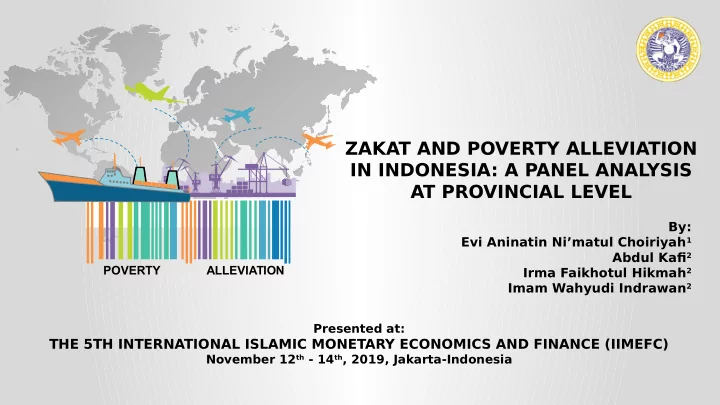
ZAKAT AND POVERTY ALLEVIATION IN INDONESIA: A PANEL ANAL YSIS AT - - PowerPoint PPT Presentation

zakat and poverty alleviation in indonesia a panel anal
SMART_READER_LITE
LIVE PREVIEW

ZAKAT AND POVERTY ALLEVIATION IN INDONESIA: A PANEL ANAL YSIS AT - - PowerPoint PPT Presentation

ZAKAT AND POVERTY ALLEVIATION IN INDONESIA: A PANEL ANAL YSIS AT PROVINCIAL LEVEL By: Evi Aninatin Nimatul Choiriyah 1 Abdul Kaf 2 POVERTY ALLEVIATION Irma Faikhotul Hikmah 2 Imam Wahyudi Indrawan 2 Presented at: THE 5TH INTERNATIONAL


slide-1
SLIDE 1

ZAKAT AND POVERTY ALLEVIATION IN INDONESIA: A PANEL ANAL YSIS AT PROVINCIAL LEVEL

By: Evi Aninatin Ni’matul Choiriyah1 Abdul Kaf2 Irma Faikhotul Hikmah2 Imam Wahyudi Indrawan2

POVERTY ALLEVIATION Presented at:

THE 5TH INTERNATIONAL ISLAMIC MONETARY ECONOMICS AND FINANCE (IIMEFC)

November 12th - 14th, 2019, Jakarta-Indonesia

slide-2
SLIDE 2

INTRODUCTION

Measurement of Zakat Impact (IKB) Zakat Potential for Reducing Poverty Zakat as Islamic Philanthropy Reducing Poverty Determinant of Poverty Level

slide-3
SLIDE 3

PROBLEM STATEMENT AND RESEARCH OBJECTIVE

  • To measure the impact of IKB on

the development of mustahik at the provincial level in Indonesia.

  • This study represents the impact
  • f zakat by IKB.

RESEARCH OBJECTIVE

  • Previous studies related to the

impact of zakat on poverty are still limited to normative research.

  • This research is the fjrst research

to discuss the topic in an empirical form.

  • The focus of this research is the

macro approach related to the infmuence of zakat on poverty. RESEARCH GAP

Research Objective Previous Studies

slide-4
SLIDE 4

2 3 4 5

95% (a=0,05)

CONFIDENC E LEVEL ROBUSTNESS TEST 1

Panel Data Analysis

METHODS

METHODOLOGY

  • Pooled OLS
  • Fixed

Efgect Model (FEM)

  • Random

Efgect Model (REM)

POSSIBLE MODELS

  • Redundant Fixed

Efgects test

  • Breusch-Pagan

LM test

  • Hausman LM test

DIAGNOSTIC TEST

slide-5
SLIDE 5

VARIABLES SOURCE OF DATA

  • Statistics Indonesia.
  • Strategic Studies Center, Badan Amil Zakat

Nasional of Indonesia (PUSKAS BAZNAS).

SOURCE OF DATA

VARIABLES

P0 = Poverty Headcount Ratio P1 = Poverty Gap Index P2 = Poverty Severity Index GRP = Gross Regional Product GINI = Gini Index Unemployment = Unemployment Ratio IKB = Indeks Kesejahteraan BAZNAS (BAZNAS Prosperity Index)

Dependen Variables Independen Variables

slide-6
SLIDE 6

RESUL T

slide-7
SLIDE 7
  • Impactful zakat, proxied by IKB is only signifjcant

to reduction of P0, the Poverty Headcount Ratio.

  • But, IKB is found to be insignifjcant to P1 and P2.
  • In the P0 model is already in line with normative

view of zakat as a tool for poverty alleviation.

  • Zakat is insignifjcantly afgect the quality of

poverty in terms of Poverty Gap Index and Poverty Severity Index.

  • The impact of zakat only benefjts for poor

population that already close to poverty line, which signifjcantly reducing the poverty headcount ratio, i.e. reducing poor population.

  • Zakat does not afgect the deepest section of the

poor population yet, which may cause poverty gap and poverty severity remains unafgected by stronger impact of zakat, measured by IKB.

RESUL T - ANAL YSIS

slide-8
SLIDE 8

RECOMMENDATION CONCLUSION

Recommendation for stakeholders in the future

02

Impactful zakat as indicated by higher IKB is strongly linked with reduction

  • f

poverty headcount ratio.

01

  • As this study indicates that

poverty gap can be reduced by stronger economic growth, economic empowerment of the poorest section of the society through zakat can be considered.

  • Future

researches should include more time series and cross sections to obtain more comprehensive observations.

  • Zakat has already played its role

to reduce population living below poverty line.

  • IKB

does not found to be signifjcantly afgect poverty gap and poverty severity, which means zakat in Indonesia has not improve the quality of poverty at provincial level.

CONLUSION AND RECOMMENDATION