SLIDE 1
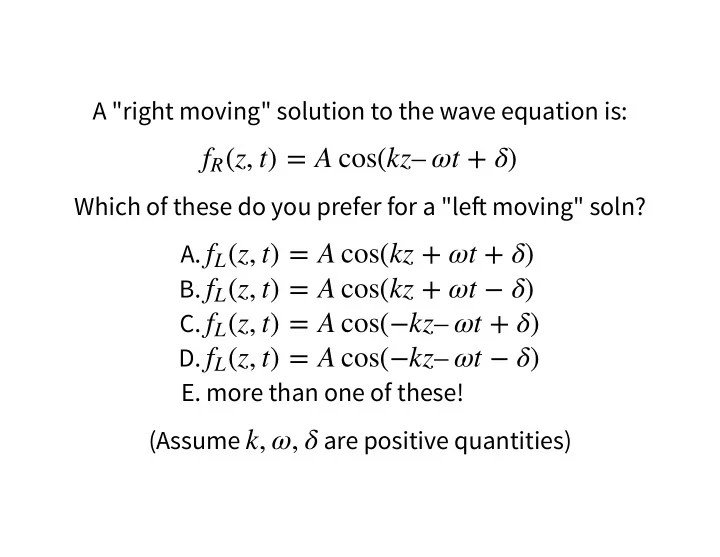
A "right moving" solution to the wave equation is:
(z, t) = A cos(kz– ωt + δ) fR
Which of these do you prefer for a "lefu moving" soln? A. B. C. D. more than one of these! E.
(z, t) = A cos(kz + ωt + δ) fL (z, t) = A cos(kz + ωt − δ) fL (z, t) = A cos(−kz– ωt + δ) fL (z, t) = A cos(−kz– ωt − δ) fL
(Assume are positive quantities)
k, ω, δ
SLIDE 2
Two different functions and are solutions of the wave equation.
(x, t) f1 (x, t) f2 = f ∂2 ∂x2 1 c2 f ∂2 ∂t2
Is also a solution of the wave equation?
(A + B ) f1 f2
Yes, always A. No, never B. Yes, sometimes depending on and C.
f1 f2
SLIDE 3
Two traveling waves 1 and 2 are described by the equations:
(x, t) = 2 sin(2x– t) y1 (x, t) = 4 sin(x– 0.8t) y2
All the numbers are in the appropriate SI (mks) units. Which wave has the higher speed? 1 A. 2 B. Both have the same speed C.
SLIDE 4
Two impulse waves are approaching each other, as shown. Which picture correctly shows the total wave when the two waves are passing through each other?
SLIDE 5
A solution to the wave equation is:
f(z, t) = A cos(kz– ωt + δ)
What is the speed of this wave? Which way is it moving? If is small (and >0), is this wave "delayed" or "advanced"? What is the frequency? The angular frequency? The wavelength? The wave number?
δ
SLIDE 6
A solution to the wave equation is:
f(z, t) = Re [A ] ei(kz–ωt+δ)
What is the speed of this wave? Which way is it moving? If is small (and >0), is this wave "delayed" or "advanced"? What is the frequency? The angular frequency? The wavelength? The wave number?
δ
SLIDE 7
A complex solution to the wave equation in 3D is:
(r, t) = f ˜ A ˜ei(k⋅r−ωt)
What is the speed of this wave? Which way is it moving? Why is there no ? What is the frequency? The angular frequency? The wavelength? The wave number?
δ