
SLIDE 1
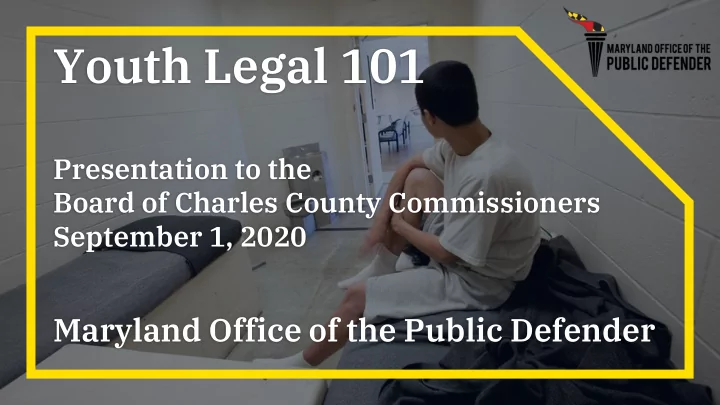
Youth Legal 101
Presentation to the Board of Charles County Commissioners September 1, 2020
Maryland Office of the Public Defender
Youth Legal 101 Presentation to the Board of Charles County - - PowerPoint PPT Presentation
Youth Legal 101 Presentation to the Board of Charles County Commissioners September 1, 2020 Maryland Office of the Public Defender 2 Learning Objectives When it started 1. Basics Who it impacts Where it operates What it does 2. Best
Youth Legal 101
Presentation to the Board of Charles County Commissioners September 1, 2020
Maryland Office of the Public Defender
Learning Objectives
When it started Who it impacts Where it operates What it does Raise the Age Shrink the System Positive Youth Development Close to Home Police Free Schools
HISTORY OF YOUTH LEGAL SYSTEM
House of Refuge Opens on Frederick Avenue in Baltimore1855
JUVENILE COURT Creates system of magistrates to hear juvenile matters1902
DJS FOUNDED1967
SCANDAL 3 youth prisons closed and senior offices fired1999
CONSENT DECREE2005
HISTORY OF YOUTH LEGAL SYSTEM
CHILD KILLED Staff at Bowling Brook murder Isiah Simmons III. Opens 2 years later as Silver Oak.2007
DISCRIMINATION Report shows that across Maryland arrests down but detention up.2012
SCANDAL Baltimore Sun reports on significant problems at Victor Cullen, discorporate treatment of young women & more2016
CLOSURES Victor Cullen closes after staff failures cause riot, Glenn Mills closed amidst abuse scandal.2018-9
$272 MILLION DJS is asking to spend another $272 million on jail & prison construction2020
Maryland’s racial & ethnic demographics
11Black White Hispanic Other
Black White Hispanic
Referrals to Youth Legal System
Referrals to Youth Legal System in Charles County
Black White Hispanic
Youth Out-of- Home Placements
"There are a lot of kids who don't belong here…especially girls.” Sam Abed, Secretary Department of Juvenile Services
State run youth prison State run youth jail
How much does it cost to incarcerate a girl at Waxters for one year?
▫ $50,000 ▫ $75,000 ▫ $150,000 ▫ $250,000 ▫ $400,000
18 Pre- Court Process: Discretion
20Intake
DJS has a dedicated intake officer Three options:
Police
Charge kids for something that would be a crime if they were an adult on a Juvenile Offense Report (JOR) They can release the kid to their parent, or ask DJS to detain them.
Diversion
The JOR is then referred to any diversionary program. If accepted and succesfully completed, the charges stop there.
Juvenile Court in a Nutshell
21Post-Disposition
If a child is found delinquent, they are either placed on probation or committed & sent to an out of home placement.
Trial
Called “adjudication” at trial rather than guilty/not guilty the court finds the child involved or not involved. Trials usually happen within 60 days of a case being brought.
Sentencing
Called “disposition” a judge or magistrate then decides if a child is delinquent or not delinquent. Sentencing usually happens 3-4 weeks after trial.
Level I includes all programs where youth reside in a community setting & attend community schools. Level II includes programs where educational programming is provided on-site & youth movement and freedom is restricted primarily by staff monitoring and supervising. Level III programs provide the highest level of security by augmenting staff supervision with physical attributes of the facility, i.e., locks, bars and fences.
Kids taken out of their homes in Maryland are there for misdemeanors or technical violations of probation
Youth Complaints in Maryland
Statewide there has been a 60% decline in youth complaints in the last 10 years.
$273,513,315 per year
DJS annual operating budget
15% on community supervision
No mentorship program in Charles County
47.7% youth jails & prisons
$150 million give or take
Bad Decision, Not Bad Kids
Only one-third of adolescents with an arrest record go on to an adult arrest; two-thirds do not.
Reforming Juvenile Justice, Footnote 5 Pg 25The majority
adolescent offenders report very low levels of
after court involvement.
Mulvey et al., 2010. A young person arrested at age 16 for robbery has the same
likelihood of
arrest at 24.5 years old as a peer with no juvenile record.
Blumstein and Nakamura, 20092/3
Kids do dumb stuff
And most grow out
This is a brain on puberty.
planning
consequences
pressure
reward U.S. Supreme Court says kids are different in:
Racism (not just implicit bias) is real Over Policing Unfairness at Arrest, Charging, & Sentencing Fines & Fees
29 Think about a time between the ages of 7-17 when you did one
following….
Congratulations! You have been found involved. You are now on probation.
Think about a time between the ages of 7-17 when you did
following….
Boy
Congratulations You violated probation.
Girl
Youth Prison Youth Center
Between the ages of 7- 17 did you ever..
Yes?
You are kicked
sent to a Youth Prison
Dangers of Detaining Young People
We Know What Works
in the long term.
Raise the Age
ceiling (end charging kids as adults).
them with the care & support they deserve.
37 Shrink the System
serious, violent offenses.
38 Positive Youth Development
with adults.
in constructive recreational, and educational activities and contribute in meaningful ways to their communities.
39 Close to Home
us less safe, do not work & are inordinately expensive.
provide intensive services only to the most high-risk young people.
40 Police Free Schools
behavior.
to police in schools prevents children from being pushed into the School to Prison Pipeline while also providing solutions to educators.
41 School Police
Are students safer without them?
Origins and Purpose
1950’s – First school police programs created in Flint, MI and Los Angeles, CA following Great Migration and school integration 1970’s-80’s –War on Drugs 1990’s – Zero Tolerance approach to crime & student discipline 1999 – Columbine school shooting → $750 million federal COPS grant puts 6,500 more police in schools nationwide 2013 – Sandy Hook school shooting → expansion of COPS program; 4X as much federal funding for school police vs. school counselors 2018 – Great Mills shooting → Safe to Learn Act creates $10 million/year fund for SROs. 1 officer for every 4 schools in state. The stated intent behind putting police in schools is to address instances
No Safety Benefits
No national or Maryland study has found that the presence of school police decreases violent incidents at school A 2018 study of 200 school shootings found that school police successfully intervened in only 2 One study found that increasing school police officers did not result in a decrease in any offense type Black students, in particular, report that police presence in schools makes them feel less safe, given police violence against communities of color
Chongmin Na & Denise Gottfredson, Police Officers in School: Effects on School Crime & the Processing of Offending Behaviors, Justice Quarterly (2011) Anya Kamanetz, Why There’s a Push to Get Police Out of Schools, National Public Radio (June 23, 2020) Criminalizatio n of Minor Behaviors
Compared to students in police-free schools, students in schools with police are… 5 times as likely to face arrest for “disorderly conduct” Twice as likely to be arrested/referred to law enforcement for fistfights not involving weapons In Maryland, 70% of school-based arrests are for fistfights not involving weapons and lesser offenses like disruption/disrespect, trespassing, alcohol/tobacco; remainder are mostly for simple drug possession
Dignity in Schools Campaign, A Resource Guide on Counselors Not Cops (2016), http://www.dignityinschools.org/wp-content/uploads/2017/10/Resource_Guide-on-CNC-1.pdf Na & Gottfredson, Police Officers in School MSDE, Maryland Public Schools Arrest Data, School Year 2018-19 Academic Harm
Long-term exposure to police in schools leads to. . . 2.5% drop in high school graduation & 4% drop in college enrollment (TX study) Lower standardized test scores for Black boys starting at ages 13-15 (NYC study)
Emily K. Weisburst, Patrolling Public Schools: The Impact of Funding for School Police on Student Discipline and Long-Term Education Outcomes, 38 J. Pol’y Analysis & Mgmt. 338 (2019) Jeffrey Fagan and Joscha Legewie, Aggressive Policing and the Educational Performance of Minority Youth, 84 Amer. Soc’l Rev. 220 (2019) Disparate Impact
Black students are more likely than white students . . . To attend schools with police officers To attend a school with more officers/security personnel than mental health professionals To be perceived as blameworthy when they engage in the same behaviors as peers → Black students receive 56% of school-based arrests in Maryland, despite comprising a third of the student population In addition, students with disabilities receive 30% of school- based arrests, despite comprising 12% of the student population
Kristen Harper & Deborah Temkin, Compared to White Majority White Schools Majority Black Schools Are More Likely to Have Security Staff, Child Trends (2018) MSDE, Maryland Public Schools Arrest Data, School Year 2018-19 Charles County Public Schools
MSDE, Maryland Public Schools Arrest Data: School Year 2018-19 (2020) 2018-19 School Year How many arrests? 198 students received school-based arrests in total 127 high school students were arrested 58 middle school students were arrested 13 elementary school students were arrested Who is arrested? Black students received 87% of arrests (56% of student population) Students of color received 92% of arrests Students w/disabilities received 27% of arrests (12% of student population) Why? 63% of arrests were for “fighting” or “attack on student” w/o weapons 13% of arrests were for “disruption” 7% of arrests were for “theft” (value unspecified) Examples: Students arrested for coloring on jackets, squirting drinks, refusing to go to office Police-Free Schools: Nationwide Movement
Districts around the country take action to remove police from schools. Denver Charlottesville Portland San Francisco Minneapolis Rochester Milwaukee West Contra Costa (CA) And more… Local governments and school boards in many of these districts are reallocating funding from police towards services for students
School Safety Reimagined: Restorative Approaches
Builds positive relationships among students and staff to prevent conflict, and repair harm and impose accountability when conflict does occur “We conclude that results from case studies, district-wide correlational studies, and experimental trials convincingly demonstrate that when schools implement a restorative initiative, their out-of-school suspension rates decrease” and “restorative initiatives have promise to narrow racial disparities in suspension” Reliance on police is “fundamentally at odds” with a restorative approach
National Education Policy Center, The Starts & Stumbles of Restorative Justice in Education: Where Do We Go From Here? (2020), https://nepc.colorado.edu/sites/default/files/publications/Revised%20PB%20Gregory_0.pdf School Safety Reimagined: Social- Emotional Learning
Curriculum focused on developing youth’s self- awareness (recognizing emotions), self- management (regulating emotions), social awareness (empathy), relationships, and responsible decision-making Based on development of “character” as a skill not a trait Has demonstrated short-term and long-term impacts on student behavior and relationships – including decreased emotional distress and violent behaviors/conduct problems
Taylor, R. Oberle, E., Durlak, J. & Weissberg, R. 2017). Promoting positive youth development through school-based social emotional learning interventions: A meta- analysis of follow-up effects. Child Development. 88(4), 1156-1171. School Safety Reimagined: Trauma-Sensitive Schools
“In which all students feel safe, welcomed, and supported, and where addressing trauma’s impact on learning on a school-wide basis is at the center of its educational mission.” Focus on students’ physical, social, and emotional safety Shared understanding among staff about impact of trauma Positive, culturally-responsive discipline policy and practice Access to comprehensive school mental health and behavioral services Effective community collaboration Trauma-sensitive schools saw decreases in student behavior crises & disciplinary referrals and felt “safer” and “calmer” Wehmah Jones et al, Trauma & Learning Policy Initiative (TLPI): Trauma-Sensitive Schools Descriptive Study, American Institutes for Research (2018), https://traumasensitiveschools.org/wp- content/uploads/2019/02/TLPI-Final-Report_Full-Report-002-2-1.pdf National Association of School Psychologists, Trauma-sensitive schools; Brief tips and policy Staffing School Safety
To keep students and educators safe, schools need enough: School counselors (1:250 students) School social workers (1:250 students) School psychologists (1:700 students) School nurses (1:750 students) Restorative approaches practitioners Community school coordinators ACLU, Cops & No Counselors: How the Lack of School Mental Health Services is Harming Students (2019), https://www.aclu.org/sites/default/files/field_document/030419-acluschooldisciplinereport.pdf Staffing School Safety: CCPS
CCBOE, FY20 Approved Operating Budget, https://www.ccboe.com/images/administrator/ BOEAPPROVEDBUDGETBOOK2020.pdfIn FY 2020, CCPS had 26,508 students (est.) and . . 31.5 Therapists → 1 per 845 students 83 Guidance Counselors → 1 per 319 students (below rec. ratio) 43.3 Psychologists → 1 per 612 students 24.5 Pupil Personnel Workers/Social Workers → 1 per 1082 students (below rec. ratio) 45 Nurses (through health dep’t) → 1 per 612 students 0 Restorative Approaches Practitioners? (some RP training) 0 Community School Coordinators? At the same time, the County has invested local funds in hiring 15 school police officers – 1 per middle/high school – and is using $276K in Safe-to-Learn funding to expand to elementary schools.
Learn More
http://www.marylandattorneygeneral.gov/Pages/JJM/
https://djs.maryland.gov/Pages/Data-Resource-Guides.aspx
https://www.aecf.org/resources/transforming-juvenile-probation/
https://www.nap.edu/catalog/14685/reforming-juvenile-justice-a-developmental-approach
https://dignityinschools.org/interactive/counselors-not-cops/# and https://wecametolearn.com/).
56 Tell Others
#RaisetheAge #ShrinktheSystem #PositiveYouth #KeepKidsClosetoHome #PoliceFreeSchools
57 Questions?
michal.gross@maryland.gov
cherayilm@publicjustice.org
58