YOUTH HEALTH FORUM Uniting Counselling & Mediation Programs - - PDF document

youth health forum
SMART_READER_LITE
LIVE PREVIEW

YOUTH HEALTH FORUM Uniting Counselling & Mediation Programs - - PDF document

29/11/2017 YOUTH HEALTH FORUM Uniting Counselling & Mediation Programs Options (Parramatta only) Gambling (Campbelltown, Wollongong) Family breakup: Supporting young people Keeping Contact (Parramatta, Newcastle, Sydney CBD)


slide-1
SLIDE 1

29/11/2017 1

YOUTH HEALTH FORUM

Family breakup: Supporting young people

through separation and conflict

29 November 2017

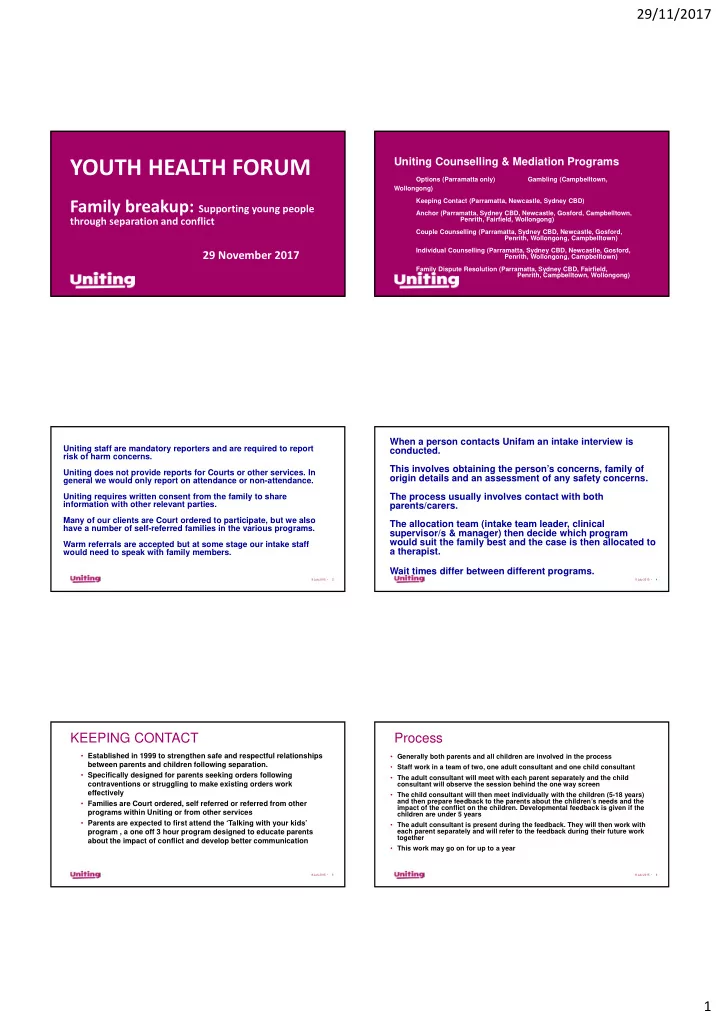
Uniting Counselling & Mediation Programs

Options (Parramatta only) Gambling (Campbelltown, Wollongong) Keeping Contact (Parramatta, Newcastle, Sydney CBD) Anchor (Parramatta, Sydney CBD, Newcastle, Gosford, Campbelltown, Penrith, Fairfield, Wollongong) Couple Counselling (Parramatta, Sydney CBD, Newcastle, Gosford, Penrith, Wollongong, Campbelltown) Individual Counselling (Parramatta, Sydney CBD, Newcastle, Gosford, Penrith, Wollongong, Campbelltown) Family Dispute Resolution (Parramatta, Sydney CBD, Fairfield, Penrith, Campbelltown, Wollongong)

8 July 2015 • 3

Uniting staff are mandatory reporters and are required to report risk of harm concerns. Uniting does not provide reports for Courts or other services. In general we would only report on attendance or non-attendance. Uniting requires written consent from the family to share information with other relevant parties. Many of our clients are Court ordered to participate, but we also have a number of self-referred families in the various programs. Warm referrals are accepted but at some stage our intake staff would need to speak with family members.

8 July 2015 • 4

When a person contacts Unifam an intake interview is conducted. This involves obtaining the person’s concerns, family of

  • rigin details and an assessment of any safety concerns.

The process usually involves contact with both parents/carers. The allocation team (intake team leader, clinical supervisor/s & manager) then decide which program would suit the family best and the case is then allocated to a therapist. Wait times differ between different programs.

8 July 2015 • 5

KEEPING CONTACT

  • Established in 1999 to strengthen safe and respectful relationships

between parents and children following separation.

  • Specifically designed for parents seeking orders following

contraventions or struggling to make existing orders work effectively

  • Families are Court ordered, self referred or referred from other

programs within Uniting or from other services

  • Parents are expected to first attend the ‘Talking with your kids’

program , a one off 3 hour program designed to educate parents about the impact of conflict and develop better communication

8 July 2015 • 6

Process

  • Generally both parents and all children are involved in the process
  • Staff work in a team of two, one adult consultant and one child consultant
  • The adult consultant will meet with each parent separately and the child

consultant will observe the session behind the one way screen

  • The child consultant will then meet individually with the children (5-18 years)

and then prepare feedback to the parents about the children’s needs and the impact of the conflict on the children. Developmental feedback is given if the children are under 5 years

  • The adult consultant is present during the feedback. They will then work with

each parent separately and will refer to the feedback during their future work together

  • This work may go on for up to a year
slide-2
SLIDE 2

29/11/2017 2

8 July 2015 • 7

OPTIONS PROGRAM

Parents and adolescents experiencing conflict:

  • Disagreements about family rules and

expectations

  • Conflict in relationships
  • Violence
  • School problems
  • Behavioural issues
  • Leaving home
  • Depression
  • Separation issues
  • Step-families

8 July 2015 • 8

The Options Team provide two types of services:‐ Family Therapy Group work

Family Therapy. The practitioner allocated the case liaises with the Options team to decide which family members will be present in the initial session. The initial session generally involves other members of the Options team, with one therapist in the room with the family and the others behind a one- way screen. The model has a systemic approach, utilising a reflective team. The team will offer their ideas to the therapist during the first session via phone, and again at the end of the session in order to facilitate feedback and for further reflection.

8 July 2015 • 9

Some families find this strange or awkward at first but our experience is that they soon relax and find it very helpful. We introduce the team and invite family members to go behind the screen to see how it works. The children seem to find it all very exciting. The therapist in the room is usually the person who continues to work with the family. This work could be with a combination of different family members or individuals over many sessions, and even over many months or a year. This systemic family therapy model is non-blaming/neutral and understands problems within the family to be relational and interactional.

8 July 2015 • 10

We note patterns of behaviour and track behavioural sequences (eg. when x happens, what happens next). Issues may relate to early attachments and different situations may trigger family of origin issues in the family and/or couple which may require different responses. Common issues relate to: Grief and loss Identity issues Structure – hierarchy, reorganisation Roles within the family Attachment disruption Trauma Re-partnering Difficult behaviour containment Parenting skills – containing behaviours Emotional regulation/soothing Self-harm

8 July 2015 • 11

GROUP WORK

The Options team provides group work in schools. These groups cover issues that include:- Resilience Emotions Stress/Anxiety, including HSC Leadership Parenting Teens Our group programs are often tailored to suit the needs of a particular school, however we recognise the need to deliver evidence based programs and are currently looking at a few different programs, for example a new one recently designed in Victoria with the aim of addressing the precursors to family violence, developing healthy relationships (emotional awareness and regulation).

8 July 2015 • 12

THE ANCHOR: Supporting Kids Through Separation

  • Attorney Generals Department
  • Children and young people aged 5-17 years old
  • Individual and group therapy
  • Child consultancy and Parent Feedback
  • Community education
  • Referrals
slide-3
SLIDE 3

29/11/2017 3

8 July 2015 • 13

The Anchor aims to:

  • Decrease levels of distress
  • Improve communication
  • Build resilience
  • Allow children’s voices to be included
  • Child protection
  • Early intervention and referrals to other

specialists

  • Systemic therapy

8 July 2015 • 14

Child’s Experience: what they need…

  • Protection from conflict
  • Someone to listen to their fears
  • Someone to help reduce parental conflict
  • Stability and security
  • Space to resolve their feelings
  • To know they are loved
  • Clear communication about any changes
  • Time to process what has happened

8 July 2015 • 15

Individual Therapy

  • The child sets the agenda for the therapy
  • Interventions are tailored to the child’s

expressed/observed needs

  • Safety assessments are ongoing
  • Exploration of the child’s inner processes
  • Helping with emotional language, emotional

regulation

8 July 2015 • 16

Ways of Exploring and Communicating:

8 July 2015 • 17

Outcomes:

Separation Story Child and Parent Reunification Resolving sadness, grief & loss Resolving anger Feeling & being safe Hope for the future Healing from hurt Recognisin g feelings Feeling heard by parents Strengthening relationships Healing after trauma Good self- esteem Individuation Protective Behaviours Social Inclusion Increased family communication Decreased anxiety

8 July 2015 • 18

The Anchor Groups:

  • Jigsaw
  • Connect Kids
  • Connect Youth
slide-4
SLIDE 4

29/11/2017 4

8 July 2015 • 19

Child Consultation:

  • What’s working / what could be different
  • What it’s like going between two homes
  • Distress, sadness, anger, fear, confusion
  • Developmental needs
  • Safety
  • Feedback to parents
  • Developmental feedback for children under 5

years old

Individual and Couples Counselling

How our service can help clients

* Dealing with grief & loss, anxiety or depression * Coping with relationship stress or conflict * Difficulties experienced by couple i.e. closeness and intimacy * Parenting Issues * Rebuilding after separation or divorce * Keeping Children Safe * Concerns about safety * Helping individuals with Trauma and traumatic memories

Family Dispute Resolution

Goals for mediation are to help resolve separation matters in a way that’s less stressful and more affordable for the clients. We help clients to reach agreements about:-

* Where the child/young person will live * The amount of time spent with each parent * Who will be involved in parental decision making * Child support arrangements * Property settlement or division of assets * interim financial arrangements * Any other concerns or issues a family may have

Hybrid cases

Uniting’s hybrid model involving both an FDR Practitioner and a Family Counsellor

The benefits of the two roles (hybrid) - Hybrid model is open-ended and flexible, with components delivered based on assessed needs. Key elements provided for each family include:

  • Individual counselling
  • Where appropriate, Child-Inclusive Practice
  • Additional interventions such as

Family counselling , Anchor and mediation Uniting has also developed partnerships with the courts and legal professionals to support separated parents to come up with solutions that meet the needs of their children/young people.

Unifam

  • Parramatta – 02 8830 0700
  • Campbelltown ‐ 02 4629 7000
  • Sydney CBD ‐ 02 9373 5500
  • Newcastle ‐ 02 4925 6000
  • Gosford ‐ 02 4325 9666
  • Fairfield ‐ 02 9794 2000
  • Penrith – 02 4732 3836

23

Our purpose

24