
SLIDE 1
‘Your contribution to the London Environment Strategy’
27th of October, 2017
1
Your contribution to the London Environment Strategy 27 th of - - PowerPoint PPT Presentation
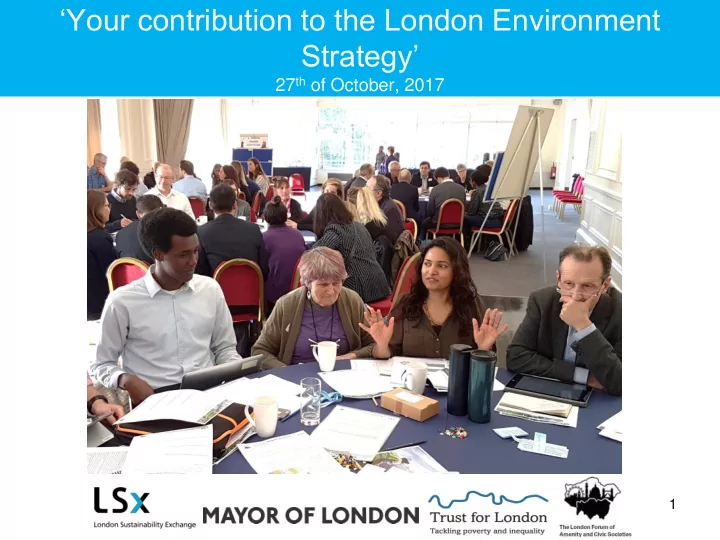
Your contribution to the London Environment Strategy 27 th of October, 2017 1 The aims of this event Explore the policies and targets of the Draft London Environment Strategy Develop ways community members can get involved in
1
2
3
London Forum of Amenity and Civic Societies
4
“This strategy is going to need you very badly” Unlike other strategies which have had targets, actions, and funding, the LES has mainly aspirations but not yet fully defined
government, local authorities, and the general public. Therefore, there needs to be an emphasis on public engagement. The LES depends heavily on the public and their communities and relevant
lobbying your MPs and select committees in the House of Commons.
The LES is an integration of 8 strategies, and the aim is for London to be a “Greenest global city” – clean, attractive, and healthy. The Mayor wants London to be Zero Carbon by 2050, a Zero Emission transport city by 2050 and Zero Waste by 2030.The GLA has looked at where previous government policies have led to unintended consequences, like increased diesel use, and have tried to integrate into the agenda more of the impacts on health, inequalities and fairness. The GLA has published a Solar Action Plan – what London needs to do in order to provide solar power within London, which includes proliferating Community Energy infrastructure. The GLA is also publishing a Fuel Poverty Action Plan, which aims to eradicate fuel poverty endured by 10% of London households. There will be a £20m Air Quality fund, a £1m fund to improve air quality for businesses, a £9m fund to improve green spaces and increase tree planting in the capital. There will also be £10m in funding over 4 years for new energy efficiency programmes, as well as funding to become available for healthy streets and to incentivise boroughs to do more to promote health benefits of improving air quality, etc. The Mayor of London has limited powers in terms of the environment, the GLA even more so. However, the Mayor does have reasonable powers in regards to waste, as authorities have to act in general conformity with waste elements of the strategy. He also has some powers over air quality which enable him to introduce variable road charges, as the chief of TFL, and is making sure improvements are being made to London’s transport. The Mayor will work to ensure that implementation of the LES will be delivered through the London Plan, as it is through this that he has more decisive power. It will be difficult to achieve these aims, but there have already been improvements made since 1990 to reduce CO2 emissions, and to waste, recycling and green spaces. Because of the Mayor’s power restrictions, the focus is on convening lobbyist and activists to work together and campaigning initiatives to make the needed changes.
Greater London Authority (GLA)
5
6
7
8
Facilitated by: Bridget Fox, Campaign for Better Transport
9
Target
London will have the best air quality of any major world city by 2050, going beyond the legal requirements to protect human health and minimise inequalities
Background
Promising steps have been made over the past 50 years Particulate matter (PM10, PM2.5 and black carbon) and nitrogen dioxide (NO2) remain to be two major concerns. London is failing to meet the legal limit for NO2. Particulate matter is damaging to health at any level and must be reduced.
Actions Suggested
Reducing exposure of Londoners to harmful pollution across London Achieving legal compliance with UK and EU limits as soon as possible. Achieving new, tighter air quality targets for a cleaner London, meeting WHO’s guidelines by 2030 by transitioning to a zero emission London.
Facilitated by: Bridget Fox, Campaign for Better Transport 10
3 key gaps in the LES: 1. There is scope to implement short-term policies now that can reduce air pollution that are not mentioned in the strategy. These include stopping vehicle idling to avoid parking tickets, including private hire vehicles and river vessels into congestion charge/T-charge/ULEZ groups, and short-term road closures. 2. Time frames are too distant, especially an electrified transport system by 2050, and terms used in individual policies aren’t authoritative, e.g. ‘encourage’ should be ‘require’
proposals will be carried out to achieve overall goals. 3. Education and public information – there is not enough public information available or accessible to induce behavioural change right now. This coupled with distant time frames for transport changes will cause a slow shift to less polluting practises. 3 key methods for community engagement: 1. Working with community groups and schools to put pressure on local authorities in order to induce road closures, increased parking tickets, parking tickets based on the vehicles age/pollution, local air quality monitoring/shaming tactics etc. 2. Lobby and pressure local authorities/decision makers/planning authorities and making them more accountable for large scale construction and its impacts
3. Reassessing how individuals/colleagues/employees travel around London, making use of latest information, transport and incentives to get around more sustainably.
air quality in London and zero emission transport by 2050? Is the proposed approach and pace realistic and achievable, and what further powers might be required? Yes, but…
implemented early, and non-transport policies must have equal attention to transport ones.
just switching to less polluting ones, and if pollution from construction and buildings is properly addressed too.
level to tackle the widespread ignorance and lack of concern that still exists. There is a lack of coordination between local authorities and schools, and there needs to be a framework for implementing air quality reduction schemes, and for effectively monitoring and reviewing the data collected.
with Brexit. Lack of costed proposals creates an atmosphere of ignorance. Bringing in experts from a range of fields to do a full cost benefit analysis of proposals will create more accessible information for the public and can reduce ambiguity.
Facilitated by: Mathew Frith, Wildlife Trust London
11
Target
London will be a National Park City where more than half of its area is green; where the natural environment is protected and the network of green infrastructure is managed to benefit all Londoners.
Background
London’s green spaces and natural landscapes provide a recreational space for Londoners as well as provide habitat for wildlife, help protect London from the impact of climate change, and help improve London’s air quality. As London grows its green infrastructure becomes even more vital; to ensure the health of Londoners is improved, to protect the city from climate change and to boost London’s economic growth.
Actions Suggested
Increasing London’s green cover, making more than half of London green by 2050. Conserving and enhancing wildlife and natural habitats. Valuing London’s natural capital as an economic asset and greater investment in green infrastructure
Facilitated by: Mathew Frith, London Wildlife Trust 12
3 key gaps in the LES: 1. Need for clearer definitions and ‘how to’ steps that turn aspirations for securing the protection, enhancement and promotion of the natural fabric of London into action. 2. Commitment to secure tenure and resources for local authorities/communities to ensure stability, security, maintenance and management of local greenspaces, and resources to those who are fully qualified to be in charge of their conservation and enhancement. 3. Considerations of soil conservation, light pollution , pesticide/herbicide use, and wildlife crime. 3 key methods for community engagement: 1. Campaigning for funding for resources and specialized skill training 2. Advertising, digital campaigns, posters etc. to instruct and educate communities and get more people involved locally in green space maintenance and care. 3. Lobbying for planning authorities and councils to take green space protection and creation into consideration as a priority, not an after-thought.
National Park City be and what would we need to achieve for it to be considered successful? Attributes:
efforts gain appropriate recognition, support, expertise and funding.
and to help instruct and keep local authorities up to date, as well as provide key information to Londoners on the biodiversity and other environmental data in London.
them for both citizens and biodiversity. What needs to be achieved:
qualified and specialised employees. This would also need to involve keeping the original environmentally-beneficial intentions of the spaces intact, and those using them accountable to these standards, as well as a revival of appreciation for green spaces.
relationships with nature, as well as with food. This should include increasing education and awareness of London’s biodiversity and natural environment, and volunteering programs and internships offered to support development and management.
spaces, as well as specialized skills training so staff are qualified to take care of London’s green spaces and biodiversity.
LES’ plans for more high quality, connected green spaces
Facilitated by: Afsheen Rashid, Repowering London
13
Target
London will be a zero carbon city by 2050, with energy efficient buildings, clean transport and clean energy.
Background
If the world continues emitting greenhouse gases (GHG) at today’s levels, average global temperatures could rise by up to five degrees Celsius by the end of this century. London, among other global cities, must play a leading role in helping to reduce these emissions.
Actions Suggested
Decarbonise London’s homes and workplaces while protecting the most vulnerable by tackling fuel poverty. Develop clean and smart, integrated energy systems using local and renewable energy resources Deliver a zero emission transport network by 2050.
Facilitated by: Afsheen Rashid, Repowering London 14
4 key gaps in the LES 1. SMART – The LES explains the logistics of rolling out Smart meters, but doesn’t explain how the Mayor can support processes and initiatives to help overcome the social, cultural and technical barriers faced by different communities using smart tech. 2. Not enough focus on how to change behaviour of end users (especially in privately rented accommodation). There needs to be an emphasis on stimulating behavioural changes from a groundwork level to induce the transformative measures needed for climate change mitigation. 3. Policy and practices to alleviate fuel poverty must be more holistic. The positioning of fuel poverty as solely an energy problem overlooks the multidimensional nature of this issue which must be tackled through targeted energy, housing and health interventions. 4. The Mayor is not offering enough solutions (within his power), such as campaigning and pressure, to overcome the barriers to widespread retrofitting in privately owned
do more to fix the energy market system that currently disadvantages local electricity supply and renewable energy. 3 key methods for community engagement 1. Lobby for change/funding for multi-layered funds which can support education drives: to teach how to use SMART, how to set up community solar initiatives and to demand a national framework which supports community groups/SME’s engaged in climate mitigation/actions. This would require the Mayor to use his public position/media influence and work with bringing community interests to a wider audience. 2. Support short/long term education efforts towards advocating solar/community energy (given funding). 3. Involvement of business and community groups in the process of designing regulations/standards – begin to harmonise the multiplicity of interests to create zero carbon developments (building, construction process etc.).
to make London a zero carbon city by 2050? Is the proposed approach and pace realistic and achievable? There was a general consensus that the policies and proposals set out in the workshop, while ambitious and leading London in the right direction, are not viable in themselves to reach the Zero Carbon City goal by 2050. There are currently too many significant gaps in the strategy that need to be addressed to make this goal achievable. Community energy is not just about solar deployment but it is a means to engage and empower communities
Community Energy Fund but would ask the Mayor to go further to provide funding for innovation to develop new business models on local electricity supply, community heat, energy efficiency and others. There are also already a number of existing problems, especially in relation to energy, that need to be resolved first before actions can be undertaken to implement these proposals.
Facilitated by: Ben Hudson, London Sustainability Exchange
15
Target
London will be a zero waste city. By 2026 no biodegradable or recyclable waste will be sent to landfill and by 2030 65 per cent of London’s municipal waste will be recycled.
Background
Our linear economy is unsustainable, with around 7m tonnes of landfill waste coming from London’s homes, public buildings and businesses each year. Of this, only 32% is currently recycled and performance has stagnated. Landfill and incineration are undesirable, costly and an inefficient use of resources. The capacity of landfills accepting London’s waste is expected to run out by 2026 and London’s waste bill is now in in excess of £2bn a year and rising.
Actions Suggested
Significantly cutting waste and encouraging reuse to minimise the use of virgin resources. Efforts will be focused on reducing food waste and single use packaging as they offer the biggest opportunity for
recycling of materials leftover. Generating low carbon energy from truly residual waste leaving very little waste going to landfill and ensuring that there is sufficient infrastructure to support these actions within London.
Map showing rate of fly-tipping (dumped waste) across London
HIPPOWaste (2017)
Facilitated by: Ben Hudson, London Sustainability Exchange (LSx) 16
4 key gaps in the LES 1. Teaching solutions and community engagement as a form of communication is missing. There needs to be a focus on communicating/educating the issues AND the solutions/benefits. 2. Identification of strategies to reduce business waste and how they will be enforced. 3. There is not enough in the LES to ensure residents in flats will be able to recycle 100% of their recyclable waste. Flats are currently exempt from the 6 materials target, which also needs to be addressed. 4. Waste and sewerage system issues created by nappies and sanitary products are not mentioned in the LES and should be addressed with support for reusable products. 3 key methods for community engagement: 1. Recognise and support community and organisational efforts to tackle waste such as anaerobic digestion, nappy recycling, local compost bins and organic waste recycling. In doing so these can provide an alternative energy source, create jobs locally and produce fertiliser to support other community engagement projects such as community gardens and local food growing. 2. Through organisations, communities can support the ambition of tackling waste with upcycling and re-use projects. This can include campaigning on their behalf, providing the ‘waste’ materials to be upcycled and supporting them as local businesses and ventures by purchasing their products. 3. Consumers should feel empowered to make informed decisions, demand transparency and hold companies to account in terms of waste and recycling. Public campaigns, petitions and policies that support social norming effects (such as the plastic bag tax) can help support this.
Londoners and businesses to recycle more? Yes, but…
greenwash since the LES’ recycling target is actually 65%.
acknowledgement of how behavior change among those who are not recycling already will take place.
service provided to kerbside properties. Targets need to take flats into account and tackle the challenges of making recycling more convenient. In the case of new-builds this can be addressed through planning and infrastructure.
be made to engage and detail how businesses and manufactures will support this ambition.
sufficiently recognised or supported.
Facilitated by: Pat Fitzsimons, Thames Estuary Partnership
17
Target
London and Londoners will be resilient to severe weather and longer-term climate change impacts. This will include flooding, heat risk and drought.
Background
Climate change will increase the existing pressures
London’s housing, infrastructure, services, and environment. It will make flooding more frequent and severe, threaten water resources, and increase the risk of overheating for buildings and infrastructure.
Actions Suggested
London’s infrastructure providers and businesses must understand and manage climate change risks and impacts to deliver resilient growth and services The risk of flooding must be reduced through appropriate flood defences and increased awareness London’s water supply must be efficient, secure, resilient and affordable People, infrastructure and public services must be better prepared for extreme heat events and increased temperatures.
Facilitated by: Pat Fitzsimons, Thames Estuary Partnership 18
3 key gaps in the LES 1. Effective and efficient methods for communication of the need for adaptation to all organisations and communities, and the methods of sufficiently doing so (this also includes poor distribution of LES itself) 2. Lack of targets- There are no indicators of when London can be deemed “adapted to climate change”, for example one target could be that there are fewer people at risk of flooding. GLA were wary of putting targets in this chapter as it is a very broad topic. 3. More inclusion of businesses and how to support them (including big businesses such as offering to research for them). 3 key methods for community engagement: 1. Local authorities need to be trained about this information in order to help communities. “trickle down” process from GLA to local authorities to communities. 2. Education on climate change and the need for adaptation 3. Media reporting of ways to adapt to climate change
increase London’s resilience to climate change? Yes, but…
important messages of adapting to climate change. Moreover, there needs to be efforts made to communicate these lessons of resilience to the diverse cultures and ethnicities within London that are not reached by generic pathways.
and coverage as issues like air quality because of the potentially dangerous impacts on London. Education is needed to help empower people to deal with changing conditions, such as increasing frequency and severity of heat waves and droughts.
and/or incentives to incorporate adaptation into their work policies. This should be done using connections and examples from C40 membership to inform London’s businesses on how they can best do this for all affected bodies, and not just financial shareholders.
Facilitated by: Andrew Dakers, West London Businesses
19
Target
London’s businesses and workers will be supported to be able to compete effectively in global and national low carbon circular markets
Background
Today's linear economic model of ‘take, make, dispose’ is reaching its physical limits. The problem being that as a society we tend to deplete finite reserves in order to create products that end up in landfills or in incinerators. Currently, London’s low carbon and environmental goods and services sector is worth a reported £30.4bn.
Actions Suggested
Create market demand for low carbon and environmental goods and services that directly address the environmental challenges and drive resource efficiency and a reduction in consumption. The public sector can increase this through procurement. Support the development
Londoners’ skills, knowledge, experience and expertise to be competitive in a low carbon circular economy and capture a share in the global market For this transition to be possible there needs to be major investment in the city’s infrastructure to create the necessary comprehensive and integrated systems, such as energy, water and waste.
Ref: Ellen MacArthur Foundation – an outline of how a circular economy works
Facilitated by: Andrew Dakers, West London Businesses 20
3 key gaps in the LES 1. Cleantech – Adopting a ‘Hub & Spoke’ approach through supporting an
hubs. 2. The 4 R’s need to appear in the strategy with any action and initiatives linking these principles to the Circular Economy model, with Re-cycling as a last option. 3. Water – Should be brought up to the same level of importance carbon. Water has a circular economy aspect - we need to reduce and re-use London’s water as there are significant risks to supply. 3 key methods for community engagement: 1. Behaviour Projects – Creating consumer awareness and inspiring action, a process that has to start with school projects alongside responsible media outlets. 2. Community Support - Local Authorities and Community Organisations supporting people in how they re-use, repair, reduce, re-make and recycle within the home and through local facilities dedicated to the R’s. 3. Encouraging co-housing – collaboration with homeowners and local authorities – ties in with housing crisis.
efficiently support growth
London’s low carbon and environmental goods and services sector? Yes, but…
seemingly dropped off the agenda. The simple concept and effective terms need to be re-introduced into political discourse. Policies and proposals need to support a move to a sharing economy.
behaviour of end users and demand.
the 4 R’s need to be effective and case studies readily available to all stakeholders.
Room Scheme’ are needed to avoid disproportionately burdening issues on vulnerable and disadvantaged people.
21
Greater London Authority Campaign for Better Transport Repowering London London Sustainability Exchange Thames Estuary Partnership West London Businesses London Forum for Amenity and Civic Societies ZSL London Zoo Art, design, and culture The Federation of City Farms and Community Gardens Eco-club Siemens Better Bankside SHA London Winckworth Sherwood London Wildlife Trust Hayes Community Forum Co-Design/Manor Farm Nature Space Living Streets Greenwood’s Global Transition Town London Hub TCV WYG WSP LETSlink London Freegle UK Artist: a changing world IFEES-EcoIslam London Hazards Centre The Community Pool CIC Sustainable Merton Breathe Easy Westminster Health Watch Cross River Partnership WRAP Kingston Environment Forum Hornsey and Wood Green CLP Climate Change and Environment Group Sustainable Hackney Pure Leapfrog EcoNexus The Brixton Society Greenspace Information for Greater London (GiGL) Mace London Green Fair Share Action Sow grow and reap Brent Council Hounslow and Brentford Friend of the Earth The EDGE Twinn Sustainability Innovation RBKC Golders Green Estate Residents Association London Community Resource Network Real Nappies for London Environment Agency Wiles Greenworld Community by Design Imperial College London London South Bank University University College London University of Westminster