Year One Tess Lengyel and Cathleen Sullivan, Alameda CTC April 2017 - - PowerPoint PPT Presentation

year one
SMART_READER_LITE
LIVE PREVIEW

Year One Tess Lengyel and Cathleen Sullivan, Alameda CTC April 2017 - - PowerPoint PPT Presentation

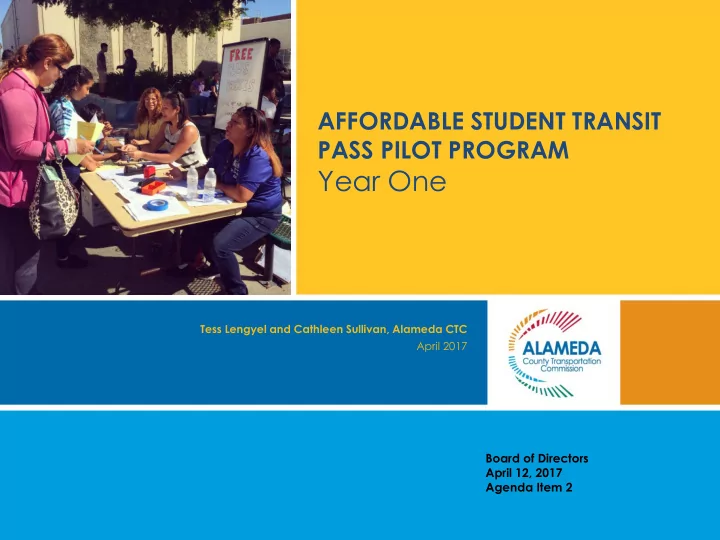
AFFORDABLE STUDENT TRANSIT PASS PILOT PROGRAM Year One Tess Lengyel and Cathleen Sullivan, Alameda CTC April 2017 Board of Directors April 12, 2017 Agenda Item 2 1 Presentation Overview Introduction Pilot Program Design Update

slide-1
SLIDE 1

1

AFFORDABLE STUDENT TRANSIT PASS PILOT PROGRAM

Year One

Tess Lengyel and Cathleen Sullivan, Alameda CTC April 2017

Board of Directors April 12, 2017 Agenda Item 2

slide-2
SLIDE 2

2

Presentation Overview

  • Introduction
  • Pilot Program Design
  • Update on

Implementation

  • Next Steps
slide-3
SLIDE 3

3

Program Background

  • The Affordable Student Transit Pass Program was

identified in the 2014 Transportation Expenditure Plan, passed by 70% of voters in 2014 as Measure BB

  • “Successful models aimed at increasing the use of transit

among junior high and high school students, including a transit pass program for students in Alameda County.”

  • $15 million for 3-year pilot program
  • 2014-2016: Program development
  • 2016: Program launch
slide-4
SLIDE 4

4

Student Transit Pass Pilot Program Goals

  • Reduce transportation access barriers to and

from schools

  • Improve transportation options for Alameda

County’s middle and high school students

  • Build support for transit in Alameda County
  • Develop effective three-year pilot programs
  • Create a basis for a countywide student transit

pass program (funding permitting)

slide-5
SLIDE 5

5

Student Transit Pass Pilot Overview

  • Commission adopted
  • Site selection methodology & shortlist of 36 eligible schools for Pilot
  • Pilot evaluation framework
  • Testing different program models in different areas

* Free and Universal

* Means-based * Grade-limited * Discounted

  • Programs include education/training on using public transit
  • Passes effective year-round, not limited by day/time
  • Year 1 – Passes distributed at 9 schools (AC Transit – 7)
  • Year 2 – Passes distributed at 15 schools (AC Transit – 11)
slide-6
SLIDE 6

6

Student Transit Pass Pilot – AC Transit passes

  • Free and universal:
  • Five schools in Oakland (3 in Year 1, 2 added in Year 2)
  • Two schools in San Leandro in Year 2
  • Means-based programs:
  • Two schools in Hayward in Year 2
  • Two schools in Union City in Year 2 (change from Year 1)
  • Discontinuing models after Year 1:
  • Discounted: Two schools in Union City
  • Grade-limited: Two schools in Union City and Two in San

Leandro

slide-7
SLIDE 7

7

Student Transit Pass Pilot – Schools with AC Transit passes in Year 2

Free and universal:

  • Oakland

1. Castlemont High 2. McClymonds High 3. Fremont High 4. Westlake Middle 5. Frick Middle

  • San Leandro

6. San Leandro High 7. John Muir Middle

Means-based:

  • Hayward

8. Hayward High 9. Bret Harte Middle

  • Union City
  • 10. James Logan High
  • 11. Cesar Chavez Middle
slide-8
SLIDE 8

8

Year Two Summary

North Central South East Total Schools Free and Universal X X X 11 Means- based program X X 4 Schools Oakland USD (5) San Leandro USD (2), Hayward USD (2) New Haven USD (2) Livermore Valley JUSD (4) 15 Transit AC Transit AC Transit AC Transit & Union City Transit LAVTA eco-pass

slide-9
SLIDE 9

9

Outreach and Engagement

slide-10
SLIDE 10

10

Outreach and Engagement

slide-11
SLIDE 11

11

Program Evaluation

18 quantitative and qualitative measures to evaluate performance, including:

  • Student perception of transit options

and barriers

  • Student transit ridership
  • Pass penetration and ease of use
  • After school activity participation
  • Participant, student attendance
  • Program cost per participant and

administrative costs

  • Framework approved by Commission in March 2016
slide-12
SLIDE 12

12

Preliminary Findings

  • August through December 2016
  • Initial analysis draws on:
  • Data reported from transit agencies
  • Information tracked by the school program administrators
  • The first student survey

All students at participating schools were encouraged to participate in online/paper survey regarding:

  • Student perception of transportation barriers
  • Transportation costs to families
  • Program participation and usage
  • BART usage by students
slide-13
SLIDE 13

13

Pass Distribution Summary

Planning Area Program Total # Students Eligible Number of Active Passes Total # Active Passes Participa- tion Rate AC Transit Union City Transit LAVTA/ Wheels North 1,832 1,670

  • 1,670

91% Central 1,616 813

  • 813

50% South 2,309 151 100 ; 76

  • 251 ;

227 11% ; 10% East 2,441

  • 110

110 5% County- wide 8,198 2,634 100 ; 76 110 2,844 ; 2,820 34%

slide-14
SLIDE 14

14

Transit Usage

Total Transit Boardings by Passholders (Aug-Dec) Average Daily Boardings Average Monthly Unique Users North 149,034 1,228 1,222 Central 25,562 211 388 South 14,179 116 125

AC Transit 6,722 55 125 Union City Transit 7,457 61 N/A

East 10,106 83 N/A Countywide 198,881 1,638 1,735

slide-15
SLIDE 15

15

AC Transit Student Passholders – Weekday Boardings by Hour (October 2016)

0% 5% 10% 15% 20% 25% 30% 35% 40%

12:00 AM 1:00 AM 2:00 AM 3:00 AM 4:00 AM 5:00 AM 6:00 AM 7:00 AM 8:00 AM 9:00 AM 10:00 AM 11:00 AM 12:00 PM 1:00 PM 2:00 PM 3:00 PM 4:00 PM 5:00 PM 6:00 PM 7:00 PM 8:00 PM 9:00 PM 10:00 PM 11:00 PM

Percentage of Total Weekday Boardings by Hour (within each Planning Area) North Central South

slide-16
SLIDE 16

16

AC Transit Student Passholders – Weekend Boardings by Hour (October 2016)

0% 5% 10% 15% 20% 25% 30% 35% 40%

12:00 AM 1:00 AM 2:00 AM 3:00 AM 4:00 AM 5:00 AM 6:00 AM 7:00 AM 8:00 AM 9:00 AM 10:00 AM 11:00 AM 12:00 PM 1:00 PM 2:00 PM 3:00 PM 4:00 PM 5:00 PM 6:00 PM 7:00 PM 8:00 PM 9:00 PM 10:00 PM 11:00 PM

Percentage of Total Weekend Boardings by Hour (within each Planning Area) North Central South

slide-17
SLIDE 17

17

Mode Split - Countywide

Get dropped

  • ff/get a

ride 63% Public transit 17% Bike 2% Walk 12% Drive myself 5% Other/I prefer not to answer 1%

Countywide Arrival Mode

Get picked up/get a ride 49% Public transit 25% Bike 2% Walk 17% Drive myself 5% Other/I prefer not to answer 2%

Countywide Departure Mode

slide-18
SLIDE 18

18

Key findings

  • Top uses of Passes:
  • 1. Travel to/from school (~ 70% )
  • 2. Afterschool activities
  • 3. Spending time with friends
  • Top reasons limiting student use
  • Prefer to travel other ways
  • Traveling by bus takes too long
  • Bus doesn’t meet needs
  • >50% participating students

said cost savings provided by the program is important

slide-19
SLIDE 19

19

Comments from Students

  • “The pilot program seems very excellent to me since it has helped me

and my family to have a safe way for me to get to school and get my

  • education. It’s a program that has helped a lot of students and for my

part I am very grateful.”

  • “Everything is good about the transit pass and I started not being late

to school which make a positive dramatic change on my grades and willingness to go to school."

  • “Thank you for this program – it is allowing me to be more

independent.”

  • “I like the transit pass and it keeps me from having to look for money

each day of the week that I ride the bus. It is convenient and I ride 5 days a week.”

  • “It is a good idea to encourage public transit, because it is better for

the environment.”

  • “You should keep doing this, it helps a lot of us with money issues.”
slide-20
SLIDE 20

20

Schedule & Next Steps

Pilot Program Development Begins Pilot School Selection Finalized Pilot Program Launch Approve Parameters for Year 2 Year 1 Evaluation Report & Begin Year 2 Year 2 Evaluation Report Year 3 Evaluation Report

slide-21
SLIDE 21

21

Thank you!