Y P O Transcranial Alternating Current Stimulation - tACS C T O - - PowerPoint PPT Presentation

y p o
SMART_READER_LITE
LIVE PREVIEW

Y P O Transcranial Alternating Current Stimulation - tACS C T O - - PowerPoint PPT Presentation

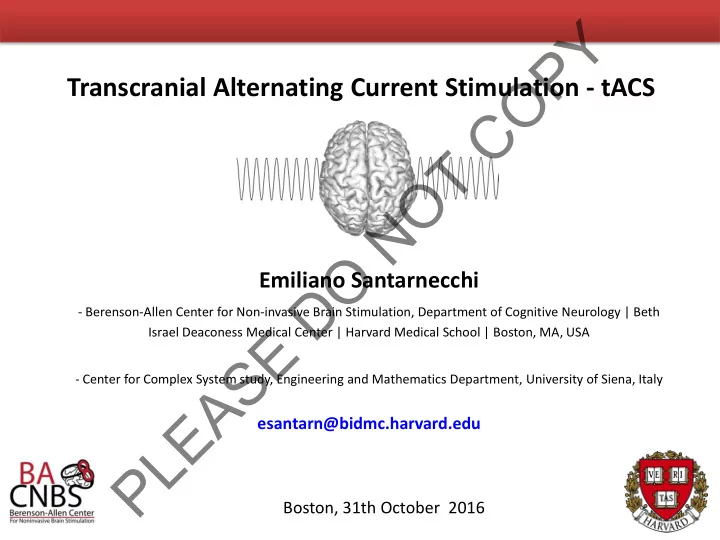
Y P O Transcranial Alternating Current Stimulation - tACS C T O N O Emiliano Santarnecchi D - Berenson-Allen Center for Non-invasive Brain Stimulation, Department of Cognitive Neurology | Beth E Israel Deaconess Medical Center | Harvard


slide-1
SLIDE 1

Emiliano Santarnecchi

  • Berenson-Allen Center for Non-invasive Brain Stimulation, Department of Cognitive Neurology | Beth

Israel Deaconess Medical Center | Harvard Medical School | Boston, MA, USA

  • Center for Complex System study, Engineering and Mathematics Department, University of Siena, Italy

esantarn@bidmc.harvard.edu Boston, 31th October 2016

Transcranial Alternating Current Stimulation - tACS

P L E A S E D O N O T C O P Y

slide-2
SLIDE 2

* PubMed Search : “Transcranial magnetic Stimulation”, “Transcranial Direct Current Stimulation”, Transcranial Alternating Current Stimulation”

A growing field

TMS: Transcranial Magnetic Stimulation tDCS: transcranial Direct Current Stimulation tACS: transcranial Alternate Current Stimulation tRNS: transcranial Random Noise Stimulation

“tACS allows to modulate brain oscillations in a frequency specific manner”

Santarnecchi et al. 2015 Curr Opin Behav Sci

P L E A S E D O N O T C O P Y

slide-3
SLIDE 3
  • Oscillatory pattern and synchronicity in the brain

 tACS - Mechanism of action

  • tACS evidence

 Perception (Hands-On session tomorrow)  Cortico-spinal excitability and motor system  Cognition  Phase-Related activity  State and Trait – dependency  Therapeutic potential

  • Future Directions

Outline

P L E A S E D O N O T C O P Y

slide-4
SLIDE 4

Questions? Comments? Ideas? Feedback?

  • Kirsten Building - KS-450
  • esantarn@bidmc.harvard.edu

P L E A S E D O N O T C O P Y

slide-5
SLIDE 5

Disclosure

Emiliano Santarnecchi serves as consultant for EBNeuro, a joint stock company developing biomedical devices for neurostimulation, neuromodulation and electroencephalography. He has no actual or potential conflict of interest in relation to this presentation, none of the tools presented in the following slides are property of EBNeuro.

P L E A S E D O N O T C O P Y

slide-6
SLIDE 6
  • Experience with EEG/Brain Oscillations?
  • Experience with tACS?

P L E A S E D O N O T C O P Y

slide-7
SLIDE 7

tCS techniques

Santarnecchi et al. 2015 Curr Opin Behav Sci

P L E A S E D O N O T C O P Y

slide-8
SLIDE 8

Why tACS?

P L E A S E D O N O T C O P Y

slide-9
SLIDE 9

Gamma: selective attention Alpha: visual perception Ѳ: working /long-term memory Beta: movement Alpha: automatic movements Θ: spatial orienting

Brain oscillations

P L E A S E D O N O T C O P Y

slide-10
SLIDE 10

Sleep–wake cycles are evident even if external light conditions are held constant (grey shade) Cyclic patterns in behaviour Intrinsic oscillators (circadian clocks) which cause periodicity in bodily function

Phase? Oscillatory pattern and periodicity in behaviour

Phase, angles, degrees….. Oscillators are in opposite phase (anti-phase)

Frequency?

Number of cycles x second (1 cycle * second=1Hz) 10Hz 2Hz

P L E A S E D O N O T C O P Y

slide-11
SLIDE 11

Tuth et al. 2012, Current Biology

  • Are these oscillatory patterns immutable?
  • Oscillatory cycle establishes a recurrent temporal reference frame that allows for the

coding of temporal relations between groups of neural elements

  • This reference frame is not fixed but is subject to dynamic changes (phase resetting),

especially in pathological states.

“Entrainment” phenomenon

Entrainment of endogenous oscillatory pattern  Changes in behaviour

tACS induces entrainment of brain oscillations following the same principle (theta, alpha, beta, gamma, ..)

P L E A S E D O N O T C O P Y

slide-12
SLIDE 12

Constant Fields Membrane Polarization Spike Rate Change

DC Stimulation AC Stimulation

Oscillating Fields Network Synchrony Spike Phase Change Synchrony Effect

Synchronize the I nput

E

Mechanism of action

Amplify the Output

P L E A S E D O N O T C O P Y

slide-13
SLIDE 13

tACS effect

P L E A S E D O N O T C O P Y

slide-14
SLIDE 14

Why tACS? (2)

P L E A S E D O N O T C O P Y

slide-15
SLIDE 15

EEG Oscillations and BEHAVIOURAL CORRELATES

Sleep, learning, motivational processing Memory, emotional regulation, creativity Active inhibition of task- irrelevant areas Mainly Motor activity Abstract mental activity, cognitive control, perceptual binding

P L E A S E D O N O T C O P Y

slide-16
SLIDE 16

EEG Oscillations and PATHOLOGY

  • Reduced synchrony in Schizophrenia
  • Reduced amplitude in Alzheimer
  • Increased Amplitude in Bipolar dis.
  • Reduced synchrony in Schizophrenia
  • Reduced synchrony in Alzheimer
  • Reduced coherence in Alzheimer
  • Increased phase-locking at Frontal and

Central electrodes in Schizophrenia

  • Reduced Coherence in Alzheimer and

Schizophrenia

  • Increased amplitude in Parkinson
  • Increased Coherence in Bipolar dis.
  • Decreased/increased amplitude in

Schizophrenia (?)

  • Increased Phase-locked response in

ADHD

P L E A S E D O N O T C O P Y

slide-17
SLIDE 17

Frequency-specific effects?

P L E A S E D O N O T C O P Y

slide-18
SLIDE 18

tACS: experimental evidence

P L E A S E D O N O T C O P Y

slide-19
SLIDE 19

tACS might shift intrinsic dominant oscillations and “tune the system”

tACS effect on brain oscillations: in vitro evidence

Higher stimulation frequency

P L E A S E D O N O T C O P Y

slide-20
SLIDE 20

0.8-1.7Hz

  • tACS induce AC Fields in the Brain
  • AC fields can phase-locked spiking activity

Rat (in-vivo)

First animal evidence

  • Effect of Stimulation Amplitude

Larger Amplitude Homogenous Phase More Neurons

Ozen et al., 2010

P L E A S E D O N O T C O P Y

slide-21
SLIDE 21

tACS induced Oscillations Synaptic mediated Oscillations

cooperate or compete

Coherent I ncoherent

tACS ~ 1.5Hz

Phase-locked (25-50% ) No Phase-locked

Exploring Sleep

Endogenous Resonance Principle

Ozen et al., 2010

S=sleep R=rest E=exploration Push & pull

P L E A S E D O N O T C O P Y

slide-22
SLIDE 22

What is frequency sensitivity of tACS evoked Visual Sensation?

Rationale Design

tACS Frequency Phosphene Threshold

Electrodes Inion (+ 4cm) - Vertex Current 0-40Hz, 0-1mA, 5s each Subjects 8 Healthy

Kanai et al., 2008

tACS and Phosphene

Eye Open/Closed Alpha (Adrian, 1934)

alpha beta gamma

P L E A S E D O N O T C O P Y

slide-23
SLIDE 23
  • Occipital tACS can evoke phosphene perception
  • Greater stimulation at alpha band (dark) and beta band (light)

Kanai et al., 2008

Results

tACS and Phosphene: frequency specific effects

P L E A S E D O N O T C O P Y

slide-24
SLIDE 24

tACS and Cortico-spinal Excitability

P L E A S E D O N O T C O P Y

slide-25
SLIDE 25
  • Are beta oscillations in motor cortex functional or epiphenomenon?

Question

tACS over M1 Amplitude of TMS induced MEP*

* MEP- Motor Evoked Potential ,indicating the strength of the corticospinal response

Design

Electrodes C4 (TMS hot-spot) + P4 (control) – Pz Current 5, 10, 20, 40Hz, 0.5mA* , 90s Subjects 15 Healthy

* Kept below phosphene or skin sensation threshold.

tACS

10xTMS 10xTMS 10xTMS 10xTMS 10xTMS 10xTMS 10xTMS

Mot

  • t or
  • r Mod
  • dalit y

tACS and Corticospinal Excitability

Feurra et al., 2011 Journal of Neuroscience

P L E A S E D O N O T C O P Y

slide-26
SLIDE 26
  • Parietal tACS @ 20HZ specifically increases MEP amplitude

Results

MEP Amplitude (µV)

tACS and Corticospinal Excitability

Feurra et al., 2011 Journal of Neuroscience

P L E A S E D O N O T C O P Y

slide-27
SLIDE 27

Institute of Biomedical Engineering Division of neuroscience

tACS and Motor performance

P L E A S E D O N O T C O P Y

slide-28
SLIDE 28

tACS and Motor performance

Santarnecchi et al., under revision

  • Are Gamma oscillations in motor cortex functional or epiphenomenon?

Question

Muthukumaraswamy 2010

  • Tracking task using MEG
  • Observed an Increase in

Gamma activity (~90HZ) in the motor cortex during movement.

  • What does Gamma
  • scillations in the motor

cortex represent..?

P L E A S E D O N O T C O P Y

slide-29
SLIDE 29

tACS and Motor performance - II

  • Are Gamma oscillations in motor cortex functional or epiphenomenon?

Question

Visuomotor task + 10, 20, 60, 80Hz and Sham tACS on the motor cortex.

Effects on several components of the motor program: Acceleration, Pursuit, Loops, Turns, etc.. (o) High spatial and temporal resolution analyses.

Santarnecchi et al., under revision

P L E A S E D O N O T C O P Y

slide-30
SLIDE 30

tACS and Motor performance - II

  • Significant enhancement
  • f performance during

TURNS during Gamma tACS (80Hz), with a trending result for 60Hz tACS.

  • Effect is present in a

specific time window (200-700ms after each TURN), coherently with MEG studies showing increase in EEG power at 90HZ during a similar task.

  • No effects during Loop,

Acceleration, Pursuit

80Hz 60Hz

P L E A S E D O N O T C O P Y

slide-31
SLIDE 31
  • Are beta oscillations in motor cortex functional or epiphenomenon?

Question

Visuomotor Task + 20Hz tACS/Sham Reaction time + EEG-EMG

Electrodes C4 (TMS hot-spot) – P3 Current 20Hz, 0.6mA* , -2s to +8s Subjects 14 Healthy

* Kept below phosphene or skin sensation threshold.

Design

tACS and Motor performance

Pogosyan et al., 2009

P L E A S E D O N O T C O P Y

slide-32
SLIDE 32

active sham

EEG-EMG Coherence

Results

Pogosyan et al., 2009 I nitial Velocity

sham= active

  • Parietal 20Hz tACS slowed initial velocity

(small effect)

  • Parietal 20Hz tACS increased somatosensory-

arm 20Hz coherence

tACS and Motor performance

P L E A S E D O N O T C O P Y

slide-33
SLIDE 33

Institute of Biomedical Engineering Division of neuroscience

tACS and Cognition

P L E A S E D O N O T C O P Y

slide-34
SLIDE 34

Sleep Architecture

for further reading see Diekelmann, 2010 * PGO: ponto-geniculooccipital

Rationale

0.8Hz 8-14Hz (neocortex) (thalamus) (hyppocampus) 100-300Hz

*

4-8Hz (Pons-LGN) (hyppocampus)

Memory Consolidation

Declarative memory Non- Declarative memory

P L E A S E D O N O T C O P Y

slide-35
SLIDE 35

Paired Associated Learning Task Finger Sequence Tapping Task

9p

learning Recall

10:30p 7a 8:30a 11p 6:30a

c W, wake; 1–4, sleep stages 1–4 Electrodes F3-Mastoid , F4-Mastoid (diam=1cm) Current 0.75Hz, ~0.33A , 5min/1min ON/OFF Subjects 13 Healthy

mastoid

Design

46 word pairs 5-element sequences (e.g. 4-2-3-1-4) in 30s Mar arshal all et al., Nature 2006

Declarative memory Non-declarative memory

Memory Consolidation

P L E A S E D O N O T C O P Y

slide-36
SLIDE 36

# Correct Words

(Recall – Training)

# Correct Taps

(Recall – Training)

  • Bilateral 0.75Hz frontal- tACS during early sleep selectively enhances

hippocampus-dependent retention of declarative memory

* * P < 0.01

Results Memory Consolidation

Mar arshal all et al., Nature 2006

P L E A S E D O N O T C O P Y

slide-37
SLIDE 37
  • tACS entrained SWS and spindle power spectra in the prefrontal region

EEG Activity

Hz

* Bands for slow oscillations (0.5–1 Hz) ; Bands for spindle oscillations (8-12 Hz)

* *

SWS spindle

Memory Consolidation Results

Mar arshal all et al., Nature 2006

P L E A S E D O N O T C O P Y

slide-38
SLIDE 38

Rationale

(Gianotti, 2009)

  • Right>Left Theta oscillations PFC

< Risk Taking

But…bilateral DLPFC tDCS (regardless of polarity) facilitate risk-adverse behaviour in Balloon Analog Risk Task (BART) ( Fecteau, 2007)

PFC: prefrontal cortex

tACS effects on Risk Taking

P L E A S E D O N O T C O P Y

slide-39
SLIDE 39

Does theta oscillation in PFC affect risky decision making?

Question

theta tACS PFC Left/Right/Sham pumps in Balloon Analog Risk Task

Electrodes F3-CP5, F4-CP6 Current 6.5Hz, 0.5mA , -5min +10mins Subjects 27 Healthy

Design

Balloon Analog Risk Task (BART)

Temporal

Risk Taking tACS effects on Risk Taking

Sela et al., 2012

P L E A S E D O N O T C O P Y

slide-40
SLIDE 40
  • Theta tACS over left and not right PFC increases risk taking

behavior

Error bars indicate SEM. * p < 0.05.

# Pumps in BART

Left PFC Sham Right PFC

higher risk

tACS effects on Risk Taking

Results

Sela et al., 2012

P L E A S E D O N O T C O P Y

slide-41
SLIDE 41

Fluid Intelligence – Abstract Reasoning

N=24; tACS 1.250mA

  • Does tACS enhance Intelligence-related processing in a frequency and trial specific

manner? Is prefrontal gamma an epiphenomenon?

Logical and Relational Reasoning Stimuli Santarnecchi et al., Curr. Biology 2013

Question Design

Stimulation sites

P L E A S E D O N O T C O P Y

slide-42
SLIDE 42
  • Decrease of Correct trials Response Time during gamma-tACS
  • Selective effect for Logic trials.
  • First evidence of a “causal” Role of gamma-oscillations in

higher-order cognition.

Results

Santarnecchi et al., Curr. Bio 2013

Fluid Intelligence

No modulation of speed-accuracy tradeoff

P L E A S E D O N O T C O P Y

slide-43
SLIDE 43

Design and Results Lustenberger et al., Cortex 2015

Creativity

  • Torrance Test of Creative Thinking (TTCT)
  • In-phase tACS over the prefrontal lobes
  • Sham, 10Hz and 40Hz tACS

10Hz tACS effect on a Creativity Index

P L E A S E D O N O T C O P Y

slide-44
SLIDE 44

Phase-Related Modulation by tACS

P L E A S E D O N O T C O P Y

slide-45
SLIDE 45

Sternberg Working memory task

Fronto-parietal Phase-lag Band-pass 6 +/- 1 Hz

Polania et al., Curr. Bio 2012

tACS and Phase Coupling: Working Memory

  • Can we modulate synchronization during

working memory processing? Does it matters?

Question

P L E A S E D O N O T C O P Y

slide-46
SLIDE 46

Online tACS protocol WM performance Polania et al., Curr. Bio 2012

Design and Results

tACS and Phase Coupling: Working Memory

P L E A S E D O N O T C O P Y

slide-47
SLIDE 47

State Dependency of tACS

P L E A S E D O N O T C O P Y

slide-48
SLIDE 48

State Dependency: Motor Imagery

N=18, tACS= 1mA (peak-to-peak).

  • Does the effects of tACS depend on brain state?

Question

Feurra et al., 2013, Journal of Neuroscience

P L E A S E D O N O T C O P Y

slide-49
SLIDE 49

State Dependency

Consistent increase of MEP size during Motor Imagery versus the quiescence state, regardless of the type of tACS applied. Dissociation between tACS (5 Hz) and-tACS (20 Hz), after removing the average facilitatory main effect of motor imagery

Results Feurra et al., 2013, Journal of Neuroscience

P L E A S E D O N O T C O P Y

slide-50
SLIDE 50

State Dependency

Neuling et al., 2013

  • Does the after-effects of tACS depend on the endogenous power of
  • scillations?
  • Exp. 1: 19 sbjs, 20’ tACS at Individual Alpha frequency*, Eyes Open
  • Exp. 2: 29 sbjs 20’ tACS at Individual Alpha frequency*, Eyes Closed

*power peak in the alpha range (8–12Hz)

P L E A S E D O N O T C O P Y

slide-51
SLIDE 51

State Dependency

tACS effect depend on brain states During the stimulation…

  • Alpha reaches a plateau during Eyes Closed condition

Neuling et al., 2013 Results

P L E A S E D O N O T C O P Y

slide-52
SLIDE 52

State-Phase Dependency

Oddball task Helfrich et al., Curr. Bio. 2014 Stimuli presented at different phase-angles

  • Phase-angle dependency of tACS effect?

14 sbjs, parieto-occipital tACS @ 10Hz

Question Design

P L E A S E D O N O T C O P Y

slide-53
SLIDE 53

State State-Phase Dependency

Increase in alpha power after tACS Coherence and Target detection accuracy relative to the different phase angles Peak Peak Helfrich et al., Curr. Bio. 2014 Results

P L E A S E D O N O T C O P Y

slide-54
SLIDE 54

Institute of Biomedical Engineering Division of neuroscience

Trait-dependency of tACS?

P L E A S E D O N O T C O P Y

slide-55
SLIDE 55

N=58 tACS=1.0 mA, tRNS=1.0 mA

Individual differences in response to tACS?

Santarnecchi et al., 2016

Compared tACS and tRNS effect in both fluid intelligence and Working memory tasks. Confirmed previous finding

P L E A S E D O N O T C O P Y

slide-56
SLIDE 56

tACS=1.0 mA, tRNS=1.0 mA

Individual differences in response to tACS?

  • Effect of tACS reflect individual differences, which can be considered a stable

“Phenotype”

  • Relevant for the ethical evaluation of cognitive enhancement intervention

Santarnecchi et al., 2016

P L E A S E D O N O T C O P Y

slide-57
SLIDE 57

Therapeutic Potential of tACS

P L E A S E D O N O T C O P Y

slide-58
SLIDE 58

Institute of Biomedical Engineering Division of neuroscience

Fedorov et al., 2010 (RCT) tACS in Stroke..?

Ninety-eight patients that had suffered ischemic stroke 21.4 months earlier were randomly assigned to either: 1) group D (n = 30) receiving conventional drug therapy 2) group ACS (n = 32) treated for 12 days with tACS (~20Hz, 30’) 3) group D/ACS (n = 36) receiving combined drug therapy/tACS. Stroke severity level (SSL) was assessed by the NIH-NINDS stroke scale before and after treatment and at a 1-month follow-up to evaluate motor impairments (weakness, ataxia), sensory loss, visual field defects, and cortical deficits (aphasia, neglect). At each time point standard EEG recordings (10–20 system) were conducted. transorbital ACS

P L E A S E D O N O T C O P Y

slide-59
SLIDE 59

Institute of Biomedical Engineering Division of neuroscience

tACS in Stroke..?

Aphasia subscale

P L E A S E D O N O T C O P Y

slide-60
SLIDE 60

Electrodes Transorbital (above-below eye) Current Individual alpha- flicker frequency, phosphene threshold (<1mA) , 15min x 10 days Subjects 24 patients with visual field loss caused by damage to the optic nerve

  • Can tACS restore lost vision in optic neuropathy?

tACS/Sham

Detection accuracy (DA) in high-

resolution perimetry (HRP) + EEG

Design

Treating Optic Neuropathy?

Question

Sabel et al., 2011 (RCT)

P L E A S E D O N O T C O P Y

slide-61
SLIDE 61

Kast st en, 1998

Visual Restitution Training (VRT)

  • Software designed for patients with visual field defects caused by optic

nerve diseases and post-chiasmal brain lesions.

  • Binocular visual stimulation within a transition zone between the intact

visual field area and the field defect.

P L E A S E D O N O T C O P Y

slide-62
SLIDE 62

High Resolution Perimetry Visual Field

Mean DA Change

2 month

  • 1. Intact
  • 2. Relative
  • 1. Intact 2. Relative defect
  • 3. Absolute defect

3 2 1

Results

3 2 1

  • 3. Absolute

Blue= increase , Red= decrease DA

Sabel et al., 2011 (RCT)

Pre Post Restored pixels

Treating Optic Neuropathy?

Improved:

  • temporal processing of visual stimuli
  • detection performance in static perimetry
  • visual acuity

P L E A S E D O N O T C O P Y

slide-63
SLIDE 63

EEG Spectrum

(Occipital)

Alpha Power Spectra

(Occipital)

I ncreased Alpha Pre Post Sham Active

Pre Post

I ncreased Alpha

  • tACS restored some lost vision in patients with optic neuropathy.
  • The effect was accompanied by an increase in occipital alpha

spectrum.

Treating Optic Neuropathy?

Results

Sabel et al., 2011 (RCT)

P L E A S E D O N O T C O P Y

slide-64
SLIDE 64
  • Can tACS reduce tremor in PD patients?

Rationale

Closed-loop tACS – tremor

phase (accelerometer) Tremor amplitude (accelerometer)

Trem or su suppressi ssion?

Brittain et al., Curr. Bio 2013

accelerometer

Tremor

Tremor Suppression?

Design

P L E A S E D O N O T C O P Y

slide-65
SLIDE 65

Brittain et al., Curr. Bio 2013 Tremor Suppression?

Identification of the optimal Phase-Delay for tremor suppression Tremor Excitation Tremor Suppression Polar Map Phased-locked tACS reduced tremor by up to 50%

P L E A S E D O N O T C O P Y

slide-66
SLIDE 66
  • Patients with tinnitus-related annoyance have lower alpha activity at

the right PFC.

Rational

Red: high distress > low distress Blue: high distress < low distress

Right PFC

  • tDCS (left temporal or bifrontal) reduce tinnitus intensity (e.g. Song

2012)

Mean Alpha Spectrum

Measured with EEG and Low Resolution Electromagnetic Tomography (LORETA)

Treating Tinnitus?

P L E A S E D O N O T C O P Y

slide-67
SLIDE 67

Results

  • left-right DLPFC tACS in the alpha “band” was not effective as

tDCS in reducing tinnitus intensity (and annoyance). Tinnitus I ntensity Rating tACS tDCS

Real Sham Real Sham

Pre Post

Vanneste et al., 2013 (RCT) Treating Tinnitus? No..

P L E A S E D O N O T C O P Y

slide-68
SLIDE 68

Institute of Biomedical Engineering Division of neuroscience

Transcranial Random Noise Stimulation (tRNS)

TMS tDCS tACS

Year

tRNS

tRNS

P L E A S E D O N O T C O P Y

slide-69
SLIDE 69

tRNS - Method

Terney et al., 2008 (first tRNS evidence)

Random level of current generated for every sample. The signal is normally distributed, with the current intensity constantly fluctuating around 0uA. For a 1mA amplitude, 99%

  • f the Current is between -500/500uA (Peak to Peak amplitude)

Stimulation frequency constantly change within a predefined spectrum

P L E A S E D O N O T C O P Y

slide-70
SLIDE 70

tRNS – Neurophysiological evidence

Terney et al., 2008 Experiment 1 10’ tRNS (1-640Hz) Experiment 2 10’ tRNS (1-100Hz) vs (101-640Hz) Stimulation site: Primary Motor Cortex, Premotor cortex Electrophysiological evaluation: Motor Evoked Potential (MEP), Rectruitment Curve, Short-Interval Intracortical Inhibition (SICI), Intracortical Facilitation (ICF), Long-Interval Intracortical Faciliation (LICI), Cortical Silent Period (CSP). Behavioural evaluation: Serial Reaction Time Task (SRTT)

P L E A S E D O N O T C O P Y

slide-71
SLIDE 71

tRNS - Results

Increase in cortical excitability lasting for 60’ after stimulation. Effect is selective for High-Frequency tRNS (101-640Hz) Significant effect on ICF (12, 15ms) No changes in Recruitment Curve, SICI, LICI, CSP. No effect for premotor cortex stimulation.

Experiment 1 tRNS (1-640Hz) Experiment 2 tRNS (1-100Hz) vs (101-640Hz)

tRNS improves implicit motor learning in its early phase (<RT). Behavioural effect

P L E A S E D O N O T C O P Y

slide-72
SLIDE 72

tRNS & Cognition

Snowball et al., 2013

  • tRNS on Bilateral Dorsolateral Prefrontal Cortex (DLPFC), a

key region in Arithmetic.

  • 5 Days of training (Calculation and Memory-recall-based

arithmetic training) + tRNS/Sham

  • Near Infrared Spectroscopy (NIRS) recording during training

Calculation learning rates increase during tRNS tRNS effect correlates with changes in the hemodynamic response

P L E A S E D O N O T C O P Y

slide-73
SLIDE 73

tES Methods

P L E A S E D O N O T C O P Y

slide-74
SLIDE 74

Principles of tACS

  • Oscillations
  • Endogenous Resonance

tACS probe oscillatory neural activities

  • Perception (vision, tactile) (HANDS-ON session)
  • Cortico-Spinal Excitability
  • Cognition (Intelligence, memory, risk-taking,...)

Potential therapeutic tool

  • Visual restoration, tremor, stroke..

Future Directions ?

E

Summary

P L E A S E D O N O T C O P Y

slide-75
SLIDE 75

esantarn@bidmc.harvard.edu

Grazie dell’attenzione

P L E A S E D O N O T C O P Y