
SLIDE 1
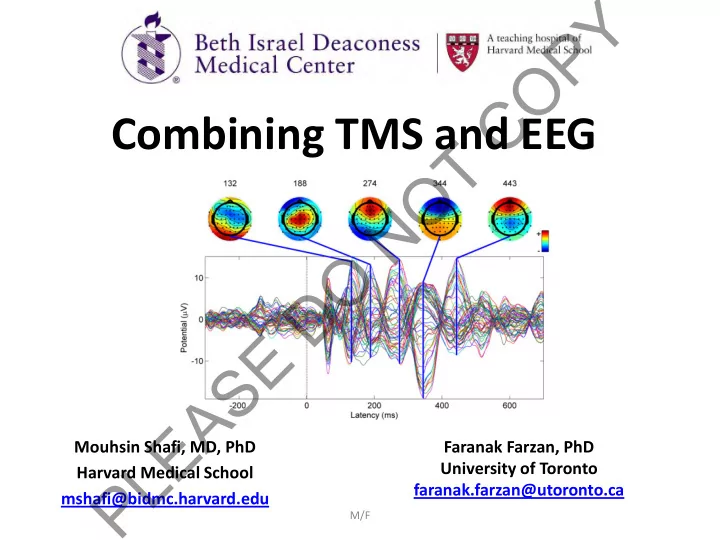
Combining TMS and EEG
Mouhsin Shafi, MD, PhD Harvard Medical School mshafi@bidmc.harvard.edu Faranak Farzan, PhD University of Toronto faranak.farzan@utoronto.ca
M/F
Y P O C Combining TMS and EEG T O N O D E S A E Mouhsin - - PowerPoint PPT Presentation
Y P O C Combining TMS and EEG T O N O D E S A E Mouhsin Shafi, MD, PhD Faranak Farzan, PhD L University of Toronto Harvard Medical School P faranak.farzan@utoronto.ca mshafi@bidmc.harvard.edu M/F Y P Talk Overview O C
Mouhsin Shafi, MD, PhD Harvard Medical School mshafi@bidmc.harvard.edu Faranak Farzan, PhD University of Toronto faranak.farzan@utoronto.ca
M/F
M/F
neurologic and psychiatric diseases
Outcome Measures MEP Amplitude
M/F
Motor Responses MEPS
M/F
M/F
M/F
Amplitude (or Power) Frequency Phase # of Cycles/Second (Hz) Strength (µV or µV2) 10Hz 20Hz π (Radians)
M/F
Trial 1 Trial 2 Trial 100
Event/Stimulus
Time: Event Related Potential or Evoked potentials Frequency: Event Related Spectral Perturbation Phase
M/F
Frequency Domain
imag real
Phase
Xi (f)
M/F
1 2 3
Spontaneous EEG: Spectral Power EEG + Event: Event-Related Potentials (ERP or EP) Event-Related Spectral Perturbation (ERSP) Event-Related Synchronization (ERS) Event-Related Desyncronization (ERD) 1 2 3
Direction of Information Flow Directed Transfer Function Directed Partial Coherence Cross-Frequency Phase-Amplitude Coupling Correlation (time) Coherence (frequency) Synchrony (phase-locking)
Θ
M/F
M/F
M/F
M/F
Ives et al., 2006, Clinical Neurophysiology
TMS pulse generated too high a voltage (> 50mV) for most amplifiers to handle. Amplifiers were saturated or even damaged!
M/F
References: Vaniero et al, 2009; Ilmoniemi et al, 2010
analog digital converter (ADC) resolution (i.e., 24 nV/bit) compared to older 16-bit ADC resolution that was limited to 6.1 mV/bit, and high sampling rate (20 kHz)=> capture the full shape of artifact and prevent amplifier clipping.
Virtanen et al., Med Biol Eng Comput, 1999;
nV/bit) and operational range of EEG amplifiers so that amplifiers would not saturate by large TMS voltage
Nexstim (Helsinki, Finland) BrainProducts (Munich, Germany) NeuroScan ( Compumedics )
reduce the gain for -50µs to 2.5 ms relative to TMS pulse.
avoid amplifier saturation; Artifact removed by finding the difference between two conditions.
Thut et al., 2003; Ives et al., 2006;
M/F
Reference: Pascual-Leone et al., 1990, Lancet
One of the subjects had a burn on the skin, to test whether this had anything to do with rTMS, they placed electrodes on their arm and stimulated the electrode with different number of stimuli, different intensity and different duration of stimulation.
M/F
Temp ~ r2 Temp ~ B2 Temp ~ metal electrical conductivity (σ)
Virtanen et la., 1999
M/F
References: Vaniero 2009; Ilmoniemi 2010;
M/F
~ 100 dB 5 cm of the coil Air & Bone Conducted
Auditory masking with a frequency matched to the spectrum of the TMS click
Nikouline 1999 Massimini 2005
M/F
Frontalis Temporalis Occipitalis
Retrieved From: http://education.yahoo.com/referen ce/gray/illustrations/figure?id=378
Independent Component Analysis
M/F
Mutanen 2012
M/F
FZ OZ EOG1 EOG2 F3 F4
M/F
M/F
Results from: H. Sekiguchi et al., Clinical Neurophysiology Solution: Rearrange the lead wires relative to the coil orientation.
C45, and CC45 directions,
M/F
Create a temporal template of TMS artifact and subtract it; Example: TMS only condition; TMS+Task Condition, then subtract TMS Only from TMS+Task
References: Thut et al. 2003; 2005. Interpolation: Cut the artifact and connect the prestimulus data point to artifact free post stimulus Refereces: Kahkonen et al. 2001; Fuggetta et al. 2005; Reichenbach et al. 2011. References: Litvak et al. 2007; Korhonen 2011 Hamidi 2010; Maki & Ilmoniemi 2011; Hernandez-Pavon 2012; Braack 2013, Rogasch 2014 Parse out EEG recording into independent (ICA) or principle (PCA) components and remove the component that are due to noise; Non-linear Kalman filter to account for TMS induced artifact References: Morbidi et al., 2007
Remove by setting the artifact to zero
References: Esser 2006; Van Der Werf and Paus 2006; Huber 2008; Farzan 2010;
M/F
M/F
Rogasch et al, NeuroImage 2014: Used ICA to remove components that are likely muscle and decay artifacts related to stimulation
**Clean**
Raw Slow Decay Blink AEP Bad electrodes
Significantly Different from Clean
Rogasch et al., NeuroImage, 2014
M/F
M/F
Step-by-Step Guideline
Select an Input
1 Control for the Brain State
disease states
2 Use a TMS Compatible EEG System
3 Prepare the EEG CAP
impedance
arrangement of sensors and wires Caution: No direct contact between the coils and the reference or ground electrodes 4 Data Collection 6 Control for Factors Affecting TMS and EEG Outcomes
5 Data Preprocessing I Remove the TMS-related artifacts 7 Data Preprocessing II
environmental noise (e.g., 60Hz noise, movement)
physiological noise (e.g, EOG, EMG, EKG) or electrode movement 8 Data Preprocessing (Optional)
channels
9 Data Analysis
measures
10 Statistical Analysis 11 M/F
M/F
Motor Responses MEPS
Cortical Responses Local Field Potentials
M/F
Stimulation (input) Recording (output) Concurrently Stimulate & Record Adjust Stimulation Parameters Based on the Recording
Manual Adjustment
M/F
Advanced Technology Neuroscience Clinical Application
F
M/F
In 1989, Cracco et al., examined transcallosal responses by applying TMS to one side and recording EEG from the other side
Cracco et al., 1989, Electroencephalogr Clin Neurophysiol
Artifact reduced by adjusting the arrangement between the coil and the electrode and placing a steel strip ground electrode in between the coil and the recording electrodes
M/F
Ilmomiemi et al., Neuroreport 1997
M/F
Komssi, Human Brain Mapping, 2004 Other Earlier or Later References: Paus 2001; Komssi, 2002; Ferreri 2010;
M/F
Maki & Ilmoniemi 2010
P30 N100
TMS Pulse
The N15-P30 correlated with the amplitude of MEP at the periphery N100 may be related to Inhibitory mechanism Bender et al., 2005; Bonato et al., 2006 Farzan et al., 2013
M/F
Potentials produced by DLPFC stimulation are correlated with, but smaller than, potentials produced by motor cortex stimulation. Motor cortex TEPs increase faster with higher intensity of stimulation than DLPFC TEPs
Kahkonen 2004
M/F
Komissi et al, Human Brain Mapping, 2004 Kahkonen 2005
M/F
Massimini 2005
M/F
Rosanova et al, JNeuroscience, 2009
Alpha in Occipital Beta in Parietal Beta and Gamma in Frontal
M/F
Canali 2015 J Affective Do
M/F
Prefrontal Cortex Motor Cortex
Daskalakis 2008
M/F
Rogasch 2015 Cortex
M/F
Esser 2006: Following, 5 Hz rTMS to motor cortex, a potentiation
M/F
Vernet 2012: TMS-evoked theta and alpha
cTBS, while TMS-evoked beta activity
state beta power after cTBS
M/F
Shafi 2014: cTBS produced distributed frequency-specific changes in network connectivity, resulting in shifts in network topology and graph-theoretic metrics with implications for brain information processing
M/F
M/F
Power of spontaneous alpha oscillations in the sensorimotor cortex immediately prior to administration of TMS is negatively correlated with TMS-evoked MEP amplitudes (Sauseng 2009; Zarkowski 2006) The amplitude and phase of the mid- range beta oscillations recorded distally
subsequent TMS-evoked MEP amplitudes (Maki & Ilmoniemi 2010)
Predict: Behavior & Motor Response, or EEG Response
M/F
Massimini 2005 Ferrarelli 2010
M/F
Morishima 2009: TMS applied to FEF during performance of a visual discrimination task for motion direction or visual gender.
M/F
Before cTBS, leftward visual exploration is positively correlated with right TPJ alpha connectivity, and with connectivity between the R IPS and R MFG cTBS to R PPC decreased leftward gaze in 7/9 subjects, decreased alpha connectivity in the R IPS and L FEF, and increased alpha connectivity in the L IPS and R FEF The decrease in leftward gaze after cTBS was correlated with the increases in alpha connectivity in the left IPS The decrease in left gaze was also correlated with the initial alpha connectivity in the R TPJ Rizk 2013
M/F
See also: Sauseng 2009, Romei 2010
Thut 2011: Showed that alpha-TMS targeted to the source of EEG alpha activity can upregulate the targeted alpha-oscillations in the attention network Klimesch 2003: Showed that rTMS at individual alpha frequency to frontal and parietal sites led to significant improvement in mental
present at other frequencies
M/F
M/F
M/F
Reference(s): Farzan 2010; Maki 2010 & 2011; Ferreri 2011
Reference(s): Lioumis 2009; Farzan 2010; Casarotto 2010
M/F
Farzan 2010
100ms
M/F
Lioumis et al., 2009 Retest after one week A high overall reproducibility (r > 0.80) was
M/F
Farzan et al., 2014, NeuroImage Cronbach’s Alpha of N100 Response across 3 Testing Sessions
N100 TMS Pulse
M/F
Decreased complexity of evoked response in subjects with loss of consciousness due to any etiology, and in patients with vegetative versus minimally conscious versus locked-in states
Casali 2013
M/F
Farzan 2010
NO difference in EMG measure of LICI. Only selective deficit when LICI measured for gamma oscillations in the DLPFC . Increased delayed activity with motor cortex stimulation in schizophrenia patients versus healthy subjects
Other TMS-EEG in SCZ: Ferrerali 2009 Fransteva 2012
M/F
Increase in delayed:early evoked activity in patients with active epilepsy as compared to controls. Abnormal delayed activity is more prominent in regions with functional connectivity to regions of abnormal cortical development
Shafi et al, 2015
Sources of abnormal delayed activity (A, B) spatially colocalized with interictal discharge (C, E) and seizure onset zones (D,F) even though stimulation site was far away (red dot in above figure Shafi et al, 2015
Selection of Location of Stimulation Target
Titration of strength, frequency or length of stimulation
(depression)
Massimini 2007)
Timing of delivery of TMS stimulation
stimulation is more likely to achieve a specific result (Romei 2008, Sauseng 2009)
2010; Dugue 2011) Identification of subjects
Duration of stimulation
M/F
M/F
– Seven-year history of morning myoclonus. First generalized seizure on 10/31/12, age 22 started on LVT. Next seizure 6/24/13 Additional GTCs with clusters in July 2 separate ICU admissions On cEEG, found to have szs arising from either L or R occipital pole, frequent focal as well as generalized
M/F
M/F
Figures courtesy of Sue Herman
M/F
VanHaerents et al, 2015 Clinical Neurophysiology
M/F
Tinnitus Patients Controls Wang 2015 PLOS One
Leuchter 2015 Br Stim
Farzan F et al., NeuroImage. In revision
M/F
M/F