
SLIDE 1
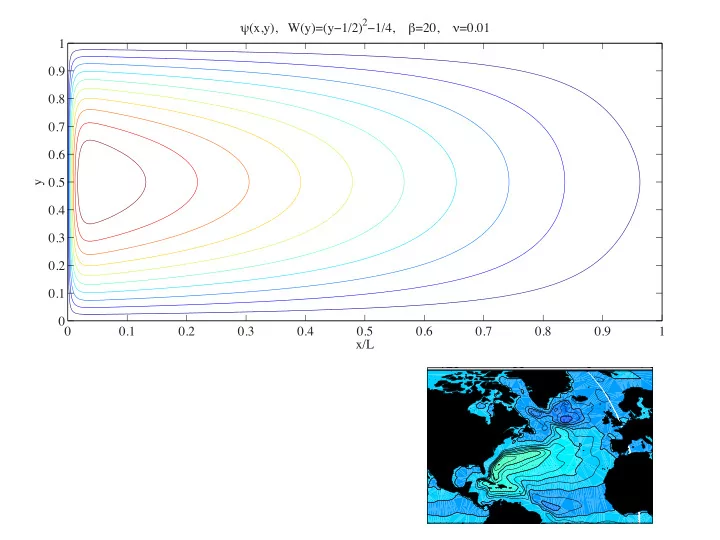
x/L y ψ(x,y), W(y)=(y−1/2)2−1/4, β=20, ν=0.01 0.1 0.2 0.3 0.4 0.5 0.6 0.7 0.8 0.9 1 0.1 0.2 0.3 0.4 0.5 0.6 0.7 0.8 0.9 1
- 120
- 60
+ 60
(x,y), W(y)=(y1/2) 2 1/4, =20, =0.01 1 0.9 0.8 0.7 0.6 0.5 - - PowerPoint PPT Presentation
(x,y), W(y)=(y1/2) 2 1/4, =20, =0.01 1 0.9 0.8 0.7 0.6 0.5 y 0.4 0.3 0.2 0.1 0 0 0.1 0.2 0.3 0.4 0.5 0.6 0.7 0.8 0.9 1 x/L -120 - 60 0 + 60 Wind Forcing Kallberg et al. 1995 (ERA-40 reanalysis) Ocean
x/L y ψ(x,y), W(y)=(y−1/2)2−1/4, β=20, ν=0.01 0.1 0.2 0.3 0.4 0.5 0.6 0.7 0.8 0.9 1 0.1 0.2 0.3 0.4 0.5 0.6 0.7 0.8 0.9 1
+ 60
Kallberg et al. 1995 (ERA-40 reanalysis)
20 40 60 80 100 150 200 +120°
0° + 60°
15 ° 0° 15° +45° +60° +75°
Time-averaged (16-year) ocean circulation
Wunsch, 2011
Transport streamfunction (106 m3/s = 1 Sverdrup)
Haidvogel, McWilliams, Gent, J. Phys. Oceanography 1992
Numerical Simulations: Time-averaged Instantaneous Eddies
Haidvogel, McWilliams, Gent, J. Phys. Oceanography 1992
Instantaneous Sea-surface temperature Gulf-stream ‘rings’
The surface sources of global ocean waters. Oceanic volume that has originated in each 2° by 2° surface location (11,113 origination sites), scaled by the surface area of each box to make an equivalent thickness, d. The color-scale follows a base ten logarithm of the field.
Antarctic Bottom Water (AABW) North Atlantic Deep Water (NADW) Antarctic Intermediate Water (AAIW)
Averaging, across an ocean in longitude
(sometimes called the Thermohaline Circulation, THC)
−30 −30 −30 − 3 −27 −27 −27 − 2 7 −24 −24 −24 − 2 4 −21 −21 −21 − 2 1 −18 −18 −18 − 1 8 −15 −15 −15 − 1 5 −12 −12 −12 −12 −12 − 9 −9 −9 −9 − 9 −6 −6 −6 −6 −6 −3 −3 −3 −3 −3 3 3 3 3 3 3 3 3 3 3 6 6 6 6 6 6 6 6 6 9 9 9 9 9 9 9 9 −3 − 3 −3 − 3 −3 −3 −3 12 1 2 12 12 12 15 15 15 15 − 6 − 6 − 6 −6 18 18 18 12 12 1 2 − 9 − 9 −9 15 15 21 21 21 21 1 8 −3 − 3 − 3 −3 − 6 −6 21 21 2 4 24 −15 24 −18 − 9 −21 30 −24 −6 −6 −27 2 7 −30 2 1 −3 30 −3 15 −12
Latitude Depth, (m) −60 −40 −20 20 40 60 −5000 −4000 −3000 −2000 −1000
Nikurashin and Vallis, 2011
Atlantic MOC (1 Sv = 106 m3/s)
MI THERMO PYCNOCLI ABYSS Abyss Thermocline Mixed layer
500 1000 1500 2000 2500 3000 3500 4000 4500 5000 5500 6000 1000 2000 3000 4000 5000 6000 7000 8000 9000 10000 11000 12000 13000
20 20 21 21 22 22 23 23 24 24 25 25 25 26 26 26 26 26 26.5 26.5 26.5 26.5 26.5 26.6 26.6 26.6 26.6 26.6 26.6 26.7 26.7 26.7 26.7 26.7 26.7 26.8 26.8 26.8 26.8 26.8 26.8 26.9 26.9 26.9 26.9 26.9 26.9 27 27 27 27 27 27 27.1 27.1 27.1 27.1 27.1 27.1 27.2 27.2 27.2 27.2 27.2 27.2 27.2 27.3 27.3 27.3 27.3 27.3 27.3 27.3 27.4 27.4 27.4 27.4 27.4 27.4 27.4 27.5 27.5 27.5 27.5 27.5 27.5 27.5 27.52 27.52 27.52 27.52 27.52 27.52 27.52 27.54 27.54 27.54 27.54 27.54 27.54 27.54 27.56 27.56 27.56 27.56 27.56 27.56 27.56 27.58 27.58 27.58 27.58 27.58 27.58 27.58 27.6 27.6 27.6 27.6 27.6 27.6 27.6 27.62 27.62 27.62 27.62 27.62 27.62 27.62 27.64 27.64 27.64 27.64 27.64 27.64 27.64 27.66 27.66 27.66 27.66 27.66 27.66 27.66 27.68 27.68 27.68 27.68 27.68 27.68 27.68 27.7 27.7 27.7 27.7 27.7 27.7 27.7 27.7 27.72 27.72 27.72 27.72 27.72 27.72 27.72 27.72 27.74 27.74 27.74 27.74 27.74 27.74 27.74 27.74 27.76 27.76 27.76 27.76 27.76 27.76 27.76 27.76 27.78 27.78 27.78 27.78 27.78 27.78 27.78 27.78 27.8 27.8 27.8 27.8 27.8 27.8 27.8 27.8 27.82 27.82 27.82 27.82 27.82 27.82 27.82 27.82 27.82 27.84 27.84 27.84 27.84 27.84 27.84 27.84 27.84 27.84 27.86 27.86 27.86 27.86 27.86 27.86 27.86 27.86 27.88 27.88 27.88 27.88 27.88 27.88
km Lat
10 20 30 40 50 60
Eq. N S
Kunze et al. JPO, 2006
Inferred diffusivity, North-South Atlantic section Munk value
Problem: Observations of ocean mixing typically find
κT ' 1.1 ⇥ 10−5m2 s−1
Inoue + Smyth 2009
1978 ARMI: BRIEF REPORT
Fig.
sketch
boundary mixing
continuous stratification into layers and subsequent transport
mixed layers into interior
either by along-isopycnal diffusion
Bottom-generated turbulence due to motion
water stirs the background stratification into layers (arrow at right); it is suggested that layers
different
and densities interleave as they decay and flatten to form a nearly uniform stratification again (arrow at left).
mixing-advection model is illustrated in Figure 8 with a steep boundary, these processes may
wherever isopycnals in- tersect the bottom, even on a large flat abyssal plain over which there exist isopycnal slopes due to the mesoscale eddy field. The depth
steps will be roughly controlled by a Froude number criterion F • 1, as described by Armi and
Millard [1976] and Armi [1977]. We take, for the estimate which follows,
an average thickness but note that the thickness
layers at any location will depend
the local velocity.
The horizontal extent
layer across isobaths is pre- sumed to be the projection
layer along the slope, i.e.,
layer along isobaths is unknown but is also presumably limited, as evidenced by the horizontal
variability found at station KN 60/4 (Figure 2). We visualize
the boundary mixing process as forming many iaminae each
approximately 50-m depth; no individual lamina extends com- pletely around the basin, although at any point on the bound- ary one is always present. We will estimate the vertical eddy diffusion within each layer at the boundary following Clauser [1956], i.e.,
Kvboun a
where u, is the friction velocity
(1)
u, (2) and h is the height
layer; with a mean velocity, U
cm/s, and h • 50 m: K%oun a
2 cmV'/s. This estimate for
the vertical eddy diffusivity at the boundary must be thought
In fact, Armi [1977] has pointed
mixed layer and above the Ekman layer scale, very little is known of the turbulence. We also assume that the horizontal
ex-
change is rapid. We do not understand how the character
the individual mixed layers formed at the boundaries is lost in
the interior. One possibility is that layers
and densities interleave as they decay and flatten. With enough interleaving a nearly uniform stratification may result. The vertical
mixing at the boundary must serve the entire basin. We will equate the vertical transport at the boundary with the total transport represented as total area times the 'average' flux. The ratio
surface area along the boundary for the mixed layers bounding any isopycnal surface
to the surface area within the considered circular basin of
diameter L is given by
4h
Ar •r(L/2)•. aL (3)
The apparent, or 'average,' eddy diffusivity for the basin,
Kv• ..... , is then given by
Kv, .... '•' gvbound'A r (4)
With typical values, e.g., L • 4 X 10 a kin, a -- •.-•o, and Kv, .... •
I cm•'/s, in agreement with the historical estimates [cf. Munk,
1966].
CONCLUSION
Data have 'been presented here to suggest that turbulent mixing in the deep
is a two-part process:
at boundaries and topographic features
within finite layers. The vertical extent
is
limited by the stable background density field and the velocity
the boundary-generated shear and
turbulence.
formed are advected along constant density surfaces into the interior and eventually lose their step charac-
ter.The combined effect
two processes may be paramet- rically disguised as a vertical eddy diffusivity in one-dimen- sional models. A crude estimate shows that the two processes can account for all the vertical eddy diffusion apparent in one-
dimensional
simple
process. It involves complicated dy- namics both at the boundary and in the interior about which
we have much to learn.
Acknowledgments. I am very grateful for the assistance
W.H.O.I. buoy group, Nan Bray, and Mary Raymer with the presen- tation of these results. The current speeds and directions shown in Figure I were provided through the courtesy
Trish Pettigrew carefully drew the conceptual sketch shown in Figure 8. This research is based
supported by the Office of Naval Re- search under contracts N00014-76-C-0197 and NR 083-400 and by the
,National Science Foundation under grant OCE 76-81190. The sugges- tions from the reviewers and editor for improving the original manu- script are sincerely appreciated. This is contribution 4060 from the Woods Hole Oceanographic Institution, Woods Hole, Massachusetts.
ARm: BmF•F R•POgT 1973
SALINITY PPT
34;,.85 34;86 :•,.87 34;88 34,89 34;90 34;91
4920' 4960' 5000' 5040- 5080. 5120-
m 5200-
5240'
D 5280 a_ 5320-
5;560-
ß5400- 5480. 5520. 5560- 5600
POT TEMP øC1.72 1.74 1.76 1.78 I.,80 I.,82 I.,84
(s
i ,"
! /'
NEPHELS (arbitrary)
KN60/4/E P
DATE 76-10-5
Ne:;;
NO. I
LAT 35 • 57.3 LONG. 53 • 45.5
34,.92 34193
1.86taken at station KN 60/4 (refer to_Figure 1) down- stream
Shown are potential temperature 0, salinity S, and light scattering N, versus pressure
is a scatter plot of potential temperature versus salinity which includes the historical data of Worthington and Metcalf[1961]. The multiple layers are due to advection
layers formed at their respective isopyc- hal depths
The water mass in each layer has the same characteristic as the background water mass. Both down and up traces
temperature and light scattering are shown; the up traces are dotted and only shown below 5200
is shown increasing to the left to emphasize similarity with potential temperature and salinity traces.
30 cm/s (refer to Figure 3b of Armi and Millard [1976]. This compares well with the velocity measured at the location of profile KN 60/4 (Figure 2) and
velocities shown for the Sohm Abyssal Plain region in Figure 1. The flow is thus energetic enough to have mixed these layers. As the flow moves by the Corner Rise, these layers presumably detach and are then carried into the interior. The layers are distinct at the location
KN 60/4 only 3-4 days downstream
Corner Rise, 100 km away. Similar step structures are also evident in the near-surface 800-m depth profiles
[1970, 1972]. He shows a systematic change in the temperature
gradient as measured with a STD as the Bermuda Islands are
approached and suggests the possibility that the stirring mech- anism is the breaking of internal waves. The profiles made as the package was both lowered and raised are shown for station KN 60/4 (Figure 2). The charac- ter of the profile obtained as the package was raised was identical, i.e., multiple layers were again
the profiler got above the first bottom layer, the numbers and locations
structures were found to be different. For example, instead
structure found on the way down between 5300 and 5500 dbar, only two larger steps were found on the way up. In the approximately 20 min between crossing 5400 dbar on the way down and the sub- sequent crossing
alone account for a Lagrangian spatial separation
The structures found a few hundred meters above the bottom have limited horizontal extent.
The included 'nephelometer shows that the light-scattering profile has a structure nearly identical to that of the salinity and potential temperature profiles. The small 1- to 2-tzm parti- cles, the concentration
is most sensitive to, have a very slow settling rate of •10 m/yr [cf. McCave, 1975]. For the advective processes with which we are dealing here they are essentially passive tracers. It appears as though the particulate matter was also mixed, to form the various nepheloid layers seen, from a background gradient
particulate matter just as the potential temperature and salin- ity were. If the material had been resuspended from the bot- tom at the depths
where the mixed layers were formed, the concentration in each layer would be a function of the amount of locally resuspended material; in contrast, the concentration appears predetermined by the background gradient, and little local resuspension has oc-
curred.
Water mass
show an anomalous water mass at a potential temperature between 1.80 and 1.81øC. This anomaly is evident in the profile made at station KN 60/9 (Figure 3) as the 150-m-thick layer sandwiched between the uniform stratification above and the bottom mixed layer below. This bottom layer and the stratification above lie on a straight 0 versus S characteristic, parallel to the Worthington and Metcalf [ 1961] characteristic shown. The anomalous layer sandwiched between is •0.0015%o saltier than the background water mass would be at the same potential temperature of 1.81øC. The anomalous layer found at station KN 60/9 is seen at the same potential density (a4 = 45.96) as the bottom layer at station KN 60/7 (Figure 4). The anomaly is due to a higher concentration
istics [cf. Worthington, 1976]. Similar anomalous water was seen in the Geosecs station 28 profile [Bainbridge et al., 1976]
at 39ø0.0'N, 43ø59.0'W near the bottom of the submarine
canyon to the east.
Recently, in August 1977, similar anomalous water was also
found
cruise at station OC 31/1 (Figure 5)
Hatteras Abyssal
used on this cruise was of a new type developed at Woods
forward angle (•6-8 ø) scattered light from
a collimated white light source. This profile, as well as those
Figure 6, was added to the paper because it illustrates the
persistence
thin anomalous layer
large distances
and long times; at 31ø43.8'N, 70ø44.9'W, station OC 31/1
was to the west of the area included in the map shown in
Figure 1. The profile illustrates the usual well-mixed bottom
(surface buoyancy flux is fixed, with Q0 5 200 W m22). The maximum streamfunction quoted is that for a two-dimensional flow in a basin of 1-m width, while the density range is Dr 5 rbottom rtop. The 208C isotherm is shown in gray.
Available Potential Energy and Irreversible Mixing in the Meridional Overturning Circulation
GRAHAM O. HUGHES, ANDREW MCC. HOGG, AND ROSS W. GRIFFITHS
The Australian National University, Canberra, Australia
Stabilizing buoyancy input Destabilizing buoyancy input Destabilizing buoyancy input
Hughes and Griffiths 2008
Wunsch and Ferrari, 2004
Video: Ryan Abernathy
0.01 0.009 0.008 0.007 0.006 0.005 0.004 0.003 0.002 0.001 0.01 0.009 0.008 0.007 0.006 0.005 0.004 0.003 0.002 0.001 0.01 0.009 0.008 0.007 0.006 0.005 0.004 0.003 0.002 0.001 0.01 0.009 0.008 0.007 0.006 0.005 0.004 0.003 0.002 0.001
0.001 0.002 0.003 0.004 0.005 0.006 0.007 0.008 0.009 0.01 0.001 0.002 0.003 0.004 0.005 0.006 0.007 0.008 0.009 0.01
0.01 0.009 0.008 0.007 0.006 0.005 0.004 0.003 0.002 0.001 0.01 0.009 0.008 0.007 0.006 0.005 0.004 0.003 0.002 0.001
0.001 0.002 0.003 0.004 0.005 0.006 0.007 0.008 0.009 0.01
Matt Colebrook
Figure 1 Changes in surface air temperature caused by a shutdown
(NADW) formation in a current
saw (Northern Hemisphere cools while the Southern Hemisphere warms) and the maximum cooling
particular model (HadCM3)7, the surface cooling resulting from switching off NADW formation is up to 6 C. It is further to the west compared with most models, which tend to put the maximum cooling near Scandinavia. This probably depends on the exact location of deep-water formation (an aspect not well represented in current coarse-resolution models) and on the sea-ice distribution in the models, as ice-margin shifts act to amplify the cooling. The largest air temperature cooling is thus greater than the largest sea surface temperature (SST) cooling. The latter is typically around 5 C and roughly corresponds to the observed SST difference between the northern Atlantic and Pacific at a given latitude. In most models, maximum air temperature cooling ranges from 6 C to 11 C in annual mean; the effect is generally stronger in winter.
–4 –2 2 4 180°W 90°W 0° 90°E 180°E 90°N 90°S 45°S 45°N 0° Temperature change (°C)
‘Cold’ ‘Off’
Depth (km) Depth (km) Depth (km)
‘Warm’ 1 2 3 4 5 1 2 3 4 5 1 2 3 4 5 30°S 30°N 60°N 90°N
Freshwater forcing (Sv) –0.1 0.1 NADW flow (Sv) 20 Stommel bifurcation Present climate? Bistable regime
60 55 50 45 40 35 30 25 20 15 10 42 40 38 36 16 18 20 22 1 2 3 4 5 6 7 8 9 10 11 12 13 14 15 16 17 YD H1 H5 H4 H3 H2 H0 Time (kyr ago) SST (°C) δ18O (°/°°) Bølling H6?