
SLIDE 1
XÉÄt
Justin Raducha Senior Thesis Structural Option April 15th, 2008 101 Eola Drive, Orlando, FL
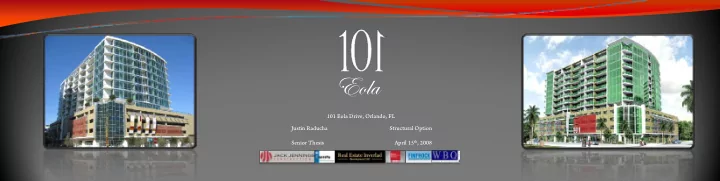
Xt 101 Eola Drive, Orlando, FL Justin Raducha Structural Option - - PowerPoint PPT Presentation
Xt 101 Eola Drive, Orlando, FL Justin Raducha Structural Option April 15 th , 2008 Senior Thesis Presentation Outline Building Statistics Introduction & Building Overview Building Statistics Location : 101 South Eola Dr.
Justin Raducha Senior Thesis Structural Option April 15th, 2008 101 Eola Drive, Orlando, FL
Presentation Outline
Introduction & Building Overview Building Statistics Existing Structure Overview Proposal Structural Depth Study Structural System Overview Redesign Details Impacts & Considerations Construction Management Breadth Study Site Analysis Existing Cost & Schedule Proposed System Impact Comparison Sustainability Breadth Study LEED Checklist Research Conclusions & Recommendations
Building Statistics
Location: 101 South Eola Dr. Orlando, FL Architecture: 12 Stories Green Glass and White Concrete Building Use: Mixed‐Use
Size: 322,810 Square Feet Cost: $36.4 Million Structure: 100% Precast Concrete Construction
Introduction & Building Overview Building Statistics Existing Structure Overview Proposal Structural Depth Study Structural System Overview Redesign Details Impacts & Considerations Construction Management Breadth Study Site Analysis Existing Cost & Schedule Proposed System Impact Comparison Sustainability Breadth Study LEED Checklist Research Conclusions & Recommendations
Presentation Outline Existing Structure
Presentation Outline
Introduction & Building Overview Building Statistics Existing Structure Overview Proposal Structural Depth Study Structural System Overview Redesign Details Impacts & Considerations Construction Management Breadth Study Site Analysis Existing Cost & Schedule Proposed System Impact Comparison Sustainability Breadth Study LEED Checklist Research Conclusions & Recommendations
Skip Truss System
Introduction & Building Overview Building Statistics Existing Structure Overview Proposal Structural Depth Study Structural System Overview Redesign Details Impacts & Considerations Construction Management Breadth Study Site Analysis Existing Cost & Schedule Proposed System Impact Comparison Sustainability Breadth Study LEED Checklist Research Conclusions & Recommendations
Presentation Outline Proposal
Redesign Rationale:
Proposed Changes:
Additional Proposals
Introduction & Building Overview Building Statistics Existing Structure Overview Proposal Structural Depth Study Structural System Overview Redesign Details Impacts & Considerations Construction Management Breadth Study Site Analysis Existing Cost & Schedule Proposed System Impact Comparison Sustainability Breadth Study LEED Checklist Research Conclusions & Recommendations
Presentation Outline Proposal
Success Measured By:
Structural Concerns: Lighter System Thinner Wall Sandwich Meet Strength & Serviceability Criteria Construction Concerns Less Expensive System Shorter Schedule Duration Maintain workable site Sustainability Concerns Provide for a more sustainable, healthy, and enjoyable environment
Introduction & Building Overview Building Statistics Existing Structure Overview Proposal Structural Depth Study Structural System Overview Redesign Details Impacts & Considerations Construction Management Breadth Study Site Analysis Existing Cost & Schedule Proposed System Impact Comparison Sustainability Breadth Study LEED Checklist Research Conclusions & Recommendations
Presentation Outline Structural System Overview
Concrete Truss Details:
Floor Construction:
Presentation Outline
Introduction & Building Overview Building Statistics Existing Structure Overview Proposal Structural Depth Study Structural System Overview Redesign Details Impacts & Considerations Construction Management Breadth Study Site Analysis Existing Cost & Schedule Proposed System Impact Comparison Sustainability Breadth Study LEED Checklist Research Conclusions & Recommendations
Truss Redesign
Materials:
Design:
Connections:
Presentation Outline
Introduction & Building Overview Building Statistics Existing Structure Overview Proposal Structural Depth Study Structural System Overview Redesign Details Impacts & Considerations Construction Management Breadth Study Site Analysis Existing Cost & Schedule Proposed System Impact Comparison Sustainability Breadth Study LEED Checklist Research Conclusions & Recommendations
Final Design
Presentation Outline
Introduction & Building Overview Building Statistics Existing Structure Overview Proposal Structural Depth Study Structural System Overview Redesign Details Impacts & Considerations Construction Management Breadth Study Site Analysis Existing Cost & Schedule Proposed System Impact Comparison Sustainability Breadth Study LEED Checklist Research Conclusions & Recommendations
Impacts & Considerations
Foundation Impact
Lateral Force Resisting System
Fireproofing
Wall Width
No Redesign Required
Presentation Outline
Introduction & Building Overview Building Statistics Existing Structure Overview Proposal Structural Depth Study Structural System Overview Redesign Details Impacts & Considerations Construction Management Breadth Study Site Analysis Existing Cost & Schedule Proposed System Impact Comparison Sustainability Breadth Study LEED Checklist Research Conclusions & Recommendations
Site and Construction Analysis
Presentation Outline
Introduction & Building Overview Building Statistics Existing Structure Overview Proposal Structural Depth Study Structural System Overview Redesign Details Impacts & Considerations Construction Management Breadth Study Site Analysis Existing Cost & Schedule Proposed System Impact Comparison Sustainability Breadth Study LEED Checklist Research Conclusions & Recommendations
Existing Cost & Schedule
Existing System Costs: (Total Structure Cost = $10.4 Million) Item Units Price per Unit Total Price Concrete Truss Beams 48 = 26,576 SF $31.70 $842,363 Design & Engineering 384 MH $2.73 $1048 Hauling 48 $427.34 $20,512 $863,923 Existing System Schedule: Item Units Units per day Total Duration Design & Engineering 384 MH 13 6 weeks Form Preparation, Place Reinforcement, Pour & Finish 48 trusses 0.33 32 weeks 38 weeks Erection Sequence (32 weeks)
Presentation Outline
Introduction & Building Overview Building Statistics Existing Structure Overview Proposal Structural Depth Study Structural System Overview Redesign Details Impacts & Considerations Construction Management Breadth Study Site Analysis Existing Cost & Schedule Proposed System Impact Comparison Sustainability Breadth Study LEED Checklist Research Conclusions & Recommendations
Proposed System Impacts
Site Impact:
Schedule Impact: (affects lead time only) Fireproofing Impact:
3 of SRFM per
truss
Rentable Floor Area:
1248 additional square feet = $492,960 additional first sales revenue Concrete Trusses Steel Trusses Lead time required to produce shop drawings, procure materials, and fabricate completely 38 weeks 20 weeks System Cost Estimate Comparison
$0 $100,000 $200,000 $300,000 $400,000 $500,000 $600,000 $700,000 $800,000 $900,000 $1,000,000 RS Means 2008 Fabricator 1 Fabricator 2 Fireproofing Overhead & Pricing Shipping Shop Drawings Labor Materials
Presentation Outline
Concrete Trusses Steel Trusses Difference Lead time required to produce shop drawings, procure materials, and fabricate completely. 38 weeks 20 weeks 18 additional weeks to make changes to structure before fabrication needs to begin to stay on schedule. Cost for trusses, including design, fabrication, transport, and other associated costs. $863,923 1) $728,978 2) $504,808 1) $134,945 saved 2) $359,115 saved Additional Revenue Possible n/a $492,960 $492,960 in additional rent due to added floor space
System Comparison
Introduction & Building Overview Building Statistics Existing Structure Overview Proposal Structural Depth Study Structural System Overview Redesign Details Impacts & Considerations Construction Management Breadth Study Site Analysis Existing Cost & Schedule Proposed System Impact Comparison Sustainability Breadth Study LEED Checklist Research Conclusions & Recommendations
Presentation Outline
Introduction & Building Overview Building Statistics Existing Structure Overview Proposal Structural Depth Study Structural System Overview Redesign Details Impacts & Considerations Construction Management Breadth Study Site Analysis Existing Cost & Schedule Proposed System Impact Comparison Sustainability Breadth Study LEED Checklist Research Conclusions & Recommendations
LEED Checklist
Rationale: 101 Eola is already very sustainable
central system
Credits: 34 of 69 possible points are able to be achieved
Presentation Outline
Introduction & Building Overview Building Statistics Existing Structure Overview Proposal Structural Depth Study Structural System Overview Redesign Details Impacts & Considerations Construction Management Breadth Study Site Analysis Existing Cost & Schedule Proposed System Impact Comparison Sustainability Breadth Study LEED Checklist Research Conclusions & Recommendations
Credit Research
Sustainable Sites Credit 2 Intent:
Requirements:
Credit Research Presentation Outline
Introduction & Building Overview Building Statistics Existing Structure Overview Proposal Structural Depth Study Structural System Overview Redesign Details Impacts & Considerations Construction Management Breadth Study Site Analysis Existing Cost & Schedule Proposed System Impact Comparison Sustainability Breadth Study LEED Checklist Research Conclusions & Recommendations Sustainable Sites Credit 4.1 Intent:
Requirements:
bus lines usable by occupants
Credit is Achievable
Credit Research
Water Efficiency Credit 3.1
Presentation Outline
Introduction & Building Overview Building Statistics Existing Structure Overview Proposal Structural Depth Study Structural System Overview Redesign Details Impacts & Considerations Construction Management Breadth Study Site Analysis Existing Cost & Schedule Proposed System Impact Comparison Sustainability Breadth Study LEED Checklist Research Conclusions & Recommendations Intent:
Requirements:
requirements Solution:
2000 4000 6000 8000 10000 Baseline Design Case Non‐Residents Residents
30.41 % Reduction
Conclusions & Recommendations Presentation Outline
Introduction & Building Overview Building Statistics Existing Structure Overview Proposal Structural Depth Study Structural System Overview Redesign Details Impacts & Considerations Construction Management Breadth Study Site Analysis Existing Cost & Schedule Proposed System Impact Comparison Sustainability Breadth Study LEED Checklist Research Conclusions & Recommendations
Success Measured By:
Structural Concerns: Lighter System Thinner Wall Sandwich Meet Strength & Serviceability Criteria Construction Concerns Less Expensive System Shorter Schedule Duration Maintain workable site Sustainability Concerns Provide for a more sustainable, healthy, and enjoyable environment
truss
concrete system. Also an additional $493,000 can be made from gained floor space
Redesign is Beneficial
Questions ?
Acknowledgements
Without you none of this would have been possible.
Finfrock Industries D‐M‐C Inc. Allen Finfrock William Finfrock Tony Owen Lloyd Kennedy Real Estate Inverlad Development LLC Chance Gordy Cives Steel Company Rory Guma Qualico Steel Inc. Harold Turner American Institute of Steel Construction Inc. Charlie Carter The Pennsylvania State University Professor M. Kevin Parfitt Professor Robert Holland
The entire AE faculty and staff My fellow AE seniors and friends A special thanks to my family and friends, especially my girlfriend, who have all provided me with guidance and support these past five years, and understandingly dealt with my not being around due to long hours in my other home, the thesis lab.