Oral Evaluation Rubric Criteria Distinguished Proficient Basic - - PDF document

oral evaluation rubric criteria distinguished proficient
SMART_READER_LITE
LIVE PREVIEW

Oral Evaluation Rubric Criteria Distinguished Proficient Basic - - PDF document

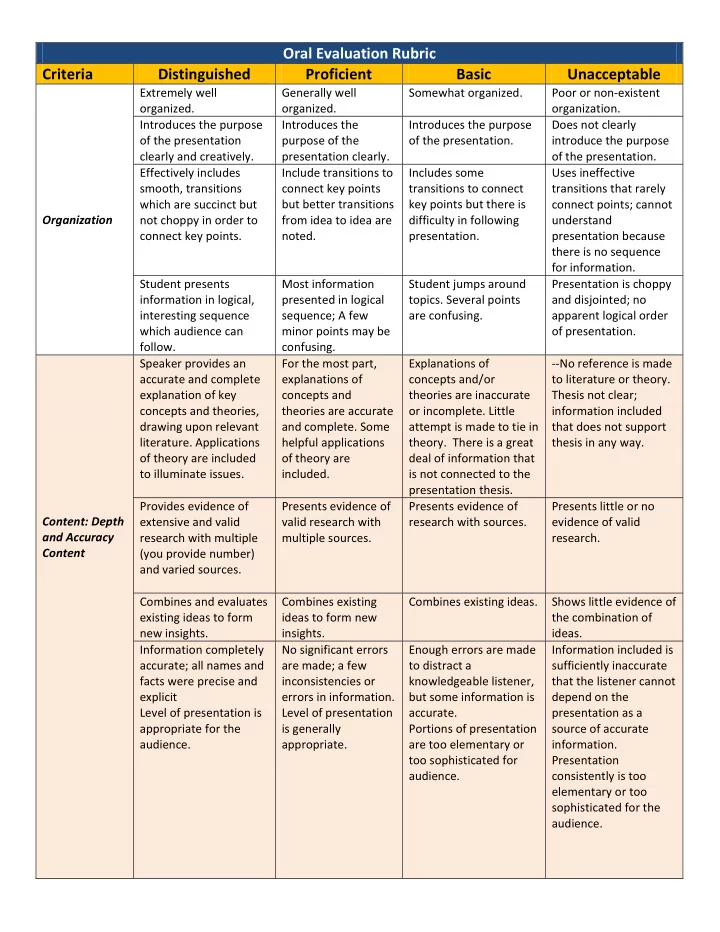
Oral Evaluation Rubric Criteria Distinguished Proficient Basic Unacceptable Extremely well Generally well Somewhat organized. Poor or non existent organized. organized. organization. Introduces the purpose Introduces the Introduces the


slide-1
SLIDE 1

Oral Evaluation Rubric Criteria Distinguished Proficient Basic Unacceptable

Organization Extremely well

  • rganized.

Generally well

  • rganized.

Somewhat organized. Poor or non‐existent

  • rganization.

Introduces the purpose

  • f the presentation

clearly and creatively. Introduces the purpose of the presentation clearly. Introduces the purpose

  • f the presentation.

Does not clearly introduce the purpose

  • f the presentation.

Effectively includes smooth, transitions which are succinct but not choppy in order to connect key points. Include transitions to connect key points but better transitions from idea to idea are noted. Includes some transitions to connect key points but there is difficulty in following presentation. Uses ineffective transitions that rarely connect points; cannot understand presentation because there is no sequence for information. Student presents information in logical, interesting sequence which audience can follow. Most information presented in logical sequence; A few minor points may be confusing. Student jumps around

  • topics. Several points

are confusing. Presentation is choppy and disjointed; no apparent logical order

  • f presentation.

Content: Depth and Accuracy Content Speaker provides an accurate and complete explanation of key concepts and theories, drawing upon relevant

  • literature. Applications
  • f theory are included

to illuminate issues. For the most part, explanations of concepts and theories are accurate and complete. Some helpful applications

  • f theory are

included. Explanations of concepts and/or theories are inaccurate

  • r incomplete. Little

attempt is made to tie in

  • theory. There is a great

deal of information that is not connected to the presentation thesis. ‐‐No reference is made to literature or theory. Thesis not clear; information included that does not support thesis in any way. Provides evidence of extensive and valid research with multiple (you provide number) and varied sources. Presents evidence of valid research with multiple sources. Presents evidence of research with sources. Presents little or no evidence of valid research. Combines and evaluates existing ideas to form new insights. Combines existing ideas to form new insights. Combines existing ideas. Shows little evidence of the combination of ideas. Information completely accurate; all names and facts were precise and explicit Level of presentation is appropriate for the audience. No significant errors are made; a few inconsistencies or errors in information. Level of presentation is generally appropriate. Enough errors are made to distract a knowledgeable listener, but some information is accurate. Portions of presentation are too elementary or too sophisticated for audience. Information included is sufficiently inaccurate that the listener cannot depend on the presentation as a source of accurate information. Presentation consistently is too elementary or too sophisticated for the audience.

slide-2
SLIDE 2

Research Effort Went above and beyond to research information; solicited material in addition to what was provided; brought in personal ideas and information to enhance project; and utilized more than eight types of resources to make project effective. Did a very good job

  • f researching;

utilized materials provided to their full potential; solicited more than six types

  • f research to

enhance project; at times took the initiative to find information outside

  • f school.

Used the material provided in an acceptable manner, but did not consult any additional resources. Did not utilize resources effectively; did little or no fact gathering on the topic. Creativity Uses the unexpected to full advantage; very

  • riginal, clever, and

creative approach that captures audience's attention. Some originality apparent; clever at times; good variety and blending of materials/media. Little or no variation; a few original touches but for the most part material presented with little originality or interpretation. Bland, predictable, and lacked “zip. Repetitive with little or no variety; little creative energy used. Use of Communication Aids(e.g., Transparencies, Slides, Posters, Handouts, Computer‐ Generated Materials) Graphics are designed to reinforce presentation thesis and maximize audience understanding; use of media is varied and appropriate with media not being added simply for the sake of use. While graphics relate and aid presentation thesis, these media are not as varied and not as well connected to presentation thesis. Occasional use of graphics that rarely support presentation thesis; visual aids were not colorful or clear Choppy, time wasting use of multimedia; lacks smooth transition from

  • ne medium to another.

Student uses superfluous graphics, no graphics, or graphics that are so poorly prepared that they detract from the presentation. Visual aids were colorful and large enough to be seen by all be even those in back of the class. Font size is appropriate for reading. Font is too small to be easily seen. Font is too small to be easily seen Media are prepared in a professional manner. Details are minimized so that main points stand

  • ut.

Appropriate information is

  • prepared. Some

material is not supported by visual aids. Communication aids are poorly prepared or used

  • inappropriately. Too

much information is

  • included. Unimportant

material is highlighted. Use of Language: Grammar, Word Choice, Voice Poised, clear articulation; proper volume; steady rate; enthusiasm; confidence; speaker is clearly comfortable in front of the group. Correct, precise pronunciation of terms. Selects rich and varied words for context and uses correct grammar. Clear articulation but not as polished; slightly uncomfortable at times Most can hear presentation. Student pronounces most words correctly. Selects words appropriate for context and uses correct grammar. Presentation has no Audience occasionally has trouble hearing the presentation; seems uncomfortable. Student incorrectly pronounces terms. Selects words inappropriate for context; uses incorrect grammar. Presentation has three misspellings and/or grammatical errors. Presenter is obviously anxious and cannot be heard or monotone with little or no expression. Student mumbles, incorrectly pronounces terms incorrectly. Selects words inappropriate for context; Uses incorrect grammar. Student's presentation has four or more

slide-3
SLIDE 3

Use of Language: Grammar, Word Choice, Voice (cont…) Presentation has no misspellings or grammatical errors. Sentences are complete and grammatical, and they flow together

  • easily. Words are

chosen for their precise meaning. more than two misspellings and/or grammatical errors For the most part, sentences are complete and grammatical, and they flow together

  • easily. With a few

exceptions, words are chosen for their precise meaning. Can follow the presentation, but some grammatical errors and use of slang are evident. Some sentences are incomplete/ halting, and/or vocabulary is somewhat limited or inappropriate. spelling errors and/or grammatical errors. Cannot focus on the ideas presented. Because of difficulties with grammar and appropriate vocabulary. Eye Contact Maintains eye contact; seldom returning to notes; presentation is like a planned conversation. Student maintains eye contact most of the time but frequently returns to notes. Student reads all or most of report with no eye contact. Student reads all or most of report with no eye contact. Personal Appearance Personal appearance is completely appropriate for the occasion and the audience. For the most part, personal appearance is appropriate for the

  • ccasion and the

audience. Personal appearance is inappropriate for the

  • ccasion and audience.

Personal appearance is inappropriate for the

  • ccasion and audience.

Audience Interaction, Questions and Answers. ‐‐Encourages audience

  • interaction. Calls on

classmates by name. Demonstrates extensive knowledge of the topic by responding confidently, precisely and appropriately to all audience questions. Encourages audience interaction. Demonstrates knowledge of the topic by responding accurately and appropriately addressing questions. At ease with answers to all questions but fails to elaborate. Avoids or discourages active audience participation. Demonstrates incomplete knowledge

  • f the topic by

responding inaccurately and inappropriately to questions. Avoids or discourages active audience participation. Demonstrates incomplete knowledge

  • f the topic by

responding inaccurately and inappropriately to questions. Audience Response Involved the audience in the presentation; held the audience's attention throughout. Presented facts with some interesting "twists"; held the audience's attention most of the time. Some related facts but went off topic and lost the audience. Incoherent; audience lost interest. Length of Presentation Within? minutes of allotted time +/– Within? minutes of allotted time +/– Within? minutes of allotted time +/– Too long or too short;

  • r more minutes above
  • r below the allotted

time