x t + h 1 , 1 ( h ) 1 , 2 ( h ) 1 ,p ( h ) . . . 2 , 1 ( h - - PowerPoint PPT Presentation

x t h
SMART_READER_LITE
LIVE PREVIEW

x t + h 1 , 1 ( h ) 1 , 2 ( h ) 1 ,p ( h ) . . . 2 , 1 ( h - - PowerPoint PPT Presentation

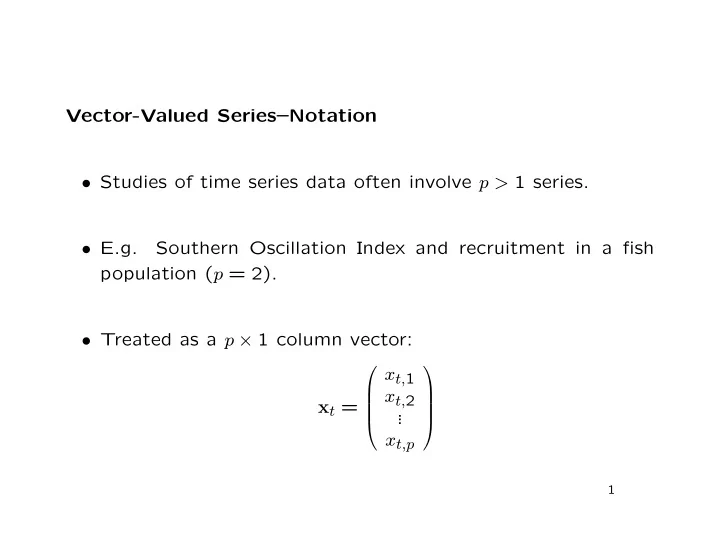
Vector-Valued SeriesNotation Studies of time series data often involve p > 1 series. E.g. Southern Oscillation Index and recruitment in a fish population ( p = 2). Treated as a p 1 column vector: x t, 1 x t, 2


slide-1
SLIDE 1

Vector-Valued Series–Notation

  • Studies of time series data often involve p > 1 series.
  • E.g.

Southern Oscillation Index and recruitment in a fish population (p = 2).

  • Treated as a p × 1 column vector:

xt =

    

xt,1 xt,2 . . . xt,p

    

1

slide-2
SLIDE 2

Mean Vector

  • Assume jointly weakly stationary.
  • mean vector:

µ = E (xt) =

      

E

  • xt,1
  • E
  • xt,2
  • .

. . E

  • xt,p

     

=

    

µ1 µ2 . . . µp

    

2

slide-3
SLIDE 3

Autocovariance Matrix

  • Autocovariance matrix contains individual autocovariances
  • n the diagonal and cross-covariances off the diagonal:

Γ(h) = E

  • xt+h − µ
  • (xt − µ)′

=

    

γ1,1(h) γ1,2(h) . . . γ1,p(h) γ2,1(h) γ2,2(h) . . . γ2,p(h) . . . . . . ... . . . γp,1(h) γp,2(h) . . . γp,p(h)

    

3

slide-4
SLIDE 4

Sample mean and autocovariances

  • sample mean:

¯

x = 1

n

n

  • t=1

xt

  • sample autocovariance:

ˆ Γ(h) = 1 n

n−h

  • t=1
  • xt+h − ¯

x

  • (xt − ¯

x)′

for h ≥ 0, and ˆ Γ(−h) = ˆ Γ(h)′.

4

slide-5
SLIDE 5

Multidimensional Series (Spatial Statistics)

  • Some studies involve data indexed by more than one variable.
  • E.g. soil surface temperatures in a field
  • Notation: xs is the observed value at location s (s for spatial).

5

slide-6
SLIDE 6

rows 20 40 60 c

  • l

u m n s 10 20 30 Temperature 4 6 8 10

Soil temperatures 6

slide-7
SLIDE 7

Autocovariance and Variogram

  • Stationary: E (xs) and cov
  • xs+h, xs
  • do not depend on s.
  • For a stationary process, the autocovariance function is

γ(h) = cov

  • xs+h, xs
  • = E
  • xs+h − µ
  • xs − µ
  • Intrinsic: E
  • xs+h − xs
  • and var
  • xs+h − xs
  • do not depend on

s.

  • For an intrinsic process, the (semi-)variogram is

Vx(h) = 1 2var

  • xs+h − xs
  • 7
slide-8
SLIDE 8
  • A stationary process is intrinsic (see Problem 1.26), but an

intrinsic process is not necessarily stationary.

  • In one dimension, the random walk is intrinsic but not sta-

tionary.

  • When stationary, Vx(h) = γ(0) − γ(h).
  • Isotropic: an intrinsic process is isotropic if the variogram is

a function only of |h|, the Euclidean distance between s + h and s.

8