
SLIDE 1
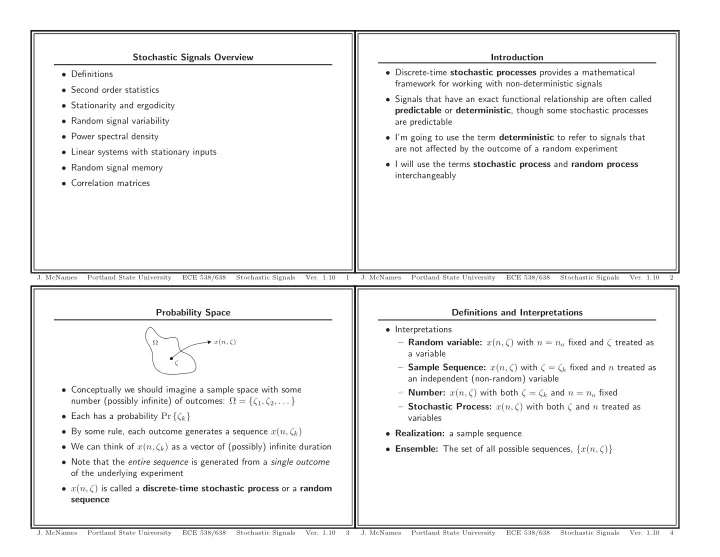
Probability Space
x(n, ζ) ζ Ω
- Conceptually we should imagine a sample space with some
number (possibly infinite) of outcomes: Ω = {ζ1, ζ2, . . . }
- Each has a probability Pr {ζk}
- By some rule, each outcome generates a sequence x(n, ζk)
- We can think of x(n, ζk) as a vector of (possibly) infinite duration
- Note that the entire sequence is generated from a single outcome
- f the underlying experiment
- x(n, ζ) is called a discrete-time stochastic process or a random
sequence
- J. McNames
Portland State University ECE 538/638 Stochastic Signals
- Ver. 1.10
3
Stochastic Signals Overview
- Definitions
- Second order statistics
- Stationarity and ergodicity
- Random signal variability
- Power spectral density
- Linear systems with stationary inputs
- Random signal memory
- Correlation matrices
- J. McNames
Portland State University ECE 538/638 Stochastic Signals
- Ver. 1.10
1
Definitions and Interpretations
- Interpretations
– Random variable: x(n, ζ) with n = no fixed and ζ treated as a variable – Sample Sequence: x(n, ζ) with ζ = ζk fixed and n treated as an independent (non-random) variable – Number: x(n, ζ) with both ζ = ζk and n = no fixed – Stochastic Process: x(n, ζ) with both ζ and n treated as variables
- Realization: a sample sequence
- Ensemble: The set of all possible sequences, {x(n, ζ)}
- J. McNames
Portland State University ECE 538/638 Stochastic Signals
- Ver. 1.10
4
Introduction
- Discrete-time stochastic processes provides a mathematical
framework for working with non-deterministic signals
- Signals that have an exact functional relationship are often called
predictable or deterministic, though some stochastic processes are predictable
- I’m going to use the term deterministic to refer to signals that
are not affected by the outcome of a random experiment
- I will use the terms stochastic process and random process
interchangeably
- J. McNames
Portland State University ECE 538/638 Stochastic Signals
- Ver. 1.10