SLIDE 1
1
Foundations of Computer Graphics (Fall 2012)
CS 184, Lecture 2: Review of Basic Math
http://inst.eecs.berkeley.edu/~cs184
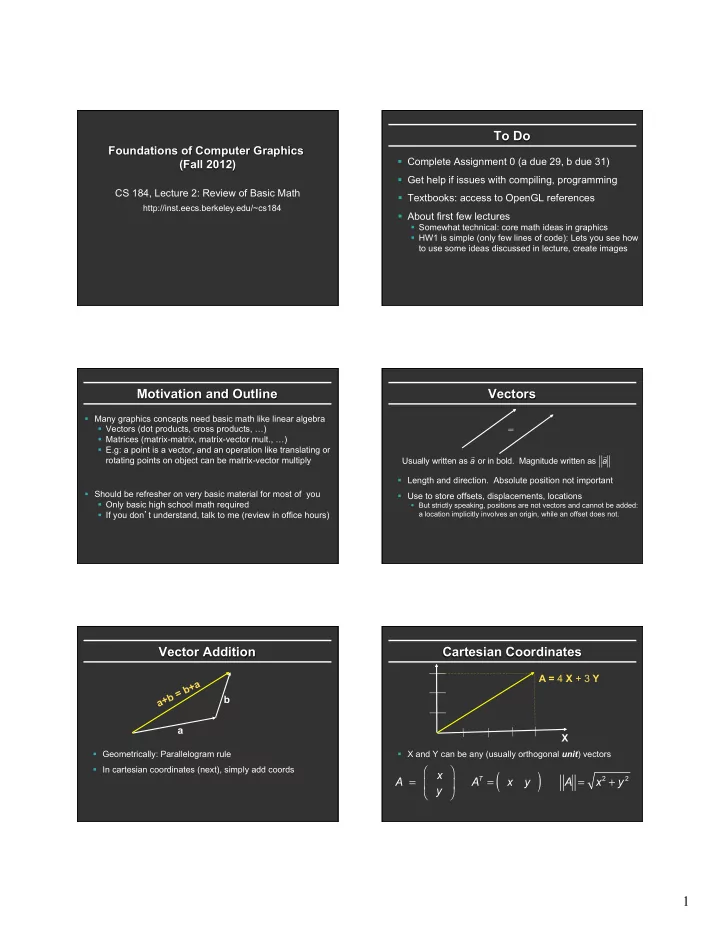
To Do
§ Complete Assignment 0 (a due 29, b due 31) § Get help if issues with compiling, programming § Textbooks: access to OpenGL references § About first few lectures
§ Somewhat technical: core math ideas in graphics § HW1 is simple (only few lines of code): Lets you see how to use some ideas discussed in lecture, create images
Motivation and Outline
§ Many graphics concepts need basic math like linear algebra § Vectors (dot products, cross products, …) § Matrices (matrix-matrix, matrix-vector mult., …) § E.g: a point is a vector, and an operation like translating or rotating points on object can be matrix-vector multiply § Should be refresher on very basic material for most of you § Only basic high school math required § If you don’t understand, talk to me (review in office hours)
Vectors
§ Length and direction. Absolute position not important § Use to store offsets, displacements, locations
§ But strictly speaking, positions are not vectors and cannot be added: a location implicitly involves an origin, while an offset does not.
=
Usually written as a or in bold. Magnitude written as a
Vector Addition
§ Geometrically: Parallelogram rule § In cartesian coordinates (next), simply add coords
a b a+b = b+a
Cartesian Coordinates
§ X and Y can be any (usually orthogonal unit) vectors
X A = 4 X + 3 Y
A = x y ⎛ ⎝ ⎜ ⎞ ⎠ ⎟ AT = x y
( )
A = x2 + y 2
SLIDE 2 2
Vector Multiplication
§ Dot product § Cross product § Orthonormal bases and coordinate frames § Note: Some books talk about right and left-handed coordinate systems. We always use right-handed
Dot (scalar) product
a b
φ
a i b = b i a = ? a i b = a b cosφ φ = cos−1 a i b a b ⎛ ⎝ ⎜ ⎞ ⎠ ⎟ a i(b + c) = a i b + a i c (ka)i b = a i(kb) = k(a i b) Dot product in Cartesian components
a b = xa ya ⎛ ⎝ ⎜ ⎜ ⎞ ⎠ ⎟ ⎟
yb ⎛ ⎝ ⎜ ⎜ ⎞ ⎠ ⎟ ⎟ = ? a b = xa ya ⎛ ⎝ ⎜ ⎜ ⎞ ⎠ ⎟ ⎟
yb ⎛ ⎝ ⎜ ⎜ ⎞ ⎠ ⎟ ⎟ = xaxb + yayb
Dot product: some applications in CG
§ Find angle between two vectors (e.g. cosine of angle between light source and surface for shading) § Finding projection of one vector on another (e.g. coordinates of point in arbitrary coordinate system) § Advantage: computed easily in cartesian components
Projections (of b on a)
a b
φ b → a = ? b → a = ? b → a = b cosφ = a i b a b → a = b → a a a = a i b a
2 a
Vector Multiplication
§ Dot product § Cross product § Orthonormal bases and coordinate frames § Note: Some books talk about right and left-handed coordinate systems. We always use right-handed
SLIDE 3
3
Cross (vector) product
§ Cross product orthogonal to two initial vectors § Direction determined by right-hand rule § Useful in constructing coordinate systems (later) a b
φ
a × b = −b × a a × b = a b sinφ
Cross product: Properties
a × b = −b × a a × a = 0 a × (b + c) = a × b + a × c a × (kb) = k(a × b) x × y = +z y × x = −z y × z = +x z × y = −x z × x = +y x × z = −y
Cross product: Cartesian formula? a × b = x y z xa ya za xb yb zb = yazb − ybza zaxb − xazb xayb − yaxb ⎛ ⎝ ⎜ ⎜ ⎜ ⎜ ⎞ ⎠ ⎟ ⎟ ⎟ ⎟ a × b = A*b = −za ya za −xa −ya xa ⎛ ⎝ ⎜ ⎜ ⎜ ⎜ ⎞ ⎠ ⎟ ⎟ ⎟ ⎟ xb yb zb ⎛ ⎝ ⎜ ⎜ ⎜ ⎜ ⎞ ⎠ ⎟ ⎟ ⎟ ⎟
Dual matrix of vector a
Vector Multiplication
§ Dot product § Cross product § Orthonormal bases and coordinate frames § Note: book talks about right and left-handed coordinate systems. We always use right-handed
Orthonormal bases/coordinate frames
§ Important for representing points, positions, locations § Often, many sets of coordinate systems (not just X, Y, Z) § Global, local, world, model, parts of model (head, hands, …) § Critical issue is transforming between these systems/bases § Topic of next 3 lectures
Coordinate Frames
§ Any set of 3 vectors (in 3D) so that u = v = w = 1 u iv = v iw = u iw = 0 w = u ×v p = (p iu)u + (p iv)v + (p iw)w
SLIDE 4
4
Constructing a coordinate frame
§ Often, given a vector a (viewing direction in HW1), want to construct an orthonormal basis § Need a second vector b (up direction of camera in HW1) § Construct an orthonormal basis (for instance, camera coordinate frame to transform world objects into in HW1)
Constructing a coordinate frame?
We want to associate w with a, and v with b § But a and b are neither orthogonal nor unit norm § And we also need to find u
u = b ×w b ×w v = w × u w = a a
Matrices
§ Can be used to transform points (vectors)
§ Translation, rotation, shear, scale (more detail next lecture)
What is a matrix
§ Array of numbers (m×n = m rows, n columns) § Addition, multiplication by a scalar simple: element by element
1 3 5 2 4 ⎛ ⎝ ⎜ ⎜ ⎞ ⎠ ⎟ ⎟
Matrix-matrix multiplication
§ Number of columns in first must = rows in second § Element (i,j) in product is dot product of row i of first matrix and column j of second matrix
1 3 5 2 4 ⎛ ⎝ ⎜ ⎜ ⎞ ⎠ ⎟ ⎟ 3 6 9 4 2 7 8 3 ⎛ ⎝ ⎜ ⎞ ⎠ ⎟
Matrix-matrix multiplication
§ Number of columns in first must = rows in second § Element (i,j) in product is dot product of row i of first matrix and column j of second matrix
1 3 5 2 4 ⎛ ⎝ ⎜ ⎜ ⎞ ⎠ ⎟ ⎟ 3 6 9 4 2 7 8 3 ⎛ ⎝ ⎜ ⎞ ⎠ ⎟ = 9 27 33 13 19 44 61 26 8 28 32 12 ⎛ ⎝ ⎜ ⎜ ⎞ ⎠ ⎟ ⎟
SLIDE 5 5
Matrix-matrix multiplication
§ Number of columns in first must = rows in second § Element (i,j) in product is dot product of row i of first matrix and column j of second matrix
1 3 5 2 4 ⎛ ⎝ ⎜ ⎜ ⎞ ⎠ ⎟ ⎟ 3 6 9 4 2 7 8 3 ⎛ ⎝ ⎜ ⎞ ⎠ ⎟ = 9 27 33 13 19 44 61 26 8 28 32 12 ⎛ ⎝ ⎜ ⎜ ⎞ ⎠ ⎟ ⎟
Matrix-matrix multiplication
§ Number of columns in first must = rows in second § Element (i,j) in product is dot product of row i of first matrix and column j of second matrix
1 3 5 2 4 ⎛ ⎝ ⎜ ⎜ ⎞ ⎠ ⎟ ⎟ 3 6 9 4 2 7 8 3 ⎛ ⎝ ⎜ ⎞ ⎠ ⎟ = 9 27 33 13 19 44 61 26 8 28 32 12 ⎛ ⎝ ⎜ ⎜ ⎞ ⎠ ⎟ ⎟
Matrix-matrix multiplication
§ Number of columns in first must = rows in second
§ Non-commutative (AB and BA are different in general) § Associative and distributive § A(B+C) = AB + AC § (A+B)C = AC + BC 3 6 9 4 2 7 8 3 ⎛ ⎝ ⎜ ⎞ ⎠ ⎟ 1 3 5 2 4 ⎛ ⎝ ⎜ ⎜ ⎞ ⎠ ⎟ ⎟ NOT EVEN LEGAL!!
Matrix-Vector Multiplication
§ Key for transforming points (next lecture) § Treat vector as a column matrix (m×1) § E.g. 2D reflection about y-axis
−1 0 1 ⎛ ⎝ ⎜ ⎞ ⎠ ⎟ x y ⎛ ⎝ ⎜ ⎞ ⎠ ⎟ = −x y ⎛ ⎝ ⎜ ⎞ ⎠ ⎟
Transpose of a Matrix (or vector?)
1 2 3 4 5 6 ⎛ ⎝ ⎜ ⎜ ⎞ ⎠ ⎟ ⎟
T
= 1 3 5 2 4 6 ⎛ ⎝ ⎜ ⎞ ⎠ ⎟
(AB)T = BTAT
Identity Matrix and Inverses
AA−1 = A−1A = I (AB)−1 = B−1A−1 I3×3 = 1 1 1 ⎛ ⎝ ⎜ ⎜ ⎞ ⎠ ⎟ ⎟
SLIDE 6
6
Vector multiplication in Matrix form
§ Dot product? § Cross product?
a b = aTb xa ya za
( )
xb yb zb ⎛ ⎝ ⎜ ⎜ ⎜ ⎜ ⎞ ⎠ ⎟ ⎟ ⎟ ⎟ = xaxb + yayb + zazb
( )
a × b = A*b = −za ya za −xa −ya xa ⎛ ⎝ ⎜ ⎜ ⎜ ⎜ ⎞ ⎠ ⎟ ⎟ ⎟ ⎟ xb yb zb ⎛ ⎝ ⎜ ⎜ ⎜ ⎜ ⎞ ⎠ ⎟ ⎟ ⎟ ⎟ Dual matrix of vector a