SLIDE 1
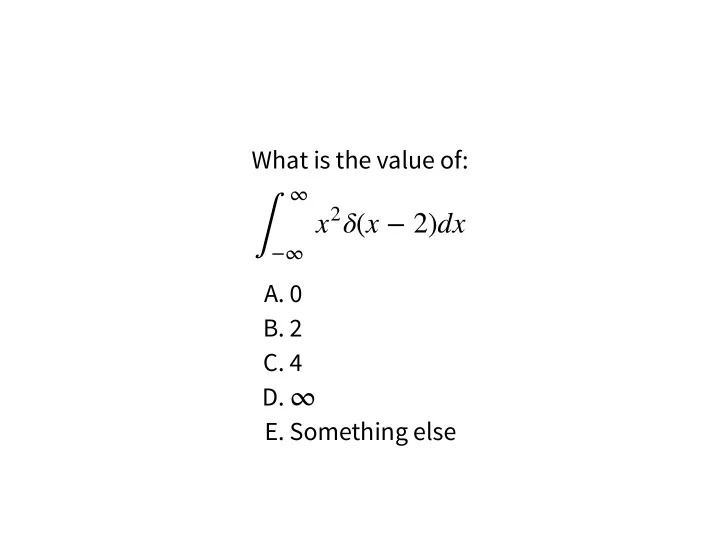
What is the value of:
δ(x − 2)dx ∫
∞ −∞
x2
A. 2 B. 4 C. D. Something else E.
∞
SLIDE 2
A point charge ( ) is located at position , as shown. What is , the charge density in all space?
q R ρ(r)
A. B. C. D. Something else?? E.
ρ(r) = q (R) δ3 ρ(r) = q (r) δ3 ρ(r) = q (R − r) δ3 ρ(r) = q (r − R) δ3
SLIDE 3 An electric dipole ( and , small distance apart) sits centered in a Gaussian sphere.
+q – q d
What can you say about the flux of through the sphere, and
sphere?
E |E|
Flux = 0, E = 0 everywhere on sphere surface A. Flux = 0, E need not be zero everywhere on sphere B. Flux is not zero, E = 0 everywhere on sphere C. Flux is not zero, E need not be zero... D.
SLIDE 4
Which of the following two fields has zero curl? I II Both do. A. Only I is zero B. Only II is zero C. Neither is zero D. ??? E.
SLIDE 5
Can superposition be applied to electric potential, ?
V = + + + … Vtot =
?
∑
i
Vi V1 V2 V3
Yes A. No B. Sometimes C.
SLIDE 6
Could this be a plot of ? Or ? (for SOME physical situation?)
|E(r)| V(r)
Could be , or A. Could be , but can't be B. Can't be , could be C. Can't be either D. ??? E.
E(r) V(r) E(r) V(r) E(r) V(r)
SLIDE 7
A point charge sits outside a solid neutral conducting copper sphere of radius . The charge q is a distance from the center, on the right side. What is the E-field at the center of the sphere? (Assume equilibrium situation).
+q A r > A
, to lefu A. , to lefu B. , to right C. D. None of these E.
|E| = kq/r2 kq/ > |E| > 0 r2 |E| > 0 E = 0
SLIDE 8
A neutral copper sphere has a spherical hollow in the center. A charge is placed in the center of the hollow. What is the total charge on the outside surface of the copper sphere? (Assume Electrostatic equilibrium.)
+q
Zero A. B. C. D. E.
−q +q 0 < < +q qouter −q < < 0 qouter
SLIDE 9
True or False: The electric field, , in some region of space is zero, thus the electric potential, , in that same region of space is zero.
E(r) V(r)
True A. False B.
SLIDE 10
True or False: The electric potential, , in some region of space is zero, thus the electric field, , in that same region of space is zero.
V(r) E(r)
True A. False B.
SLIDE 11
The general solution for the electric potential in spherical coordinates with azimuthal symmetry (no dependence) is:
ϕ V(r, θ) =
(
+
)
(cos θ) ∑
l=0 ∞
Alrl Bl rl+1 Pl
Consider a metal sphere (constant potential in and on the sphere, remember). Which terms in the sum vanish outside the sphere? (Recall: as )
V → 0 r → ∞
All the 's A. All the 's except B. All the 's C. All the 's except D. Something else E.
Al Al A0 Bl Bl B0
SLIDE 12
p = ∑
i
qiri
What is the dipole moment of this system? (BTW, it is NOT overall neutral!) A. B. C. D. Someting else (or not defined) E.
qd 2qd qd
3 2
3qd
SLIDE 13 You have a physical dipole, and a finite distance
- apart. When can you use the expression:
+q −q d V(r) = 1 4πε0 p ⋅ r̂ r2
This is an exact expression everywhere. A. It's valid for large B. It's valid for small C. No idea... D.
r r
SLIDE 14 You have a physical dipole, and a finite distance
- apart. When can you use the expression:
+q −q d V(r) = 1 4πε0 ∑
i
qi ℜi
This is an exact expression everywhere. A. It's valid for large B. It's valid for small C. No idea... D.
r r
SLIDE 15
Which charge distributions below produce a potential that looks like when you are far away?
C r2
E) None of these, or more than one of these! (For any which you did not select, how DO they behave at large r?)