
SLIDE 1
WORLD CLASS DEVELOPER AND EPC CONTRACTOR
WORLD CLASS DEVELOPER AND EPC CONTRACTOR Structure SUNEL Group - - PowerPoint PPT Presentation
WORLD CLASS DEVELOPER AND EPC CONTRACTOR Structure SUNEL Group consists of highly-experienced and specialized teams of engineers, project managers, site managers, electricians and technicians. With our knowledge and our strong strategic
WORLD CLASS DEVELOPER AND EPC CONTRACTOR
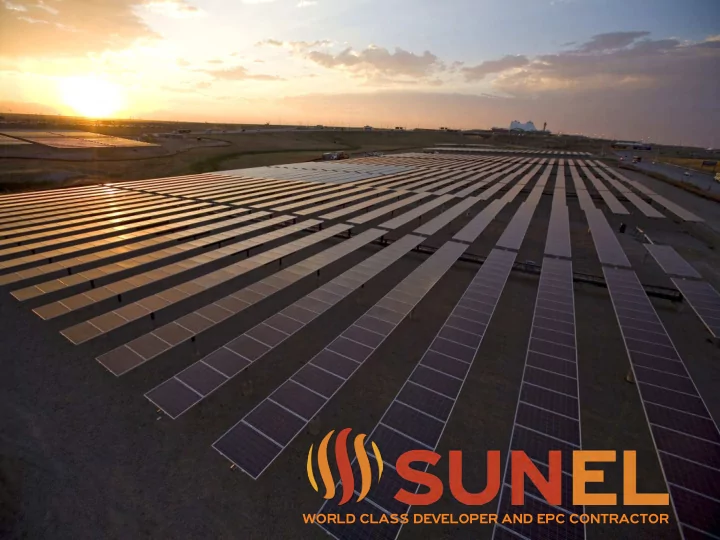
SUNEL Group consists of highly-experienced and specialized teams of engineers, project managers, site managers, electricians and technicians. With our knowledge and our strong strategic partnerships, we provide and materialize customized solutions according to the investors technical and economical needs. As a solar EPC contractor SUNEL Group has completed more than 350 projects in 10 countries. Photovoltaic projects are long term investments and need continuous cooperation. In SUNEL Group we believe that trust, honesty and transparency are the foundation for a long-term cooperation. By consulting and supporting
benefit of each investment.
continents
countries
employees
projects
solar projects
Development of solar projects
Our team is planning and developing feasible solar projects starting with the assesment of the land, following the issuing
the licenses and permissions required.
Engineering – design
Our engineering team provides our customers with the most efficient and cost effective solutions, adjusting the design according to the terrain, the location, size of project and meeting any special requirements.
Construction of solar projects
Our highly experienced construction team guarantees the excellence of the final result, leading to higher efficiency, durability and longer life time of the projects.
Maintenance and monitoring
We
packages for the maintenance and monitoring of the solar projects, guaranteeing a performance ratio of at least 80% and availability of 98%.
Sunel’s commitment to its customers
Operation and asset management
We follow every day operation of the solar projects and make sure that all local procedures are followed, thus achieving a higher return of the investment.
Re-engineering
We support the investors with projects already in
to maximize their return by re- engineering their project and proposing corrective actions.
Co-investing
We may prticipate in some investments, taking in consideration the feasibility of the project and the available funds.
Project Financing
We offer our customers possibilities for project financing.
“We Implement proven smart solutions that can give added value to the investors”
Sunel’s commitment to its customers
Some of our projects
“80% performance ration guarantee, 98% availability guarantee, up to 10 years installation guarantee”
Sunel’s commitment to its customers
Cyprus France Turkey
Cyprus Greece Greece Greece Greece
Cyprus Greece Greece Greece Greece
Cyprus Turkey Turkey France Turkey
Cyprus Cyprus Cyprus Cyprus
Understanding the legislation – Net metering
It is very important to understand the legislation in
Calculating your consumption
Calculating and predicting your consumption over the next years is important to determine the size of your installation
Calculating the available area
Roof top, ground mounted, carports, facade are some of the options for installation area.
Choosing the equipment
Once you know what should be your size and area
installation, you can choose the proper equipment.
There are many parameters that determine the optimization of a system. Here are some that we will analyze.
How it works
The electricity produced by the solar system is available for the investor’s consumption and any excess is fed back into the grid.
What happens with the excess electricity
Any surplus of electricity will be offset from the investor’s bills in the following months. An indefinite rollover is applied, so any surplus will be carried forward to the next bill.
Limitations
The capacity installed should not exceed the maximum load allowed at the investor’s premises. Moreover, DEWA could impose a lower threshold should it be justified by technical limitations related to the integration of the PV system into the power distribution grid.
Available area for installation
PV modules can installed almost everywhere, but inside the same plot where is the consumption. The financial optimum solution is to install the on the rood top since the cost will be less.
These are the main important points of the legislation that we should consider
Example with shortage of electricity production
The electricity produced by the PV system reduces the amount of energy that a customer has drawn from the
than consumed, the excess is exported to the grid. The monthly energy bill will only reflect the net amount
Example with surplus of electricity production
If during a billing period more energy is exported than imported, the invoiced value of electricity will be zero and the surplus electricity will be shown as a credit which can be brought forward in the following billing period The following billing period, the credit will be offset against net consumption. If during the course of several consecutive months more energy is produced than imported from the grid, the credit accumulates and is carried over to the following months.
What is the benefit
Consumption/ month for residential / commercial consumers Slab tariff Fuel surcharge September 2017 Total tariff In USD G 0-2000 kWh 23 fils / kWh 6,5 fils / kWh 29,5 fils / kWh 0,080 USD / kWh Y 2001-4000 kWh 28 fils / kWh 6,5 fils / kWh 34,5 fils / kWh 0,094 USD / kWh O 4001-6000 kWh 32 fils / kWh 6,5 fils / kWh 38,5 fils / kWh 0,105 USD / kWh R 6001 kWh & Above 38 fils / kWh 6,5 fils / kWh 44,5 fils / kWh 0,121 USD / kWh Consumption/ month for industrial consumers Slab tariff Fuel surcharge September 2017 Total tariff In USD G 0-10000 kWh 23 fils / kWh 6,5 fils / kWh 29,5 fils / kWh 0,080 USD / kWh Y 10001 kWh & Above 38 fils / kWh 6,5 fils / kWh 44,5 fils / kWh 0,121 USD / kWh
Calculate the yearly consumption
The real yearly consumption can be easily calculated by adding 12 consecutive electrical bills. It is also necessary to predict of possible any changes in the close future.
Draft calculation for energy production
In Dubai region, the energy production can vary from 1.700 KWh/KWp/year to 2.000 KWh/Kwp/year, depending on the architecture of the solar system. This is a difference of 15% between the two figures.
Checking the available area
The installation should be in the same plot where is the consumption, so the area is limited to this. First choice will be the roof top, then ground mounted, then car ports and then the facade.
Orientation and inclination of the PV panels
The main parameter determining the energy production is the orientation and inclination of the PV panels. Since we are installing on an existing building, in most cases we need to follow the
roof.
Basic steps
The black line is how energy yield is affected at orientation 0 to 90 degrees, for a flat roof project, with PV panels at optimum inclination of 24o . The red line is how energy yield is affected at orientation 0 to 90 degrees, for horizontal PV panels. The blue line is how energy yield is affected at orientation 0 to 90 degrees, for a flat roof project, with PV panels at inclination of 10o . The green line is how energy yield is affected at orientation 0 to 90 degrees, for a flat roof project, with PV panels at optimum inclination of 20o .
Possible variations
1550 1600 1650 1700 1750 1800 1850 1900 1950 2000 2050 20 40 65 90
Energy Yield according to orientation / inclination
Check available area
If the available area is enough for installing the preferred size of project, we optimize both the
will give us the highest yield.
Check orientation of the building
If the area is not enough, following the orientation of the building will help to install more panels. Maximum deviation in such case is 45o that still will provide a high yield.
Checking inclination of panels
Another trick to fit more panels when the area is not enough is to lower the inclination from optimum. This will enable us to bring one row closer to the
Checking shadow
In some cases it is more efficient to use the
minimize the distance between rows. The shadow will affect the production but it might not affect more than 3-4%.
Flat roof, steps for designing
Check inclination and orientation
Unfortunately on inclined roofs we cannot easily
roofs are at around 10-15o of inclination that is not
yield so much.
Air circulation
The biggest problem with the inclined roof installations is the air circulation. Since the panels are parallel to the roof it is not possible to have good air circulation for cooling the panels. Using mounting structure that leaves more space between the panels and roof can partially solve the problem.
Maintenance corridors
Since the inclination of the panels is around 10-15o cleaning
panels is needed more regularly. Designing with corridors every 3-4 lines of panels makes the cleaning more efficient and also helps the air circulation.
Changing the inclination
If the available area is big, then we can use triangle mounting structure and optimize the inclination, helping also the air circulation and cooling of panels. We will need much bigger area and the cost will be increased but it the extra yield is worth it.
Inclined roof, steps for designing
Example of using mounting structure with triangles on an inclined roof
Higher yield equals more savings, equals better ROI. Ways to achieve higher yield Choosing the design Choosing optimal architecture for the system Choosing the correct equipment Installing according to the international norms Maintaining the project regularly during operation period The EPC company can provide minimum Performance Ration (PR) guarantee, so the risk can be transferred from the investor to the EPC contractor.
Reliability equals less downtime periods, equals higher income, equals better ROI. Ways to achieve better reliability Choosing the correct equipment Keep spare parts near the installation Organized maintenance team Installation of the equipment according to the installation manuals of the manufacturers Installing according to the international norms The EPC company can provide minimum availability guarantee, so the risk can be transferred from the investor to the EPC contractor.
Longer life time of the project means that less amount will be needed to keep the investment
The investors will have a payback period from 4-6 years depending on the project. After that period the real benefit is expected. Just imagine after the first period of 4-6 years replacement of the main equipment to be needed. The investor at the end is working for the banks, the EPC contractor and the O&M contractor. In any case this is not called an investment. Ways to achieve better reliability Choosing the optimal architecture of the system Choosing the correct equipment Installation of the equipment according to the installation manuals of the manufacturers Installing according to the international norms Maintaining the project regularly
Layout Shading analysis Grouping Combining equipment Optimizing orientation Loss calculations Yield simulation Need experienced team Need professional tools Need wise evaluation
Although all equipment are important for the system, we will concentrate in the basic 3 components. Panels Inverters Mounting system
Normal backsheet panels Glass to glass panels Monocrystaline panels Polycrystaline panels 60 cells 72 cells Efficiency of panels PERC Busbars 4-5 Voltage 1.000 V – 1.500 V
String inverters Central inverters MPPTs Voltage 1.000V – 1.500V Maximum efficiency voltage range