Workshop on Theoretical Morphology, University of Leipzig, June 20-21 - - PDF document

workshop on theoretical morphology university of leipzig
SMART_READER_LITE
LIVE PREVIEW

Workshop on Theoretical Morphology, University of Leipzig, June 20-21 - - PDF document

Workshop on Theoretical Morphology, University of Leipzig, June 20-21 2008 Defectiveness and morphosyntactic deviance Matthew Baerman, Surrey Morphology Group, University of Surrey m.baerman@surrey.ac.uk (1) A defective paradigm: be in


slide-1
SLIDE 1

Workshop on Theoretical Morphology, University of Leipzig, June 20-21 2008

The research reported here was funded by the Arts and Humanities Research Council (UK) under grant number AH/D001579/1. Their support is gratefully acknowledged.

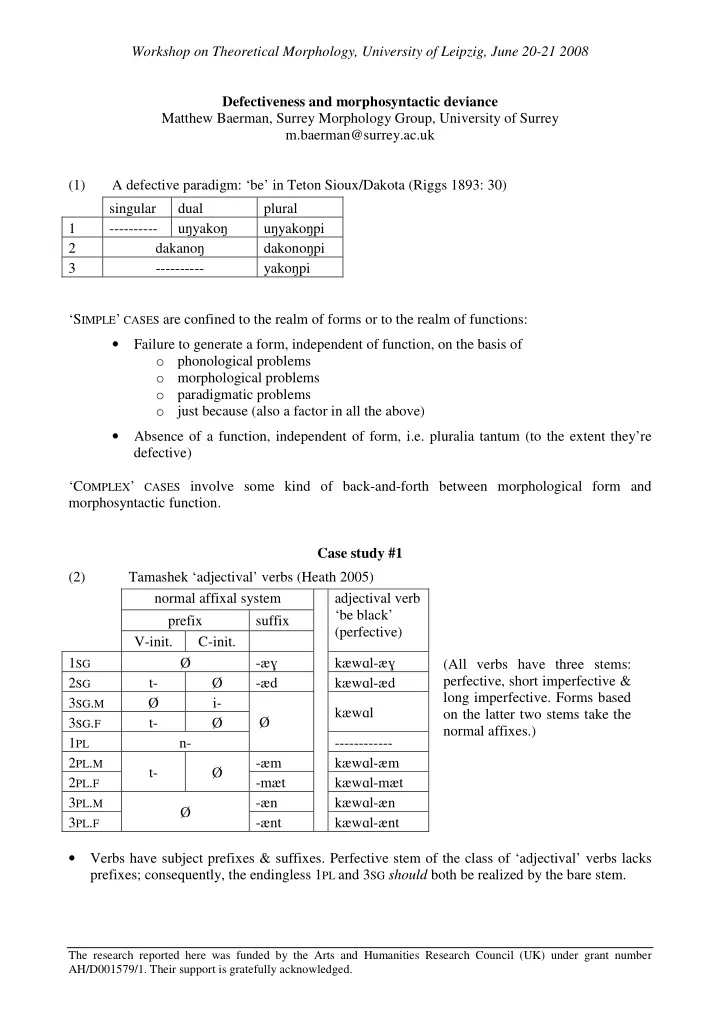
Defectiveness and morphosyntactic deviance Matthew Baerman, Surrey Morphology Group, University of Surrey m.baerman@surrey.ac.uk (1) A defective paradigm: ‘be’ in Teton Sioux/Dakota (Riggs 1893: 30) singular dual plural 1

  • uŋyakoŋ

uŋyakoŋpi 2 dakanoŋ dakonoŋpi 3

  • yakoŋpi

‘SIMPLE’ CASES are confined to the realm of forms or to the realm of functions:

  • Failure to generate a form, independent of function, on the basis of
  • phonological problems
  • morphological problems
  • paradigmatic problems
  • just because (also a factor in all the above)
  • Absence of a function, independent of form, i.e. pluralia tantum (to the extent they’re

defective) ‘COMPLEX’ CASES involve some kind of back-and-forth between morphological form and morphosyntactic function. Case study #1 (2) Tamashek ‘adjectival’ verbs (Heath 2005) normal affixal system prefix suffix V-init. C-init. adjectival verb ‘be black’ (perfective) 1SG Ø

  • æ

kæwl-æ 2SG t- Ø

  • æd

kæwl-æd 3SG.M Ø i- 3SG.F t- Ø kæwl 1PL n- Ø

  • 2PL.M
  • æm

kæwl-æm 2PL.F t- Ø

  • mæt

kæwl-mæt 3PL.M

  • æn

kæwl-æn 3PL.F Ø

  • ænt

kæwl-ænt (All verbs have three stems: perfective, short imperfective & long imperfective. Forms based

  • n the latter two stems take the

normal affixes.)

  • Verbs have subject prefixes & suffixes. Perfective stem of the class of ‘adjectival’ verbs lacks

prefixes; consequently, the endingless 1PL and 3SG should both be realized by the bare stem.

slide-2
SLIDE 2

2

But speakers reject 1PL interpretation of bare stem: Instead, a circumlocution or a specialized construction was offered to express senses like ‘we became black’ A T-ka (Timbuktu area, Kal Ansar) informant offered kæw

  • l-æte-næ
  • ,

a difficult -to-segment morphological oddity that seems to involve an apparent preposition- like-extension -æte- that takes the 1Pl suffix -næ

  • , but the only -æt suffix that can occur in

such a position is FeSg Participle suffix -æt, so the construction is obscure. Another T-ka speaker, the R (Rharous area) speaker, offered a circumlocution with Reslt[ative] -æmós- ‘be, become’ and a plural relative clause: n-æmós [i kæw

  • l-nen] ‘we have become black
  • nes’. (Heath 2005: 437f).
  • What’s wrong with syncretism anyway?
  • If syncretism is unacceptable, there’s an obvious default solution available (prefixes); since the

perfective stem is distinct from other stems, no danger of homophony. At least one Malian variety of Tamashek does this (Prasse 1985: 24).

  • Note that we’re dealing not with defective lexemes, but with a defective rule! It never works.

(3) A possible diachronic account: incremental importation of normal verb suffixes into

  • riginally adjectival paradigm (Prasse 1973: 10f, Beguinot 1942: 66f)

archaic type intermediate type later type Nefusi Kabyle Tamashek 1SG

  • 1SG
  • æ

M Ø

2SG

  • 2SG
  • æd

3SG M Ø

  • 3SG M

SG F yet

3SG F

  • t

3SG F Ø

  • 1PL
  • 1PL

??? 2PL M 2PL M

  • æm

2PL F 2PL F

  • mæt

3PL M 3PL M

  • æn

perfective adjectival verbs

PL

et 3PL F

  • it

3PL F

  • ænt

1SG

  • V

2SG t- … -Vd 3SG M i-

  • 3SG F

t- 1PL n- 2PL M t- … -Vm 2PL F t- … -mVt 3PL M

  • Vn

normal verbal paradigm 3PL F

  • nVt

Stage I: Borrowing of overt singular suffixes from the normal verbal paradigm; original gender- number suffixes restricted to 3rd person. Stage II: Complete accommodation to the suffixal pattern of the normal verbal paradigm in the singular. Stage III: Borrowing of overt plural suffixes from the normal verbal paradigm; status of zero suffix in 1PL unclear. Stage I Stage II Stage III

slide-3
SLIDE 3

3

Case study #2 (4) Chiquihuitlan Mazatec ‘carry’ (Jamieson 1982) neutral aspect incompletive aspect positive negative positive negative 1SG ba3nh31 ba2nh21 kua3nh31 kua2nh21 2SG ča3nĩh31 ča2nĩh21 ča4nĩh41

  • 3

ba3nĩh31 ba2nĩh21 kua4nĩh41

  • 1INCL ča3nh31

ča2nh21 ča4nh41

  • 1PL

ča3nĩh314 ča2nĩh214 ča4nĩh414

  • 2PL

ča3nũh31 ča2nũh21 ča4nũh41

  • Vh indicates laryngealized

vowel. (5) Endings (i-stem verbs) normal stem nasalized stem positive negative positive negative 1SG

  • æ
  • 2SG

3

  • i
  • ĩ
  • ĩ

1INCL

  • 1PL
  • ĩ
  • ĩ

2PL

  • ũ
  • ũ
  • Underlying form of negative

ending is -ĩ, realized variously in the different conjugation classes.

  • æ and e merge under

nasalization (6) Tone (class A, prefixal sets 8-18) normal stem laryngealized stem positive negative positive negative 1SG 3-1 2-21 3-31 2-21 2SG 3 4-1 4-41 1INCL 4-41 4-41 1PL 4-414 4-414 2PL 4-1 4-41 4-41

  • 1=high tone … 4=low tone
  • Negation marked by: (i) tone

alternation in 1SG, (ii) lengthening, tone contour realized on final syllable, and (iii) upglide in 1PL.

  • Laryngealization causes

lengthening; tone contour realized on final syllable. (7) Homophony is or isn’t fatal normal verb (tone class A, prefixal sets 8-18) ‘throw away’ laryngealized + nasalized stem verb ‘carry’ positive negative positive negative 1SG ska3 ntæ1 ska2 nt21 kua3nh31 kua2nh21 2SG ča4 nti1 ča4 ntĩ41 ča4nĩh41 3 ska4 nti1 ska4 nti41 kua4nĩh41 1INCL ča4 nt41 ča4nh41 1PL ča4 ntĩ1 ča4 ntĩ414 ča4nĩh414 2PL ča4 ntũ1 ča4 ntũ41 ča4nũh41

  • Positive and negative regularly

homophonous for 1INCL of some verbs (but apparently is tolerated?). (Alternative negation strategy involves preposed negator a4kũĩ41.)

slide-4
SLIDE 4

4

Case study #3 (8) Person-number markers in Chickasaw (Munro & Gordon 1982, Munro 2005) set I set II 1SG hopoo-li ‘I am jealous’ sa-chokma ‘I am good’ 1PL (k)ii-hopoo ‘we are jealous’ po-chokma ‘we are good’ 2 ish-hopoo ‘you are jealous’ chi-chokma ‘you are good’ 3 hopoo ‘he is jealous’ chokma ‘he is good’

  • Set I ≈ active/agentive subject,

set II ≈ patientive subject, but seems lexically arbitrary much

  • f the time.
  • 2PL marked by ha- prefixed to

2nd person marker (so long as it’s in word-initial position). (9) Normal transitive verb uses set I for subject and set II for object set I markers (subject) 1SG 1PL 2 3 1SG is-sa-hoyo ‘you look for me’ sa-hoyo ‘he looks for me’ 1PL ish-po-hoyo ‘you look for us’ po-hoyo ‘he looks for us’ 2 chi-hoyo-li ‘I look for you’ kii-chi-hoyo ‘we look for you’ chi-hoyo ‘he looks for you’ set II markers (object) 3 hoyo-li ‘I look for him’ ii-hoyo ‘we look for him’ ish-hoyo ‘you look for him’ hoyo ‘he looks for him’ (10) Defective transitive verb: set II used for subject. ‘These verbs cannot be used with non-third person objects; thus, Sa-nokfónkha is ‘I remember her’, but ‘She remembers me’ cannot be expressed in a single clause.’ (Munro 2005: 125) set I markers lacking 1SG 1PL 2SG 3 1SG

  • sa-banna

‘I want him’ 1PL

  • po-banna

‘we want him’ 2

  • chi-banna

‘you want him’ set II markers (subject) 3

  • banna

‘he wants him’ (11) Closely-related Choctaw fleshes out the paradigm by (i) prefixing set II markers for object; (ii) allowing syncretism in single-affixed forms (Broadwell 2006) set II markers (object) 1SG 1PL 2 3 1SG chi-sa-bannah ‘I want you’ sa-bannah ‘I want him’ 1PL chi-pi-bannah ‘we want you’ pi-bannah ‘we want him’ 2 sa-chi-bannah ‘you want me’ pi-chi-bannah ‘you want us’ chi-bannah ‘you want him’ set II markers (subject) 3 sa-bannah ‘he wants me’ pi-bannah ‘he wants us’ chi-bannah ‘you want him’ bannah ‘he wants him’

slide-5
SLIDE 5

5

References Beguinot, F. 1942. Il Berbero Nefûsi di Fassâo. Rome: Instituto per l’oriente. Broadwell, G. A. 2006. A Choctaw reference grammar. Lincoln: University of Nebraska Press. Heath, J. 2005. A grammar of Tamashek (Tuareg of Mali). Berlin: Mouton de Gruyter. Jamieson, C. A. 1982. Conflated subsystems marking person and aspect in Chiquihuatlan Mazatec. International Journal of American Linguistics 48/2. 139-176. Munro, P and L. Gordon. 1982. Syntactic relations in Western Muskogean: A typological

  • perspective. Language 58/1. 81-115.

Munro, P. 2005. Chickasaw. In: H. K. Hardy and J. Scancarelli (eds) Native languages of the Southeastern United States. Lincoln, Nebraska: University of Nebraska Press. Prasse, K.-G. 1973. Manuel de grammaire touarègue [vol. 6/7: Verbe]. Copenhagen: Akad. Forl. Prasse, K.-G. 1985. Tableaux morphologiques: dialecte touareg de l'Adrar du Mali (berbère). Copenhagen: Akad. Forl. Riggs, Stephen Return. 1893. Dakota grammar, texts and ethonography [ed. by James Owen Dorsey]. Washington: Government Printing Office.