Workshop kshop Ex Exper erien ence ce in Niger eria ia The - - PowerPoint PPT Presentation

workshop kshop ex exper erien ence ce in niger eria ia
SMART_READER_LITE
LIVE PREVIEW

Workshop kshop Ex Exper erien ence ce in Niger eria ia The - - PowerPoint PPT Presentation

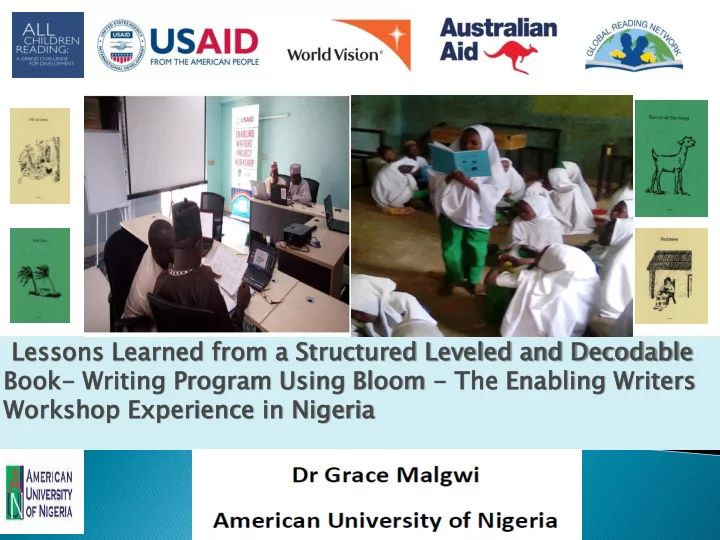
Lessons ssons Learne rned d from m a Structured ctured Leve vele led d and Deco codable dable Book- Writing ing Progr ogram am Using ng Bloom m - The Enabli ling ng Writer ers s Workshop kshop Ex Exper erien ence ce in


slide-1
SLIDE 1

Lessons ssons Learne rned d from m a Structured ctured Leve vele led d and Deco codable dable Book- Writing ing Progr

  • gram

am Using ng Bloom m - The Enabli ling ng Writer ers s Workshop kshop Ex Exper erien ence ce in Niger eria ia

slide-2
SLIDE 2

The Task

 To develop high-quality books in Hausa that

support reading instruction.

50 decodable texts - simple single-word to short sentence texts for the beginning reader. 150 leveled texts – texts grouped at increasingly difficult levels for the emerging reader – 4 levels

To develop books that depict the cultural context of the lives of the children and are written by authors who live within the children’s community and understand the cultural context.  To develop the capacity of local writers to use the Bloom book writing software for sustainable book development. To secure the buy-in of relevant government establishments.

slide-3
SLIDE 3

Puttin ting g Toget gether her the e Guidin iding g Documents cuments

St Structur ure e for the book develop lopmen ment The Gu Guid idin ing g Documen ments s – 2 m major r documen ments ts + grade appropriate sample texts ( About 3000 words)

1.

Hausa Phonics scope and sequence

2.

Leveling Document

3.

Sample texts Needed ed for the Hausa sa Blo loom Se Set up

slide-4
SLIDE 4

Stakeho akeholder lder invo volvement vement and d partner tnership ship at the

  • nset

et

1.

Nigerian Research and Development Council (NERDC).

2.

Northern Education Initiative Plus (NEIplus).

3.

Reading and Numeracy Activity (RANA – fhi360) New w from existi ting ng and d endo dors rsed ed

1.

EW Hausa Phonics scope and sequence - NEIPlus

2.

Leveling Document – NEIPlus/Adaptation of URC samples

3.

Sample texts – STELLAR/TELA/NEIPlus/RANA

slide-5
SLIDE 5

Assembl sembling ing the wr writers ers Writers were drawn as follows:

a.

Writers who have worked on other Hausa EGR material development projects – NEIPlus and RANA (fhi360)

b.

Hausa Language teacher trainers from Colleges

  • f Education

c.

Community Children Library

d.

Primary school teachers who participated in the AUN?USAID TELA Project

e.

Hausa Language experts (Consultants for NERDC)

slide-6
SLIDE 6

The Wo Works kshops ps – February,

uary, March ch & M & May

slide-7
SLIDE 7

Wo Works kshop p 1 - 6 to 10 Febru ruary ary 2017

37 write ters rs 3 3 observe ervers rs 116 books

  • ks – Pre –

revie iew 95 books

  • ks – Post

t review ew 21 books

  • ks discard

carded

Lesso son s L Learne arned from

  • m Workshop

kshop 1 ❖ Conferencing and making sure writers were producing books that would meet set standards proved to be a challenge due to the large number of writers ❖ Story structure needs to be further explained. ❖ Pair/Group stories met requirement more than individual stories

slide-8
SLIDE 8

Wo Works kshop p 1: The focus was as follows:

 Guiding participants to discuss the core elements

  • f early grade and the importance of books in the

reading process.

 Providing participants with deeper insight on

decodable and leveled books and the role of each in the reading process.

 Installing Bloom on the writers’ laptops.  Training on the use of Bloom.  Getting participants to understand the leveling

document and how it is used.

 Guiding the writers on how to type

decodable/leveled stories on Bloom.

slide-9
SLIDE 9

Wo Works kshop p 2 - 13 to 17 March ch 2017

10 0 writers iters - auth uthors/c s/co – authors of f book

  • ks

s selec ected ted from

  • m work
  • rkshop

shop 1 70 0 leveled eled book

  • ks

s – Informa formatio ional al/nar /narrat ativ ive Foc

  • cus of work
  • rkshop

shop 2 ❖ Review books from workshop 1 ❖ Write leveled books on themes not sufficiently addressed in workshop 1. ❖ Topics from core curriculum subjects – Informational texts ❖ Peace and conflict resolution ; Responsibility; local folktales.

slide-10
SLIDE 10

Wo Works kshop p 3 - 8 to 10 May 2017

6 write ters rs 38 leveled eled books ks Focus cus of workshop kshop 3 ❖Write leveled books on themes not sufficiently addressed previous workshops. ❖Topics from core curriculum subjects – Informational texts ❖Local folktales

slide-11
SLIDE 11

Sa Sample le Task sheets ets

Tasks were organized around varied themes

and curriculum content

▪ Peace/peaceful coexistence - level 4 ▪ Conflict Resolution - level 3 ▪ Topic from Basic Science and Technology Bk 2 Level : 4

slide-12
SLIDE 12

Re Revi view ew for Quali lity ty As Assura suranc nce Monit itoring

  • ring and

d Eva valua uatio ion n (ME) ) Team revi view ew - M&E lead with a Hausa native speaker Project intern

❖Reviewed hard copies of books ❖Used the book review checklist and Illustrator

brief completed by writers. The main focus of the M&E review are:

❖Content Check ❖Context Check ❖Equity Check ❖Type and Quality Check ❖Gender and Inclusion Focus

slide-13
SLIDE 13

Re Revi view ew for Quali lity ty As Assura suranc nce Wr Writing ng trainer iner revi view ew and d editing ting - Pedagogy lead, select writers, & EW project staff

❖Reviewed stories on Bloom.

The main focus of this review are:

❖Follow up and revise areas highlighted by M&E

review

❖Carry out level check ❖Narrative and non-fiction organization check ❖ Content quality check ❖Picture and page layout check ❖Edit basic errors of mechanics

slide-14
SLIDE 14

Revi view w for Quali lity ty Assura suranc nce Ha Hausa sa Language nguage Exper ert Revi view w - 2 Hausa Professors – Consultants from NERDC

❖Reviewed hard copies of books that have

passed the M&E and Writing Trainer review. The main focus of this review are:

❖Edit errors in mechanics ❖Ensure use of acceptable standard Hausa –

structure and vocabulary

slide-15
SLIDE 15

Lessons ns Learned d fr from Book k Developm pmen ent t Activi vitie ties

1.

Maintaining a ratio of 10 or less writers to 1 writing trainer is important to quality book development.

2.

Conferencing with writers during the writing task and reviewing books with writers soon after task completion ensures that books meet set standards.

3.

Having Bloom and the Hausa shell ready on flash drives and giving each participant a prepared flash drive made it easy for the technical team to install Bloom on writers’ laptops quickly and with no risk of computer virus transfer.

4.

A systematic review process is needed to ensure book quality

5.

A refresher lesson on elements of a good story can boost narrative quality.

slide-16
SLIDE 16

Fi Field ld Testing sting

 Field Testing Training and Distribution of Field Testing Kit - 6th

July 2017

 Field Testing of books – 10th to 28th July 2017 Total Number of Books Written 200 25% of Total Books (Sample) 50 List of Stages Proportional Number of Books Decodables 10 Level 1 10 Level 2 10 Level 3 10 Level 4 10 TOTAL 50

Participants 20 20 Teachers 2 Directors Quality Assurance 5 schools in Bauchi 5 schools in Sokoto

slide-17
SLIDE 17

Pu Purpose rpose of Field ld Testing ing To find out:

1.

Whether the levels of text are appropriate for your students

2.

Teachers’ opinion about the books, and the most effective ways teachers can use them

3.

Pupil opinions about the books, and whether pupils find them interesting and engaging

4.

Next steps for revision before publishing and larger use

slide-18
SLIDE 18

Fiel eld d Te Testing ting Pr Proces ess s (July uly 10 10 – 28 28, 20 2017 17) Teachers used one book at a time following the process below for each book, using 2-3 days for each book.

1.

Introduce book to students, and using it as a read-aloud book.

2.

Then use the book with students during regular reading instruction,

3.

Make the book available for independent student reading.

4.

Repeat this process for each book in field test packet (5 different titles)

5.

Complete Teacher Data Form included in pack

slide-19
SLIDE 19

Fiel eld d Te Testing ting Monit itoring

  • ring

Director of Quality Assurance – Bauchi & Sokoto

SUBEB served as an independent field test monitors and completed Field Test Observation Form

The M & E team monitored all schools, collected

completed forms from independent monitors and all teachers, and did the following in 25% of the schools

1.

Observed teachers using the field test books during instruction.

2.

Interviewed teachers about the books tested.

3.

  • 3. Interviewed a small group of students about

their opinions of the books.

slide-20
SLIDE 20

Feed ed Ba Back k from Field d Testing ting Feedback edback from Stud udents: ents:

 The children liked all the books field tested.  Each child should have a copy during reading

lesson

 Children have a preference for books with

animal characters.

 Some words were not familiar.  Some illustrations did not support text

comprehension.

slide-21
SLIDE 21

Lessons ssons Learned rned from Field d Testing ing

1.

Involving the Directors of Quality Assurance from the SUBEB of the 2 states that participated in the field testing had the following effects :

a. Teachers were more committed b. Head teachers cooperated with the teachers doing the field testing c. The SUBEBs got interested in the books and EW project d. Daily monitoring of the field testing process was done

  • 2. Students wished they had their own copy of the

storybooks for independent reading.

slide-22
SLIDE 22

Po Post t Field d Test Revi view The main area of review was illustration:

1.

Combining 2 or more SIL images to support content

2.

Partnering with a stakeholder for complete illustration of 25 of the 50 decodables

slide-23
SLIDE 23

Sam ample ple Illustration ustration Revie view

slide-24
SLIDE 24

St Stakehold akeholder/ er/Book Book Ad Adopti ption

  • n Meet

eeting ing 18 18 O October ber 2017 2017

Agencies cies and Or Organiza nizatio tion n in Attenda ndanc nce

1.

Federal Ministry of Education

2.

Nigerian Educational Research and Development Council (NERDC)

3.

Ministry of Education, Sokoto State

4.

State Universal Basic Education Board (SUBEB)– Sokoto , Bauchi and Adamawa States

5.

United States Agency for International Aid (USAID)

6.

British Council

7.

Fhi360 (RANA Project)

8.

Northern Education Initiative Plus (NEIPlus)
slide-25
SLIDE 25

Lessons ssons Learned rned

1.

Involvement of relevant government agencies from the start of the project is key not just for material acceptance, but for guidance and direction.

2.

Collaboration with agencies and organization involved in similar projects is time saving and helps to improve product quality.

slide-26
SLIDE 26

Chall llenges enges

1.

Writer motivation and inspiration tends to wane towards the end of the workshop day and on the last 2 days of a 5 day workshop.

2.

Working on the same Bloom folder for the different quality assurance review processes.

3.

Writers who play with Bloom and make the page uneditable.

slide-27
SLIDE 27

Re Recomm mmen endati dations

  • ns for Si

Simi milar ar Futur ure e Pr Projec jects ts

1.

To increase motivation, plan writing tasks - specify themes and give scenario.

2.

Writers working in groups with the grouping changing after every task helps with motivation and inspiration

3.

Punctuating writing sessions with 10 – 15 minutes fun activities (Brain Teasers) also refreshers the writers.

4.

Have one computer designated for review or work on an external hard drive. This will ensure all revisions are done on the same Bloom folder.

slide-28
SLIDE 28

Than hank k yo you for u for li liste stening ning

Dr Dr Grace Malgwi American Univer ersi sity ty of Nigeria grace.malgwi@aun.ed .edu.ng