WORKSHOP #3 STRATEGIC PLANNING February 15, 2018 1 Todays - - PowerPoint PPT Presentation

workshop 3 strategic planning
SMART_READER_LITE
LIVE PREVIEW

WORKSHOP #3 STRATEGIC PLANNING February 15, 2018 1 Todays - - PowerPoint PPT Presentation

WORKSHOP #3 STRATEGIC PLANNING February 15, 2018 1 Todays Workshop Structure and Status of Planning Process SWOT Results Findings of Research Interviews Discussion of Plan Construct (Vision Approach) Discussion of Goal


slide-1
SLIDE 1

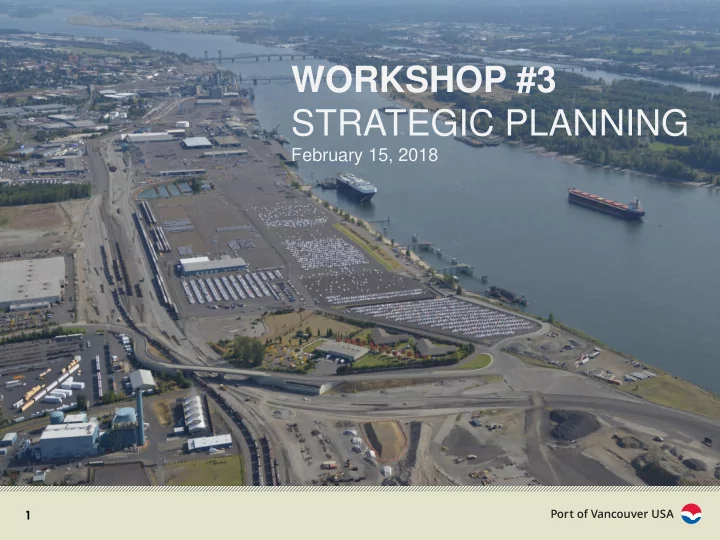
WORKSHOP #3 STRATEGIC PLANNING

February 15, 2018

1
slide-2
SLIDE 2

Today’s Workshop

  • Structure and Status of Planning Process
  • SWOT Results
  • Findings of Research Interviews
  • Discussion of Plan Construct (Vision Approach)
  • Discussion of Goal Areas
  • Discussion of Value Statements
  • Next Steps

2

slide-3
SLIDE 3

Structure and Status

  • f Planning Process

3

slide-4
SLIDE 4

OBJECTIVES

▪ Provide policy direction ▪ Clear road map to the community, staff, tenants, and partners ▪ Annual budget priorities align with its mission, values, and goals ▪ Aligning keystone documents:

Annual operating budget Capital budget Sustainability plan Port branding plan Department work plans Annual work plans Employee evaluations

4

slide-5
SLIDE 5

PROJECT STATUS

5

Phase I Initiation Phase II – Plan Development

✓ Commission Workshop 1: Introduction ✓ Commission Workshop 2: SWOT Analysis ✓ Workshops with Port Staff ✓ Research Interviews ✓ Design Planning Process ▪ Commission Workshop 3: Goal Areas & Values ▪ Roundtable Discussions ▪ Commission Workshop 4: Discuss Goals ▪ Community Conversations 1 ▪ Commission Workshop 5: Refine Goals and Strategies ▪ Draft Plan ▪ Community Conversations 2 ▪ Final Plan & Adoption

slide-6
SLIDE 6

PHASE II The PLAN

6

slide-7
SLIDE 7

SWOT RESULTS

7

slide-8
SLIDE 8

SWOT - STRENGTHS

  • Ample facilities and real property assets
  • Location, location, location
  • Relationships with local, state and federal

governments

  • Financial capacity
  • Diverse tenant portfolio
  • Skilled and experienced staff

8

slide-9
SLIDE 9

SWOT - WEAKNESSES

(aka: WHAT WE CAN DO BETTER)

  • Access to only a single rail carrier
  • Communicate the port’s role in the community
  • Engage with the community more effectively
  • Lack of strong experience in urban development
  • Internal communications
  • Co-locating management functions
  • More pro-active vs reactive in maintenance work

9

slide-10
SLIDE 10

SWOT - THREATS

  • Perception that the Port has unlimited resources
  • Strain on tribal relations
  • Potential for changes in national trade policies
  • Growing congestion in regional surface

transportation infrastructure

  • Need for resiliency planning
  • Changing dynamic in the regulatory environment
  • Unpredictability in State funding

1

slide-11
SLIDE 11

SWOT - OPPORTUNITIES

  • Improve relations with local governments
  • Partnerships with private development

community

  • Tribal-Port collaboration
  • Expand global cargo marketing and address

regional cargo mobility challenges (heavy lift corridor)

  • Open for business initiative: incubators & pre-

permit projects

  • Pursue more port to port partnerships
  • Terminal 1 development and more river access

1 1

slide-12
SLIDE 12

Research Interviews Findings

12

slide-13
SLIDE 13

RESEARCH INTERVIEWS

  • Economic Development
  • Labor
  • Education
  • Workforce
  • Industrial and Commercial

Tenants

  • Marine Tenants and

Partners

  • Federal and Local Elected

Officials

  • Tribes
  • Environmental
  • Neighborhoods

13

slide-14
SLIDE 14

RESEARCH INTERVIEW FINDINGS

Opportunity to set a new course

  • With the recent changes in leadership, there is an
  • ptimism for greater alignment between the port’s

initiatives and community aspirations

  • Tremendous opportunity to redefine partnerships that will

support the port’s mission

1 4

slide-15
SLIDE 15

RESEARCH INTERVIEW FINDINGS

Increase public engagement and improve communications

  • Explain the reason “Why” it is making its investment

decisions and clearly articulate the public benefit

  • Tell the story about promoting family wage jobs,

connecting the community to the global economy, and being responsible environmental stewards

15

slide-16
SLIDE 16

RESEARCH INTERVIEW FINDINGS

The Port of Vancouver plays a key role in promoting family wage and industrial jobs

  • The port plays a unique and important role in the local and

regional economy by providing well-paying “industrial” jobs for people without advanced degrees

  • It is a leader in developing public infrastructure to promote

economic development

16

slide-17
SLIDE 17

RESEARCH INTERVIEW FINDINGS

The port is widely recognized as an effective, well-run organization

  • As a local government, the port has unique abilities and

valuable capacity to partner with private industry

  • Don’t let new business recruitment overshadow existing

business expansion

17

slide-18
SLIDE 18

RESEARCH INTERVIEW FINDINGS

Support the core business of marine cargo and industrial jobs

  • Regional leader in marine cargo shipping (facilities, labor

force, marketing and sales)

  • Great interest in what comes next for Terminal 5 given

the financial investment of public resources

18

slide-19
SLIDE 19

RESEARCH INTERVIEW FINDINGS

Embrace the Columbia River and Waterfront as an essential element of the culture, economy, and identity of the region

  • Terminal 1 waterfront redevelopment is generally seen

as a strong positive for the community

  • It has the opportunity to be an icon for Vancouver,

support downtown development, and provide much needed public access to the river

  • The port should provide greater public access and

interpretation opportunities to the waterfront and adjacent natural areas

19

slide-20
SLIDE 20

RESEARCH INTERVIEW FINDINGS

Leverage Port Resources and Patient Capital to Position Challenging Properties for Redevelopment

  • Important role in protecting scarce large industrial

parcels and positioning them for development

  • Make investments more broadly across the port district,

beyond waterfront properties

20

slide-21
SLIDE 21

RESEARCH INTERVIEW FINDINGS

Support Programmatic Economic Development

  • Increase financial and personnel support of economic

development efforts

  • Continue and increase support for education and

technical training to support workforce development

21

slide-22
SLIDE 22

ASSESSMENT

  • The port is widely recognized as an essential community

asset

  • Port partners are willing and able to assist the Port in its

future efforts

  • The Vancouver Energy efforts resulted in actionable

skepticism within a portion of the community

  • There is a window of opportunity for the new leadership

to re-cast the port’s direction

  • The port has effective authorities and tools to improve

the community’s future

  • Maintain the port’s established marine cargo market

presence and culture, while embracing an informed future for new opportunities

22

slide-23
SLIDE 23

Discussion of Plan Construct

23

slide-24
SLIDE 24

STRUCTURE OF CURRENT STRATEGIC PLAN

VISION Mission

Corporate Values Operational Values Safety Values Environmental Values Industrial Goal Marine Cargo Goal Destination Goal Multi-Modal Goal Financial Goal

Revenue Initiative WFVA Initiative Centennial Industrial Park Initiative Freight Corridors Initiative Terminal One Initiative Columbia Gateway Parcel 3 Initiative

24

slide-25
SLIDE 25

PRINCIPLES AND FUNDAMENTALS

Action Plan

VISION

25

slide-26
SLIDE 26

Discussion of Goal Areas

26

slide-27
SLIDE 27

WHAT IS A GOAL?

A goal is a destination, that once achieved, speaks to the success of the

  • rganization. The most effective goals are

those that are quantified, measurable and have a timing component.

27

slide-28
SLIDE 28

WHAT IS A STRATEGY?

The route and mechanism an

  • rganization deploys to achieve a goal.

There may be more than one strategy for a particular goal.

28

slide-29
SLIDE 29

WHAT IS A TACTIC?

A specific set of maneuvers designed to advance a strategy. There may be several tactics to support a strategy and often they are set within a calendar schedule.

29

slide-30
SLIDE 30

GOAL AREAS

  • Topics for setting goals
  • Not specific goals language
  • Group discussion

30

slide-31
SLIDE 31

Discussion of Value Statements

31

slide-32
SLIDE 32

VALUES

  • Corporate
  • Operational
  • Environmental

32

slide-33
SLIDE 33

Next Steps

33

slide-34
SLIDE 34

PHASE II The PLAN

3 4

slide-35
SLIDE 35

Roundtable Discussions

  • March 27 & 28, 2018

Commission Workshops

  • Workshop #4: March 2018
  • Discuss Goal Language
  • Workshop #5: TBD (Q2)

Open Houses

  • April/June

NEXT MEETINGS

35

slide-36
SLIDE 36

Food for thought:

Did we capture all of our goal areas? Though which lens should we cast our vision? What goals do we want to establish? Should we re-think our values?

36