Workplace Parking Levy (WPL) 1 Click to edit Master title style - - PowerPoint PPT Presentation

workplace parking levy wpl
SMART_READER_LITE
LIVE PREVIEW

Workplace Parking Levy (WPL) 1 Click to edit Master title style - - PowerPoint PPT Presentation

Click to edit Master title style Workplace Parking Levy (WPL) 1 Click to edit Master title style Road User Charging Congestion Charging Schemes all motorists liable and responsible for payment Workplace Parking Levy (WPL) only


slide-1
SLIDE 1

Click to edit Master title style

1
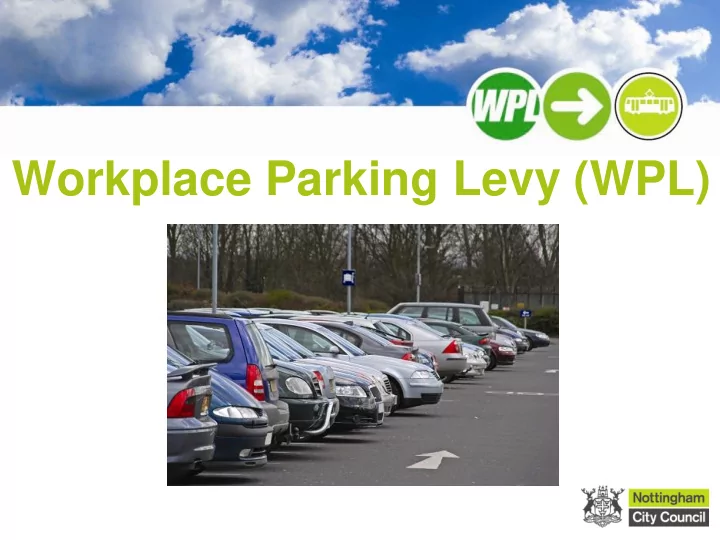
Workplace Parking Levy (WPL)

slide-2
SLIDE 2

Click to edit Master title style

2

  • Congestion Charging Schemes

all motorists liable and responsible for payment

  • Workplace Parking Levy (WPL)
  • nly commuter parking liable, employer pays

Road User Charging

slide-3
SLIDE 3

Click to edit Master title style

3

  • Congestion is costing Nottingham £160m a year

(mostly in peak period)

  • 70% of peak period congestion is commuters

Solutions for the future:

  • Provide attractive alternatives to the car
  • Continue to develop high quality public transport
  • Protect the city’s commerce and inward investment
  • Improve the city’s environment and sustainability

Congestion

slide-4
SLIDE 4

Click to edit Master title style

4

WPL Scheme Development

  • 2000 – 2005 Scheme Development
  • 2006 NET Phase Two Programme Entry Approval
  • 2007 Public consultation
  • 2008 Scheme Order
  • 2009 Secretary of State decision
  • Oct 2011 Licensing begins
  • April 2012 Charging begins
slide-5
SLIDE 5

Click to edit Master title style

5

WPL Operation

  • Approximately 2400 employers hold a WPL licence
  • About 425 employers are liable for a WPL charge
  • 100% compliance of liable employers since year 1
  • No penalty charges issued to date
  • £25.3 million revenue raised in the first 3 years
  • > 99.9% of revenue collected
  • < 5% operating costs
slide-6
SLIDE 6

Click to edit Master title style

6

Public Transport Improvements

  • Extending the existing tram network

(NET Phase Two) – Delivered August 2015

  • The redevelopment of Nottingham’s

Railway Station into a 21st century transport and business Hub – Delivered 31/3/14

  • Maintaining and improving the city’s

Link bus service which serve some

  • f the city’s key employment sites,

hospitals and universities

  • Delivering
slide-7
SLIDE 7

Click to edit Master title style

7

  • 45 fully electric midi buses in service

since 2012 – largest electric bus fleet in UK

  • 13 more electric buses due for

delivery in 2016

  • Charging equipment already

installed: 60 trickle chargers and 8 rapid chargers

  • Total investment to date £15m -

£5.4m from WPL, £2.6m from LSTF/LTP and the rest from BBA, Green Bus Fund etc

Electric Link Buses

slide-8
SLIDE 8

Click to edit Master title style

8

Business Support

A range of ongoing business support measures are available to employers and employees, these include:

  • Travel planning and smarter choices
  • Public transport and personal journey planning support
  • Parking management
  • Traffic management
  • Parking management support grants available
  • Cycling infrastructure support grants available
slide-9
SLIDE 9

Click to edit Master title style

9

From: Meta Analysis of Outcomes of Investment in the 12 LSTF Large Projects, Interim Findings, Transport for Quality of Life and TRL for DfT, 2015

Impact on Congestion

Still awaiting evaluation due to building public transport alternatives But signs are good:

slide-10
SLIDE 10

Click to edit Master title style

10

Economic Impacts

  • No evidence so far of negative

impact

  • WPL plays a very small role in

business location decisions

  • However public transport

investment proven to attract investment

  • Economic indicators in Nottingham

similar to benchmarked cities

  • Main expressed issue is availability
  • f suitable premises
  • £375 per liable wpp
slide-11
SLIDE 11

Click to edit Master title style

11

  • There would be no business

incentive to minimise parking provision and encourage more sustainable commuter travel

  • Further public transport

investment, particularly NET Phase Two, would have been unaffordable

  • More of a challenge to

manage impacts of economic and population growth

Without WPL