Working with Foreign Trained Skilled Professionals Maine College - - PowerPoint PPT Presentation

working with foreign trained skilled professionals
SMART_READER_LITE
LIVE PREVIEW

Working with Foreign Trained Skilled Professionals Maine College - - PowerPoint PPT Presentation

Working with Foreign Trained Skilled Professionals Maine College Transitions Conference October 12, 2018 Sally Sutton, Program Coordinator Mission To support Maines economic development by meeting employers demands for a skilled and


slide-1
SLIDE 1

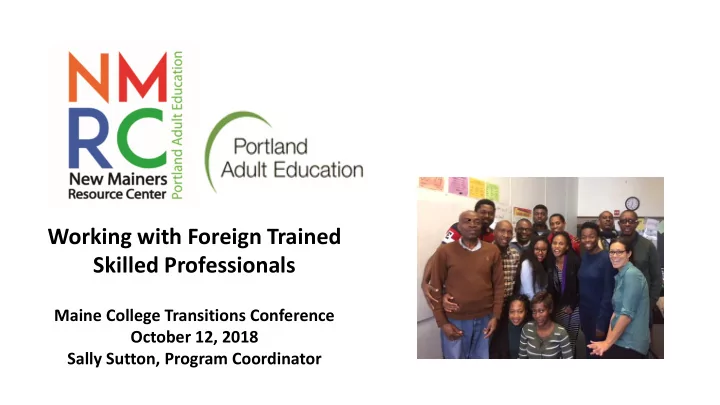
Working with Foreign Trained Skilled Professionals

Maine College Transitions Conference October 12, 2018 Sally Sutton, Program Coordinator

slide-2
SLIDE 2

Mission To support Maine’s economic development by meeting employers’ demands for a skilled and culturally diverse workforce. Vision

  • To grow Maine’s economy by fully utilizing the skills of foreign trained

professionals.

  • To help employers hire and retain qualified workers for a skilled and

diverse workforce

  • To help Maine’s immigrant and refugees overcome barriers and

resume their professional careers

slide-3
SLIDE 3

Barriers to Employment Foreign trained skilled professionals face many barriers as they seek to enter the Maine workforce. In addition to needing an adequate level of English competency (also a need for computer skills), these barriers include lack of information about:

  • Career options and pathways
  • Transferring credentials – getting recognition for their training and

experience

  • US standards and approaches for resumes, interviews and job

searches

  • American workplace culture
slide-4
SLIDE 4

NMRC Program Offerings The New Mainers Resource Center (NMRC) is a program within Portland Adult Education serving area immigrants and refugees. It includes:

  • a skilled professional program
  • employment case management and advising
  • intensive classes focused on job readiness skills
  • professional networking groups
  • workshops and other offerings

These offerings are designed to help new Mainers, of all professions,

  • vercome barriers to entering the US workforce.
slide-5
SLIDE 5

444 420 227 190 155 130 87 75 41 40 39 35 33 27 25 25 19 16 16 14 12 12 11 9 9 9 8 8 7 7 7 6 6 5 5 50 100 150 200 250 300 350 400 450 500

Number of Students Countries Total Immigrant Enrollment for September 2017-June 2018: 2,269 Number of Countries Represented at PAE: 82

Countries with 4 or less students attending: Albania, Argentina, Belarus, Belgium, Benin, Bosnia, Brazil, Chad, Costa Rica, Cuba, Czech Republic, Ecuador, Egypt, France, Gambia, Guinea,

Hong Kong, India, Italy, Japan, Kenya, Kosovo, Kuwait, Lebanon, Macedonia, Mali, Morocco, Mozambique, Myanmar, Nigeria,Pakistan, Peru, Rep. of Georgia, Russia, Senegal, South Africa,

Portland Adult Education Immigrant Enrollment

slide-6
SLIDE 6

204 325 438 438 Annual Totals of Program Participants

Total NMRC Participants by Year

2014 2015 2016 2017

slide-7
SLIDE 7

24 25 136 45 30 29 158 51 48 45 180 75

20 40 60 80 100 120 140 160 180 200

High School Diploma Some College Undergraduate Degree Graduate Degree and Above

Educational Level Among NMRC Participants by Year

2015 2016 2017

slide-8
SLIDE 8

19 32 36 39 72 99 20 40 60 80 100 120 Legal Education Arch/Engineers Computer/IT Healthcare Business/Economic

2017 NMRC Participants/Students by Most Frequent Professional Backgrounds

Professional Backgrounds

slide-9
SLIDE 9

Career Guidance Advice and Case Management One important component of NMRC programming is the individualized career guidance, advice and case management that program participants receive. This is important particularly as people try to understand and maneuver professional licensing requirements and take steps to move up the career ladder in their chosen field. The initial goal with many people is to help them find employment in a job that utilizes as much of their previous training and experience as possible, that pays a livable wage and that will provide opportunities for career growth.

slide-10
SLIDE 10

“Since I was first in touch with the New Mainers Resource Center in August 2015, I have received a range of support that has allowed me to learn and improve my English… I have learned how to network and search for a job in my field and understand employer expectations. All of this has enabled me to accept a position as a Substation Technician at Electric Power Systems.” Claude M., Electrical Engineer from the Democratic Republic of Congo

slide-11
SLIDE 11

Career advising and case management takes into consideration

  • English level
  • Previous training and experience, need for additional training or

education

  • Short and long term career goals
  • Availability of training resources or scholarships
  • Job search skills and familiarity with US work culture
  • Degrees, access to college transcripts and diplomas
  • Work authorization and immigration status, i.e., when will they be able

to work

  • Family commitments both in the US and in country of origin
  • Office and computer skills
  • Need for specific credential or license in their professional field, an

understanding of that process and likelihood of successful completion

  • Access to transportation, need for child care, etc.
slide-12
SLIDE 12

Tam T., from Viet Nam, is a former PAE/NMRC student and PAE Computer Lab Summer Coordinator. She works for the City of Portland as a Computer Programmer Analyst. She continues to stay involved at PAE by helping in whichever way she can. Innocent B., a former NMRC/PAE student from the Democratic Republic of Congo, was recently hired by Chewonki Foundation as IT Help Desk. Steve B., a former NMRC/PAE student from Burundi now works as a Teller at Key Bank. In 2017, representing NMRC/PAE on behalf of the Maine Adult Education Association, he gave a presentation at an event at the Statehouse in Augusta Abdul Q., a physician who worked as an interpreter for the US army in Afghanistan was one of NMRC’s earliest students. In June 2017 he graduated from UNE’s Physician Assistant program. He is now working as a Physician Assistant in the Urology Department at MaineMed. Olesya S., a former NMRC/PAE student from Russia now works as a HR Generalist at Growers Express. She continues to look to NMRC as a recruitment source and assists Job Classes with mock interviews.

Some Success Stories

slide-13
SLIDE 13

NMRC 2017 Program Data and Impact

  • 438 people received services; 261 were new in 2017; 171 continued

from previous years

  • 317 people received case management/career advising
  • 81% of those eligible to work and receiving case management/career

advising services found jobs

  • Job class students report higher wages than area minimum wages,

receiving an average of $12.84

  • NMRC program participants are successful at getting jobs in all sectors
  • In 2017 NMRC programmatic offerings designed to help immigrants
  • vercome barriers and engage with employers had 566 participants
  • A majority of new Mainers served by NMRC have a bachelor’s degree or

higher

slide-14
SLIDE 14

Issues to Consider for New Mainers with Professional Degrees and Experience in College Transitions

  • English proficiency
  • US credential is important to success and gainful employment in the US
  • What is the least amount of training or steps that can be taken that will get

someone the best job they can get in their field?

  • Assessing educational program for people who already have college degrees
  • An important question is to ask why?
  • Education needs to be a means to an end
  • How will they be further ahead if they complete the program?
  • Making sure they understand their options and different programs

▪ i.e. what are the admission requirements, how long will a program take, can they get any credit for their previous education or training, what will it cost and how will they pay for it?

slide-15
SLIDE 15

Issues to Consider for New Mainers with Professional Degrees and Experience in College Transitions, cont.

  • Need to help people be smart consumers, help them learn how to

research programs, such as: ▪ What is the success or completion rate of people who have entered the program? ▪ How many complete or graduate the specific program? ▪ How long does it take? ▪ Do they have loans, and if so how much? ▪ Do they get jobs when they finish and if so what is the pay?

  • How will they pay for their education?
  • Many new Mainers if they already have a degree or are an asylum seeker

(without permanent status) are not eligible for federal financial aid?

  • Most new Mainers work while they are in school. Will they be able to

continue working while they are pursuing an educational program?

  • Life circumstances
slide-16
SLIDE 16

Sally Sutton, Program Coordinator New Mainers Resource Center

Maine’s Welcome Back Center Portland Adult Education 14 Locust St. Portland, Maine 04101 207 874-8155 www.nmrcmaine.org suttos@portlandschools.org