SLIDE 5 05/03/2018 5
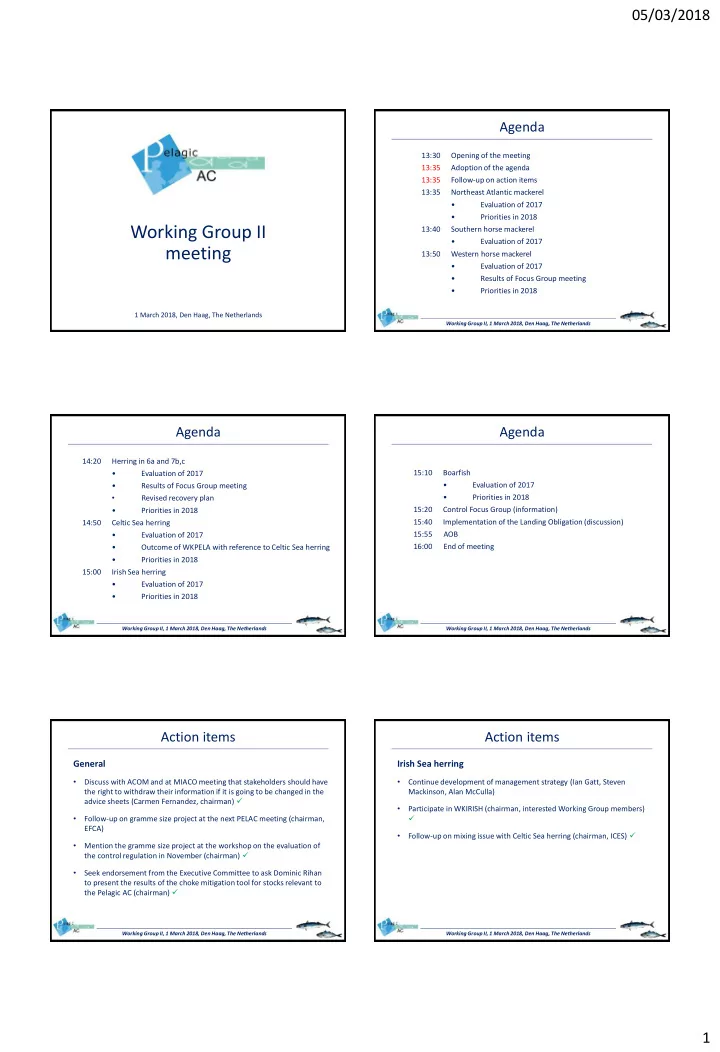
Herring in 6a and 7b,c
Working Group II, 1 March 2018, Den Haag, The Netherlands
Criteria and definitions Article 1 subject matter This plan pertains to the herring stocks in the following geographical areas: a) 6a North b) 6a South and 7bc Article 2 geographical definitions of stocks For the purposes of this plan, the following geographical definitions of stocks shall apply (subject to article 5): a) ‘6a North stock’ means the autumn-spawning herring stock that spawns in the waters of 6a North. b) ‘6a South, 7bc stock’ means the winter-spawning herring stock that spawns in the waters of 6a South and 7cb. c) ‘Combined 6a, 7bc stock’ means the combined stocks of 6a North autumn spawning herring and 6a South and 7bc winter spawning herring stocks.
Herring in 6a and 7b,c
Working Group II, 1 March 2018, Den Haag, The Netherlands
Article 3 definitions
For the purposes of this Plan, in addition to the definitions laid down in Article 4 of Regulation (EC) No 1380/2013, the following definitions shall apply:
- 1. ‘Monitoring TAC’ means the allocated TAC for herring in 6a and 7bc that will fulfil the
- bligations for appropriate monitoring of stock development and/or stock
discrimination. 2. ‘Catch sampling’ means the collection and analysis of catch samples taken from a commercial fishery, in accordance with the EU Multi-annual programme for data collection (EC 2016_1251)
- 3. ‘Genetic sampling’ means the collection and analysis of genetic tissue samples from a
commercial fishery or from research surveys with the aim of identification of distinct fish stocks.
- 4. ‘Morphometric sampling’ means the collection and analysis of morphometric images
- f fish body shape from commercial fisheries or from research surveys.
‘Monitoring plan’ means the detailed approach and methods to be used to collect relevant and credible information on the herring stocks that are part of this rebuilding plan.
Herring in 6a and 7b,c
Working Group II, 1 March 2018, Den Haag, The Netherlands
Article 3 definitions Contd. 6. Survey period(s)’ means the period(s) during which commercial fishing vessels are being used as research platforms to carry out research activities in the context of this rebuilding plan.
- 7. ‘Survey area(s)’ means the areas(s) where commercial fishing vessels are
being used as research platforms to carry out research activities in the context of this rebuilding plan.
- 8. ‘Research activities’ refers to catch sampling, genetic sampling,
morphometric sampling, acoustic surveying or any other activity that contributes to an enhanced understanding of stock status or stock discrimination.
- 9. ‘Spawning ground’ refers to locations where there is evidence of herring
spawning. 10.‘Spawning habitat’ refers to preferred substrate used by herring during spawning.
Herring in 6a and 7b,c
Working Group II, 1 March 2018, Den Haag, The Netherlands
Article 4 reference points
- 1. The precautionary and MSY reference points for the two herring stocks in 6a North
and 6a South-7bc are currently unknown because it is not possible to separate the stocks in the catch or the surveys. On the basis of the combined assessment (ICES 2016a) relevant reference points are:
- a. The minimum spawning biomass level and the precautionary spawning
biomass level for the combined herring stock shall be as follows: Blim = 250 000 tonnes, Bpa (= MSY Btrigger) = 410 000 tonnes. These values are based on the 2017 ICES advice.
- b. The maximum fishing mortality associated with Maximum Sustainable Yield
(Fmsy) for the combined herring stock shall be as follows: Fmsy = 0.16. This value is based on the 2017 ICES advice.
- c. The rebuilding target for herring in 6a and 7bc is for spawning stock biomass to
be greater than Blim for a minimum of three consecutive years.
- 2. If the stock is perceived to be below Blim, a monitoring TAC will be allocated for
commercial vessels that carry out scientific research within the context of the monitoring plan (Article 7). Based on status quo, the monitoring TAC shall be 5 800 tonnes, unless the TAC setting procedures in Article 6 determine that it should be lower.
Herring in 6a and 7b,c
Working Group II, 1 March 2018, Den Haag, The Netherlands
Article 5 End of the rebuilding plan
- 1. The rebuilding plan will be superseded by a long term plan for
the stock(s) when according to ICES, spawning stock biomass is assessed to have been above Blim for 3 consecutive years and forecast to above Blim in the subsequent year.
- 2. Should the definitions of stocks in Article 2 change based on
new scientific knowledge, this rebuilding plan will be deemed no longer to be applicable. A new plan will be required to accommodate the new understanding of stock identity and status.
Herring in 6a and 7b,c
Working Group II, 1 March 2018, Den Haag, The Netherlands
Article 6 TAC setting procedures during the rebuilding plan
- 1. In the case where spawning stock biomass of the combined stock is forecast to be less
than Blim at spawning time of the year for which the TAC is to be set, and where the status-quo monitoring TAC of 5 800 tonnes would result in an F larger than in the ICES MSY rule, the monitoring TAC will be reduced to match the F following from the ICES MSY rule. Otherwise, the status-quo monitoring TAC of 5 800 tonnes will apply.
- 2. In the case where spawning stock biomass of the combined stock was assessed to be less
than Blim in the previous year and is forecast to be larger than Blim and less than MSY Btrigger at spawning time of the year for which the TAC is to be set, the status-quo monitoring TAC of 5 800 tonnes will apply.
- 3. Unless the end of the rebuilding plan has been reached (Article 5), in the case where
spawning stock biomass of the combined stock was assessed to be larger than Blim and less than MSY Btrigger in the previous year, and is forecast to be larger than Blim and less than MSY Btrigger at spawning time of the year for which the TAC is to be set, the status-quo monitoring TAC of 5 800 tonnes will apply.