Working Group I Western Baltic spring spawning herring Blue - - PDF document

working group i
SMART_READER_LITE
LIVE PREVIEW

Working Group I Western Baltic spring spawning herring Blue - - PDF document

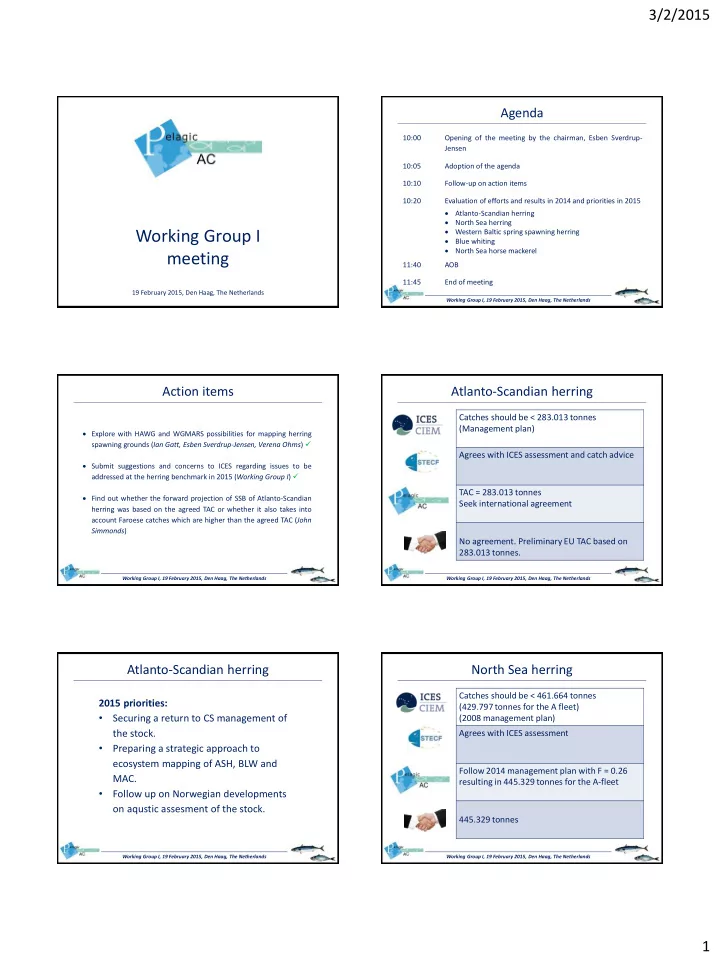
3/2/2015 Agenda 10:00 Opening of the meeting by the chairman, Esben Sverdrup- Jensen 10:05 Adoption of the agenda 10:10 Follow-up on action items 10:20 Evaluation of efforts and results in 2014 and priorities in 2015 Atlanto-Scandian


slide-1
SLIDE 1

3/2/2015 1

Working Group I meeting

19 February 2015, Den Haag, The Netherlands

Agenda

Working Group I, 19 February 2015, Den Haag, The Netherlands

10:00 Opening of the meeting by the chairman, Esben Sverdrup- Jensen 10:05 Adoption of the agenda 10:10 Follow-up on action items 10:20 Evaluation of efforts and results in 2014 and priorities in 2015  Atlanto-Scandian herring  North Sea herring  Western Baltic spring spawning herring  Blue whiting  North Sea horse mackerel 11:40 AOB 11:45 End of meeting

Action items

Working Group I, 19 February 2015, Den Haag, The Netherlands

 Explore with HAWG and WGMARS possibilities for mapping herring spawning grounds (Ian Gatt, Esben Sverdrup-Jensen, Verena Ohms)   Submit suggestions and concerns to ICES regarding issues to be addressed at the herring benchmark in 2015 (Working Group I)   Find out whether the forward projection of SSB of Atlanto-Scandian herring was based on the agreed TAC or whether it also takes into account Faroese catches which are higher than the agreed TAC (John Simmonds)

Atlanto-Scandian herring

Working Group I, 19 February 2015, Den Haag, The Netherlands

Catches should be < 283.013 tonnes (Management plan) Agrees with ICES assessment and catch advice TAC = 283.013 tonnes Seek international agreement No agreement. Preliminary EU TAC based on 283.013 tonnes.

Atlanto-Scandian herring

Working Group I, 19 February 2015, Den Haag, The Netherlands

2015 priorities:

  • Securing a return to CS management of

the stock.

  • Preparing a strategic approach to

ecosystem mapping of ASH, BLW and MAC.

  • Follow up on Norwegian developments
  • n aqustic assesment of the stock.

North Sea herring

Working Group I, 19 February 2015, Den Haag, The Netherlands

Catches should be < 461.664 tonnes (429.797 tonnes for the A fleet) (2008 management plan) Agrees with ICES assessment Follow 2014 management plan with F = 0.26 resulting in 445.329 tonnes for the A-fleet 445.329 tonnes

slide-2
SLIDE 2

3/2/2015 2

North Sea herring

Working Group I, 19 February 2015, Den Haag, The Netherlands

2015 priorities:

  • Adjustment of / adoption of 2014

management plan

  • Mapping of spawning areas
  • Monitor development in herring stock,

age structure, infections.

  • Monitor developments after

introduction of discard ban.

  • Preparing a strategic approach to

ecosystem mapping

North Sea Herring spawning areas

Working Group I, 19 February 2015, Den Haag, The Netherlands

ICES NSAS herring advice:

  • ICES advises, under precautionary

considerations, that activities that have a negative impact on the spawning habitat of herring, such as extraction of marine aggregates and marine construction on the spawning grounds, should not occur. WGMARS:

  • ICES group meet the 2nd-5th December to map

the spawning areas of NSAS herring,

  • Input from Stakeholders,
  • Historical maps,
  • Participation from European Dredging

Association,

  • Report is expected shortly.

Parasite: Ichthyophonus hoferi

Working Group I, 19 February 2015, Den Haag, The Netherlands

Parasite infecting a suite of fish including herring. It is an unicellular Protista, earlier believed to be an fungus. Present:

  • Observed in January in several North Sea Herring

landings in both Norway and Denmark (estimated 3% of the catch being infected),

  • Has also been observed in Atlantoscandian

herring (second hand information),

  • Cannot be used for human consumption.

Precedents:

  • Gulf of Saint Lawrence (1954-1955): Prevalence

78%; Mortality 50%,

  • North Sea, Western Baltic and Central Baltic

herring stocks was infected between 1991 and

  • 1994. Mortality range for 2-36% and decreased

stocksizes with etimated 10-20%.

WBSS herring

Working Group I, 19 February 2015, Den Haag, The Netherlands

Catches should be < 44.439 tonnes (MSY) Agrees with ICES advice No TAC advice, Management plan and clear TAC setting procedure needed 43 604 tonnes (including 50% transfer to NS)

WBSS herring

Working Group I, 19 February 2015, Den Haag, The Netherlands

Long-Term Management Strategy TAC based on: 41% of WBSS MSY advice + 5,7% of NSAS. Including +-15% constraint. ICES Advice February 2015: ICES considers that the proposed Division IIIa TAC-setting procedure is precautionary provided it includes a requirement to transfer at least 10% of the TAC from Division IIIa to the North Sea. With transfers of less than 10%, ICES considers that the procedure is not precautionary.

WBSS herring

Working Group I, 19 February 2015, Den Haag, The Netherlands

2015 priorities:

  • Adopt management plan
  • Monitor mixing of stocks
  • Monitor developments after

introduction of discard ban.

  • Preparing a strategic approach to

ecosystem mapping

slide-3
SLIDE 3

3/2/2015 3

Blue whiting

Working Group I, 19 February 2015, Den Haag, The Netherlands

Catches should be < 839.886 tonnes (Management plan) Agrees with ICES assessment and catch advice

Existing management plan is no longer appropriate, Seek adoption of a new management plan with the Coastal States, Consider PELAC management plan from 2012 No agreement

Blue whiting

Working Group I, 19 February 2015, Den Haag, The Netherlands

2015 priorities:

  • Securing a return to CS management of

the stock.

  • Re-launch of PELAC management plan.
  • Preparing a strategic approach to

ecosystem mapping of ASH, BLW and MAC.

North Sea horse mackerel

Working Group I, 19 February 2015, Den Haag, The Netherlands

Reduce catches by more than 20% corresponding to ˂ 15.200 tonnes Agrees with ICES assessment and catch advice Improve knowledge base through data collection and analysis 15 200 tonnes

North Sea horse mackerel

Working Group I, 19 February 2015, Den Haag, The Netherlands

2015 priorities:

  • Preparing a strategic approach to ecosystem mapping
  • Improve knowledge base through data collection and

analysis

  • Define stock boundaries and degree of mixing by:
  • Utilizing past catch records
  • Collecting samples for chromatographic and

genetic analysis

  • Develop stock indicators
  • Use catch records to derive index of abundance

based on search time

  • Explore coupling of IBTS and CGSF survey

AOB

Working Group I, 19 February 2015, Den Haag, The Netherlands

Thank you!

Working Group I, 19 February 2015, Den Haag, The Netherlands