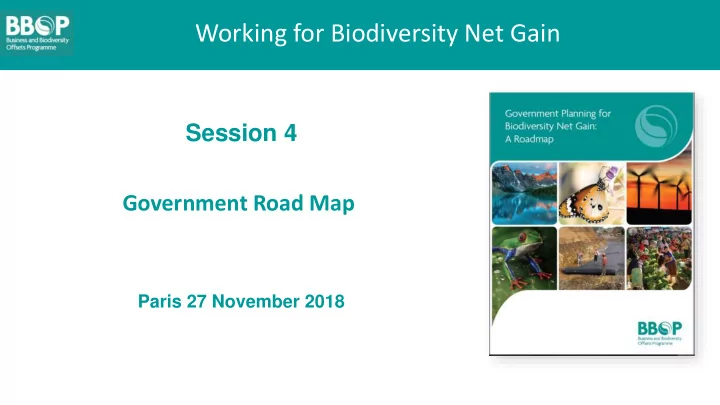
SLIDE 1
Session 4
Paris 27 November 2018
Government Road Map
Working for Biodiversity Net Gain
SLIDE 2 Why a roadmap? Systems evolve over many years.
1989 – Regulation of native vegetation clearing
- An end to large scale clearing. However offsetting was
sporadic and unquantified 1998 – Biodiversity mapping
- Extant vegetation, 1750 vegetation, bioregions, threatened
- species. Provided state-wide information base
2000 – Auction-based incentive program – BushTender
- Introduced site assessment, landowner agreements.
Development of key techniques outside regulatory environment 2002 – Policy - the Native Vegetation Management Framework
- No net loss, like-for-like, metrics. However developers found
it hard to find their offsets 2007 – Offset market based on credit trading
- Third party suppliers, brokers, credit register
2013-17 – Revisions to like for like, information base
Example: Evolution of offsetting in Victoria
Victoria 1750 Victoria 2018
SLIDE 3 What does the document cover? Part 1: Why should a government plan for Biodiversity Net Gain, and what’s at stake? Part 2: How can we develop policy for achieving Biodiversity Net Gain and put it into practice in our country? Phases of planning for BNG & principal elements
Benefitting from lessons from the past Elements of a roadmap Backed by Technical Notes
The BBOP Government Roadmap, 2018
SLIDE 4
Supporting information: Technical notes
SLIDE 5
Phases of planning for biodiversity net gain Elements of a roadmap Benefitting from lessons from the past
introduction to core roadmap concepts
SLIDE 6 Analysis
- “SWOT”, options and gaps
- Establish risks & opportunities, strengths & weaknesses; identify policy options with
their advantages, disadvantages and needs; analyse gaps; assess likely losses and feasibly gains over 20+ years; involve stakeholders; select preferred policy option
Building blocks
- Framework with data, capacity and supply of offsets
- Put in place the policy framework, gather data, build information systems and capacity
for the initial BNG/NNL system
- Line up supply of offsets ready for launch.
- Start any pilot projects.
Launch
- System in operation
- Government administers the system, monitoring and evaluating individual projects and
their cumulative progress in achieving the overall policy goals.
- Developers must comply with any requirements.
Evolution
- Adapting the system
- Broader scope
- Build capacity and data
- Adaptive management based on monitoring & evaluation against policy goals.
The four stages
SLIDE 7
The four elements
Law & policy: principles that underpin BNG/NNL; statement of policy itself (including whether mandatory or voluntary); biodiversity targets; how policy established (e.g. through a legal requirement supplemented by guidelines); scope and limits of the policy Supporting measures: guidelines that spell out the policy and any associated regulations underlying information needed to apply them standards, agreements and management plans financial arrangements Governance & planning: coordination between different branches of government; integration of BNG/NNL into land-use (& marine) planning & other policies; assessment; oversight, monitoring and enforcement. Capacity building & partnerships (including pilot projects): building capacity of government, consultants and NGOs, companies and investors, and offset providers and brokers.
SLIDE 8 The roadmap table
The Table integrates:
- the four stages &
- the four elements
SLIDE 9 Lessons for success with mitigation
- Clear goals and targets for biodiversity outcomes
- Improve the application of the entire mitigation hierarchy
- Clear, consistent guidance, for certainty and to avoid delays. Remove perverse and conflicting policy signals. Clear
roles for national, state and local government and ensure good coordination between government departments.
- Adequate monitoring of performance and enforcement of commitments, with adequate budgetary provision for
them and good governance mechanisms.
- Clear principles and standards for mitigation measures (including offsets).
- Legal and financial instruments available to secure long-term implementation.
- Plan proportionate approaches, e.g. streamlined procedures. Simple baseline studies and metrics for the least
significant impacts on biodiversity. Full assessments with more sophisticated metrics for more significant impacts.
- Realistic roadmap to develop the BNG/NNL system. Prepare for implementation of the system (including checking
there will be adequate supply of offsets) during the policy development phase.
- Good baseline data, mapping and landscape level planning.
- Select good methods and avoid those that don’t deliver (e.g. poor metrics).
- Support flexibility by allowing options for implementation of mitigation, provided the same standards are met.
- Help parties who need to find each other (e.g. those who need offsets and potential providers of offsets).
SLIDE 10
Using the BBOP roadmap for government can help: Assess feasibility of policy options Assess needs (laws, guidelines, institutions, data, capacity building) Make realistic plans to improve mitigation over time Implement plans in orderly, systematic and predictable way Avoid mistakes of the past! Benefit from lessons learned and experiences worldwide
Using the roadmap can help
SLIDE 11
Paris 27 November 2018
Thank You
Working for Biodiversity Net Gain