Womens Health Initiative Profiles May 2019 Objectives of WHI - - PowerPoint PPT Presentation

women s health
SMART_READER_LITE
LIVE PREVIEW

Womens Health Initiative Profiles May 2019 Objectives of WHI - - PowerPoint PPT Presentation

Womens Health Initiative Profiles May 2019 Objectives of WHI Profiles Knowing the Population Served Evaluation Quality Improvement Future Performance Based Payments Types of Profiles Community Assigns Vermont Female


slide-1
SLIDE 1

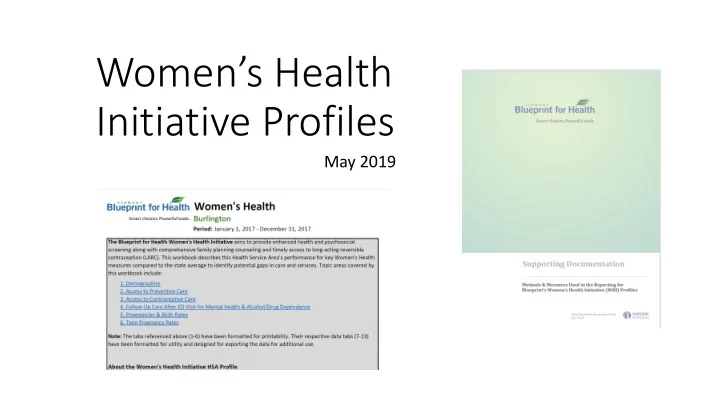
Women’s Health Initiative Profiles

May 2019
slide-2
SLIDE 2

Objectives of WHI Profiles

  • Knowing the Population Served
  • Evaluation
  • Quality Improvement
  • Future Performance Based Payments
slide-3
SLIDE 3

Types of Profiles

  • Community – Assigns Vermont Female Residents, aged 15-44, with

VHCURES data by region of residence

  • Practice - Assigning female patients, aged 15-44, to participating

practices sites (i.e., women’s health clinics, OB/GYN practices, family practices, or other primary care practices)

  • Supporting Documentation – Methods and Measures

https://blueprintforhealth.vermont.gov/sites/bfh/files/Blueprint_WHI _Profiles_Methodology.pdf

slide-4
SLIDE 4

Data Sources

  • VHCURES – Vermont Health Care Uniform Reporting and Evaluation

System (WHI only relevant to Medicaid population at this time)

  • Includes: All covered commercial, Medicaid, and Medicare members
  • Excludes: opt-out commercial self-funded (ERISA) plans, federal plans,

military plans, non-insured

  • BRFSS – Behavioral Risk Factor Surveillance System Measures
  • Annual phone interview of 6,000-7,000 Vermonters sponsored by the

Vermont Department of Health

slide-5
SLIDE 5

Why the Data Delay?

  • Time period is 2017 calendar year
  • VHCURES data – we calculate average and distinct members in a

given year and use commonly accepted timelines for claims run out (timeline can range between 3-6 months); can experience delays in insurer record systems; time required for analytics vendor

  • BRFSS - We use the latest available BRFSS data. The BRFSS is collected

throughout each month in a given calendar year. At the end of the year, the data is processed and then made available for analysis. Data is usually released for use by June of the following year (e.g.2017 Vermont BRFSS data became available in June 2018).

slide-6
SLIDE 6

Who is Being Reported?

  • Attribution Methodology
  • Vermont residents with applicable insurances
  • 24 month look back
  • Members are first attributed to participating women’s health providers

(e.g., OB/GYNs), then to participating primary care providers based on where a member received care, and finally to a Hospital Service Area (HSA) based on a member’s location of residence. If a member visited both an OB/GYN and a PCP, they could be attributed to both practices and would appear in the profiles for both practices.

  • Results <11 not reported
slide-7
SLIDE 7

Included Measures - Demographics

  • Behavioral and Socioeconomic Risk Factors
  • Household Income
  • Physical Activity Level
  • Fruit and Vegetable Consumption
  • Cigarette use
  • Educational Level
  • Age
  • Insurance Type
  • Health Status*
  • Condition Prevalence
  • Depression, Asthma, Hypertension, Diabetes, Mental Health, Substance Use

(Tobacco, Opioid Use, Non-Opioid Substance Use)

slide-8
SLIDE 8

Health Status - 3M Clinical Risk Groups

slide-9
SLIDE 9

Included Measures – Access to Preventative Care

  • Primary care visit within the last two years
  • Cervical cancer screening
  • Chlamydia screening

Ties to Practice’s WHI Participation Agreement to:

  • Ensuring protocol for patients who are

without a primary care provider. Ties to Overall WHI Program aim of helping women be well.

slide-10
SLIDE 10

Included Measures – Access to Contraceptive Care

  • Choice of LARC or Most or Moderately Effective Contraception
  • All Women 15-44
  • Postpartum
  • Choice of LARC

Ties to Practice’s WHI Participation Agreement to:

  • Stock the full spectrum of LARC at

adequate level for practice size

  • Implement One Key Question (R)
  • See patient within 1 week of referral for

comprehensive family planning services

  • Provide same day LARC insertion

Ties to Overall WHI Program aim of avoiding unintended pregnancies.

slide-11
SLIDE 11

Included Measures – Follow up After ED Visit

  • ED Visit Rates for Mental Illness or

Alcohol and Other Drug Dependence (male and female)

  • Follow-Up after ED Visit for Mental

Illness

  • 7 day
  • 30 day
  • Follow-Up after ED Visit for Alcohol

and Other Drug Dependence

  • 7 day
  • 30 day

Ties to Practice’s WHI Participation Agreement to:

  • Implement screening, brief

intervention, and navigation to services for depression, substance use disorder, and interpersonal violence.

  • Execute formal referral protocols with

community –based organizations Ties to Overall WHI Program Aim of helping women be well and building thriving families.

slide-12
SLIDE 12

Included Measures – Pregnancies and Birth Rates

  • Live Births
  • Miscarriages
  • Abortions
  • Teen Pregnancy Rates

Ties to Overall WHI Program aim of supporting healthy pregnancies. Ties to Practice’s WHI Participation Agreement to:

  • Implement screening, brief

intervention, and navigation to services for depression, substance use disorder, and interpersonal violence.

  • Execute formal referral protocols with

community –based organizations

slide-13
SLIDE 13

Observations and Opportunities

  • Denominator of approx. 87,143 for WHI - approximately 34% of attributed

Vermont females have moderate chronic, significant chronic, or cancer/catastrophic conditions

  • High proportion of individuals with diagnosed depression (13%) and MH

conditions (33%)

  • While the majority had a visit with a primary care provider over the last two

years, there is opportunity to improve preventative screening rates (especially Chlamydia Screening)

  • Drastic increase in the percentage of females choosing LARC over the last 9 years
slide-14
SLIDE 14

Observations and Opportunities for Improvement

  • In absence of a standardized measure that we can effectively collect

about screening and intervention for mental health and substance use, we have considerable opportunities for follow up after ED visits for mental health and substance use

  • Overall rate of births, miscarriages, and abortions has remained

relatively consistent over time; teenage pregnancy rates have been steadily decreasing over time (but still present an opportunity for intervention)

slide-15
SLIDE 15

Questions and Supports

Interpretation and use for Quality Improvement

Program Manager / QI Facilitators https://blueprintforhealth.vermont.gov/contact-us Profile distribution/data source questions Laura Wreschnig, Data Analytics and Information Administrator - Laura.Wreschnig@vermont.gov Community WHI Profiles and Methods Document https://blueprintforhealth.vermont.gov/womens-health-initiative-profiles