SLIDE 1
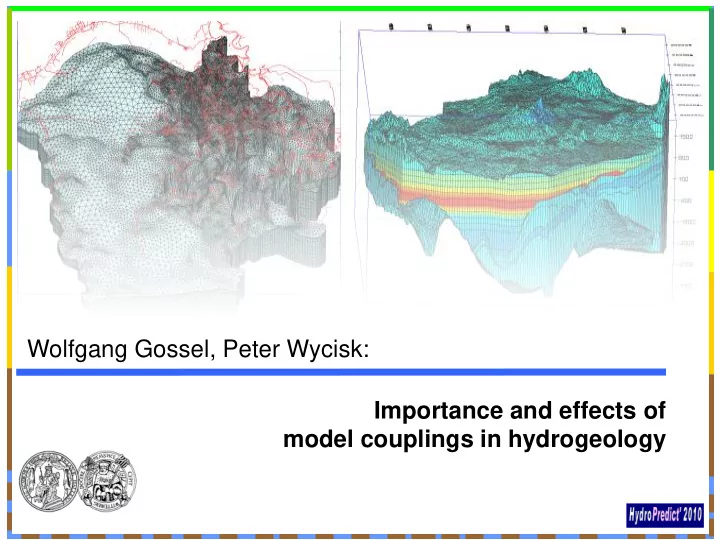
Wolfgang Gossel, Peter Wycisk: Importance and effects of model couplings in hydrogeology
SLIDE 2 Two examples for solution of hydrogeological problems
3/26
- How were the groundwater flow and transport conditions influenced by open pit
lignite mining in the region Untere Mulde/Fuhne?
- What was the impact of climate change during the last 140 000 years on the
groundwater balances in the Nubian Aquifer System?
?
Objectives Implementation Reasons Kinds Behaviour Calibration
SLIDE 3 Problem and model
Pumpversuch_02102002: Darstellung der Messwerte mit einer logarithmischen Geraden zur Auswertung der Absenkung 0.000 0.010 0.020 0.030 0.040 0.050 0.060 1 10 100 1000 10000 Zeit t [s] Absenkung s [m] B6A B6E B6C logarithmische Gerade, B6C logarithmische Gerade, B6E logarithmische Gerade, B6A
1 2
lg 4 3 . 2 t t s Q T
Analytical methods Numerical methods
Problem solution with diverse methods:
Statistical methods
Objectives Implementation Reasons Kinds Behaviour Calibration
SLIDE 4
Modelling systems, -tools and models
Changed after Bossel (1992)
„data“
Objectives Implementation Reasons Kinds Behaviour Calibration
SLIDE 5
Modelling systems, -tools and models
Geology (hardrocks, unconsolidated rocks): static, constructive Groundwater recharge: dynamic, GIS-based Surface water: statistic, time series Groundwater: transient, numeric GSI3D GIS, Excel Excel, own programming Feflow
Modelling systems Modelling tools
Computer- implementation Objectives Implementation Reasons Kinds Behaviour Calibration
SLIDE 6 Suitability of modelling tools
Objective modelling tool
time domain, long time frames
resolution according to data availabilty and
Objectives Implementation Reasons Kinds Behaviour Calibration
SLIDE 7 Complexity of models and necessity of couplings
Nubian Aquifer System Untere Mulde/Fuhne Climatic changes Groundwater flow and transport, density driven Ground- water recharge Surface water Ground- water flow and transport Unsat. zone Geology
Dependent on:
- Number of compartments
- Number of used modelling systems
- Nonlinearity of the functions in modelling systems and the connections of
the modelling systems
- Number of parameters
- Heterogeinity of parameters and boundary conditions in time and space
Objectives Implementation Reasons Kinds Behaviour Calibration
SLIDE 8 Pros and Cons of complex models Pros:
- Substitution of weakly defined parameters (or b.c.) by better
systematical approach
- Range of objectives increases
Cons:
- High affinity to instabilities of the coupled modelling systems
- Sensitivity difficult to measure
- Scale dependency of parameters in different modelling
systems
- Technical implementation of interfaces -> solvable
Objectives Implementation Reasons Kinds Behaviour Calibration
SLIDE 9 Kinds of coupling
Objectives Implementation Reasons Kinds Behaviour Calibration
ModSys 1
e.g. flow modelling
ModSys 2
e.g. transport modelling
ModSys 1
Serial coupling (non iterative)
ModSys 2
Parallel coupling (iterative)
ModSys 1 ModSys 2
Periodically synchronized coupling
ModSys 1
Integrated coupling
ModSys 2 ModSys 1
e.g. local model
ModSys 1
e.g. regional model
Horizontal coupling
SLIDE 10
Coupling construktive geolog. mod. with hydrogeol. mod.
Objectives Implementation Reasons Kinds Behaviour Calibration
SLIDE 11 Sequential and serial coupling, periodically synchronized
145 hydrotopes
Soil (substrate) Land use Depth to groundwater
Jährliche Niederschlagssummen Bitterfeld 100 200 300 400 500 600 700 800 900 1000 1947 1949 1951 1953 1955 1957 1959 1961 1963 1965 1967 1969 1971 1973 1975 1977 1979 1981 1983 1985 1987 1989 1991 1993 1995 1997 1999 2001 2003 Mittel Max Jahre Niederschlagssumme [mm] Min Stabw Jährliche Summe der potentiellen Evapotranspiration (ETP) Bitterfeld 100 200 300 400 500 600 700 800 900 1000 1947 1949 1951 1953 1955 1957 1959 1961 1963 1965 1967 1969 1971 1973 1975 1977 1979 1981 1983 1985 1987 1989 1991 1993 1995 1997 1999 2001 2003 Mittel Max Jahre Jahressumme ETP [mm] Min Stabw Jährliche Klimatische Wasserbilanz (KWB) Bitterfeld
100 200 300 400 500 1947 1949 1951 1953 1955 1957 1959 1961 1963 1965 1967 1969 1971 1973 1975 1977 1979 1981 1983 1985 1987 1989 1991 1993 1995 1997 1999 2001 2003 Mittel Max Jahre Jahressumme KWB [mm] Min Stabw
Climatic data
Objectives Implementation Reasons Kinds Behaviour Calibration
SLIDE 12
Nubian Aquifer System: Completely density driven groundwater modelling
Iterative, integrated coupling
Transient groundwater flow model Transient groundwater transport model Transient density coupled groundwater flow and transport model Flow parameters Transport parameters Density parameters B.C. for flow model
Objectives Implementation Reasons Kinds Behaviour Calibration
B.C. for transport model
SLIDE 13 Interfaces of modelling systems
Technical problem: Coupling of modelling systems for surface water (SW) and groundwater (GW)
- Systematical approach: Total discharge of SW doesn‘t influence GW
level but SW level
- Level and discharge of SW are dominated by catchment abroad of
investigation area
- Realisation of the Transfer-/Leakage-coefficient in groundwater
modelling system
- Level-discharge-dependency is implemented in SW modelling
system
Objectives Implementation Reasons Kinds Behaviour Calibration
SLIDE 14 Stability
for numerical solutions
interpolations or in dynamical models between time steps
between modelling systems
„effective“ parameters necessary
Objectives Implementation Reasons Kinds Behaviour Calibration
SLIDE 15
Complex example
Objectives Implementation Reasons Kinds Behaviour Calibration
SLIDE 16 Calibration of coupled models
Dilemma of the geological model:
- Can not be calibrated on itself but only proven (geometrical
criteria).
- Importance: „Database“ for unsaturated and saturated zone
modelling
- Solution: Indecies for the derived model and calibration of ranges of
values Impact of kind of coupling on calibration of models:
Objectives Implementation Reasons Kinds Behaviour Calibration
Kind of coupling Work load Stability Transparency Sequential middle high high Periodically synchronized high high high Iterative low low low Integrated middle low low
SLIDE 17
Results of coupled models
Transport model Untere Mulde/Fuhne 1895-2005
Objectives Implementation Reasons Kinds Behaviour Calibration
SLIDE 18 The future ....
Trends of development of model couplings
- Horizontal coupling needless or integrated
- Vertical couplings applicable via integrated solutions, unstable
- Defined programming interfaces of the tools are good solution, up
to now not user friendly
- Data base will dominate the applicability of model couplings
- OpenSource
- Open standards
- Documented interfaces
Additional tools, e.g. Modpath, MT3D, RT3D, HUF, UZF, Pre- and Postprocessors
- Closed Source
- Open and proprietary stand.
- Documented interfaces
Integration of transport, density, heat, unsat. zone, discrete features, development of self- made modules
SLIDE 19 Summary
- Application of complex models increases
- Complex models depend often on couplings of modelling
systems
- Different kinds of coupling have consequences for behaviour,
calibration, results and prognoses of models
- Systematical application after detailed analyses necessary
- Trend in hydrogeology towards opening of central parts of
modelling tools via defined interfaces and standards
SLIDE 20 Thanks
- Thanks for your attention
- Thanks to the department for the support
- Projects for the examples:
SAFIRA I and II: Prof. Dr. Peter Wycisk, Tobias Hubert, (Dr.) Tilmann Steinmetz, Andreas Wollmann, Karsten Sommerwerk, Steffi Schnabel, Gerd Fleck, Oliver Neef, Raik Richter und Holger Fabritius Ad-Hoc-Project „Mulde-Hochwasser 2002 and Austragsdynamik“: Christian Neumann Nubian Aquifer System: Dr. Ahmed Sefelnasr,