with Mental Illness to Breakthrough to Employment & Education - - PowerPoint PPT Presentation

with mental
SMART_READER_LITE
LIVE PREVIEW

with Mental Illness to Breakthrough to Employment & Education - - PowerPoint PPT Presentation

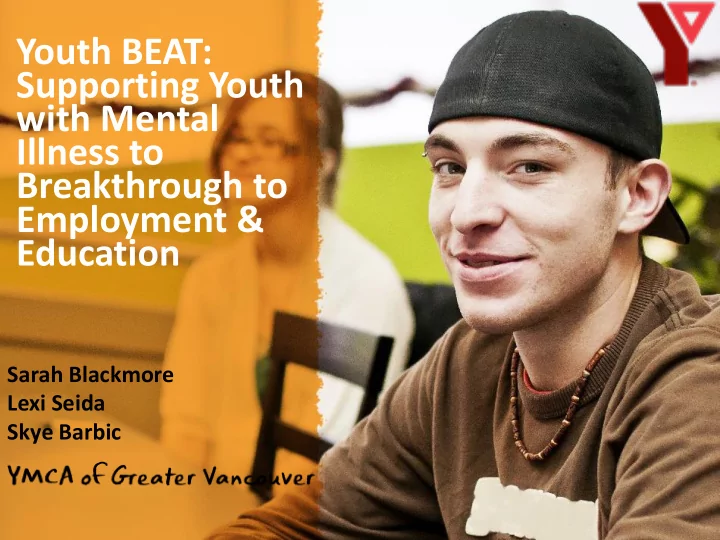
Youth BEAT: Supporting Youth with Mental Illness to Breakthrough to Employment & Education Sarah Blackmore Lexi Seida Skye Barbic Youth Landscape Youth BEAT Employment Program Participant Testimonial Program


slide-1
SLIDE 1

Youth BEAT: Supporting Youth with Mental Illness to Breakthrough to Employment & Education

Sarah Blackmore Lexi Seida Skye Barbic

slide-2
SLIDE 2
  • Youth Landscape
  • Youth BEAT Employment Program
  • Participant Testimonial
  • Program Evaluation Strategy & Presentation of

Preliminary Data

  • Lessons Learned & Program Adaptations
  • Facilitators & Barriers to Employment & Education
  • Questions
slide-3
SLIDE 3
  • 1. Describe an integrated supported employment program for

youth and young adults with mental illness

  • 2. Differentiate between the YMCA Youth BEAT employment

program and other youth employment programs

  • 3. Understand how participant feedback has been used to

develop and refine the Youth BEAT supported youth employment program

  • 4. Describe the barriers and facilitators to gaining and

maintaining employment for youth with mental illness

slide-4
SLIDE 4

In BC, 1 in 5 youth experience a mental health problem or illness.

Source: Kirby, M. & Keon, W. (2004). Report 1, Mental Health, Mental Illness and Addiction: Overview Of Policies and Programs in Canada. Interim Report of the Standing Senate Committee on Social Affairs, Science And Technology.

slide-5
SLIDE 5
slide-6
SLIDE 6

One of the best indicators of recovery is a person’s ability to

  • btain and maintain meaningful employment and participate in

higher education. In a recent national survey of the recovery needs of Canadians with mental illness, 87% of young adults under the age of 30 identified that “work was important to them” In the same study….only 9% indicated that they were working in any capacity (marginally, part-time, full time).

slide-7
SLIDE 7
slide-8
SLIDE 8

Youth BEAT was designed as a community intervention to address this gap! YMCA partnered with the Inner City Youth Program from Providence Health to develop an integrated coordinated program that could help young adults achieve:

  • Employment/training goals
  • Self-Management
  • Opportunities for Career Exploration
  • Health
slide-9
SLIDE 9

Funding

  • Ministry of Jobs, Tourism and

Skills Training & The Canada- BC Jobs Fund

Eligibility Criteria

  • Between 15 – 29
  • Eligible to work in BC
  • Not currently in school
  • Not receiving EI
  • Experiencing a mental health
  • r other barrier

Partnership

  • YMCA of Greater Vancouver &

Inner City Youth Clinic (ICY)

Youth BEAT Team

  • 2 YMCA Program Facilitators
  • YMCA Job Developer
  • YMCA Youth Employment

Programs Manager

  • YMCA Administrative Support
  • ICY Occupational Therapist
  • ICY Peer Support Worker
slide-10
SLIDE 10

Three Phases

  • I. Phase 1 - Workshops (5 weeks)
  • Pre-employment & job-readiness skills
  • Short-term training & certification
  • Mental wellness & physical activity
  • II. Phase 2 – Job Development (12 weeks)
  • Employment & training/education
  • Group & individual job development sessions
  • Job maintenance support
  • III. Phase 3 – Follow Up Support (on-going)
  • Employment
  • Individualized job development support
  • Job maintenance support
slide-11
SLIDE 11

Number of Youth Served to Date

  • Year 1 (4 Intakes) – 47 participants
  • Year 2 (1 Intake) – 14 participants

Employed

  • Year 1 – 37 participants
  • Year 2 – 6 participants

Further Education or Training

  • Year 1 – 4 participants
  • Year 2 – 2 participants
slide-12
SLIDE 12

Leo – Intake 5 (completed Phase 1 December 9, 2016)

slide-13
SLIDE 13

We have partnered with the University of British Columbia to measure the feasibility and preliminary effectiveness of the intervention:

slide-14
SLIDE 14

BASELINE T=0 Post class T=5 weeks Post

  • nsite job

training T-16 weeks 32 weeks 52 weeks

slide-15
SLIDE 15
  • Self-esteem (Rosenberg)
  • Personal recovery (PROM)
  • Quality of Life (ReQOL, EQ-5D)
  • Time use (IMR)
  • Mental Health (PHQ-9)
  • Goal Attainment (Goal attainment scale)
slide-16
SLIDE 16

In first 5 cohorts:

  • 59/60 youth who started the program completed the

program.

slide-17
SLIDE 17
slide-18
SLIDE 18

Highlights include: Changes in time use:

  • Baseline mean: 3.5 hours
  • T1 mean: 21 hours
  • T3 mean: 23 hours

Changes in mental health and recovery

slide-19
SLIDE 19

BL T1 T2

slide-20
SLIDE 20
  • Inclusion of weekly evaluation forms
  • Modified short-term training & changed to earlier in Phase 1
  • Catering budget
  • Financial assistance for professional wear & physical activity

attire

  • Adapted mental wellness workshops (general topics + CBT)
  • Reduced & condensed workshop time
  • Modified transition between Phase 1 & 2
  • Increased team support
  • Opportunities to connect with other youth programming
  • Tailored workshops (disclosure and Supports &

Accommodations)

  • Individualized job development
  • Strengthening of community partnerships with employers
slide-21
SLIDE 21

Outcome Facilitators

  • Meet basic needs
  • Safe and non-judgmental space & attitude
  • Structure and consistency of Phase 1
  • YMCA fitness membership
  • Interpersonal relationships with peers & program staff
  • Individualized training & certification
  • Professional relationships (mentors & references)
  • Training and support in disclosure
  • Normalizing career development process
  • Identifying meaningful employment with supportive employers
  • Community partnerships with supported employment
  • rganizations
  • Continued follow up support
slide-22
SLIDE 22

Outcome Barriers

  • Homelessness or

unstable/unsupported housing

  • Ongoing substance use, relapse
  • r early recovery
  • Medication management and

side effects

  • Poor sleep hygiene
  • Travel & accessibility
  • Financial pressure
  • Fear and/or perception of not

being ready

  • Lack of support
  • Limited work experience and/or

poor work performance

  • Negative experiences at work (&

limited knowledge of labour rights)

  • Ineffective and/or lacking

communication skills

  • Low self-confidence
  • Scheduled appointments with

service providers limit availability

  • Mental illness symptoms
slide-23
SLIDE 23

The program builds off the Individual Placement Support Model with the following modifications:

  • 1. 5 week in class session to build relationships, confidence,

and to strategize/coordinate plans of support from health and social services.

  • 2. Time limited
  • 3. Incorporation of employment specialists, health specialists,

peer support worker, and ongoing evaluation team.

slide-24
SLIDE 24
  • Ongoing research and focus groups with

youth

  • Scalability of the program
  • Manual
  • Knowledge Sharing Plan
  • Canadian Association for Supported Employment
  • Canadian Association for Occupational Therapy

Conference

slide-25
SLIDE 25
slide-26
SLIDE 26
slide-27
SLIDE 27
  • Dr. Skye Barbic, PhD, OT

Assistant Professor, University of British Columbia skye.barbic@ubc.ca

Sarah Blackmore, MA, RCC

Youth BEAT Program Facilitator, YMCA of Greater Vancouver Sarah.blackmore@gv.ymca.ca

Lexi Seida, BA (Hons)

Youth BEAT Program Facilitator, YMCA of Greater Vancouver Lexi.seida@gv.ymca.ca