SLIDE 1
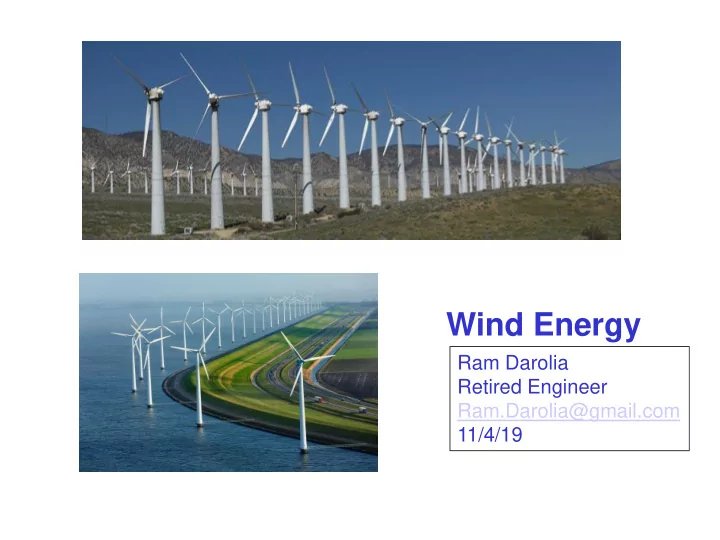
Wind Energy
Ram Darolia Retired Engineer Ram.Darolia@gmail.com 11/4/19
SLIDE 2 References
- 1. 20% Wind Energy by 2030 Increasing Wind Energy’s
Contribution to U.S. Electricity Supply www.nrel.gov/docs/.../41869.pdf National Renewable Energy Laboratory
SLIDE 3
Don Quixote thought wind mills were Monsters, Giants and Devils Civic duty to kill them Don Quixote and his loyal servant Sancho Panza
SLIDE 4
SLIDE 5 Population Growth Rate
Education Affluence Farming to industrial age
Social pressure
SLIDE 6
SLIDE 7
Growth in energy consumption
SLIDE 8
New Delhi, November 2, 2019
SLIDE 9
- Wind energy is to supplement other modes
- f power generation
- Clean and renewable/sustainable
- Never run out of wind
Production of wind energy does not result in any form of solid, liquid, or gaseous emissions or residues: no CO2 or toxic fumes are emitted
- It does not deplete any form of fuel
- Once installed, it is easy and inexpensive to maintain
- Offshore installations becoming popular
SLIDE 10
Land heats up faster than water
Wind is a form of solar energy. Winds are caused by the uneven heating of the atmosphere by the sun, the irregularities of the earth's surface, and rotation of the earth. Wind flow patterns are modified by the earth's terrain, bodies of water, and vegetation Wind is formed when hot surface heat the air making it to rise. The cooler air moves into empty space creating wind
SLIDE 11
10X Growth Estimate 22 percent of world’s electricity generation by wind power in two decades (Global Wind Energy Council)
SLIDE 12
Twenty eight percent of all new power generation built in the United States since 2009 has come from wind
SLIDE 13
How many have seen/driven by a wind turbine? How can you get electricity from slow rotating blades?
SLIDE 14
How can you get electricity from slow rotating blades?
SLIDE 15
SLIDE 16 Basic parts: Blades (B) and Rotor (A) which rotate when the wind blows Shaft (C) Gearbox (D) to adjust for the speed of the wind Generator (G), which generates the electricity
The dynamo works by rotating a permanent magnet inside a coil of copper wire. The magnet causes the electrons inside the wire move in a particular direction. At the end of the coil are wires which carry electrons to provide electrical energy
How a wind turbine works
SLIDE 17
SLIDE 18
An automatic yaw mechanism is provided to ensure that the rotor always faces the wind direction
SLIDE 19
Requirements Stiffness Bending stresses (wind load and gravity) Fatigue life: vibration and wind variation Lightweight (fiberglass composites)
SLIDE 20
Blades are made of fiber-reinforced plastics
GRP = glass-fiber-reinforced plastic, CRP = carbon fiber reinforced plastic Blades must be stiff, and placed far enough ahead of the tower, to prevent collision with the tower under maximum wind conditions Three-blade designs are by far the most common Because the wind speed increases and the wind flow stabilizes and becomes less turbulent with height from the ground, towers as high as possible Offshore sites offer very high winds and large areas for utilization, often having more limited local environmental impacts Corrosive marine environment impose additional requirements
SLIDE 21
Rotor blade weight versus length
SLIDE 22
Long blades Can be two football field long High Tower to capture more wind Wind turbines convert the kinetic energy in the wind into mechanical power. A generator converts the mechanical power into electricity Towers made of steel
SLIDE 23
SLIDE 24
Size of large wind turbines
Enercon, Germany E-126 Can generate up to 7 MW of electricity 500 homes Rotor diameter of 413 feet Height 650 feet Total weight 6000 ton It only turns at 12 rpm. That means it takes five seconds to complete one revolution 10 to100 turbines in a wind farm Football field is 360 feet long
Vestas, Denmark V164, 8 MW, rotor diameter, 538 ft
SLIDE 25
SLIDE 26
SLIDE 27
Power rating: 9.5MW Rotor diameter: 164m 540 feet Blade weight 35 ton, Tower height 613 feet Worlds largest turbines
- 2. Siemens Gamesa SG 8.0-167 DD
Power rating 8MW Rotor diameter 167m 548 feet Length of a football field 360 feet
SLIDE 28
SLIDE 29
SLIDE 30
Wind power potential in USA
SLIDE 31 Wind energy is the kinetic energy of air in motion, also called wind. Total wind energy flowing through an imaginary surface with area A during the time t is:
[32]
where ρ is the density of air; v is the wind speed; Avt is the volume of air passing through A (which is considered perpendicular to the direction of the wind); Avtρ is therefore the mass m passing through "A". ½ ρv2 is the kinetic energy of the moving air per unit volume. Power is energy per unit time, so the wind power incident on A (e.g. equal to the rotor area of a wind turbine) is:
[32]
SLIDE 32 Wind energy content is proportional to the cube of its speed. Energy generation typically does not cut in until wind is blowing at speeds of at least 3 m/s to 5 m/s. High wind speeds cause high rotation speeds and high stresses in the wind turbine which can result in serious damage to the installation. Wind turbines are usually designed to cut out at wind speeds
- f around 14 m/s either by braking or
feathering the rotor blades allowing the wind to spill over the blades. Because of the upper speed limit at which the wind turbine can safely be used, it may capture only half or less of the available wind energy.
11 miles/hour 31 miles/hour
Gentle breeze: 6-10 miles/hour Leaves and small twigs in constant motion, wind extends light flag. Moderate breeze: 10 to 16 miles/hour Wind raises dust and paper, moves small branches.
The Betz Limit 59% of the energy
SLIDE 33
What is the minimum wind speed to turn the blades of a wind turbine?
Latest models can start at about 5 miles per hour wind speed, but most start at around 8 miles per hour, Turbines also need a electrical 'kick-start' from the National Grid to get them into action, and a large amount of power is also required to brake them when the wind speed hits around 50-55 miles per hour, which is their upper safety limit. Wind energy council estimate (1994): 27% of land surface has wind speed greater than 11miles/hour Only 4% might be suitable due to unsuitable terrain, urban areas, crop cultivation, and other land uses
SLIDE 34 20 GW Jiuquan Wind Power Base. Goal 200GW of installed wind capacity in the country 1,600MW Jaisalmer Wind Park, India 1,548MW Alta Wind Energy Centre (AWEC) in Tehachapi, Kern County, California 1,500MW Muppandal Wind Farm, India 845MW Shepherds Flat Wind Farm near Arlington in Eastern Oregon London Array Offshore Wind Farm, UK The London Array Offshore Wind Farm, the largest offshore wind farm in the world with an installed capacity of 630MW, ranks as the world’s sixth largest wind farm. It is located in the outer Thames Estuary more than 20km off the coasts of Kent and Essex.
Largest wind farms
SLIDE 35
Energy Storage with a Battery
SLIDE 36 Southern California Edison and San Diego Gas & Electric claims supply from batteries now competes against natural-gas fired plants
BloombergBusiness, October 19, 2015
A gigawatt can power about 800,000 households
SLIDE 37
SLIDE 38
- Molten salt is circulated through highly specialized piping in the receiver (heat
exchanger) during the day, and held in storage tanks at night – requiring no fossil fuels
- The tanks store the salt at atmospheric pressure
- Use of molten salt for both heat transfer and thermal energy storage minimizes
number of storage tanks and salt volumes needed
- Molten salt is stored at 1050⁰F (566⁰C) until electricity is needed – day or night,
whether or not the sun is shining
- As electricity is needed, molten salt is dispatched from the hot tank through a
heat exchanger to create super-heated steam which then powers a conventional steam turbine
- The molten salt never needs replacing or topping up for the entire 30+ year life
- f the plant
- Heat loss is only 1⁰F per day
- The salt, an environmentally friendly mixture of sodium nitrate and potassium
nitrate, is able to be utilized as high grade fertilizer when the plant is eventually decommissioned
SLIDE 39
Molten salt is stored at 1050⁰F until electricity is needed – day or night, whether or not the sun is shining
SLIDE 40
SLIDE 41
SLIDE 42
SLIDE 43
SLIDE 44
GE to provide world's most powerful turbines for British wind project: capacity of 12 megawatts (MW) October 1, 2019
World's Largest Offshore Wind Farms
SLIDE 45 The Mid-Atlantic region offers more than 60,000 MW of
- ffshore wind potential in the relatively shallow waters
- f the outer continental shelf. These shallow waters,
which extend miles out to sea, allow for the development of large, distant wind farms, mitigating visibility issues and allowing for greater energy capture from stronger winds.
Built by Trans-Elect and sponsored by Good Energies, Google, Marubeni Corporation and Elia System Operator 7,000 MW of offshore wind, enough power to serve approximately 1.9 million households. Initial cost; $1.3 billion Google commitment: $5 B 133,000 and 212,000 U.S. Jobs during construction 43,000 permanent operations and maintenance jobs would be created if 54,000 MW of
- ffshore wind turbines were installed by 2030.
Status unknown: numerous challenges and barriers
SLIDE 46
SLIDE 47
SLIDE 48
Wind can provide 40 times current worldwide consumption of electricity, 5 times total global use of energy in all forms Countries Depending on Wind Power
SLIDE 49
SLIDE 50
SLIDE 51
New industry guidelines, aim to save tens of thousands of bats each year by idling turbines at low wind speeds during peak bat migration season. They could reduce by a third the number of bats killed at wind farms Migratory bats, for some reason, have a lethal attraction to wind turbines. Now, they may get help via "feathering.“ By Andrew Curry, for National Geographic PUBLISHED SEPTEMBER 02, 2015
SLIDE 52
SLIDE 53 North America’s largest bird, Candor: nine-and-a-half- foot wingspan bird of uncommon intelligence and
- longevity. manipulates hot winds to soar hundreds of
miles without flapping its wings. With the investment of tens of millions of dollars and extraordinary effort by scientists, the condor, is staging a spectacular comeback after verging on extinction 25 years ago. The 200 birds in the wild today (out of 400 total) are rapidly expanding their historic range It’s a flight path that is taking the condor perilously closer to the spinning blades of Tehachapi wind turbines that depend on those same thermal currents to generate power; biologists fear it’s only a matter of time before the condor begins hitting the 500-foot-high machines. A single death could be catastrophic for the wind industry, the regional economy and, not least, the
- condor. “We cannot envision a situation where we
would permit the lethal take of California condors. The day a condor is killed by a wind turbine in California changes the course of future development.”
Deploying avian radar units that could shut down turbines when a condor approaches appears to be getting the most attention
SLIDE 54 Revival Of Iconic California Condor Threatens State's Wind Farm Boom
Forbes, 1/16/2012
In the past 36 months the wind industry has attracted $3.2 billion in investment to the Kern County, region, California (Tehachapi Mountains) A multibillion-dollar transmission line under construction in the Tehachapi will carry as much as 4,500 megawatts of renewable energy, most of it from wind farms, to coastal cities. At peak output that’s the equivalent of four or five big nuclear power plants and a linchpin of California’s mandate to obtain a third of its electricity from renewable sources by 2020.
SLIDE 55