WHITE-TAILED DEER AND FOREST HEALTH IN NORTHERN VIRGINIA 1 Photo - - PowerPoint PPT Presentation

white tailed deer and forest health in northern virginia
SMART_READER_LITE
LIVE PREVIEW

WHITE-TAILED DEER AND FOREST HEALTH IN NORTHERN VIRGINIA 1 Photo - - PowerPoint PPT Presentation

WHITE-TAILED DEER AND FOREST HEALTH IN NORTHERN VIRGINIA 1 Photo by Gigi Charters Pixabay License Photo by David Howell 2 . . . becoming more Population Estimate 1250000 plentiful . . . 1000000 750000 500000 250000 0 1600 1700


slide-1
SLIDE 1

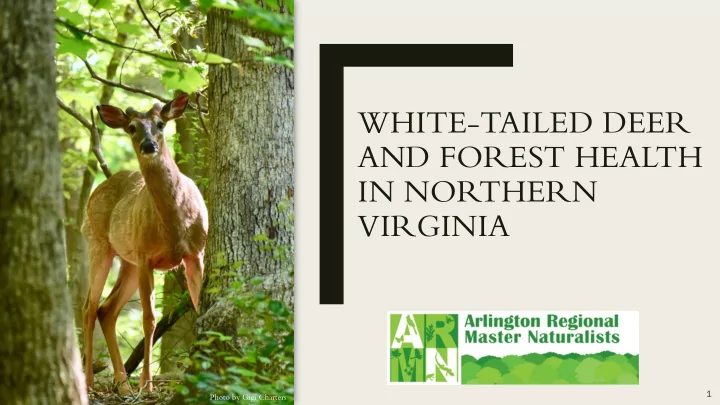
WHITE-TAILED DEER AND FOREST HEALTH IN NORTHERN VIRGINIA

1

Photo by Gigi Charters
slide-2
SLIDE 2

Photo by David Howell Pixabay License

2

slide-3
SLIDE 3

. . . becoming more plentiful . . .

  • Hunting and suburban development have been

key factors in population fluctuations.

Hypothetical Virginia deer population curve. Source: Department of Game and Inland Fisheries.

3

Photo by Donna Owen

Figure 2. Hheical lai ce f Vigiia dee hed, 1600-present. 250000 500000 750000 1000000 1250000 1600 1700 1800 1900 2000 Population Estimate

slide-4
SLIDE 4

Adult deer are eating machines

4

Annual consumption Daily consumption

Photos by Bill Browning and Sandy Munnell

slide-5
SLIDE 5

Deer browse changes the forest structure

Left: Forest with healthy understory. Right: Over-browsed forest cannot regrow.

Photos by Charles Smith

5

slide-6
SLIDE 6

Deer browse affects bird habitat

  • The Woodthrush nest ranges in

height from 6 to 50 feet from the ground.

  • It forages along the ground

which exposes it to predators.

6

Woodthrush, David Howell Source: The Birder's Handbook. A Field Guide to the Natural History of North American Birds. Paul R. Erilich, David S. Dobkin, and Darryl Wheye, 1988.

slide-7
SLIDE 7

Deer browse affects butterfly habitat

  • The Spring Azure butterfly relies on dogwood

(Cornus spp.), blueberry (Vaccinium spp.), and viburnum (Viburnum spp.)

  • The Spicebush Swallowtail caterpillar feeds

exclusively on spicebush (Lindera benzoin)

  • Many pollinators in various instar stages rely on

forest habitat

7

Photos by David Howell

slide-8
SLIDE 8

Deer browse undermines our investment in our parks

Photos by Bill Browning 8 Photo by Ron Battocchi

slide-9
SLIDE 9

WHAT COULD BRING BALANCE TO ECOSYSTEM

Photo by Gigi Charters

9

slide-10
SLIDE 10

Effective predators to deer are extirpated from Virginia

Gray Wolf

Photos: Pixabay License

10

Eastern Cougar

slide-11
SLIDE 11

Contraception and Sterilization Methods Do Not Work

  • Immunocontraceptives
  • PZP
  • By hand or dart
  • Needs to be administered repeatedly
  • GonaCon
  • USDA approved
  • Must be administered by hand
  • Not effective in open herds
  • Expensive—about $1,000 per deer per

year

  • Deer are susceptible to capture myopathy

Pixabay License

11

slide-12
SLIDE 12

Hunting Can Control Deer Population

  • Humans have been

hunting deer for thousands of years

  • Death by hunting more

humane than death by stress-inducing medical procedures

Pixabay License

12

slide-13
SLIDE 13

Fairfax Program

  • Deer management began in 1998
  • Proven safety record
  • Includes archery, managed shotgun hunts, and police

sharpshooting

  • Significant county oversight
  • Implemented by police
  • Collaborate with park authorities
  • Hunters have to prove themselves
  • Pass qualifications and frequently have to re-qualify
  • Complete educational courses

13

slide-14
SLIDE 14

Montgomery Program

  • County program to manage began over deer twenty years ago
  • Culled 1,137 deer in 2019/20
  • Cover more than 50 percent of county parkland
  • Archery and sharpshooting used in urban areas
  • Zero public safety incidents
  • Supplemented by private organization
  • Hunt on lots as small as 1/5 acre

14

slide-15
SLIDE 15

National Park Service Approach

  • Rock Creek Park
  • History
  • Before 1960, there were no deer sightings in the park
  • By the 1990s, there were so many that they stopped counting
  • Nearly 100 per square mile a decade ago
  • Public process resulted in deer management plan in 2012
  • Goal was to reduce deer density to support native plants and promote a

healthy forest

  • Have removed between 34 and 94 every year for last three years
  • Using trained firearms experts from USDA under NPS direction
  • Conducting operations at night
  • No safety incidents in seven years

Photo by Gigi Charters

15

slide-16
SLIDE 16

Other Jurisdictions

  • Prince George’s County—police sharpshooters and bow

hunting in public parks

  • Loudon County—private hunting permitted, generous limits
  • Prince William County—pilot program
  • Arlington County—no official program
  • Alexandria City—no official program

16

slide-17
SLIDE 17

Key Takeaways

  • Doing nothing means favoring deer over many
  • ther species of mammals, birds, and reptiles
  • Doing nothing will allow the deer to continue to

destroy our forests and jeopardize public and private landscapes

  • Human intervention is needed to restore balance

Photo by Gigi Charters

17

slide-18
SLIDE 18

“I now suspect that just as a deer herd lives in mortal fear of its wolves, so does a mountain live in mortal fear of its deer. And perhaps with better cause, for while a buck pulled down by wolves can be replaced in two or three years, a range pulled down by too many deer may fail of replacement in as many decades.”

Aldo Leopold, Thinking Like a Mountain

1 8