SLIDE 1 Sponsored by
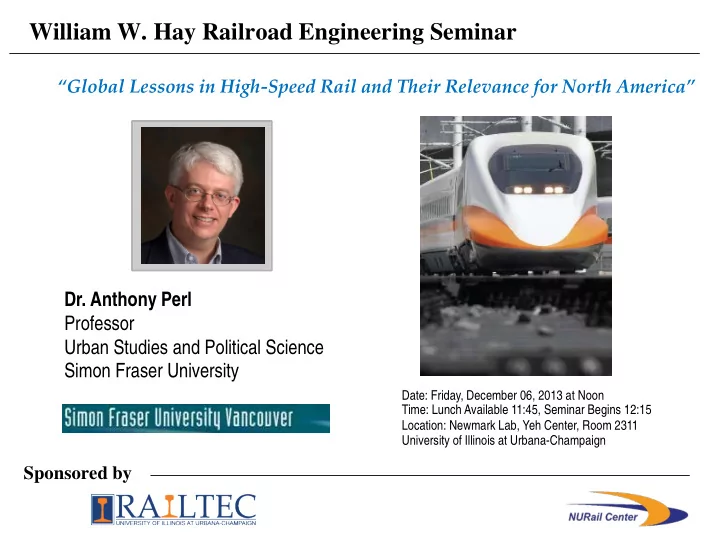
William W. Hay Railroad Engineering Seminar
“Global Lessons in High-Speed Rail and Their Relevance for North America”
Professor Urban Studies and Political Science Simon Fraser University
Date: Friday, December 06, 2013 at Noon Time: Lunch Available 11:45, Seminar Begins 12:15 Location: Newmark Lab, Yeh Center, Room 2311 University of Illinois at Urbana-Champaign
SLIDE 2
Anthony Perl
Global lessons in High-Speed Rail and their relevance for North America
aperl@sfu.ca
SLIDE 3
Americans have been early adopters of transportation technology that was invented elsewhere
1830 1829
SLIDE 4
Auto and jet aircraft technology were both launched in Germany, before taking off in the U.S.
SLIDE 5
Where America exceled was in re-imagining autos and aviation as mass transport modes
SLIDE 6 U.S. has long embraced mobility as a means to advance
- pportunity
- Travel and trade enable
Americans to pursue a better life.
- Social mobility increased
when the U.S. has introduced new transport technology.
SLIDE 7
After Japan launched the Shinkansen, America took the first steps to adapt and adopt HSR technology
SLIDE 8
President Lyndon Johnson signed the High Speed Ground Transportation Act in 1965
SLIDE 9 Americans quickly built a train that could reach very high speeds
New York Central M-497 set the still standing U.S. speed record
183.85 mph,
July 23, 1966!
SLIDE 10
Fast(er) trains entered commercial service in 1968
TurboTrain operated NY - Boston, until 1976. Schedule equaled today’s Acela. Reached 170 mph in tests.
SLIDE 11 Public-private partnership built America’s first high-speed EMU
product of a “public- private partnership”
funds leveraged $60 million from PRR, Budd, GE, & Westinghouse.
SLIDE 12
In the 1970s, Amtrak could boast that a 3 hour trip time from NY to DC made their train “one of the fastest in the world”
SLIDE 13
When Amtrak experienced many problems during its early years, Metroliner was the only train to consistently cover its operating costs
SLIDE 14 America’s fastest trains have been stymied by the tracks they need to operate effectively
SLIDE 15
Even in the Northeast Corridor today, tracks exact a heavy toll on Acela
The ‘breadbox’
SLIDE 16 9 Presidents and 24 sessions
… the U.S. holds the world record for time elapsed between launching HSR development and building tracks that are needed to operate it.
SLIDE 17
Why has HSR moved so slowly?
SLIDE 18
When HSR was gaining momentum in Asia and Europe, many U.S. railroads went through a near death experience
SLIDE 19
Billions went into bailing out bankrupt carriers when Uncle Sam got into running freight and passenger railroads
SLIDE 20 Railroad ownership wasn’t the only thing that changed during this crisis
Government rewrote a century-long accumulation
SLIDE 21
Railroads no longer had to serve everyone, they could focus on profitable market niches
SLIDE 22
Downsizing to carry profitable traffic led to reduced track capacity
Some rights of way have potential capacity; 20,000 miles of railroad got converted to trails
SLIDE 23
While Asia and Europe perfected HSR… the United States reinvented ways to move moving freight profitably by rail
SLIDE 24
This strategy worked!
U.S. railroads have been the only transport mode to post consistent profits since 2001
SLIDE 25
Smart money from big investors has moved into U.S. railroads
SLIDE 26
The infrastructure gap between North American freight rail innovation and Asian and European HSR development has widened
SLIDE 27
So what’s the matter with the U.S., Europe and Asia going their separate ways in reinventing railroads?
SLIDE 28
Climate and energy vulnerability are global problems that rail offers part of the solution to
SLIDE 29
Growing climate & energy risks are likely to drive future mobility changes
SLIDE 30
U.S. dependence on oil has gone up since the 1973 OPEC Embargo
Source: USA Today, Sept. 19, 2013
SLIDE 31
U.S. economy depends on vehicles that don’t work well without oil
SLIDE 32
HSR offers proven technology for moving people without oil for travel up to 1,000 miles
SLIDE 33
Conventional wisdom: the mid-point of the world’s oil reserves gives plenty of time to plan adjustments
SLIDE 34
The oil we’ll burn tomorrow is physically different from the oil we’ve already used
SLIDE 35
Do we invest a trillion plus into new oil infrastructure or billions in transportation infrastructure that doesn’t need oil?
SLIDE 36
New mandates to restart HSR development given by the 2008 election
SLIDE 37
2008 election provided both Washington and state governments a mandate to invest in rail infrastructure
SLIDE 38
Taking full advantage of America’s lag in adopting HSR technology will pay dividends
Trains, planes, and automobiles HSR
SLIDE 39 3 models of HSR have emerged, each with their own strategic orientation
- 1. Exclusive Corridors: linking mega-cities
2. Hybrid networks: blending new and conventional rail to extend HSR reach
- 3. Comprehensive National Networks: Making
HSR a backbone of intercity mobility
SLIDE 40
Exclusive Corridors: linking mega-cities
SLIDE 41
Hybrid networks: blending new and conventional rail to extend HSR reach
SLIDE 42
Comprehensive National Network: Making HSR a backbone of intercity mobility
SLIDE 43
California is now the HSR design laboratory for the U.S.
SLIDE 44
No need to reinvent the know-how for exclusive corridors; this is the place for global partnerships
SLIDE 45 Global knowledge can support local experience in sharing tracks among intercity and regional rail passenger
SLIDE 46
Sharing tracks will be essential to getting HSR into mega-cities like Los Angeles and San Francisco
SLIDE 47
Sharing rights of way with freight railroads will require innovations that are unique to the USA
SLIDE 48
Climate and energy challenges will affect freight railroads too
What will freight railroads need from government to adapt their business model in the decade ahead?
SLIDE 49
Building America’s first new rail infrastructure to move people between cities in over 100 years will advance essential capacities
SLIDE 50
Innovation will attract states looking to add rail to their intercity mobility mix
SLIDE 51 Institutionalizing that know-how could bring rail an exciting new role
- f moving more people and freight
across the U.S.