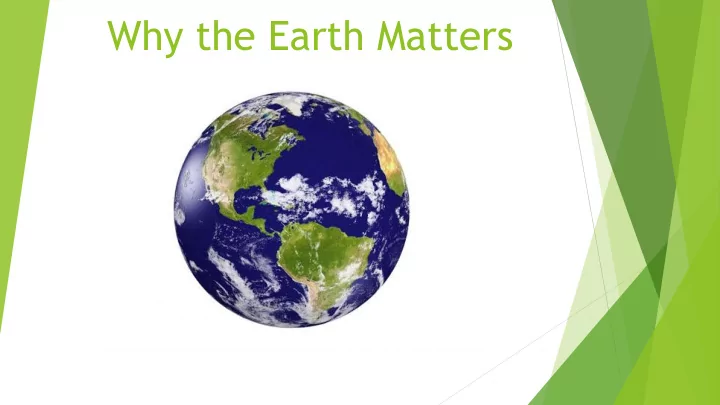
Why the Earth Matters Earth is the only planet viable for life - - PowerPoint PPT Presentation

why the earth matters earth is the only planet viable for
SMART_READER_LITE
LIVE PREVIEW

Why the Earth Matters Earth is the only planet viable for life - - PowerPoint PPT Presentation

Why the Earth Matters Earth is the only planet viable for life Venus is too hot and is a Mars? Mars might gaseous planet Neptune is too far, too have potential for cold and has many storms life, but research still has to be done Earth is


slide-1
SLIDE 1

Why the Earth Matters

slide-2
SLIDE 2

Earth is the only planet viable for life

Venus is too hot and is a gaseous planet Neptune is too far, too cold and has many storms Mars? Mars might have potential for life, but research still has to be done

slide-3
SLIDE 3

Earth is the perfect distance away from the sun to support life

If Earth was any closer or farther from the sun, it would either be too hot, or too cold to support all life on the planet

slide-4
SLIDE 4

Earth has different ecosystems

 What are

ecosystems?

 An ecosystem is a

community of living and non living

  • rganisms

interacting with their physical environment

slide-5
SLIDE 5

What are all of the ecosystems?

 There are eight major ecosystems: The temperate forest,

tropical forest, desert, grassland, taiga, the tundra, the chaparral, and the ocean.

slide-6
SLIDE 6

The Temperate Forest

  • Temperature forest have rainfall which

promotes tree growth

  • Trees lose their leaves in the fall
  • Temperate Forests have four distinct seasons
  • The soil is rich
  • Deer, bears and squirrels are some of the

animals that live in the Temperate Forest

slide-7
SLIDE 7

The Tropical Forest

  • Tropical Rainforests have lots of rainfall

and moisture

  • Hot temperatures and humidity
  • “Nutrient-poor” soil
  • Very high levels of species diversity. It is

said that about 10% of the species found

  • n Earth can be found in the Rainforest.
  • Jaguars, Macaws and Monkeys are some
  • f the animals that can be found in the

Rainforest

slide-8
SLIDE 8

The Desert

  • Deserts have very little rainfall
  • They have extreme temperatures, very

hot during the day and very cold at night.

  • Deserts are very dry
  • Some animals that live in the deserts

are Jack Rabbits, Coyotes, and Mountain Lions

slide-9
SLIDE 9

The Grassland

  • Vegetation is mostly grasses
  • Has some of the most fertile soil
  • n Earth
  • Grasslands are typically used for

agriculture

  • Very few trees in this ecosystem
  • Grasslands in the U.S. typically

have bison and mice, while grasslands in Africa have Zebras, Gazelles and Lions

slide-10
SLIDE 10

The Taiga (or Boreal Forest)

  • Long winters (up to 6 months)
  • Has coniferous tree species (meaning there are a lot of evergreen

trees in the Boreal Forest. These trees are green all year round, and are pine trees

  • Wolves, Moose, Foxes and Owls are some of the animals that live in a

Boreal Forest

slide-11
SLIDE 11

The Tundra

  • Extremely cold climate
  • Short season of growth
  • The ground is mostly frozen and there is little life in

this ecosystem

  • Some animals that live in this climate are Caribou,

Artic Foxes, Muskox, and Polar Bears

slide-12
SLIDE 12

The Chaparral

  • Chaparral is usually located on the coast
  • Has hot dry summers, and mild rainy winters
  • The chaparral is most vulnerable to fire in the summer and

early fall

  • This ecosystem is important, because it protects the land

from erosion

slide-13
SLIDE 13

The Ocean

  • The ocean is one of the largest ecosystems in the world!
  • The various amounts of life, (such as animals and plants, vary

by the light that is distributed in the ocean, the nutrients, and depth of the ocean

  • 71% of the Earth’s surface is covered by oceans
  • There are countless of animals that live in the oceans
slide-14
SLIDE 14

What are the risks that effect these habitats?

Rainforests are very vulnerable to deforestation and logging of trees. Many of the trees are being clear cut, which destroys many habitats, and causes animals to flee and find new homes. Polar Bears live in the Tundra, where the permafrost is melting

  • rapidly. This causes Polar

Bears to search for food for longer periods of time, sometimes unsuccessful, or displacing Polar Bears to different areas. The Oceans are the most vulnerable to plastic pollution. Plastic takes hundreds of years to breakdown, and it doesn’t break down fully. Plastic normally breaks down in micro plastics, which causes many

  • rganisms to ingest it and

become sick.

slide-15
SLIDE 15

What can you do to help?

slide-16
SLIDE 16

Respect the Earth! It is the only one you have!