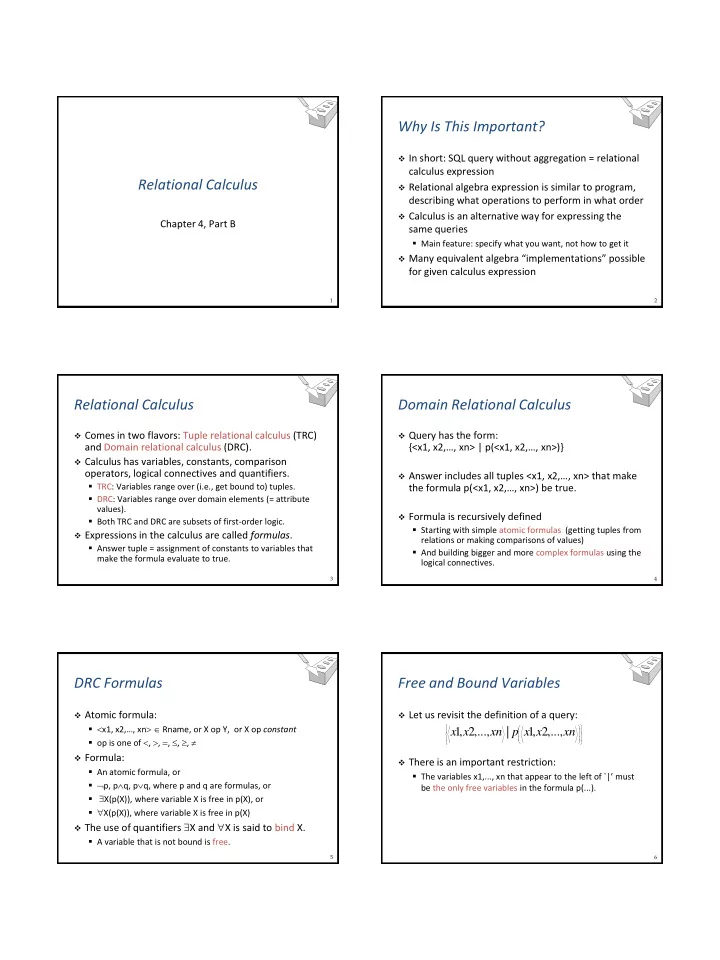
Why Is This Important? In short: SQL query without aggregation = - - PDF document

why is this important
SMART_READER_LITE
LIVE PREVIEW

Why Is This Important? In short: SQL query without aggregation = - - PDF document

Why Is This Important? In short: SQL query without aggregation = relational calculus expression Relational Calculus Relational algebra expression is similar to program, describing what operations to perform in what order Calculus is


slide-1
SLIDE 1

1

Relational Calculus

Chapter 4, Part B

2

Why Is This Important?

 In short: SQL query without aggregation = relational

calculus expression

 Relational algebra expression is similar to program,

describing what operations to perform in what order

 Calculus is an alternative way for expressing the

same queries

  • Main feature: specify what you want, not how to get it

 Many equivalent algebra “implementations” possible

for given calculus expression

3

Relational Calculus

 Comes in two flavors: Tuple relational calculus (TRC)

and Domain relational calculus (DRC).

 Calculus has variables, constants, comparison

  • perators, logical connectives and quantifiers.
  • TRC: Variables range over (i.e., get bound to) tuples.
  • DRC: Variables range over domain elements (= attribute

values).

  • Both TRC and DRC are subsets of first-order logic.

 Expressions in the calculus are called formulas.

  • Answer tuple = assignment of constants to variables that

make the formula evaluate to true.

4

Domain Relational Calculus

 Query has the form:

{<x1, x2,…, xn> | p(<x1, x2,…, xn>)}

 Answer includes all tuples <x1, x2,…, xn> that make

the formula p(<x1, x2,…, xn>) be true.

 Formula is recursively defined

  • Starting with simple atomic formulas (getting tuples from

relations or making comparisons of values)

  • And building bigger and more complex formulas using the

logical connectives.

5

DRC Formulas

 Atomic formula:

  • x1, x2,…, xn  Rname, or X op Y, or X op constant
  • op is one of , , , , , 

 Formula:

  • An atomic formula, or
  • p, pq, pq, where p and q are formulas, or
  • X(p(X)), where variable X is free in p(X), or
  • X(p(X)), where variable X is free in p(X)

 The use of quantifiers X and X is said to bind X.

  • A variable that is not bound is free.

6

Free and Bound Variables

 Let us revisit the definition of a query:  There is an important restriction:

  • The variables x1,..., xn that appear to the left of `|’ must

be the only free variables in the formula p(...).

                   

xn x x p xn x x ,..., 2 , 1 | ,..., 2 , 1

slide-2
SLIDE 2

7

Find all sailors with a rating above 7

 Condition I,N,T,ASailors ensures that the domain

variables I, N, T and A have to be fields of the same Sailors tuple.

 The term I,N,T,A to the left of `|’ (which should be

read as “such that”) says that every tuple I,N,T,A that satisfies T>7 is in the answer set.

 Modify this query to answer:

  • Find sailors who are older than 18 or have a rating under

9, and are called ‘Joe’.

         

   7 Sailors , , , | , , , T A T N I A T N I

8

Find sailors rated > 7 who have reserved boat #103

 We have used  Ir,Br,D (…) as a shorthand for

Ir (Br (D (…)))

 Note the use of  to find a tuple in Reserves that

`joins with’ the Sailors tuple under consideration.

    

    7 Sailors , , , | , , , T A T N I A T N I

              

      103 Reserves , , , , Br I Ir D Br Ir D Br Ir

9

Find sailors rated > 7 who’ve reserved a red boat

 Observe how the parentheses control the scope of

each quantifier’s binding.

 This may look cumbersome, but with a good user

interface, it can be very intuitive. (MS Access, QBE)

    

    7 Sailors , , , | , , , T A T N I A T N I

    

     I Ir D Br Ir D Br Ir Reserves , , , ,

                   

      ' red ' Boats , , , , C Br B C BN B C BN B

10

Find sailors who’ve reserved all boats

 Find all sailors I such that for each 3-tuple B,BN,C

either it is not a tuple in Boats or there is a tuple in Reserves showing that sailor I has reserved it.

    

 Sailors , , , | , , , A T N I A T N I  

              

Boats , , , , C BN B C BN B

                            

      B Br Ir I D Br Ir D Br Ir Reserves , , , ,

11

Find sailors who’ve reserved all boats (again)

 Simpler notation, same query. (Much clearer)  To find sailors who’ve reserved all red boats:

    

 Sailors , , , | , , , A T N I A T N I Boats , ,   C BN B

                      

     B Br Ir I D Br Ir Reserves , ,

                      

       B Br Ir I D Br Ir C Reserves , , ' red '

...

12

Unsafe Queries, Expressive Power

 It is possible to write syntactically correct calculus

queries that have an infinite number of answers.

  • Such queries are called unsafe.
  • E.g., {S | (SSailors)}

 Theorem: Every query that can be expressed in

relational algebra can be expressed as a safe query in DRC / TRC

  • The converse is also true.

 Relational Completeness: Query language (e.g., SQL)

can express every query that is expressible in relational algebra/calculus.

slide-3
SLIDE 3

13

Summary

 Relational calculus is non-operational

  • Users define queries in terms of what they want, not in

terms of how to compute it. (Declarativeness.)

 Algebra and safe calculus have the same expressive

power, leading to the notion of relational completeness.

 Relational calculus had big influence on the design of

SQL and Query-by-Example