Why is Medicaid at the Center of State and Federal Budget Debates? - - PowerPoint PPT Presentation

why is medicaid at the center of state and federal budget
SMART_READER_LITE
LIVE PREVIEW

Why is Medicaid at the Center of State and Federal Budget Debates? - - PowerPoint PPT Presentation

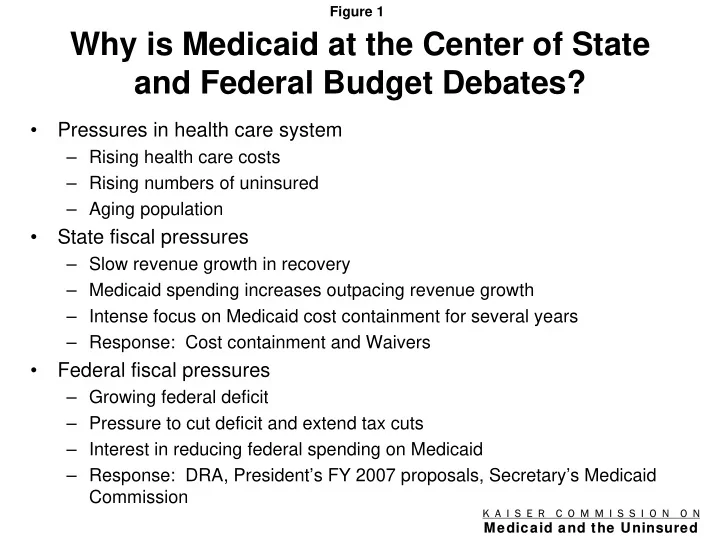
Figure 1 Why is Medicaid at the Center of State and Federal Budget Debates? Pressures in health care system Rising health care costs Rising numbers of uninsured Aging population State fiscal pressures Slow revenue


slide-1
SLIDE 1

K A I K A I S E S E R C R C O M M I S S I O M M I S S I O O N N O N O N

Medicaid and Medicaid and the Uninsured the Uninsured Figure 1

Why is Medicaid at the Center of State and Federal Budget Debates?

  • Pressures in health care system

– Rising health care costs – Rising numbers of uninsured – Aging population

  • State fiscal pressures

– Slow revenue growth in recovery – Medicaid spending increases outpacing revenue growth – Intense focus on Medicaid cost containment for several years – Response: Cost containment and Waivers

  • Federal fiscal pressures

– Growing federal deficit – Pressure to cut deficit and extend tax cuts – Interest in reducing federal spending on Medicaid – Response: DRA, President’s FY 2007 proposals, Secretary’s Medicaid Commission

slide-2
SLIDE 2

K A I K A I S E S E R C R C O M M I S S I O M M I S S I O O N N O N O N

Medicaid and Medicaid and the Uninsured the Uninsured Figure 2

Distribution of Medicaid Spending Reductions in the Deficit Reduction Act

37% 28% 2006-2010 2006-2015

Long-Term Care Prescription Drug Payment Other

10 Year Savings = $43.2 Billion

Benefits and Cost Sharing

5 Year Savings = $11.5 Billion

Note: “Other” provisions in the conference report include targeted case management, third-party recovery, provider taxes, and requiring evidence of citizenship SOURCE: CBO, January 27, 2006

slide-3
SLIDE 3

K A I K A I S E S E R C R C O M M I S S I O M M I S S I O O N N O N O N

Medicaid and Medicaid and the Uninsured the Uninsured Figure 3

Cost Sharing and Benefit Provisions in the DRA

  • Cost sharing and premiums

– Allows states to impose higher or new cost sharing and premiums – Allows states to make cost sharing “enforceable” – Maintains exemption for mandatory children and pregnant women (except for non-preferred prescription drugs)

  • Benefit “benchmarks”

– Allows states to use “benchmark” plans for certain groups (family planning, mental health & rehabilitation services may not be covered) – Maintains current benefits for individuals with disabilities or long term care needs (guidance suggests that mandatory adults can be subject to limits) – Maintains EPSDT coverage as wrap-around for children

  • Allows variation in benefits and cost sharing across groups

and geographic areas

slide-4
SLIDE 4

K A I K A I S E S E R C R C O M M I S S I O M M I S S I O O N N O N O N

Medicaid and Medicaid and the Uninsured the Uninsured Figure 4

DRA Requires Proof of Citizenship for Medicaid

  • DRA requires all new and current Medicaid enrollees to

provide documentation to prove citizenship

  • Main sources of documentation include U.S. passport or

birth certificate

– HHS given authority to list alternative documents (not released yet)

  • Effective date: July 1, 2006
  • Will impose new administrative burdens for states and new

barriers for beneficiaries to obtain and retain Medicaid

  • Many states have been working to simplify eligibility process
  • Wide range of estimates about coverage impact
slide-5
SLIDE 5

K A I K A I S E S E R C R C O M M I S S I O M M I S S I O O N N O N O N

Medicaid and Medicaid and the Uninsured the Uninsured Figure 5

Medicaid Spending Reductions in the DRA Attributable to Asset Transfer Changes

2006-2010 2006-2015

Treatment of Home Equity Treatment of Annuities Other

  • $2.4 Billion
  • $6.4 Billion

Changes to the Penalty Period

SOURCE: CBO, January 27, 2006

slide-6
SLIDE 6

K A I K A I S E S E R C R C O M M I S S I O M M I S S I O O N N O N O N

Medicaid and Medicaid and the Uninsured the Uninsured Figure 6

Key Medicaid LTC Spending Increases in the Deficit Reduction Act

2006-2010 2006-2015

$2.6 Billion $11.4 Billion

Long-Term Care Partnership Program Cash and Counseling Programs Home and Community Based Services Family Opportunity Act Money-Follows-the- Person

SOURCE: CBO, January 27, 2006

slide-7
SLIDE 7

K A I K A I S E S E R C R C O M M I S S I O M M I S S I O O N N O N O N

Medicaid and Medicaid and the Uninsured the Uninsured Figure 7

Emerging Trends in Medicaid

  • Emphasis on personal behavior and responsibility

– “Consumer choice” of plans / Long-term Care Services – Increased premiums and/or cost sharing – Behavior modification through incentives

  • “Tailored” benefits

– Variation in benefit packages across groups or geographic areas

  • Increased role of private marketplace

– Increased control to plans to determine benefit packages – Emphasis on premium assistance – Public/private long-term care partnerships

  • Restricting spending/increasing spending predictability

– Defined contribution approaches – Aggregate cap on federal funding

slide-8
SLIDE 8

K A I K A I S E S E R C R C O M M I S S I O M M I S S I O O N N O N O N

Medicaid and Medicaid and the Uninsured the Uninsured Figure 8

Issues to Consider for Women’s Medicaid Coverage

  • What do the DRA and recent waiver changes mean for

availability and affordability of women on Medicaid?

  • How is fiscal responsibility and risk shifting among the

federal government, states, plans, and beneficiaries?

  • Will variations in coverage for women between and within

states broaden?

  • What is the right balance between state flexibility and

federal standards?

  • Are changes occurring with enough evaluation,

transparency, and accountability?