
SLIDE 1
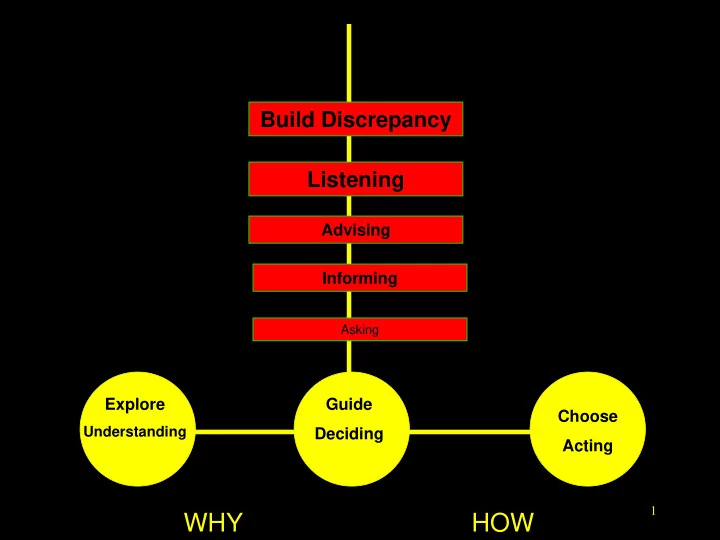
1 Asking
Listening
Informing Advising Explore
Understanding
Guide Deciding Choose Acting
WHY HOW Explore Choose Guide 2 4 Processes 1-Engage 2-Guide - - PowerPoint PPT Presentation
Build Discrepancy Listening Advising Informing Asking Explore Guide Choose Understanding Deciding Acting 1 WHY HOW Explore Choose Guide 2 4 Processes 1-Engage 2-Guide 3-Evoke 4-Plan 3 Build Discrepancy Listening Advising
1 Asking
Informing Advising Explore
Understanding
Guide Deciding Choose Acting
2
Explore Guide Choose
3
Asking
Informing Advising Explore
Understanding
Guide Deciding
Choose Acting
1-Engage2-Guide 3-Evoke 4-Plan
▪
Explore (WHAT/WHY/WHY NOT)
– COMFORT THE AFFLICTED – Build Initial rapport & Express Empathy – Drain the swamp of negativity – Obtain a history – Collaborative agenda setting – Explore pros, cons, hopes and fears (Reasons)
▪
Guide (IF)
– AFFLICT THE COMFORTBLE
– Build Motivation & Discrepancy
– Elicit change talk
– Do Summary with Sandwich – SPIN THE BALLS
– Obtain COMMITMENT – Move toward a behavior decision
▪
Choose (if a decision/commitment has been made) (WHEN/HOW)
– Taking STEPS – Establish a Goal – Provide Menu of Options – Set an Action Plan – Overcome/anticipate barriers – Make a contract & Discuss follow up 5
6
7
8
9
12
▪ With Parent Screener… ▪ Paramatized Choice: In our remaining time today, I
13
14
15
behavior...basically it is what happens right before the behavior occurs.
▪
Diary Keeping/Map A-B-C
▪
Set Goals for child and family
▪
Have F & V around/Don’t buy Junk
▪
Reinforcement for Effort/Outcomes
▪
Order Salad at Wendy’s (Sub)
▪
Limit Screen Time to 1 hr a day (Mod)
▪
Limit Soda/SSB to 1 per day (Mod)
▪
Order apple fries (Sub)
19
20
❖ Trying new food ❖ Trying exercise
21
22
23
Sugar Sweetened Drinks Diary
Day Circle the number of drinks your child had Total# Comments Monday Tuesday Wednesday Thursday Friday Saturday Sunday Keep a record of the number of sweet- ened drinks your child has each day. Write any comments in the final column. These may include reasons you feel you and your child didn’t meet your goal, or how you both feel about your progress. UNT My child,
NAME
will increase/decrease
DRINK
by ea ch day.
GLASSES
M O
NUMBER
NT A glassesof R E A L CU
DRINK
GO
Exercise Diary
Day Activity and/or Type of Exercise How long? (minutes) Comments Monday Tuesday Wednesday Thursday Friday Saturday Sunday Keep a record of the length of time and type
riding a bike, playing, walking, doing sports, dancing) your child does this week. Write any comments in the final column. These may include reasons you feel you and your child didn’t meet the goal, or how you both feel about your progress. UNT My child,
NAME
will exercise
MINUTES
each day this week. M O
NUMBER
NT A minutes of R E AL CU
ACTIVITY
GO
Dining Out Diary
Day How many times? What did your child eat? Comments Monday Tuesday Wednesday Thursday Friday Saturday Sunday Keep a record of the total number of times your child dines out (including fast food) this week. Write any comments in the final column. These may include reasons you feel you and your child didn’t meet the goal, or how you both feel about your progress. CURRENT AMOUNT
NUMBER
times each week GOAL My child,
NAME
will dine out
NUMBER
times this week.
Whole Grain Diary
Day Circle the icon for each whole grain serving your child eats Total# Comments Monday Tuesday Wednesday Thursday Friday Saturday Sunday Keep a record of the number of whole grain servings your child has each day. Write any comments in the final column. These may include how you feel you’re doing, or whole grains that your child enjoyed. CURRENT AMOUNT
NUMBER
servings of whole grain each day GOAL My child,
NAME
will eat
NUMBER
servings of whole grain each day.
Fruits Diary
Day Circle the icon for each serving of fruit your child eats Total# Comments Monday Tuesday Wednesday Thursday Friday Saturday Sunday Keep a record of the number of fruit servings your child has each day. Write any comments in the final column. These may include reasons you feel you and your child didn’t meet your goal, or how you both feel about your progress. CURRENT AMOUNT
NUMBER
servings of fruit each day GOAL My child,
NAME
will eat
NUMBER
servings of fruit each day.
Vegetables Diary
Day Circle the icon for each serving of veggies your child eats Total# Comments Monday Tuesday Wednesday Thursday Friday Saturday Sunday Keep a record of the number of vegetable servings your child has each day. Write any comments in the final column. These may include reasons you feel you and your child didn’t meet your goal, or how you both feel about your progress. CURRENT AMOUNT
NUMBER
servings of vegetables each day GOAL My child,
NAME
will eat
NUMBER
servings of vegetables each day.
TV & Screen Time Diary
Day Circle the icon for each 30-minute TV & screen time block Total# Comments Monday 30 30 30 30 30 30 30 30 Tuesday 30 30 30 30 30 30 30 30 Wednesday 30 30 30 30 30 30 30 30 Thursday 30 30 30 30 30 30 30 30 Friday 30 30 30 30 30 30 30 30 Saturday 30 30 30 30 30 30 30 30 Sunday 30 30 30 30 30 30 30 30 Keep a record of your child’s screentime this week. In the final column, you may want to write down which programs your child watches,
goal difficult or easier to reach. CURRENT AMOUNT
NUMBER
minutes of TV and/or screen time each day GOAL My child,
NAME
will watch
NUMBER
minutes of TV and/or screen time each day.
Playing Video Games & Using the Internet Diary
Day Circle the icon for each 30-min game/Internet time block Total# Comments Monday 30 30 30 30 30 30 30 30 Tuesday 30 30 30 30 30 30 30 30 Wednesday 30 30 30 30 30 30 30 30 Thursday 30 30 30 30 30 30 30 30 Friday 30 30 30 30 30 30 30 30 Saturday 30 30 30 30 30 30 30 30 Sunday 30 30 30 30 30 30 30 30 Keep a record of your child’s video game and internet time thisweek. In the final column, you may want to write down which games your child plays, or comments about when you found the goal difficult or easier to reach. CURRENT AMOUNT
NUMBER
minutes of video game play and/or Internet use each day GOAL My child,
NAME
will play video games/use the Internet
NUMBER
minutes each day.
Sweets & Desserts Diary
Day Sweet 1 Sweet 2 Sweet 3 Sweet 4 Comments Monday Tuesday Wednesday Thursday Friday Saturday Sunday UNT My child,
NAME
will have sweets and/or desserts each day.
NUMBER
We are going to try to eatless
SWEET / DESSERT
M O
NUMBER
T A
N
UNITS (BAGS, SLICES, ETC.)
RE AL CU
SWEET / DESSERT
GO Keep a record of the number of sweets and desserts your child eats this week. Write any comments in the final column. These may include how you feel you are doing and/or healthy substitutions your child enjoyed. For each sweet and/or dessert, please write what your child ate and how much
Unhealthy Snack Diary
Day Snack 1 Snack 2 Snack 3 Snack 4 Comments Monday Tuesday Wednesday Thursday Friday Saturday Sunday UNT My child,
NAME
will have snacks each day.
NUMBER
We are going to try to eatless
UNHEALTHY SNACK
M O
NUMBER
T A
N
UNITS (BAGS, CUPS, ETC.)
RE AL CU
UNHEALTHY SNACK
GO Keep a record of the unhealthy snacks your child eats every day. Write any comments in the final column. These may include reasons you feel you and your child didn’t meet the goal, or how you both feel about your progress. For each unhealthy snack, please write what your child ate and how much
35
▪ Abstinence violation syndrome/Not All or Nothing ▪ Giving Credit/Even for Effort ▪ Counting small changes ▪ Craving/discomfort will pass ▪ You can deal with it ▪ Taking actions gives you a sense of control ▪ Giving it your best shot
36
37
38
39
40
41
42