Why do we seek out consultation? Guidelines for Providing - - PDF document

why do we seek out consultation
SMART_READER_LITE
LIVE PREVIEW

Why do we seek out consultation? Guidelines for Providing - - PDF document

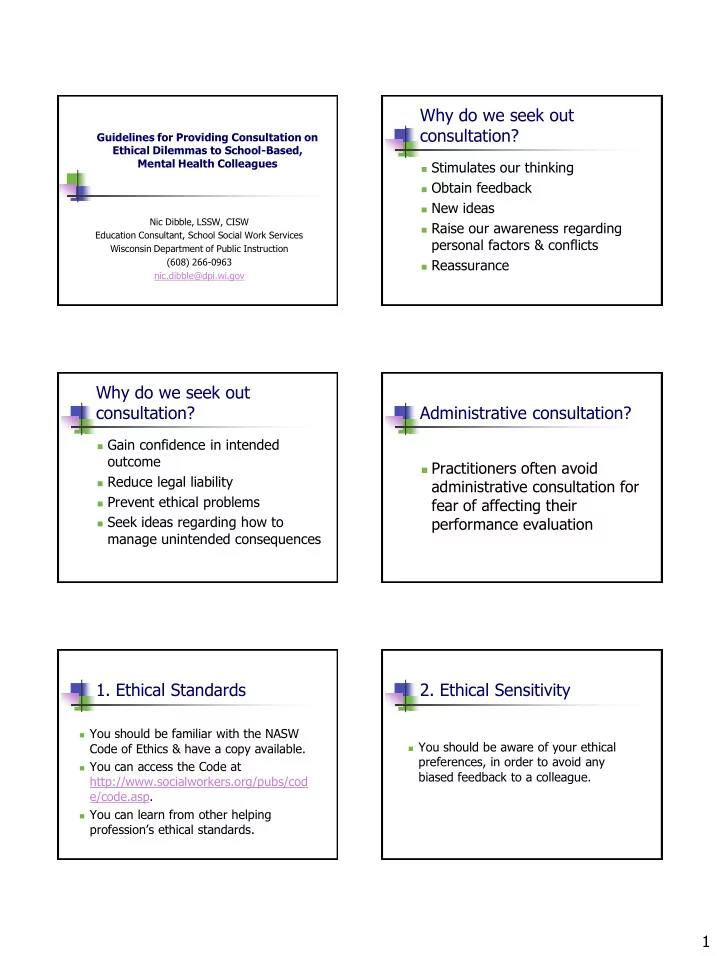
Why do we seek out consultation? Guidelines for Providing Consultation on Ethical Dilemmas to School-Based, Mental Health Colleagues Stimulates our thinking Obtain feedback New ideas Nic Dibble, LSSW, CISW Raise our awareness


slide-1
SLIDE 1

1

Guidelines for Providing Consultation on Ethical Dilemmas to School-Based, Mental Health Colleagues

Nic Dibble, LSSW, CISW Education Consultant, School Social Work Services Wisconsin Department of Public Instruction (608) 266-0963 nic.dibble@dpi.wi.gov

Why do we seek out consultation?

 Stimulates our thinking  Obtain feedback  New ideas  Raise our awareness regarding

personal factors & conflicts

 Reassurance

Why do we seek out consultation?

 Gain confidence in intended

  • utcome

 Reduce legal liability  Prevent ethical problems  Seek ideas regarding how to

manage unintended consequences

Administrative consultation?

 Practitioners often avoid

administrative consultation for fear of affecting their performance evaluation

  • 1. Ethical Standards

 You should be familiar with the NASW

Code of Ethics & have a copy available.

 You can access the Code at

http://www.socialworkers.org/pubs/cod e/code.asp.

 You can learn from other helping

profession’s ethical standards.

  • 2. Ethical Sensitivity

 You should be aware of your ethical

preferences, in order to avoid any biased feedback to a colleague.

slide-2
SLIDE 2

2

  • 3. Timing

 Be sure you have the necessary time to

spend with your colleague before you agree to provide consultation.

 Assess the level of urgency and, if

needed, schedule another time to meet

  • r refer your colleague to someone else

who can help.

  • 4. Listen

 Begin the interaction simply by

listening.

 Allow your colleague to explain the

ethical dilemma & why she/he is struggling with how to manage it.

  • 5. Assess your competence

 Assess your level of competence to provide

consultation to your colleague on this situation.

 Ethical  Clinical  Legal

 If your competence is limited in some manner,

inform your colleague.

 If your competence is not adequate, refer your

colleague to another professional with the requisite competence to help.

  • 6. Assess your influence

 The younger your colleague is, the

greater your professional responsibility.

 The more your colleagues respect your

work, the more power you have to influence their decision-making.

  • 7. Ask questions

 Ask clarifying questions to ensure you

fully understand the situation.

 Offering any feedback based upon

incomplete information is not constructive & may actually cause harm.

  • 8. Empathize & encourage

 Empathize with your colleague.  Acknowledge that the situation is a

difficult one.

 Encourage use of consultation to

manage ethical dilemmas.

slide-3
SLIDE 3

3

  • 9. Ask more questions

 Ask questions designed to determine if

your colleague has followed the recommended steps of a decision- making model for mental health professionals facing an ethical dilemma.

 If appropriate, share an ethical

decision-making model that you find helpful with your colleague.

Ethical Decision-Making Process

1.

Know yourself, your profession’s code of ethics & the relevant laws.

2.

Analyze the predicament.

3.

Seek consultation.

4.

Identify courses of action.

5.

Manage the clinical concerns.

6.

Enact the decision.

7.

Reflect on the process & outcomes.

Raines & Dibble (2011) http://www.us.oup.com/us/catalog/general/subject/SocialWork/?vi ew=usa&view=usa&ci=9780199735853

  • 10. Professional differences

 If you believe that your colleague may

have handled the situation differently than you would have, do not rush to judgment.

 Take care to distinguish between an

ethical violation & a difference of professional opinions.

  • 11. Share knowledge &

experience

 Share any specific knowledge you may have

about how to successfully manage this kind

  • f ethical dilemma.

 Share any experience you may have

regarding how a similar situation was managed with a poor outcome.

 Cautioning a colleague to avoid a particular

course of action is valuable, as well.

  • 12. Scope of response

 A colleague may approach you with a

very narrow request for consultation.

 Do not feel obligated to provide a

comprehensive, consultative response as is outlined in these guidelines.

  • 13. Other Professions

 Remember that while some ethical

standards may be parallel across professions, they are still different.

 Offering your profession’s perspective is

helpful.

 It is not constructive or appropriate to

hold your colleague accountable to your profession’s ethical standards.

slide-4
SLIDE 4

4

Example: Duty to warn

 School nurses

“Duties of confidentiality, however, are not absolute and may need to be modified in

  • rder to protect the patient, other innocent

parties, and in circumstance of mandatory disclosure for public health reasons.”

ANA Code of Ethics, 3.2

Example: Duty to warn

 School psychologists

“Information is revealed only with the informed consent of the child, or the child’s parent or legal guardian, except in those situations in which failure to release information would result in clear danger to the child or others.”

NASP Principles for Professional Ethics, III.A.9.

Example: Duty to warn

 School counselors

“Keeps information confidential unless disclosure is required to prevent clear and imminent danger to the student or others or when legal requirements demand that confidential information be revealed.”

ASCA Ethical Standards for School Counselors, A.2.b.

Example: Duty to warn

 School social workers

“The general expectation that social workers will keep information confidential does not apply when disclosure is necessary to prevent serious, foreseeable, and imminent harm to a client or other identifiable person.”

  • 14. Consult, don’t direct

 Resist the temptation to tell your

colleague how to manage the situation.

 Your goal should be to help your

colleague come to his/her own decision about how to manage this ethical dilemma.

  • 15. Don’t be offended

 Don’t be offended if your colleague

declines to follow your advice. Consultation is non-binding.

 There may be more than 1 ethical

course of action.

 She/he must take responsibility for the

decision, its outcomes, and any related ramifications.

slide-5
SLIDE 5

5

  • 16. Resources

 If you know of someone else or a

specific resource that you believe could help your colleague, share that information.

  • 17. Referral

 If you are not able to directly assist

your colleague, connecting your colleague to someone who can help is a valuable service.

  • 18. Personal Conflicts

 Use your clinical skills to manage any

perceived personal bias of your colleague in a manner that will not elicit a defensive reaction.

 You may wish to recuse yourself from

any consultation on any issue where you have strong personal feelings.

  • 19. Follow-up

 Check in with your colleague in the near

future to learn how the situation was managed & what the outcomes were.

 You can learn from this experience, as

well.