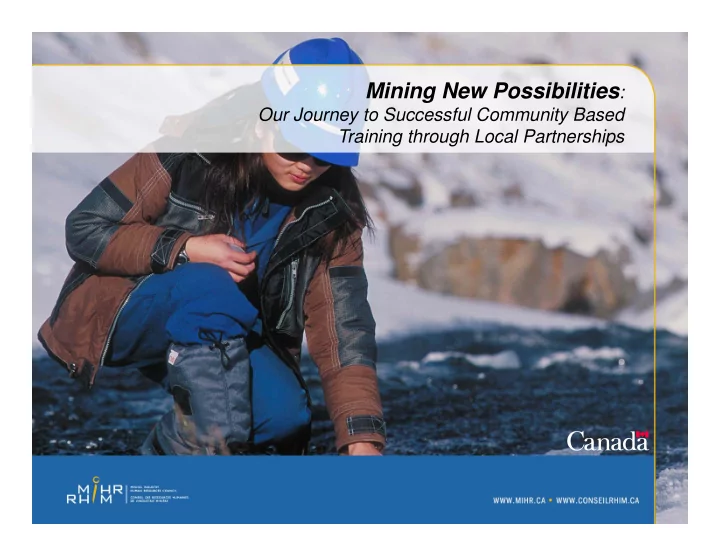
SLIDE 1
Mining New Possibilities:
Our Journey to Successful Community Based Training through Local Partnerships
SLIDE 2 Who we are:
- National HR Council for the minerals and metals sector
- Not-for-profit
- Board of Directors
- Over 200 volunteers from many communities of interest
What we do:
- Identify national HR challenges and opportunities for the
minerals and metals industry
- Create national solutions through collaboration, partnerships
and synergy
SLIDE 3
Finding the Pathway
SLIDE 4
Participation of Aboriginal Peoples, Immigrants and Women
SLIDE 5
Aboriginal Peoples in Mining in Canada
SLIDE 6
Mining and Aboriginal Community Partnership Agreements in Canada
http://www.nrcan.gc.ca
SLIDE 7 Companies
- Jobs Opportunities
- Intent to Hire Locally
Communities
- Youth
- Looking for Jobs
- Local Knowledge
The Challenge
SLIDE 8
Where the Journey Began
SLIDE 9
SLIDE 10 The Program Model
HOW?
Teaching
Context/ Exposure
WHAT?
Requirements
Readiness Skills
SLIDE 11 Objectives
- Foundational skills, attitudes and
industry knowledge
- Skilled and safety conscious Aboriginal
workforce through training partnerships between Aboriginal communities, educators, and the mining industry
- Increase self-confidence through information and
- pportunities, to find pathways to fulfilling,
meaningful employment
- National consistency delivered with flexibility
locally by a variety of qualified training
11 IRC
SLIDE 12
Enhancing the Pathway
SLIDE 13 Mining New Possibilities Project
- Strategic communications plan and materials
- Trainer Guides to PowerPoint
- Additional Métis and Inuit content
- eLearning components and activities
- Re-write and online quizzes
- Monitoring
- Trainer Qualification model
- Online Trainers’ Portal
- Needs assessment and report on developing a similar
program for other under-represented groups
SLIDE 14
Balancing National Consistency and Regional Flexibility
National Consistency Regional Flexibility
SLIDE 15
Blended Learning Options
Hands-on Online Classroom
SRC
SLIDE 16 eLearning and Learning Management System (LMS)
- eLearning
- Online evaluations, tracking
and reporting
- Less paper
- Less administration
- Learning curve
- Testing with active sites
- Sharing portals
- Trainers, Site Coordinators
- Best practices, tools
SLIDE 17
Local delivery through local partnerships EDUCATION EMPLOYERS COMMUNITIES
SLIDE 18
- Oshki-Pimache-O-Win, Thunder Bay, ON
- Northern College, Timmins, ON (2 intakes)
- Southeast College, Whitewood, SK
- Inuvialuit Regional Corporation, Inuvik, NT
- Parkland College, Esterhazy, SK (2 intakes)
- Anishinabek Employment & Training Services, Thunder Bay, ON (3 intakes)
- Confederation College (Ring of Fire Aboriginal Training Alliance), Matawa FN
Communities, ON (11 intakes)
- Temiskaming Native Women’s Support Group, Kirkland Lake, ON (3 intakes)
- Northwest Community College (NWCC), Hazelton, BC
- Carleton Trail Regional College, SK (2 intakes)
- Collège Boréal, Sudbury, ON
Mining Essentials Training Sites
SLIDE 19 Customization and Flexible Approach
“Trés bon programme. J’ai apprie beaucoup du secteur minier et de mon hèrtitage Métis.” – Learner, 2014
- Prov/Terr certificates and licenses
- Criminal Records/Drug and Alcohol
Testing
- Educational requirements
- 7 in, 7 out
- 8 weeks classroom, 4 weeks trades
training
- 3 days in class, 2 days on-site
Culture Industry Needs Delivery Schedule
SLIDE 20
Qualified Trainers
Paul Giles, Thunder Bay, ON - Oshki- Pimache-O-Win Education & Training Institute Sandra Elanik, Inuvik, NT - Inuvialuit Regional Corporation Howard Twance, Thunder Bay, ON - Anishinabek Employment and Training Services Jennifer Nadeau, Kirkland Lake, ON - Temiskaming Native Women’s Support Group Kelly Lamontagne, Kirkland Lake, ON - Temiskaming Native Women’s Support Group Benjamin Williamson, Whitewood, SK - Southeast Regional College
SLIDE 21 Qualified Trainers
Anne Commando-Dubé, Kirkland Lake, ON - Temiskaming Native Women’s Support Group Estelle Howard, Thunder Bay, ON – Confederation College, Ginoogaming and Neskantaga First Nations Alfred Friday, Whitewood, SK - Southeast Regional College Daniel Wemigwans, Thunder Bay, ON – Confederation College, Webequie, Eabametoong, Ginoogaming, and Neskantaga First Nations Ray Atwood, Thunder Bay, ON – Confederation College, Long Lake 58 and Aroland First Nations Brad Ferrell, Thunder Bay, ON – Confederation College, Nibinimik, Aroland, Marten Lake, and Long Lake 58 First Nations
SLIDE 22
Continuing the Journey
SLIDE 23 “I am impressed with his growth and notice his confidence has grown substantially!!” – Parent of a graduate
Results to Date
Participants Results Total graduates 132 Currently enrolled 177 Graduation success rate 75% (+/-) Graduates furthering education or finding employment within 3-12 months of completion 75% (+/-)
Collège Boréal
SLIDE 24
New Communication Materials
SLIDE 25 Process to Become a ME Training Site
Contact MiHR or the AFN Receive & Review Documents Identify partners & funding
Complete proposal Confirm Funding & Trainers Train the Trainer Workshop & Recruit Learners Deliver!
SLIDE 26 Workforce Diversity Sector Studies Project
Gender Aboriginal Peoples Immigrants
National Employee Survey Focus Groups Interviews
Workplace Culture Career Pathways Innovative Practices To get involved in the research or learn more, contact Sarah: sgauen@mihr.ca
SLIDE 27
THANK YOU WWW.ABORIGINALMINING.CA
Mel Sturk, Director, Attraction, Retention & Transition msturk@mihr.ca