When the Insurer Can Extinguish the Duty Advocating the Defense - - PowerPoint PPT Presentation

when the insurer can extinguish the duty
SMART_READER_LITE
LIVE PREVIEW

When the Insurer Can Extinguish the Duty Advocating the Defense - - PowerPoint PPT Presentation

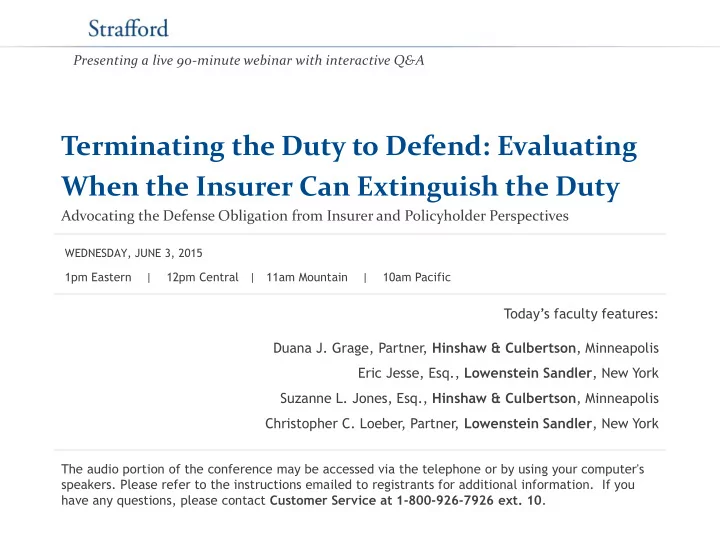
Presenting a live 90-minute webinar with interactive Q&A Terminating the Duty to Defend: Evaluating When the Insurer Can Extinguish the Duty Advocating the Defense Obligation from Insurer and Policyholder Perspectives WEDNESDAY, JUNE 3, 2015


slide-1
SLIDE 1

Terminating the Duty to Defend: Evaluating When the Insurer Can Extinguish the Duty

Advocating the Defense Obligation from Insurer and Policyholder Perspectives

Today’s faculty features:

1pm Eastern | 12pm Central | 11am Mountain | 10am Pacific

The audio portion of the conference may be accessed via the telephone or by using your computer's

  • speakers. Please refer to the instructions emailed to registrants for additional information. If you

have any questions, please contact Customer Service at 1-800-926-7926 ext. 10.

WEDNESDAY, JUNE 3, 2015

Presenting a live 90-minute webinar with interactive Q&A Duana J. Grage, Partner, Hinshaw & Culbertson, Minneapolis Eric Jesse, Esq., Lowenstein Sandler, New York Suzanne L. Jones, Esq., Hinshaw & Culbertson, Minneapolis Christopher C. Loeber, Partner, Lowenstein Sandler, New York

slide-2
SLIDE 2

Tips for Optimal Quality

Sound Quality If you are listening via your computer speakers, please note that the quality

  • f your sound will vary depending on the speed and quality of your internet

connection. If the sound quality is not satisfactory, you may listen via the phone: dial 1-866-927-5568 and enter your PIN when prompted. Otherwise, please send us a chat or e-mail sound@straffordpub.com immediately so we can address the problem. If you dialed in and have any difficulties during the call, press *0 for assistance. Viewing Quality To maximize your screen, press the F11 key on your keyboard. To exit full screen, press the F11 key again.

FOR LIVE EVENT ONLY

slide-3
SLIDE 3

Continuing Education Credits

In order for us to process your continuing education credit, you must confirm your participation in this webinar by completing and submitting the Attendance Affirmation/Evaluation after the webinar. A link to the Attendance Affirmation/Evaluation will be in the thank you email that you will receive immediately following the program. For additional information about CLE credit processing call us at 1-800-926-7926

  • ext. 35.

FOR LIVE EVENT ONLY

slide-4
SLIDE 4

Program Materials

If you have not printed the conference materials for this program, please complete the following steps:

  • Click on the ^ symbol next to “Conference Materials” in the middle of the left-

hand column on your screen.

  • Click on the tab labeled “Handouts” that appears, and there you will see a

PDF of the slides for today's program.

  • Double click on the PDF and a separate page will open.
  • Print the slides by clicking on the printer icon.

FOR LIVE EVENT ONLY

slide-5
SLIDE 5

Strafford Webinar 2015

Terminating the Duty to Defend: Evaluating When the Insurer Can Extinguish the Duty

Christopher C. Loeber Eric Jesse LOWENSTEIN SANDLER LLP Duana J. Grage Suzanne L. Jones HINSHAW & CULBERTSON LLP

slide-6
SLIDE 6

The Duty to Defend, Generally

  • What establishes the duty to defend?
  • Policy defense agreement – Insurer has the right and duty to

defend.

  • Applies to groundless, false, or fraudulent claims.
  • Duty to defend broader than duty to indemnify. First

Bank of Turley v. Fidelity and Deposit Ins. Co., 928 P.2d 298 (Okla. 1996).

  • What does this mean?

Page 6

slide-7
SLIDE 7

The Duty to Defend, Generally

  • How to determine if a defense is owed?
  • 4 corners/8 corners rule (4 corners of complaint, and 4 corners of

the policy). See, e.g., Guideone Elite Ins. Co. v. Fielder Road Baptist Church, 197 S.W.3d 305 (Tex. 2011).

  • If complaint against insured alleges facts within or potentially

within the scope of the policy coverage, a defense is owed. City

  • f College Station, Tex. v. Star Ins. Co., 735 F.3d 332 (5th Cir.

2013)

  • Duty to defend is triggered when the allegations of a complaint,

liberally construed, suggest a reasonable possibility of coverage.

Page 7

slide-8
SLIDE 8

The Duty to Defend, Generally

  • What about facts outside the complaint?

 Who may rely on extrinsic evidence – insurer or insured?

  • Later use of extrinsic evidence to terminate the duty to defend. Polarome

Int’l, Inc. v. Greenwich Ins. Co., 961 A.2d 29 (N.J. App. Div. 2008)

 Insurers’ duty to discover reasonably attainable facts vs. Insureds’

responsibility to inform the Insurer of relevant facts.

 The insurer has actual knowledge of facts establishing a reasonable

possibility of coverage. Bruckner Realty, LLC v. County Oil Co., Inc., 838 N.Y.S.2d 87 (2d Dep’t 2007); SL Indus. v. Am. Motorists Ins. Co., 607 A.2d 1266 (N.J. 1992); Boston Symphony Orchestra Inc. v. Commercial Union Ins. Co., 545 N.E.2d 1156 (Mass. 1989).

 Facts reasonably apparent to the insurer. Esicorp, Inc. v. Liberty Mut.

  • Ins. Co., 193 F.3d 966 (8th Cir. 1999).

Page 8

slide-9
SLIDE 9

The Duty to Defend, Generally

  • When is the duty to defend not triggered?
  • Where the insurer establishes as a matter of law that there is no

possible factual or legal basis upon which it might ultimately be

  • bligated to indemnify under any policy provision, the insurer is

relieved of such duty. Great Northern Ins. Co. v. Kobrand Corp., 837 N.Y.S.2d 41 (1st Dep’t 2007).

Page 9

slide-10
SLIDE 10

The Duty to Defend, Generally

  • If the underlying factual basis of the complaint, even if

true, would not result in coverage under the policy, then no duty to defend.

  • Look at the factual allegations alleged, or the causes of

action?

  • Example, facts relating to defamation contained in the complaint,

but no cause of action for defamation.

  • Intentional conduct cannot be done negligently. Erie Ins.

Exchange v. Fidler, 808 A.2d 587 (Pa. 2002).

  • Intentional pollution over time is not sudden and accidental.

Guaranty Nat. Ins. Co. v. Vic Mfg. Co., 143 F.3d 192 (5th Cir. 1998).

Page 10

slide-11
SLIDE 11

The Duty to Defend, Generally

  • Whether the claimant is seeking damages based on a

reason covered by the policy, not whether the claimant could have sought damages based on a reason covered by the policy.

  • Duty to defend cannot be based on speculation as to claims that

could have been brought. Storek v. Fidelity & Guar. Ins. Underwriters, Inc., 504 F. Supp. 2d 803 (N.D. Cal. 2007).

  • But when the coverage question cannot be decided from the face
  • f the complaint, the insurer must provide a defense until all

potentially covered claims are resolved. See Flomerfelt v. Cardiello, 997 A.2d 991 (N.J. 2010).

Page 11

slide-12
SLIDE 12

The Duty to Defend: Mixed Claims

  • Insurer efforts to limit the duty to defend when a claim

includes covered and uncovered components.

  • Duty to defend all claims when only one is potentially covered, or
  • nly the covered claims?
  • Allocation / Recoupment of defense costs for uncovered claims.

 Insured can recover defense costs that simultaneously benefit

covered and uncovered claims; insurer can only withhold defense costs solely relating to uncovered portion of the claim. See Buss v. Superior Court, 16 Cal. 4th 35, 50 (1997).

 Insurer has no right to recoupment of defense costs for uncovered

claims in the absence of express agreement. See Shoshone First Bank v. Pacific Employers Ins. Co., 2 P.3d 510 (Wyo. 2000).

Page 12

slide-13
SLIDE 13

The Duty to Defend: Mixed Claims

  • Conflict of interest between the Policyholder and Insurer.
  • Theory: insurer’s defense of a complaint with covered and

uncovered claims divides the loyalty of counsel selected and paid for by the insurer, creating concern that defense counsel would skew the defense in favor of the insurer. See Nowacki v. Federated Realty Group, 36 F. Supp. 2d 1099, 1109 (E.D. Wis. 1999).

  • Duty to defend transformed into a duty to pay defense costs.
  • Insurer loses the right to select defense counsel and control the

policyholder’s defense.

  • For whose benefit is defense counsel appointed?

Page 13

slide-14
SLIDE 14

The Duty to Defend: Mixed Claims

  • Delaying the Duty to Defend – An Outlier.
  • When an insurer asserts a defense to coverage that depends on

facts that will not be decided in the underlying case, the duty to defend is transformed into a duty to reimburse. See Burd v. Sussex Mut. Ins. Co., 267 A.2d 7 (N.J. 1970)

  • But that rule was recently eroded in Flomerfelt v. Cardiello, 997

A.2d 991 (N.J. 2010): “[I]n circumstances in which the underlying coverage question cannot be decided from the face of the complaint, the insurer is obligated to provide a defense until all potentially covered claims are resolved” in the underlying action

  • r a DJ action between insured and insurer.

Page 14

slide-15
SLIDE 15

The Duty to Defend: Are there Sufficient Protections for the Insured?

  • Burden of proof.
  • Policy wording ambiguities.
  • Any doubt as to what is alleged.
  • Covered and uncovered claims.
  • Frivolous claims.

Page 15

slide-16
SLIDE 16

Breach of the Duty to Defend

  • What happens if the insurer breaches the duty to

defend?

  • Extra-contractual (bad faith) damages?
  • Attorney’s Fees? Brown v. State Auto. and Cas. Underwriters,

293 N.W.2d 822 (Minn. 1980)

  • Waive other provisions of the policy?

Page 16

slide-17
SLIDE 17

Exhaustion of limits – withdrawing from the defense

  • Defense is a separate contractual right from

indemnity

  • Withdrawing from the defense is an issue only

where defense is supplementary to an insurer's indemnity obligation

  • Notice that the insurer may withdraw from the

defense should be given to the insured in a reservation of rights

Page 17

slide-18
SLIDE 18

Exhaustion of limits – withdrawing from the defense

  • Policy language controls
  • Pre-1966 – No language in policies regarding

withdrawing from the defense

  • Post-1966 – Language added to policies allowing

insurers to withdraw from the defense if their limit of liability has exhausted by payment of settlements or judgments

  • Policy language differs greatly from policy to policy

Page 18

slide-19
SLIDE 19

Exhaustion of limits – withdrawing from the defense

  • Examples
  • Once our limit of liability applicable to the claim is exhausted, we

will no longer pay legal expenses for that claim.

  • Page 19
slide-20
SLIDE 20

Exhaustion of limits – withdrawing from the defense

  • Withdrawal allowed
  • "Exhausted" – American States Ins. Co. of Tex. v.

Arnold, 930 S.W.2d 196 (Tex. App. 1996)

  • "Offering, tendering or paying" – Thompson v. Arbella
  • Mut. Ins. Co., 1999 WL 1325975 (Mass. Super. Ct.

1999)

  • "Limit of liability has been offered or paid" – Novak v.
  • Am. Fam. Mut. Ins. Co., 515 N.W.2d 504 (Wis. Ct.
  • App. 1994)

Page 20

slide-21
SLIDE 21

Exhaustion of limits – withdrawing from the defense

  • Withdrawal not allowed
  • Meaning of "paid" – Am. Standard Ins. Co. v.

Basbagill, 775 N.E.2d 255 (Ill. Ct. App. 2002)

  • Interplead remaining policy limits after excess verdict

– Jenkins v. Ins. Co. of N. Am., 220 Cal. App. 3d 1481 (Cal. App. Ct. 1990)

  • Interplead limits before insured's liability has been

determined by judgment – Exchange Mut. Ins. Co. v. Geiser, 498 N.Y.S.2d 291 (NY. Sup. Ct. 1986)

Page 21

slide-22
SLIDE 22

Exhaustion of limits – withdrawing from the defense

  • Loy release
  • When excess insurance applies, primary settles in exchange for

covenant not to hold insured liable for primary amounts to force excess to assume the defense. Loy v. Bunderson, 320 N.W.2d 175 (Wis. 1982); Teigen v. Jelco of Wisc. Inc., 367 N.W.2d 806 (Wis. 1985)

  • Drake v. Ryan
  • Primary settled for below its limit and plaintiff agreed to be

responsible for the gap. Drake v. Ryan, 514 N.W. 2d 785 (Minn. 1994)

Page 22

slide-23
SLIDE 23

Covered claims resolved – withdrawing from the defense

  • Meadowbrook Inc. v. Tower Ins. Co., 559

N.W.2d 411 (Minn. 1997) (insurer has right to settle covered claims directly with plaintiff and withdraw from defense when those claims have been dismissed with finality)

  • Cagle v. Home Ins. Co., 483 P.2d 592 (Ariz. Ct.
  • App. 1971)
  • Allstate Ins. Co. v. Mende, 575 N.Y.S.2d 520

(N.Y. App. Div. 1991)

Page 23

slide-24
SLIDE 24

Covered claims resolved – withdrawing from the defense

  • Finality
  • Don't prejudice the insured
  • Act in good faith

Page 24

slide-25
SLIDE 25

Too many claimants, not enough limits

  • No national bright-line rule
  • 3 general approaches
  • First-come, first-served
  • Pro-rata
  • Interpleader

Page 25

slide-26
SLIDE 26

Too many claimants, not enough limits

  • First-come, first-served
  • In re Sept. 11 Litig., 723 F.Supp.2d 534, 542 (S.D.N.Y. 2010)

(insurer has discretion to settle multiple claims on a first-come, first-served basis as long as it acts in good faith)

  • U.S. Fire Ins. Co. v. Worcester Ins. Co., 821 N.E.2d 91, 94

(Mass. App. Ct. 2005) (an insurer may settle with less than all claimants even if it results in an exhaustion of the policy proceeds)

  • Aetna Cas. & Sur. Co. v. Sullivan, 597 N.E.2d 62, 64 (Mass. App.
  • Ct. 1992) (insurer is discharged from any further duty to defend if

it pays policy limits – either to settle a claim against the insured,

  • r in total or partial satisfaction of a judgment against the insured

– upon conclusion of the litigation)

Page 26

slide-27
SLIDE 27

Too many claimants, not enough limits

  • Pro-rata
  • Christleib v. Luten, 633 S.W.2d 139 (Mo. Ct. App. 1982) (pro-rata

approach is warranted)

  • Underwriters for Lloyds of London v. Jones, 261 S.W.2d 686 (Ky.

1953) (insurance proceeds distributed on a pro-rata basis following adjudication of multiple claims)

  • Farinas v. Florida Farm Bureau General Ins. Co., 850 So.2d 555,

560-561 (Fla. Dist. Ct. App. 2003) (where multiple claims arise

  • ut of one accident, insurer may exercise discretion in how to

settle claims and may choose to settle certain claims to the exclusion of others provided that the decision is reasonable and "in keeping with its good faith duty." )

Page 27

slide-28
SLIDE 28

Too many claimants, not enough limits

  • Interpleader
  • Boris v. Flaherty, 672 N.Y.S.2d 177, 180 (N.Y. Sup. Ct. 1998)

("[i]nterpleader actions, while not required in situations such as this, are to be encouraged as part of the duty of good faith of an insurer.")

  • Club Exch. Corp. v. Searing, 567 P.2d 1353, 1356 (Kan. 1977) (insurer

can take three alternative courses of action when faced with competing claims in excess of policy limits)

  • McReynolds v. Am. Commerce Ins. Co., 235 P.3d 278, 282 (Ariz. Ct.
  • App. 2010) (where available coverage is not adequate to resolve all

claims, insurer can find a "safe harbor")

  • Even if an insurer files an interpleader and deposits its limits into court, the

insurer should not withdraw the defense unless it has clear policy language which would permit a withdrawal.

Page 28

slide-29
SLIDE 29

Too many insureds, not enough limits

  • Strauss v. Farmers Ins. Exchange, 31 Cal. Rptr.

2d 811 (Cal. App. Ct. 1994) (insurer not

  • bligated to pay demand for policy limits if it

does not resolve liability for all its insureds)

  • Pride Transp. V. Continental Cas. Co., 804

F.Supp.2d 520 (N.D. Tex. 2011) (insurer allowed to accept claimant's demand for policy limits to the exclusion of other insureds)

Page 29

slide-30
SLIDE 30

What Does It All Mean?

  • Should an insurer be penalized for breaching the duty to

defend, and how?

  • Current repercussions:
  • Bad faith/extra-contractual damages.
  • Attorney’s fees in coverage action.
  • Limited ability to contest settlement.
  • Waiver of policy provisions.

Page 30

slide-31
SLIDE 31

Practice Pointers

  • Check your policy language and your jurisdiction before withdrawing

from the defense.

  • Explain the problem of potential excess exposure to the insured

early on and in writing.

  • Identify claimants and potential claimants.
  • Conduct meaningful investigations and evaluations of various

claims.

  • Keep the insured advised as claims are settled and limits are

exhausted.

  • Notify all excess insurers and keep them apprised of the

investigation and settlement efforts.

Page 31

slide-32
SLIDE 32

Practice Pointers

  • Consider immediately filing an interpleader action if the jurisdiction

allows it. Deposit the money into court and continue defending until those funds are disbursed to claimants. In some states, an insurer must file an interpleader to avoid a claim for bad faith. Other courts do not allow an interpleader action in these circumstances.

  • Develop and attempt to implement a strategy to resolve all the

claims.

  • Never artificially inflate the value of any claims, particularly the first

claims that are made. Do not overpay a claim with the intention of exhausting the limit as soon as possible to justify withdrawing from the defense.

Page 32

slide-33
SLIDE 33

Practice Pointers

  • Pay the limits to claimants to resolve claims and obtain

releases of liability for the insured; do not pay the limits to the insured in an attempt to "buy out" the coverage or the defense obligation.

Page 33

slide-34
SLIDE 34

Practice Pointers

  • Don’t waive coverage (timely notice, etc.).
  • Even if defense is rejected, keep insurer apprised of the

litigation.

  • Advise insurer of settlement possibility, and ask that it

contribute.

  • Be mindful of costs of defense – reasonableness and

relatedness issues.

  • Enlist coverage counsel.

Page 34

slide-35
SLIDE 35

Questions?

Page 35

Christopher C. Loeber cloeber@lowenstein.com Eric Jesse ejesse@lowenstein.com LOWENSTEIN SANDLER LLP Duana J. Grage dgrage@hinshawlaw.com Suzanne L. Jones sjones@hinshawlaw.com HINSHAW & CULBERTSON LLP