Insurer vs. Policyholder Perspectives Navigating Insurer Defenses - - PowerPoint PPT Presentation

insurer vs policyholder perspectives
SMART_READER_LITE
LIVE PREVIEW

Insurer vs. Policyholder Perspectives Navigating Insurer Defenses - - PowerPoint PPT Presentation

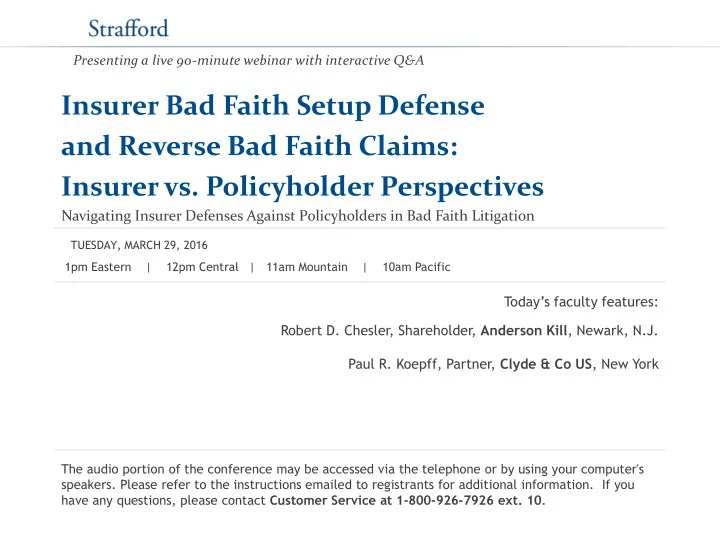
Presenting a live 90-minute webinar with interactive Q&A Insurer Bad Faith Setup Defense and Reverse Bad Faith Claims: Insurer vs. Policyholder Perspectives Navigating Insurer Defenses Against Policyholders in Bad Faith Litigation TUESDAY,


slide-1
SLIDE 1

The audio portion of the conference may be accessed via the telephone or by using your computer's

  • speakers. Please refer to the instructions emailed to registrants for additional information. If you

have any questions, please contact Customer Service at 1-800-926-7926 ext. 10.

Presenting a live 90-minute webinar with interactive Q&A

Insurer Bad Faith Setup Defense and Reverse Bad Faith Claims: Insurer vs. Policyholder Perspectives

Navigating Insurer Defenses Against Policyholders in Bad Faith Litigation

Today’s faculty features:

1pm Eastern | 12pm Central | 11am Mountain | 10am Pacific TUESDAY, MARCH 29, 2016

Robert D. Chesler, Shareholder, Anderson Kill, Newark, N.J. Paul R. Koepff, Partner, Clyde & Co US, New York

slide-2
SLIDE 2

Tips for Optimal Quality

Sound Quality If you are listening via your computer speakers, please note that the quality

  • f your sound will vary depending on the speed and quality of your internet

connection. If the sound quality is not satisfactory, you may listen via the phone: dial 1-866-961-8499 and enter your PIN when prompted. Otherwise, please send us a chat or e-mail sound@straffordpub.com immediately so we can address the problem. If you dialed in and have any difficulties during the call, press *0 for assistance. Viewing Quality To maximize your screen, press the F11 key on your keyboard. To exit full screen, press the F11 key again.

FOR LIVE EVENT ONLY

slide-3
SLIDE 3

Continuing Education Credits

In order for us to process your continuing education credit, you must confirm your participation in this webinar by completing and submitting the Attendance Affirmation/Evaluation after the webinar. A link to the Attendance Affirmation/Evaluation will be in the thank you email that you will receive immediately following the program. For additional information about continuing education, call us at 1-800-926-7926

  • ext. 35.

FOR LIVE EVENT ONLY

slide-4
SLIDE 4

Program Materials

If you have not printed the conference materials for this program, please complete the following steps:

  • Click on the ^ symbol next to “Conference Materials” in the middle of the left-

hand column on your screen.

  • Click on the tab labeled “Handouts” that appears, and there you will see a

PDF of the slides for today's program.

  • Double click on the PDF and a separate page will open.
  • Print the slides by clicking on the printer icon.

FOR LIVE EVENT ONLY

slide-5
SLIDE 5

Insurer Bad Faith Set-Up Defense and "Reverse Bad Faith" Claims: Insurer vs. Policyholder Perspectives

March 29, 2016

Presented by:

Robert Chesler

Shareholder, Anderson Kill

Paul R. Koepff

Senior Equity Partner, Clyde & Co

slide-6
SLIDE 6

Disclaimer

This presentation and discussion only reflects the personal views of the presenters. The content does not represent the views of their firms or their clients.

6

slide-7
SLIDE 7

The Fundamental Basis For A Reverse Bad Faith Claim

  • The basis a claim of reverse bad faith is

that every insurance contract contains an implied covenant of good faith and fair dealing, which applies to both insurer and insured.

– Comunale v. Traders & Gen. Ins. Co., 50 Cal. 2d 654, 328 P.2d 198 (1958). – Brassil v. Maryland Cas. Co., 210 N.Y. 235, 104 N.E. 622 (1914).

7

slide-8
SLIDE 8

The Fundamental Basis For A Reverse Bad Faith Claim (cont.)

  • It is well established that insureds are permitted to

pursue claims against insurers for the alleged breach of the implied covenant of good faith and fair dealing.

– Welfl v. Northland Ins. Co., 192 F.3d 1169 (8th Cir. 1999) – Nat'l R.R. Passenger Corp. (Amtrak) v. TIG Ins. Co., 178 F. App'x 695 (9th Cir. 2006)

  • In numerous ways, courts have relied upon this

principle to hold insurers liable for breaching the implied covenant of good faith and fair dealing with their insured.

8

slide-9
SLIDE 9

The Fundamental Basis For A Reverse Bad Faith Claim (cont.)

  • By like reasoning, insurers should be able to

bring claims against insureds for their breach

  • f the implied covenant of good faith and fair

dealing, because the covenant applies to both the insurer and the insured.

  • In other words, if an insured breaches the

implied covenant of good faith and fair dealing, it seems equitable and reasonable for the insurer to be able to assert a claim against it.

9

slide-10
SLIDE 10

No Statutory Basis For Reverse Bad Faith Claims

  • Aside from the state of Tennessee, it appears that there

are no state statutes expressly authorizing a reverse bad faith claim. R. Steven Rawls and Gary L. Printy, Who Killed Reverse Bad Faith? And Why It Could Make A Comeback, 25-18 Mealey's Litig. Rep. Ins. Bad Faith 16 (2012).

  • Tenn. Code Ann. § 56-7-106 allows an insurer to recover up to 25%
  • f the amount claimed by an insured if the insured did not bring a

suit against the insurer in good faith and caused the insurer to suffer damages and unnecessary expense.

  • Adams v. Tennessee Farmers Mut. Ins. Co., 898 S.W.2d 216 (Tenn.
  • Ct. App. 1994) (holding that statute allowed defendant insurer to

collect from plaintiff insured the expenses it incurred in defending the insured’s bad faith claim).

10

slide-11
SLIDE 11

Status of a Claim of Reverse Bad Faith

  • Every court that has ruled on reverse

bad faith has rejected it, either at the trial or appellate level. Those trial courts that have accepted it have been reversed.

11

slide-12
SLIDE 12

Status of a Claim of Reverse Bad Faith

  • An insurance policy is an adhesion contract.
  • Policyholder performs at onset of contract; insurance company

much later (if at all)

  • Often no longer any corresponding benefit to insurance

company performance

  • Countervailing legal mechanisms include

– ambiguities are construed narrowly against the insurance company – terms in an insurance policy are given their ordinary, commonly used meaning – policies are interpreted pursuant to the objectively reasonable expectations

  • f the insured.
  • It is in this context that the policyholder’s bad faith cause of

action developed.

12

slide-13
SLIDE 13

Status of a Claim of Reverse Bad Faith

  • These circumstances give rise to a higher duty on the

part of the insurance company to the policyholder.

  • Duty to settle within limits
  • Duty to resolve claims promptly
  • Similar basis for the recognition of a bad faith cause
  • f action on the part of the policyholder against the

insurance company.

13

slide-14
SLIDE 14

Status of a Claim of Reverse Bad Faith

  • None of the equities that led to a bad faith cause of

action on the part of policyholders exist for the insurance company. No public policy exists to create a reverse bad faith cause of action.

  • Reverse bad faith is essentially a way to intimidate

the insured

  • Every contract has a covenant of good faith and fair
  • dealing. No case law where insurance company has

relied on that covenant to assert reverse bad faith.

14

slide-15
SLIDE 15

Judicial Treatment Of Reverse Bad Faith Claims

  • Where courts have addressed reverse bad

faith claims asserted by an insurer, decisions fall into one of three categories:

– Cases in which reverse bad faith claims have been rejected. – Cases in which courts have acknowledged a reverse bad faith claim as viable. – Cases in which courts have seemingly acknowledged in dicta a reverse bad faith claim.

15

slide-16
SLIDE 16

Cases In Which Reverse Bad Faith Claims Have Been Rejected

  • Kransco v. Am. Empire Surplus Lines Ins. Co., 23 Cal. 4th 390, 2 P.3d 1

(2000) held that an insurer could raise comparative bad faith as a defense.

– The California Supreme Court held that an insurer’s and insured’s duties of good faith were not equivalent due to the inherent unequal footing of the parties. – The insured’s duty of good faith was held to be purely based on the insurance contract, while the insurer had an additional duty sounded in tort. – While the insurer can still bring breach of contract claims against its insured, and an insured’s fraud is still grounds for tort damages, the court eliminated the claim

  • f reverse bad faith.

– Subsequent cases have likewise held an insurer cannot assert a reverse bad faith claim against its insured.

  • Endurance Am. Specialty Ins. Co. v. Lance-Kashian & Co., 2010 WL 3619476 (E.D. Cal. Sept.

13, 2010).

  • Hale v. Provident Life & Acc. Ins. Co., 2003 WL 1510463 (Cal. Ct. App. Mar. 25, 2003).
  • Hangarter v. Paul Revere Life Ins. Co., 236 F. Supp. 2d 1069 (N.D. Cal. 2002) aff'd in part,

rev'd in part sub nom. Hangarter v. Provident Life & Acc. Ins. Co., 373 F.3d 998 (9th Cir. 2004).

16

slide-17
SLIDE 17

Cases In Which Reverse Bad Faith Claims Have Been Rejected (cont.)

  • In Rhodes v. USAA Cas. Ins. Co., 2011 PA Super 105,

21 A.3d 1253 (Pa. Super. Ct. 2011), the insurer sought to place the conduct of the insured at issue when defend a bad faith claim.

  • The court rejected the insurer’s argument and held that

the insured’s actions had nothing to do with the analysis

  • f whether the insurer acted in good faith: “the relevant

inquiry in a bad faith case is whether the insurer had a reasonable basis for its conduct. The state of mind of the insured is irrelevant.”

  • This is the biggest danger an insurer faces in attempting

to prove a reverse bad faith claim or assert such a defense – that the court will deem the question of an insured’s conduct immaterial to the insurer’s actions.

17

slide-18
SLIDE 18

Cases In Which Reverse Bad Faith Claims Have Been Rejected (cont.)

  • In Houchin v. Allstate Indem. Ins. Co., 4:07-

CV-00071-M, 2012 WL 2430474 (W.D. Ky. June 26, 2012), the court dismissed the insurer’s counterclaim for reverse bad faith because “[t]he Court is not aware of any jurisdiction that has recognized a cause of action for reverse bad faith.”

  • Courts are naturally reluctant to create new

causes of action or expand the law where

  • ther jurisdictions have declined to do so.

18

slide-19
SLIDE 19

Cases In Which Reverse Bad Faith Claims Have Been Rejected (cont.)

  • Courts often rely upon the power dynamic inherent in

the insurer-insured relationship in order to characterize the obligations owed and remedies available to each party.

  • Stephens v. Safeco Ins. Co. of Am., 258 Mont. 142,

852 P.2d 565 (1993)

– Supreme Court of Montana declined to compare insurer and insured’s bad faith. – The court held that the parties’ different positions and concerns limited the analysis of bad faith to the insurer’s conduct. – The Court held that an insurer’s bad faith can rise to the level of a tort, while an insured’s can only be a breach of contract.

19

slide-20
SLIDE 20

States that have specifically denied a reverse bad faith cause of action

  • Oklahoma – First Bank of Turley v. Fidelity and Deposit
  • Ins. Co., 928 P.2d 298 (Okla. 1996)
  • “[Reverse bad faith] creates an independent tort that

allows an insurer to seek affirmative relief for an insured’s breach of the duty of good faith and fair dealing.”

  • “We hence hold that an insured’s misperformance of its

contractual duty is neither a “free-standing” ex contractu breach nor a civil harm actionable in tort as an incident of the insurer/insured status.”

20

slide-21
SLIDE 21

States that have specifically denied a reverse bad faith cause of action

  • Iowa – Johnson v. Farm Bureau Mut. Ins. Co., 533

N.W.2d 203 (Supreme Court Iowa 1995).

  • “[The insurer] argues that we should recognize a

cause of action for ‘reverse bad faith’ when an insured brings a frivolous bad faith claim against the insurer.”

  • “However, we are aware of no jurisdiction that has

adopted the tort of reverse bad faith.” “…sanctions under Iowa Rule of Civil Procedure 80(a)provide an adequate remedy to insurance companies when an insured files a frivolous bad faith claim.”

21

slide-22
SLIDE 22

States that have specifically denied a reverse bad faith cause of action

  • Ohio – Tokles & Sonv Midwestern
  • Indem. Co., 605 N.E.2d 936 (Ohio

1992)

  • “Midwestern argues that even if we do

not recognize the new tort of reverse bad faith, its counterclaim alleges fraud.”

22

slide-23
SLIDE 23

Cases In Which Courts Have Acknowledged A Reverse Bad Faith Claim As Viable

  • Our research has not disclosed any decisions

that have held an insurer has a valid and viable claim for reverse bad faith.

  • Thus, the issue of a reverse bad faith claim

appears to be open in the jurisdictions except for those that have rejected such claims, which include California, Hawaii, Iowa, Montana, New Jersey, Ohio, Oklahoma, Oregon, and Rhode Island.

23

slide-24
SLIDE 24

Cases In Which Courts Have Seemingly Acknowledged In Dicta Reverse Bad Faith

  • In Snap-on Tools Corp. v. First State Ins. Co., 175 Wis. 2d 622, 502

N.W.2d 282 (Wis. Ct. App. 1993), an insurer asserted a bad faith counterclaim to its insured’s claims for breach of the insurance contract and bad faith.

  • The trial court granted the insured’s pre-trial motion for summary

judgment on its breach of contract claim, and held that the insurance policy covered the claim at issue.

  • A jury ruled that the insured acted in bad faith and awarded the insurer

$500,000 in compensatory damages and $4 million in punitive damages.

  • On appeal, the Wisconsin Court of Appeals reversed the summary

judgment ruling siding with the insurer and holding that the acts of the insured at issue were excluded from coverage. This ruling mooted all the

  • ther issues and reversed the jury’s findings on the insured’s bad faith.

The appellate court declined to consider the issue of reverse bad faith.

24

slide-25
SLIDE 25

Cases In Which Courts Have Seemingly Acknowledged In Dicta Reverse Bad Faith (cont.)

  • In Callahan v. Norfolk & Dedham Grp.,

NOCV2007-0265, 2009 WL 3282941 (Mass.

  • Super. Aug. 6, 2009), the court noted that the

insurer’s defense of reverse bad faith “need not be reached in deciding the merits of the [insured]'s case” because the insured’s claims for unfair claims settlement practices were dismissed.

  • The court did not rule on the insurer’s reverse bad

faith defense but did deny the insured’s motion to strike the insurer’s defense, and noted that “the insurer's action in raising this issue, in the circumstances presented here, was not inappropriate.” Id. at *9.

25

slide-26
SLIDE 26

Cases In Which Courts Have Seemingly Acknowledged In Dicta Reverse Bad Faith (cont.)

  • In Fon v. Amica Mut. Ins. Co., No. CIV.A. 06-0607, 2008 WL

1932074, (Mass. Super. Apr. 30, 2008), an insurer asserted claims for breach of contract, deceit and reverse bad faith against a claimant based on misrepresentations and conflicting stories surrounding an alleged hit-and-run.

  • An arbitrator held the claimant’s assertions were fraudulent and she

could not recover under the policy.

  • The court granted summary judgment in favor of the insurer, holding

that the arbitrator's conclusions were sufficient to support the insurer’s claims of deceit and bad faith, both of which were based on the claimant’s misrepresentations.

  • Because the insurer only sought a declaration that it was not liable

to pay the claims, there was no further implication or consideration

  • f the reverse bad faith claim.

26

slide-27
SLIDE 27

Cases In Which Courts Have Seemingly Acknowledged In Dicta Reverse Bad Faith (cont.)

  • In AMEC Constr. Mgmt. v. Fireman’s Fund Ins. Co.,

2015 U.S. Dist. LEXIS 23729 (M.D. La. February 26, 2015), the court denied a motion to dismiss the insurer’s claim for breach of the duty of good faith and fair dealing against the successor in interest to its insured.

  • The court found that, “considering the context of the

alleged insured/insurer relationships,” the claim was “highly unlikely to ultimately succeed,” but held that the claim could withstand the motion to dismiss.

27

slide-28
SLIDE 28

Cases In Which Courts Have Seemingly Acknowledged In Dicta Reverse Bad Faith (cont.)

  • In Shannon v. New York Cent. Mut. Ins. Co.,

3:13-CV-1432, 2013 WL 6119204 (M.D. Pa.

  • Nov. 21, 2013), a third party claimant

asserted bad faith claims against an insurer (assigned from the insured).

  • The insurer’s answer included allegations

that the plaintiff’s attorney “orchestrated” a “bad faith set-up” to obtain punitive damages.

  • The court allowed the insurer’s affirmative

defense to stand, holding that it was relevant to an analysis of the insurer’s actions.

28

slide-29
SLIDE 29

Cases In Which Courts Have Seemingly Acknowledged In Dicta Reverse Bad Faith (cont.)

  • Granite State Ins. Co. v. Integrity Structures, LLC, 2015 WL

136006 (W.D. Wash. Jan. 9, 2015), was characterized by the court as a “reverse bad faith case.”

– After the insurer commenced a DJ action, the insured and its assign asserted counterclaims including bad faith against the insurer. – The insurer demonstrated that its insured and its assign executed a consent judgment, failed to inform the insurer, hindered the insurer’s investigation, and misled the insurer as to whether the insured was seeking coverage. – The court granted partial summary judgment for the insurer, dismissing the insured’s claims for bad faith, based in part on the evidence of a bad faith “set up.” – Issues of fact remained as to the competing breach of contract claims and the insurer’s claims against the insured.

29

slide-30
SLIDE 30

Cases In Which Courts Have Seemingly Acknowledged In Dicta Reverse Bad Faith (cont.)

  • In Utica Mut. Ins. Co. v. Century Indem. Co., No. 6:13-CV-995, 2015

WL 3429116 (N.D.N.Y. May 11, 2015), a reinsurer sought leave to amend its answer and add a counterclaim for reverse bad faith, based

  • n its reinsured’s alleged manipulation of records.
  • The reinsured argued that reverse bad faith claims were contrary to

New York law, but it could not provide controlling authority expressly rejecting such a claim.

  • The reinsurer argued that, because a reinsured owed a duty of utmost

good faith under New York law, there had to be some remedy for the breach of such a duty.

  • The court held that the claim was sufficiently plausible under New York

law in the context of reinsurance such that allowing the amended pleading was proper. In doing so, the court was careful to specify that it was not opining on the likelihood of success of the claim.

30

slide-31
SLIDE 31

Possible Benefits Of Asserting A Reverse Bad Faith Claim

  • The insurer can combat the insured’s bad faith claim

by attacking the insured’s actions and motivation for bringing the claim.

  • The insurer can attempt to recover costs spent in

defending the underlying complaint from the insured.

  • The action may discourage insureds from asserting

frivolous bad faith claims against the insurer or trying to “set up” bad faith claims with claimants through a consent judgment.

31

slide-32
SLIDE 32

Possible Disadvantages Of Asserting A Reverse Bad Faith Claim

  • There is a potentially large expense of prosecuting a reverse

bad faith claim involving significant discovery.

  • If the underlying action is still active, the insured will not be

inclined to cooperate and assist the insurer’s defense of the claim.

  • It may be easier for the insurer to assert coverage defenses,

(e.g. failure to cooperate / provide notice), or bring a common law fraud claim against its insured.

  • If the insurer brings a reverse bad faith counterclaim to its

insured’s bad faith action or raises reverse bad faith as an affirmative defense, the attack on the insured could sour a judge or jury and harm the insurer’s case.

32

slide-33
SLIDE 33

Conclusions With Respect To Claims For Reverse Bad Faith

  • Reverse bad faith claims turn on the applicable law, so

insurers must research the controlling precedent.

– In some jurisdictions, courts have rejected reverse bad faith as a matter of law. – In other jurisdictions, courts have addressed the concept in dicta. – Some jurisdictions have not yet addressed reverse bad faith claims. – Insurers should think creatively in asserting a claim for reverse bad faith.

  • Insurers should document their files on a contemporaneous

basis to document wrongful conduct by the insured

  • Insurers should communicate to the insured where the

insured is not acting appropriately

  • Consider using outside resources to investigate and further

document the insured’s actions

33

slide-34
SLIDE 34

Policyholder (Reverse) Bad Faith Strategies

  • Best Practices Are Universal

– Put Everything In Writing – Your Delay Is Not Your Friend

  • Respond to all requests quickly
  • Provide immediate notice
  • Hand over and report new developments, new

losses, damage reports, etc as soon as possible

34

slide-35
SLIDE 35

Cooperation

  • Be Creative with Compliance
  • Emphasize Cooperation
  • Avoid Saying No
  • Invite Insurance Company to View

Documents On Site

  • Privilege

35

slide-36
SLIDE 36

Settlement

  • Policy language
  • Is There Independent Counsel?
  • Permission Before Forgiveness
  • Give Insurance Company Reasonable

Time For Response

  • Use Sharp Deadlines When Necessary

– eve of trial – imposed by claimant – effect on business finances

36

slide-37
SLIDE 37

What Is “Bad Faith Set Up”?

  • A defense available to an insurer facing a bad faith claim is that the

claim was improperly “set up.”

  • In a “set up,” a demand is made on an insurer within or up to policy

limits with the express purpose of using the insurer’s refusal against it in a bad faith claim. 3 Law and Prac. of Ins. Coverage Litig. § 29:6

  • A bad faith claim can be asserted by:

– The insured, demanding coverage of a settlement with a third party or payment of a first party claim. Coventry Associates v. Am. States Ins. Co., 136 Wash. 2d 269, 961 P.2d 933 (1998) – A third party claimant, demanding the insurer consent to a settlement with its insured. Pavia v. State Farm Mut. Auto. Ins. Co., 82 N.Y.2d 445, 605 N.Y.S.2d 208 (1993). – An excess insurer, demanding that a primary insurer settle a claim below the excess insurer’s limits. California Union Ins. Co. v. Excess Ins. Co., 780

  • F. Supp. 1010 (S.D.N.Y. 1991) ("In the context of settlements this duty [to

the excess insurer] obligates an insurer to attempt to settle a claim where liability is clear and the potential for recovery far exceeds the primary coverage limit”) (internal quotations and citations omitted).

37

slide-38
SLIDE 38

Judicial Treatment Of Bad Faith Set Up

  • Courts have rejected claims of bad faith asserted against

insurers when evidence shows that the claim was merely the result of a “set up.”

  • In DeLaune v. Liberty Mut. Ins. Co., 314 So. 2d 601 (Fla.
  • Dist. Ct. App. 1975), an injured claimant offered to settle

with the insurer for $10,000, but gave the insurer only ten days to accept.

  • The court held that the deadline, and the claimant’s

rejection of the insurer’s acceptance days after the deadline showed “that this whole charade might have been a ‘set up’” for the bad faith claim.

38

slide-39
SLIDE 39

Judicial Treatment Of Bad Faith Set Up (cont.)

  • Similarly, in AAA Nevada Ins. Co. v. Vinh Chau,

808 F. Supp. 2d 1282 (D. Nev. 2010) aff'd, 463 F. App'x 627 (9th Cir. 2011), a court held that a party’s demand letter to an insurer that included an “arbitrary” two week deadline to settle was unreasonable, “and appears to be nothing more than an attempt to set up a potential bad faith claim.”

  • The court held that the insurer did not lack a

reasonable basis to not settle the claim within the time period of the demand letter, because it was doing all it could to investigate the claim.

39

slide-40
SLIDE 40

Tips For Preventing and Defending “Bad Faith Set Up” Claims

  • As a general rule, insurers should undertake a

timely and comprehensive evaluation of liability and damages.

  • As a general rule, insurers should also take a timely

and comprehensive evaluation of underlying facts and coverage issues.

  • As a general rule, insurers should timely

communicate in writing their positions to insureds.

  • As a general rule, insurers should thoroughly and

timely document their claims file.

40

slide-41
SLIDE 41

Robert D. Chesler

Shareholder, Anderson Kill rchesler@andersonkill.com 973-642-5864

Paul R. Koepff

Senior Equity Partner, Clyde & Co paul.koepff@clydeco.us 212-710-3900